

Choosing the "easiest" shipping method is often the fastest way to lose control of your profit margins. For many, the appeal of an all-inclusive "delivered" price is hard to resist, especially when you're managing the daily pressures of a growing business. You've likely felt the relief of a supplier promising to handle every detail, only to feel that same relief vanish when surprise "terminal handling" fees appear once your goods reach the port. When we look at the reality of FOB vs DDP for US importers, it's clear that what looks like convenience on paper often becomes a "convenience trap" in practice.
We understand how intimidating the world of international freight can feel, especially with the 2026 suspension of the de minimis threshold and new Section 301 tariffs complicating every arrival. This article will help you master the critical differences between these terms so you can eliminate hidden markups and take full control of your US import compliance. We'll walk through a step-by-step comparison that reveals how to lower your total landed costs while building a rock-solid relationship with US Customs and Border Protection. By the end, you'll have the transparency you need to move your goods with total peace of mind.
Key Takeaways
- Master the fundamental differences of FOB vs DDP for US importers to gain total clarity on your financial risks and shipping milestones.
- Uncover the hidden "buffer fees" and markups suppliers often include in their quotes to protect their own margins at your expense.
- Protect your business from US Customs audits by understanding your non-negotiable legal duties as the Importer of Record.
- Use our decision framework to determine when to prioritize the convenience of DDP and when to take control with FOB.
- Learn how a professional customs broker acts as a protective bridge between your operations and the complexities of global trade.
The Fundamentals of FOB and DDP: Defining the Responsibility Gap
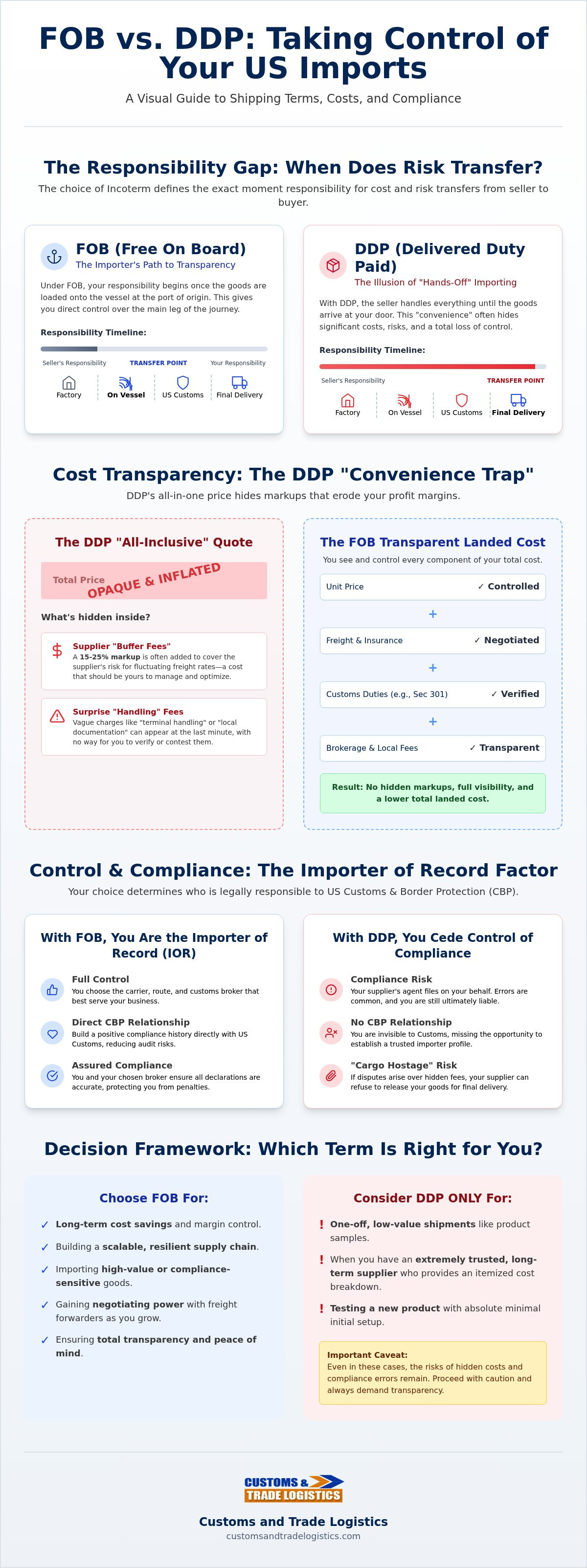
At its core, the choice of shipping terms determines who pays the bills and who carries the risk. These Incoterms rules serve as a universal language for global trade, acting as a roadmap for every shipment. For those weighing FOB vs DDP for US importers, the most critical factor is the "transfer point." This is the exact moment when the supplier's responsibility ends and yours begins. In the volatile trade environment of 2026, where Section 301 tariff rates can shift mid-transit, this line in the sand is what protects your bottom line from unexpected shocks.
FOB: The Importer’s Path to Transparency
Under FOB (Free on Board) terms, your supplier is responsible for getting the goods onto the vessel at the port of origin. Once that cargo is safely loaded, you take the lead. While this might sound like extra work, it's actually your greatest strategic advantage. You aren't just a passive observer; you're the manager of your own supply chain. By choosing FOB, you gain:
- Carrier Choice: You decide which shipping line and route best fit your timeline.
- Cost Visibility: You see the direct breakdown of ocean freight versus local trucking, rather than a single lumped sum.
- Negotiation Power: As your shipping volume grows, you can leverage that scale to secure better rates directly with forwarders.
This transparency ensures that every dollar you spend is accounted for. It's the "safe pair of hands" approach that seasoned businesses use to scale without losing their margins to hidden fees.
DDP: The Illusion of "Hands-Off" Importing
DDP (Delivered Duty Paid) is often marketed as a stress-free solution where the seller handles everything until the goods reach your door. However, this convenience is often a mask for lost profit. Suppliers are experts at manufacturing, not logistics. They often outsource the shipping to their own local forwarders and add a significant markup, sometimes 15-25%, to protect themselves against fluctuating freight rates. This "buffer fee" is money that should stay in your pocket.
The risks go beyond just cost. We've seen "cargo hostage" situations where suppliers demand extra payments for "unforeseen" port fees before they'll release the goods for final delivery. You also lose control over which US port your goods enter. This lack of oversight can lead to your shipment sitting in a congested terminal for weeks while you have no power to intervene. Understanding the reality of FOB vs DDP for US importers means recognizing that true security comes from oversight, not from handing over the keys to your logistics.
Cost Transparency: Uncovering the Hidden Markups in DDP
When a supplier offers a DDP quote, they aren't just giving you a shipping rate; they're selling you a convenience package. Most manufacturers are experts at production, not global logistics. To manage the risk of fluctuating ocean freight rates, they often include a "Buffer Fee." This is a hidden markup designed to protect their profit if shipping costs spike before your goods leave the factory. Analyzing FOB vs DDP for US importers reveals that true cost control starts with unbundling these expenses to see exactly what you're paying for the product versus the transportation.
Hidden "handling fees" are another common surprise that can erode your margins. These often appear on DDP invoices at the last minute, labeled as "special processing" or "local documentation." When you control the shipment through FOB, these variables disappear. You get a clear view of the actual market rates rather than a padded estimate from a third party who may not have your best interests in mind.
The Landed Cost Comparison
To truly understand your margins, you must calculate the Landed Cost. Landed Cost is the total price of a product once it has arrived at the buyer’s door. This calculation is vital when comparing FOB vs DDP for US importers because DDP often obscures individual line items. A standard landed cost breakdown should include:
- Unit Price: The actual cost of the goods from the factory.
- Freight and Insurance: The cost of transit and protection against loss.
- Customs Duties: Taxes based on the latest 2026 Section 301 rates.
- Brokerage and Local Fees: Filing costs and "last mile" delivery to your warehouse.
According to the International Trade Administration guidelines, knowing where these specific cost transfers happen helps you avoid paying twice for the same service. We always recommend asking your supplier for an "EXW" or "FOB" price to compare against their all-in quote. This simple step reveals the supplier's logistics markup and puts the power back in your hands.
Why Freight Forwarding Control Saves Money
Managing your own logistics gives you direct access to carrier contracts through a trusted partner. You avoid the "destination terminal fees" that suppliers frequently fail to mention until the cargo is already at the port. Building a relationship with a US-based expert ensures you aren't just a number in a database. If you're looking for clarity, our import from China consulting can help you identify exactly where these hidden costs are draining your budget.
The long-term ROI of this control is substantial. You gain the ability to choose faster routes or consolidate shipments, options that a DDP-focused supplier will rarely offer. This oversight replaces logistics anxiety with a sense of security, knowing that every cent of your shipping budget is working to protect your bottom line.
Control and Compliance: The Importer of Record (IOR) Factor
Many business owners assume that "Delivered Duty Paid" means they've also offloaded their legal responsibility to the US government. This is a dangerous misconception. When you're looking at FOB vs DDP for US importers, you must understand the role of the Importer of Record (IOR). The IOR is the entity legally responsible for ensuring that all goods are correctly classified, valued, and documented according to US law. Even if your supplier pays the bill, the liability for the data provided to the government often rests on your shoulders.
Suppliers often use generic or all-purpose HS codes to simplify their own paperwork or reduce the duties they pay on your behalf. If US Customs and Border Protection (CBP) discovers these errors, they won't go after the overseas factory; they'll come after you. By choosing FOB, you ensure that your own licensed customs broker audits every entry for accuracy before it's filed. This oversight acts as a "safe pair of hands," protecting you from the fallout of someone else's shortcuts. Choosing FOB vs DDP for US importers is ultimately a choice between blind trust and verified compliance.
The Risk of CBP Audits and Fines
What happens if a discrepancy is found in a DDP shipment? CBP holds the US-based entity liable for any underpaid duties or misclassifications. You cannot simply "blame the supplier" for incorrect paperwork filed in your name. This is why having a Power of Attorney (POA) with a US-based broker is so vital. It allows a professional you trust to act on your behalf, ensuring that every document matches the International Trade Administration's guide to Incoterms. This legal bridge replaces anxiety with the security of knowing your filings are audit-ready.
Managing Customs Bonds and HTS Classification
A professional broker doesn't just file papers; they act as a mentor for your business growth. They ensure your goods use the exact HTS code required, which is especially critical in 2026 as Section 301 tariff rates fluctuate across 60 trading partners. They also help you manage Continuous Bonds, which streamline national imports and cover all your entries for a full year. This level of management is essential when dealing with Partner Government Agencies (PGAs) like the FDA or EPA, where a single coding mistake can lead to an entire shipment being seized or delayed indefinitely.
Decision Framework: Choosing the Right Term for Your Business
How do you decide which term is right for your specific situation? The choice of FOB vs DDP for US importers often shifts as a business matures. For a startup ordering its first round of prototypes, DDP can be a helpful way to test a product's market fit without managing complex logistics. These small parcel samples or low-value air shipments are often the only time the "hands-off" nature of DDP outweighs the cost markups. However, with the 2025 suspension of the de minimis threshold, even these small shipments now require careful duty considerations that a supplier might overlook.
Once you move from samples to inventory, the math changes. For full container loads (FCL) or high-value goods, FOB is the strategic choice for anyone serious about their bottom line. A hybrid approach is often the smartest path for scaling brands. You might use DDP for your initial testing phase to keep things simple, then transition to FOB the moment you begin shipping consistent volumes. This transition ensures you aren't leaving a significant portion of your profit on the table through supplier logistics markups and "buffer fees."
Strategic Advice for Amazon FBA Sellers
Amazon has very strict rules: they won't act as the Importer of Record for your shipments. If you rely on a supplier's DDP service, you risk your goods being rejected at the fulfillment center if the paperwork isn't perfect or if the supplier hasn't correctly identified the US-based IOR. By using FOB, you maintain total control at the origin while ensuring a "door-to-door" flow that meets all FBA labeling and compliance requirements. If you're feeling overwhelmed by these requirements, our Amazon FBA logistics support can act as your dedicated bridge to the global marketplace.
The "Safety First" Checklist for New Importers
If you're ready to move beyond the convenience trap of DDP, follow this methodical three-step process to secure your supply chain. When evaluating FOB vs DDP for US importers, this checklist provides a clear path to resolution:
- Step 1: Request an FOB quote from your factory to see the "naked" cost of your goods without logistics padding.
- Step 2: Consult with a US-based customs broker for a transparent freight and duty estimate based on 2026 tariff rates.
- Step 3: Compare the total landed costs and the level of transit visibility you receive with each method.
This simple comparison often reveals that the "easier" path was actually the most expensive. Taking these steps ensures your business is built on a foundation of transparency and rock-solid compliance, giving you the peace of mind to focus on growth rather than paperwork.
Navigating the Transition with a Professional Customs Broker
Transitioning from the hands-off approach of DDP to the strategic control of FOB is a significant milestone for any growing business. While digital-only platforms might promise a streamlined software experience, they often lack the human intuition needed when a shipment is flagged at a port or a tariff code is questioned. A family-owned brokerage provides more than just a portal; it offers a partnership. We act as a seasoned mentor, helping you move away from the "convenience trap" of supplier-led shipping and toward a model that prioritizes your profit margins and compliance.
The reality of FOB vs DDP for US importers is that true security comes from having an advocate who understands your specific business needs. We don't just file paperwork; we provide a stabilizing force that lifts the heavy administrative burden from your shoulders. This personal touch is what separates a service provider from a dedicated partner who is deeply invested in your long-term growth.
35 Years of Expertise at Your Service
With over 35 years of industry experience, we've developed a deep understanding of the nuances involved in imports from China. This longevity allows us to act as a "safe pair of hands" for your cargo across all US Customs ports. When you choose to work with us, you aren't just getting an automated filing service. You're gaining personal oversight from experts who know how to prevent costly delays before they happen. For those currently planning their 2026 shipping budgets, we recommend reviewing our guide on Understanding Custom Brokerage Service Fees to ensure every dollar is accounted for.
Ready to Take Control of Your Imports?
Starting the conversation is the first step toward reclaiming your supply chain. When comparing FOB vs DDP for US importers, the data usually points toward FOB as the superior long-term strategy, but the transition doesn't have to be overwhelming. Our onboarding process is designed to be simple and supportive, specifically for small businesses that feel ready to scale. We'll help you communicate with your factory, coordinate with carriers, and manage the end-to-end journey from the factory floor in China to your final US warehouse destination.
You don't have to navigate the complexities of global trade alone. By partnering with a team that values personal connection as much as technical compliance, you can replace logistical anxiety with a sense of total resolution. We're here to bridge the gap between your local operations and the global marketplace, ensuring your business remains protected, diligent, and ready for whatever 2026 brings.
Take Control of Your Global Logistics Journey
Mastering the choice between FOB vs DDP for US importers is more than just a logistical decision; it's a commitment to your business's financial health and legal security. By moving away from the hidden costs of DDP, you gain the transparency needed to unbundle your expenses and protect your margins from "buffer fees." You also ensure that your compliance as the Importer of Record is never left to chance, shielding your brand from the risk of customs audits or misclassification penalties.
Transitioning to a more controlled shipping model doesn't have to be a solo mission. With over 35 years of logistics experience, our family-owned team acts as a dedicated mentor to help you navigate every port and regulation. We specialize in China-to-US import consulting, providing a "safe pair of hands" to manage your cargo from the factory floor to final delivery. If you're ready to eliminate the guesswork and build a resilient supply chain, Request a Customs and Trade Logistics Consultation today. We're here to help you grow with confidence.
Frequently Asked Questions
Is FOB or DDP better for a first-time US importer?
While DDP feels simpler for a first-time US importer, FOB is usually the better choice for building a sustainable business. FOB gives you total control over your shipping costs and ensures you aren't paying hidden markups to your supplier. We often act as a mentor for new businesses making this switch, providing a safe pair of hands to help you understand the process while protecting your profit margins from day one.
Does DDP include US customs duties and taxes?
Yes, DDP includes all US customs duties and taxes as part of the all-in price provided by the seller. The term literally stands for "Delivered Duty Paid," meaning the supplier is responsible for every cost until the goods arrive at your door. However, you should still verify that the supplier is using the correct 2026 tariff classifications, as the US government ultimately holds the domestic entity responsible for compliance.
Who is responsible for insurance in an FOB shipment?
In an FOB shipment, the buyer is responsible for arranging and paying for insurance once the goods are loaded onto the vessel at the port of origin. The supplier's risk ends the moment the cargo clears the ship's rail. This allows you to choose your own insurance provider and ensure the coverage levels actually protect the full value of your investment, rather than relying on whatever basic policy a supplier might choose.
Can I change from DDP to FOB mid-shipment?
You cannot change your Incoterms once the goods are already in transit. The shipping documents, carrier contracts, and insurance policies are all issued based on the terms agreed upon before the cargo leaves the factory. If you want to transition from DDP to FOB, you must negotiate this change with your supplier during the purchase order stage. Making the switch early ensures a smooth journey from the China factory to your US warehouse.
What is the "Importer of Record" and why does it matter for DDP?
The Importer of Record (IOR) is the party legally responsible for the accuracy of customs documentation and the payment of duties. This matters for DDP because many suppliers claim to handle everything, but US Customs still holds the US-based business liable for any errors. Understanding this legal role is a critical part of the FOB vs DDP for US importers debate, as it determines who pays the fines if an audit occurs.
Why do suppliers prefer DDP over FOB?
Suppliers often prefer DDP because it allows them to control the logistics process and add significant markups to the freight costs. By bundling the shipping into the product price, they can hide "buffer fees" that protect their own margins against rate spikes. When you choose FOB, you strip away this layer of profit for the supplier and keep that money in your own business, giving you a much clearer view of your actual costs.
How do I calculate the total landed cost for an FOB shipment?
To calculate the total landed cost for an FOB shipment, you need to add the factory's unit price to the costs of freight, insurance, customs duties, and brokerage fees. You'll also need to include local trucking from the port to your final destination. This unbundled approach is the primary reason why FOB vs DDP for US importers is such a vital comparison, as it reveals the true cost of every single item you bring into the country.
What happens if my DDP shipment is stuck in US Customs?
If a DDP shipment gets stuck, you're often left in the dark because the supplier's forwarder holds the relationship with the carrier. You don't have the legal standing to intervene directly with US Customs. This lack of visibility can lead to weeks of delays and mounting storage fees. With an FOB shipment managed by a professional broker, you have a direct line of communication and an expert advocate to resolve issues immediately.


