

Choosing the lowest freight rate on your quote is often the fastest way to overpay for your shipment. It's a common trap for US importers who assume that sharing a container always saves money. In reality, the choice between FCL vs LCL shipping from China involves much more than just the base price per cubic meter. You're balancing the risk of unexpected port fees against the security of having a container all to yourself.
We understand how frustrating it is to deal with Customs delays caused by a stranger's cargo or to find your goods damaged in a crowded container. You want predictable timelines and a clear bottom line for your business. This 2026 guide gives you the tools to decide with confidence. We'll show you why 14 CBM is the magic number for switching to a full container, how to avoid "hidden" LCL costs at US ports, and what you need to know about current shipping trends to keep your supply chain moving smoothly. By the end, you'll have a clear roadmap to optimize your costs and stay compliant with US Customs.
Key Takeaways
- Understand the core operational differences between exclusive container use and shared cargo space to choose the right fit for your inventory size.
- Pinpoint the 14-15 CBM threshold where the cost of FCL vs LCL shipping from China tips in favor of booking a full container to maximize your margins.
- Protect your supply chain by learning how to mitigate "contamination risks" and Customs holds that frequently impact shared LCL shipments.
- Identify hidden terminal fees and deconsolidation charges that often inflate LCL quotes, allowing for more accurate landed cost calculations.
- Gain predictable delivery timelines by mastering the consolidation and deconsolidation cycles that add extra days to shared shipments.
Understanding FCL and LCL: The Foundation of China-to-US Ocean Freight
Success in international trade starts with a single decision: how will you move your cargo? In 2026, the China-to-US shipping corridor remains the most complex logistics route in the world. Between vessel capacity shifts and global route diversions, importers face a landscape where every choice impacts their bottom line. Understanding the fundamental mechanics of FCL vs LCL shipping from China is your first step toward building a predictable supply chain.
Why is this route so challenging right now? Global events, including Red Sea diversions, have pushed transit times up by 10 to 14 days for many vessels. This makes the distinction between "full" and "shared" containers more than just a matter of volume. It's about how much control you want over your timeline. At the heart of this process is the Container Freight Station (CFS). This facility acts as the staging ground where cargo is organized before it ever touches a ship. For LCL shipments, the CFS is where your goods meet their "container mates," a step that adds layers of coordination and potential delay that FCL shipments simply skip.
What is FCL (Full Container Load)?
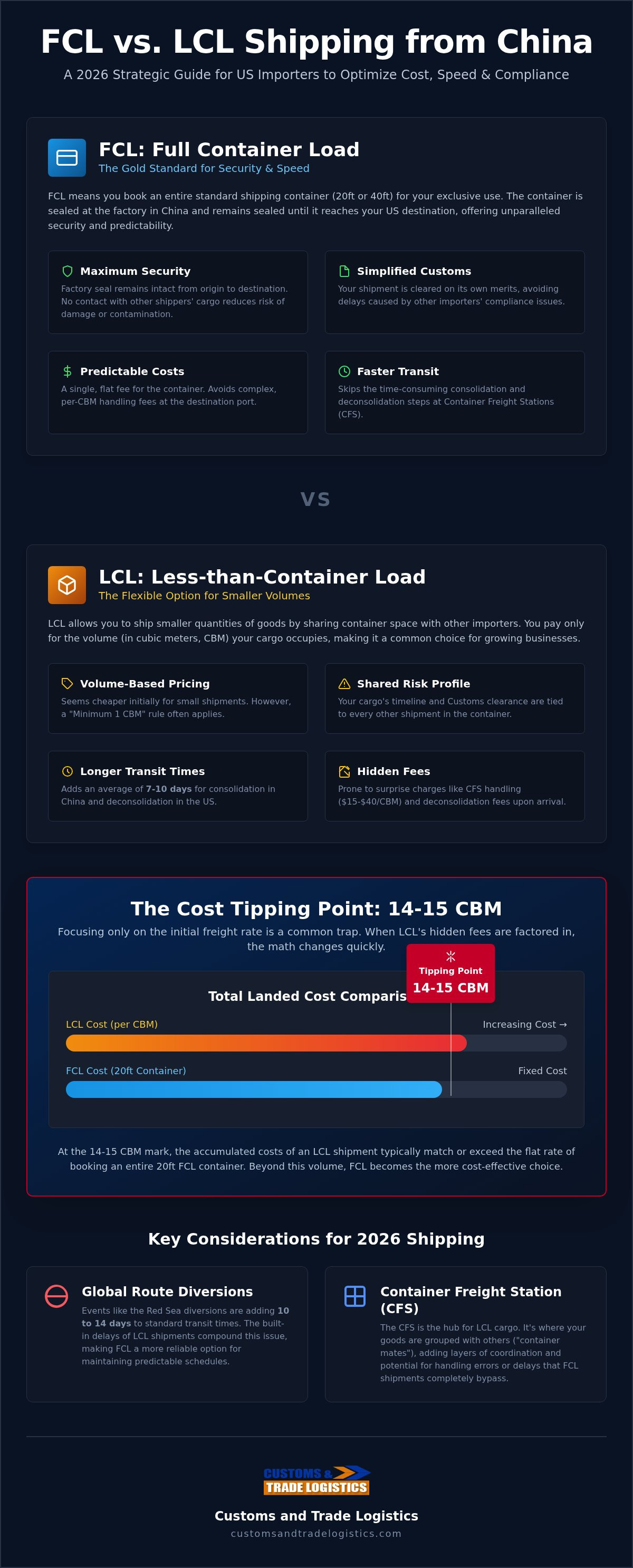
FCL refers to the exclusive use of a standard shipping container, typically in 20ft or 40ft sizes. When you book FCL, you aren't just buying space; you're buying the entire capacity of the unit. This means you have exclusive rights to the container's volume and weight limits, regardless of whether you fill it to the brim. FCL is the gold standard for security and speed because the factory seal remains intact from the moment it leaves the manufacturer in China until it arrives at your US warehouse. You don't have to worry about other people's cargo or the handling risks that come with shared space.
What is LCL (Less-than-Container Load)?
If you don't have enough inventory to fill a whole container, Less-than-container load (LCL) is your strategic alternative. This model allows you to pay only for the cubic meters (CBM) your cargo actually occupies. Through a process known as "groupage," a freight forwarder combines your shipment with others headed to the same US port. LCL is the primary entry point for growing SMBs and Amazon sellers who need to maintain lean inventory levels without the high cost of air freight. While it offers flexibility for smaller volumes, it requires a higher level of oversight to manage the extra handling at the CFS. Balancing the pros and cons of FCL vs LCL shipping from China ensures you aren't overpaying for "air" in a container you don't actually need.
The Direct Comparison: Cost, Speed, and Security Factors
Deciding between FCL vs LCL shipping from China requires looking past the initial freight quote. While FCL involves paying a flat fee for a 20ft or 40ft container, LCL pricing is based on the volume of your cargo, measured in cubic meters (CBM). This volume-based pricing seems attractive for smaller batches, but the physical reality of sharing space introduces variables that don't exist in a dedicated container. You aren't just paying for space; you're paying for the coordination required to keep your inventory separate from others.
Freight Rates vs. Total Landed Costs
A common mistake for first-time importers is focusing solely on the ocean freight rate. LCL quotes often look incredibly cheap at origin, but they can hide significant arrival fees at US national ports. Most LCL shipments are subject to a "Minimum 1 CBM" rule, meaning even if your box is tiny, you'll pay for a full cubic meter. Once the ship docks, you'll face Container Freight Station (CFS) handling fees that can range from $15 to $40 per CBM depending on the specific facility. In contrast, FCL costs are more predictable for budgeting because you aren't split-billing the terminal handling or drayage with other parties. The Federal Maritime Commission (FMC) oversees these regulated practices to ensure fair competition, but the complexity of these fees is why many businesses seek import from China consulting to avoid surprises.
The Speed Gap: Why LCL Takes Longer
Speed is where the two methods diverge most sharply. LCL usually adds 7 to 10 days to your total transit time. This delay happens at both ends of the journey. In China, your goods sit in a warehouse until the forwarder has enough cargo to fill the entire container. After arrival at major US entry points, the container must be hauled to a deconsolidation warehouse, opened, and sorted before it's ready for final pickup. If you're in a rush, some carriers offer "Premium LCL" services that prioritize your cargo for faster discharge, but FCL remains the fastest route for high-volume needs because it bypasses the sorting facility entirely.
Security is the final piece of the puzzle. Every time your cargo is moved, the risk of damage increases. LCL cargo is handled at least twice more than FCL cargo during the consolidation and deconsolidation phases. Because your goods are packed alongside items from other shippers, they're exposed to shifting loads or improper stacking. This makes robust cargo insurance a non-negotiable requirement in 2026, regardless of which shipping method you choose. Protecting your investment ensures that a minor logistical hiccup doesn't become a major financial loss for your business. Balancing the pros and cons of FCL vs LCL shipping from China is about protecting your margins as much as your inventory.
The Compliance Conflict: How FCL vs LCL Affects US Customs Clearance
When you choose FCL vs LCL shipping from China, you aren't just deciding on a price point. You're choosing your level of exposure to other people's mistakes. In our 35 years of industry experience, we've seen how a single error in one importer's paperwork can paralyze an entire shared container. This "compliance contamination" is the primary reason why LCL shipments often face more scrutiny than their FCL counterparts. While you might be diligent with your documentation, you're essentially tethered to the compliance habits of every other shipper in that container.
Customs Exams and Shared Containers
One of the most frustrating experiences for an importer is the "VACIS" hold. This refers to a non-intrusive X-ray scan performed by US Customs. If an inspector sees something suspicious in just one pallet of an LCL container, the entire unit is flagged for an intensive exam. This means your goods are stuck in a bonded warehouse until every item in that shared space is cleared. The costs for these exams, including the drayage to the exam site and the labor for stripping the container, are often split among the shippers. However, the delay to your supply chain is a cost you bear alone. FCL offers a cleaner legal profile for US Customs because your business is the only entity associated with the container, significantly reducing the chance of being caught in someone else's red tape.
Manifesting and Paperwork Accuracy
Accuracy is critical because LCL shipments rely on a "House Bill of Lading" issued by your freight forwarder. This document must align perfectly with the "Master Bill of Lading" used by the shipping line. Because of this added layer of complexity, your broker usually needs LCL data at least 72 hours earlier than FCL data to file the Importer Security Filing (ISF) correctly. Missing the ISF deadline can result in a $5,000 fine per violation. You can find helpful guidance through SBA international trade tools to help stay organized during this phase.
Regardless of your shipment size, you must have a Customs Bond in place to guarantee the payment of duties and taxes. Managing these details requires a mentor who understands the nuances of different ports. For a deeper look at the specific requirements for 2026, explore our comprehensive guide on Customs Clearance Services in the US. Proper oversight at this stage ensures that your choice between FCL vs LCL shipping from China doesn't lead to an avoidable legal headache.
Strategic Decision-Making: The 15 CBM Threshold and Beyond
When does it make financial sense to stop sharing space? While every quote is unique, the general rule for 2026 is that the break-even point sits between 15 and 18 CBM. Even though a 20ft container can technically hold about 28 to 30 CBM, the total landed cost of shipping 15 CBM via LCL often equals the flat rate of a full container. This happens because LCL terminal fees are billed per unit of volume, while FCL fees are mostly fixed. If your shipment is approaching that 15 CBM mark, switching to FCL isn't just about price; it's about the security and speed we discussed in previous sections.
Your cargo's density also plays a major role. High-volume, low-weight goods will hit the CBM limit quickly, making FCL attractive. Conversely, high-density goods might hit weight limits first. Planning around 2026 shipping peaks like the Chinese New Year or Golden Week is equally vital. During these high-demand windows, FCL space disappears weeks in advance. If you haven't secured a container early, LCL might be your only way to keep inventory moving, even if it's less efficient. For a deeper dive into managing these moving parts, check our Import From China Logistics Guide.
The Amazon FBA Specific Roadmap
Amazon sellers face unique requirements that influence the choice of FCL vs LCL shipping from China. Amazon generally prefers palletized shipments for faster receiving at their fulfillment centers. When you use LCL, your goods are almost always palletized at the Container Freight Station (CFS) before final delivery. With FCL, you have the option to "floor-load" the container to maximize every inch of space. While floor-loading saves money on pallet costs, it can lead to longer unloading times and potential "detention" fees if the warehouse takes too long to empty the container. For tailored support, see our Amazon Seller Import Help.
Inventory Strategy: Small Batches vs. Bulk Stock
LCL is the perfect tool for testing the market with a new supplier. It allows you to vet product quality without committing to a full container of stock. However, once you scale, a "Consolidated FCL" strategy is often the smartest move. This involves buying from multiple Chinese vendors and having them deliver to a single warehouse where we combine their products into one dedicated container. This gives you the security of FCL with the flexibility of sourcing from different partners. If you're unsure which path fits your current volume, our team provides expert international freight logistics to help you calculate the most efficient route.
Conclusion: Building a Resilient Logistics Chain with CTL
Mastering the choice between FCL vs LCL shipping from China is a fundamental skill for any growing US business. As we've explored, FCL offers the highest level of security and speed by giving you exclusive use of a container. Conversely, LCL provides the flexibility needed for smaller volumes and market testing. The right choice depends on your specific volume, budget, and risk tolerance at this stage of your growth. We're here to ensure that as your volume increases, your logistics strategy evolves with you, moving you from shared space to dedicated containers without missing a beat. Growth requires a steady hand.
The CTL 'Safe Pair of Hands' Advantage
At Customs and Trade Logistics, we act as a stabilizing force in an industry that can often feel overwhelming. With 35 years of experience across all major national US ports, we specialize in identifying the pitfalls that catch others off guard. We don't just clear your cargo; we vet your LCL partners to minimize the "compliance contamination" risks that lead to expensive Customs exams. Our expertise acts as a protective buffer, saving you from the hidden LCL port fees and terminal handling charges that often surprise first-time importers. We pride ourselves on being more than a service provider; we're a family-owned mentor dedicated to your long-term success.
Your Next Steps for 2026
To prepare your business for a successful year of growth, start by gathering accurate data for your next shipment. Having precise cubic meter (CBM) measurements and verified HTS codes allows us to provide the most accurate cost projections. If you plan to ship multiple times this year, securing a Continuous Bond is a smart investment that simplifies your paperwork and demonstrates your commitment to compliance. We invite you to join the CTL family of successful importers and experience the peace of mind that comes with professional oversight. Contact Customs and Trade Logistics for a Shipping Consultation today to optimize your FCL vs LCL shipping from China and build a more resilient supply chain.
Secure Your Supply Chain Success
Choosing between FCL vs LCL shipping from China isn't just about the volume of your goods. It's a strategic decision that impacts your delivery speed, total landed costs, and Customs compliance. Remember that the 15 CBM threshold often serves as the tipping point where a full container becomes the more cost-effective and secure option. By understanding these nuances, you can avoid the "compliance contamination" of shared cargo and keep your inventory moving predictably through US ports.
At Customs and Trade Logistics, we've spent over 35 years acting as a "safe pair of hands" for SMBs and Amazon sellers. Our family-owned firm specializes in navigating the complexities of every US Customs port to ensure your shipments arrive without unnecessary delays. We're here to help you demystify the logistics process and transition smoothly from small batches to bulk stock as your business scales. Ready to take the next step? Get a Professional China-to-US Shipping Quote today and join our family of successful importers. Your growth is our priority, and we're excited to support your journey.
Frequently Asked Questions
At what volume (CBM) should I switch from LCL to FCL?
You should consider switching to a full container when your shipment reaches approximately 14 to 15 cubic meters (CBM). While a 20ft container can hold more, the volume-based fees for LCL often equal the flat rate of FCL at this point. Choosing FCL vs LCL shipping from China at this threshold gives you exclusive space and better security. We help you calculate these landed costs to ensure you aren't overpaying for shared space.
Is LCL shipping more likely to be inspected by US Customs?
Yes, LCL shipments statistically face a higher risk of inspection because you're sharing space with other importers. If any single shipment in the container has paperwork errors or suspicious items, US Customs may hold the entire container for an X-ray scan or intensive exam. This contamination risk is a major factor for businesses prioritizing speed. FCL provides a cleaner legal profile since your company is the only entity associated with the container's contents.
What are the hidden arrival fees in LCL shipping from China?
LCL shipments often incur fees that aren't always clear on the initial freight quote. These include Container Freight Station (CFS) handling, deconsolidation charges, and terminal handling fees at the US port. You might also see charges for palletization and documentation. Because these costs are billed per CBM, they can add up quickly. Our consulting services help you identify these expenses early so you can budget accurately for your total landed costs.
Can I use LCL for Amazon FBA shipments?
You can certainly use LCL for Amazon FBA, and it's a popular choice for sellers testing new products. Amazon has strict requirements for palletization and labeling that must be met before delivery. When using LCL, your goods are typically palletized at a US warehouse before being redistributed to an FBA center. We coordinate this entire process to ensure your shipment meets Amazon's standards, helping you avoid costly rejection at the fulfillment center.
Who is responsible for cargo damage in a shared LCL container?
While the carrier has a legal responsibility, their liability is often limited by international maritime law, which may not cover the full value of your goods. In a shared container, damage can occur during the extra handling steps at the CFS. This is why we strongly recommend comprehensive cargo insurance for every shipment. It provides a necessary safety net, ensuring you're protected if items are damaged by shifting loads or improper stacking by other shippers.
Do I need a different Customs Bond for FCL vs LCL?
No, you don't need a different type of Customs Bond for FCL vs LCL shipping from China. A standard Continuous Bond covers all your imports for an entire year, regardless of the shipping method or the US port of entry. This bond acts as a financial guarantee to US Customs that all duties and taxes will be paid. We can help you secure or renew this bond to keep your supply chain moving without interruption.
What is a CFS charge and why is it on my LCL invoice?
A CFS charge stands for Container Freight Station fee, and it covers the labor and equipment used to unload and sort your cargo. Since LCL involves multiple shipments in one container, the goods must be physically separated at a bonded facility after the ship docks. This charge is a standard part of the LCL process and is usually billed based on the volume of your shipment. It's the price of the flexibility that LCL offers for smaller volumes.
How much extra time should I budget for LCL deconsolidation at US ports?
You should generally budget an additional 7 to 10 days for the deconsolidation process at US ports. Unlike FCL, where the container is hauled directly to your warehouse, LCL units must be moved to a secondary facility to be opened and sorted. This timeline can fluctuate based on port congestion and the efficiency of the local warehouse. Planning for this extra week helps you maintain accurate inventory levels and meet your customers' delivery expectations without stress.


