
What if a six-month gate closure at the Seagirt Marine Terminal could derail your entire national distribution schedule? For many importers, the port remains a source of high anxiety, filled with the fear of expensive penalties and the confusion of ever-shifting HTS codes. You've likely felt that sense of helplessness when cargo hits the dock and your visibility vanishes under a mountain of paperwork. It's a heavy burden to carry alone while you're trying to grow a business.
Understanding the benefits of using a local customs broker in Baltimore is about more than just geography; it's about gaining a dedicated advocate who navigates these hurdles for you. We promise to show you how personalized, port-specific expertise can streamline your national supply chain and eliminate those costly import delays. In this article, we'll preview the latest 2026 customs regulations, explain how to optimize duty payments under the new fee structures, and demonstrate how a seasoned logistics mentor provides the peace of mind you deserve from factory to final delivery.
Key Takeaways
- Learn how a local partner acts as your legal liaison with US Customs to ensure full compliance and clear communication.
- Discover the benefits of using a local customs broker in Baltimore to navigate port-specific hurdles and eliminate common causes of cargo delays.
- Master the art of HTS classification to optimize your duty payments and protect your business from expensive audit penalties.
- Gain total visibility into your supply chain with a seamless logistics roadmap that covers every step from the factory floor to final delivery.
- Understand why a family-owned mentor provides a more reliable partnership than faceless digital platforms for managing complex international trade.
The Strategic Value of Local Expertise in Global Trade
How do you ensure your cargo doesn't get stuck in a bureaucratic bottleneck? For national importers, the solution often starts with understanding the role of a customs broker. These professionals act as your legal liaison with US Customs and Border Protection (CBP), translating complex federal regulations into a clear path for your goods. They don't just file paperwork; they protect your business from the financial and legal risks of non-compliance. One of the primary benefits of using a local customs broker in Baltimore is that they act as a "logistics mentor," guiding you through the technical density of trade laws with professional assurance.
When we talk about "local" expertise, we aren't suggesting you need to be physically located near the water. Instead, we're highlighting the deep familiarity a broker has with specific port procedures and the personnel who enforce them. This ground-level knowledge allows them to demystify regulations that might otherwise feel overwhelming. It's about having a partner who understands the operational pulse of the entry point, providing a sense of security that extends across your entire national supply chain.
Why Port-of-Entry Knowledge is a Competitive Advantage
Every port has its own nuances, from terminal-specific gate hours to the way local inspectors prioritize certain types of examinations. A broker with local roots understands these patterns intimately. They act as a stabilizing force when disruptions occur, such as the scheduled 2026 gate closures at the Seagirt Marine Terminal. Knowing how to pivot during such events can drastically improve clearance speed. While this expertise is port-centric, filings are handled at all US ports. This gives you a single, knowledgeable point of contact who can manage your shipments regardless of where they land on American soil.
The Difference Between a Digital Platform and a Dedicated Broker
Many importers are tempted by "faceless" digital platforms that promise low-cost, automated filing. However, these systems often lack the nuanced oversight required when things go wrong. A family-owned firm offers a "safe pair of hands" that technology simply cannot replicate. With over 35 years of industry experience, a dedicated broker provides personalized care and proactive problem-solving. They don't just process data; they take ownership of your administrative burden. This partnership replaces the anxiety of international operations with the relief of knowing an expert advocate is watching over every container.
Navigating US Customs: How Experts Prevent Costly Port Delays
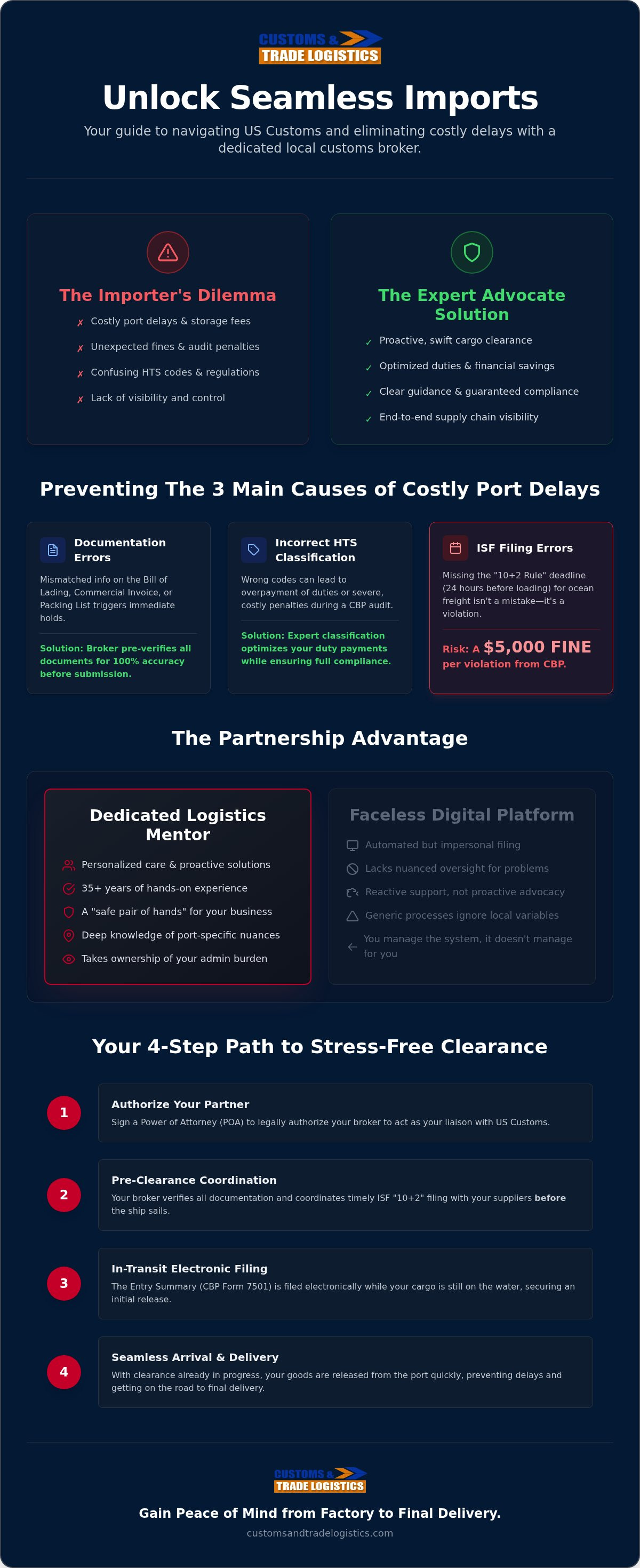
Why is your cargo still sitting at the port? Most importers face delays due to three main issues: missing documentation, incorrect classification, or Importer Security Filing (ISF) errors. These aren't just minor inconveniences; they can result in heavy storage fees and missed delivery windows. One of the primary benefits of using a local customs broker in Baltimore is their ability to identify these red flags before your ship even docks.
A professional broker is licensed, regulated and empowered by U.S. Customs and Border Protection to act as your advocate. They handle the electronic preparation of the Entry Summary, also known as CBP Form 7501. This document is the heart of the clearance process, as it determines the duties, taxes, and fees owed to the government. By submitting this package electronically, your broker secures an initial release, often while your goods are still on the water. This proactive oversight is the best defense against random examinations that can stall your supply chain.
Mastering Documentation and Paperwork Requirements
Accuracy is the bedrock of a smooth entry. Your broker reviews three essential documents for every shipment: the Bill of Lading, the Commercial Invoice, and the Packing List. They verify that the descriptions, quantities, and values match exactly what US regulations require. To begin this partnership, you'll need to sign a Power of Attorney (POA), which is the foundational legal document that authorizes your broker to file entries on your behalf. This step ensures that your administrative burden is handled by a safe pair of hands.
The Importance of Timely ISF Filings
If you're importing ocean freight, you must comply with the "10+2" rule. This requires specific data to be filed at least 24 hours before your goods are loaded onto a vessel at the foreign port. Missing this deadline isn't just a mistake; it can lead to fines of $5,000 per violation from CBP. A dedicated broker coordinates directly with your suppliers in China to ensure data accuracy. It's a huge relief to know that these strict deadlines are being managed by experts. Choosing to partner with a seasoned firm allows you to enjoy the benefits of using a local customs broker in Baltimore while maintaining a national distribution reach. If you're ready to secure your supply chain, our customs clearance services provide the end-to-end support you need to avoid these pitfalls.
Financial Stewardship: Mitigating Risks and Optimizing Duties
How much of your profit margin is swallowed by unexpected duties? Every product entering the country must be categorized under the Harmonized Tariff Schedule (HTS), a complex system where a single digit difference can change your tax liability. A seasoned partner will assist importers in meeting federal requirements by ensuring every item is classified with surgical precision. This is one of the key benefits of using a local customs broker in Baltimore; they don't just file papers, they protect your bottom line through expert oversight.
Misclassification is a double-edged sword. On one side, you might overpay duties for years, losing thousands of dollars in potential profit. On the other, underpaying puts you at risk for retroactive billing and severe penalties during a government audit. Your broker acts as a financial steward, identifying the most favorable, yet legally defensible, classification for your goods. This level of care ensures you aren't leaving money on the table or leaving your business vulnerable to federal scrutiny.
HTS Classification and Duty Management
The HTS system contains thousands of codes, making it a minefield for those without specialized training. It's not enough to simply guess a category; you must understand the "General Rules of Interpretation" that CBP uses to define products. Your broker uses decades of industry expertise to navigate these nuances. For a clearer picture of how these services fit into your overall shipping budget, it's helpful to spend time understanding custom brokerage service fees. This knowledge helps you build a more accurate financial roadmap for your business and prevents unexpected costs from derailing your growth.
Avoiding Fines and Regulatory Penalties
Maintaining a clean compliance record with CBP is perhaps the most valuable asset an importer can have. A history of errors triggers higher scrutiny and more frequent inspections, which lead to even more delays and fees. Think of your broker as a protective buffer. If CBP issues an inquiry or initiates an audit, your broker handles the technical response. They draw on 35 years of experience to resolve the issue quickly, acting as a knowledgeable bridge between your small business and the global marketplace. This relationship creates a sense of security that allows you to focus on sales rather than regulations.
Beyond duties, your broker manages the complexities of customs bonds, which are required for the release of your cargo. They also help you calculate the true "landed cost" of your inventory. This includes everything from the factory price to the last mile delivery fees. Knowing these numbers upfront allows for better business budgeting and prevents the "sticker shock" that often plagues new importers. When you experience the benefits of using a local customs broker in Baltimore, you gain a partner who is deeply invested in your long-term success.
End-to-End Logistics: From Port Arrival to Final Delivery
Clearing customs is only half the battle. Once the government gives the green light, your shipment still needs to navigate the physical hurdles of the terminal to reach its final destination. For national importers, this "last mile" is often the most stressful part of the journey. One of the primary benefits of using a local customs broker in Baltimore is having a single point of contact who manages both the legal paperwork and the physical movement of your cargo. This integrated approach ensures that your goods don't just sit on a dock after clearance, but move quickly toward your warehouse.
The journey typically begins at a foreign supplier and involves a complex handoff between several key entities:
- Foreign Factory: Goods are produced and prepared for international export.
- Ocean Carrier: Cargo is loaded and transported across the trade lanes.
- Port Terminal: Containers are offloaded and staged for customs clearance.
- Ground Transport: Drayage trucks move the cargo to a warehouse or redistribution center.
Importers who leverage the benefits of using a local customs broker in Baltimore often find that their total transit times are reduced because of this synchronized oversight. Coordinating these moving parts requires a holistic view of the entire logistics chain. Instead of juggling multiple vendors, you can rely on a dedicated advocate to oversee drayage and transport, providing the professional assurance that your supply chain remains unbroken from the factory floor to the final delivery.
Coordinating International Freight Logistics
Managing the physical transport of containers from the terminal to a redistribution center is a specialized task. It involves scheduling pickups, managing chassis availability, and avoiding port congestion. This level of coordination is essential for maintaining a steady flow of inventory. Because every shipment has unique requirements, understanding the nuances of import from China logistics is vital for businesses looking to scale. Our team acts as a stabilizing force, handling the administrative and physical burdens so you don't have to.
Specialized Support for Amazon FBA Sellers
For e-commerce brands, the stakes are even higher. Shipping directly to Amazon fulfillment centers requires strict adherence to labeling and scheduling rules. Our delivery and redistribution services are designed to help you meet these requirements without the headache. By using a "safe pair of hands" to manage your Amazon seller import help, you can ensure your products are correctly routed and processed. This end-to-end support allows you to focus on sales while we handle the heavy lifting. To streamline your own supply chain, consider our international freight logistics services for total peace of mind.
Partnering with Customs and Trade Logistics for National Success
Choosing a logistics partner is one of the most critical decisions you'll make as an importer. It isn't just about finding someone to file a form; it's about finding a stabilizing force that can weather the storms of global trade alongside you. At Customs and Trade Logistics, we bring over 35 years of industry leading experience to the table. As a family owned firm, we treat your business growth with the same diligence we apply to our own. One of the primary benefits of using a local customs broker in Baltimore is the ability to receive this high level, personalized care while still maintaining the capacity to clear cargo at every single US port.
We understand that the scale of international operations can feel overwhelming for small and medium sized businesses. That's why we position ourselves as a knowledgeable bridge between your local operations and the global marketplace. We offer a sense of security that replaces the anxiety of potential audits and penalties. When you partner with us, you gain more than a service provider; you gain a dedicated advocate who is deeply invested in your long term success.
The Value of a Personalized Logistics Partnership
Our approach is rooted in the role of a family oriented mentor. We don't just process transactions. We provide total management of the import process to lift the heavy administrative burden from your shoulders. This dedicated advocacy allows you to focus on what you do best: growing your brand and serving your customers. By leveraging the benefits of using a local customs broker in Baltimore, you ensure that a "safe pair of hands" is managing your technical compliance and physical logistics. This relationship is built on professional assurance and a deep commitment to protective care.
Getting Started with Your National Import Strategy
Taking the first step toward a streamlined supply chain is simpler than you might think. Whether you are a seasoned importer or just beginning your journey, a proactive strategy is your best defense against the complexities of 2026 trade regulations. For those just launching their business, we recommend exploring our guide on import logistics for startups to build a strong foundation. We invite you to experience the reliability and relief that comes from expert logistics management. Contact us today for a consultation or quote, and let us help you turn the challenges of international trade into a competitive advantage for your national business.
Securing Your Supply Chain for the Future of Global Trade
Success in international trade isn't just about moving goods from point A to point B; it's about the precision and care taken at the border. You've seen how port-specific knowledge can turn a potential six-month gate closure into a manageable pivot rather than a supply chain disaster. By focusing on accurate HTS classification and proactive ISF filings, you protect your profit margins and maintain a clean record with federal authorities. One of the primary benefits of using a local customs broker in Baltimore is that you gain a partner who understands these nuances intimately, providing a safe pair of hands for your cargo regardless of which US port it enters.
Customs and Trade Logistics brings 35+ years of industry expertise to your business, offering the personalized service that only a family-owned and operated firm can provide. We act as your logistics mentor, offering national coverage across all US ports to ensure your shipments move seamlessly from the factory floor to the final delivery. It's time to replace the anxiety of customs paperwork with the relief of professional assurance. Get a Professional Customs Clearance Quote Today and take the first step toward a more reliable, optimized import strategy. We're here to help your business grow with confidence.
Frequently Asked Questions
Do I legally need a customs broker to import goods into the US?
You aren't legally required to hire a broker for personal imports, but most commercial importers find it essential. Managing federal regulations and filing the correct documentation requires technical precision. One of the benefits of using a local customs broker in Baltimore is that they handle the complex legal requirements on your behalf. This prevents expensive errors and ensures your business stays compliant with US Customs and Border Protection standards.
What are the typical service fees for a customs broker in 2026?
Service fees are typically structured per entry and depend on the complexity of your shipment. Most brokers charge a flat fee for standard entries, while additional costs may apply for extra HTS lines or specific government agency filings. It's important to factor in federal user fees, like the Merchandise Processing Fee, which adjusted on October 1, 2025. Working with a veteran partner helps you budget accurately for these unavoidable costs.
Can a customs broker help me if I am importing from China for the first time?
Yes, a broker acts as a logistics mentor for first-time importers. They guide you through the specific challenges of the China-to-US trade lane, including HTS classification and supplier coordination. This protective care is vital for small businesses that don't have in-house compliance teams. By demystifying the process, your broker ensures your first shipment arrives without the administrative headaches or surprise penalties that often plague new importers who try to go it alone.
How does a customs broker help with Amazon FBA shipments?
Brokers streamline the transition from the port to Amazon's fulfillment network. They manage the specific labeling and scheduling requirements that Amazon demands for incoming freight. Through delivery and redistribution services, a broker ensures your goods are routed correctly to avoid rejection at the warehouse. This specialized support allows e-commerce sellers to scale their operations nationally while a safe pair of hands handles the logistical heavy lifting and ensures your inventory stays in stock.
What is the difference between a customs broker and a freight forwarder?
A customs broker is your legal liaison with the government, focusing on compliance and duty payments. A freight forwarder manages the physical movement of cargo via ocean, air, or ground transport. While they serve different roles, some experienced firms provide both services. This creates a seamless end-to-end experience where one advocate oversees both the regulatory paperwork and the actual delivery of your international shipments, providing total management of your supply chain.
How long does the customs clearance process typically take at major US ports?
Most shipments clear within 24 to 48 hours of arrival if the documentation is submitted electronically and error-free. However, this timeline can change if your cargo is selected for a random examination or if there are port-specific disruptions. One of the benefits of using a local customs broker in Baltimore is their ability to monitor these timelines closely and provide a stabilizing force when delays occur at any US port across the country.
What happens if my shipment is flagged for a customs exam?
If flagged, your cargo is moved to a Centralized Examination Station (CES) for inspection. You'll be responsible for the devanning and facility fees associated with the exam, which vary based on container size. Your broker acts as a buffer during this process, coordinating with the terminal and providing the necessary information to CBP. Their goal is to resolve the inquiry quickly and get your supply chain moving again without unnecessary administrative burdens on your part.
Can one broker handle my shipments at multiple US ports of entry?
Yes, a broker with a national permit can file customs entries at every port in the United States. You don't need a different partner for every city where your goods land. This allows you to maintain a single point of contact for your entire national import strategy. Having one dedicated advocate ensures consistent compliance standards and a personalized touch across all your international shipping operations, regardless of where your cargo hits the dock.


