
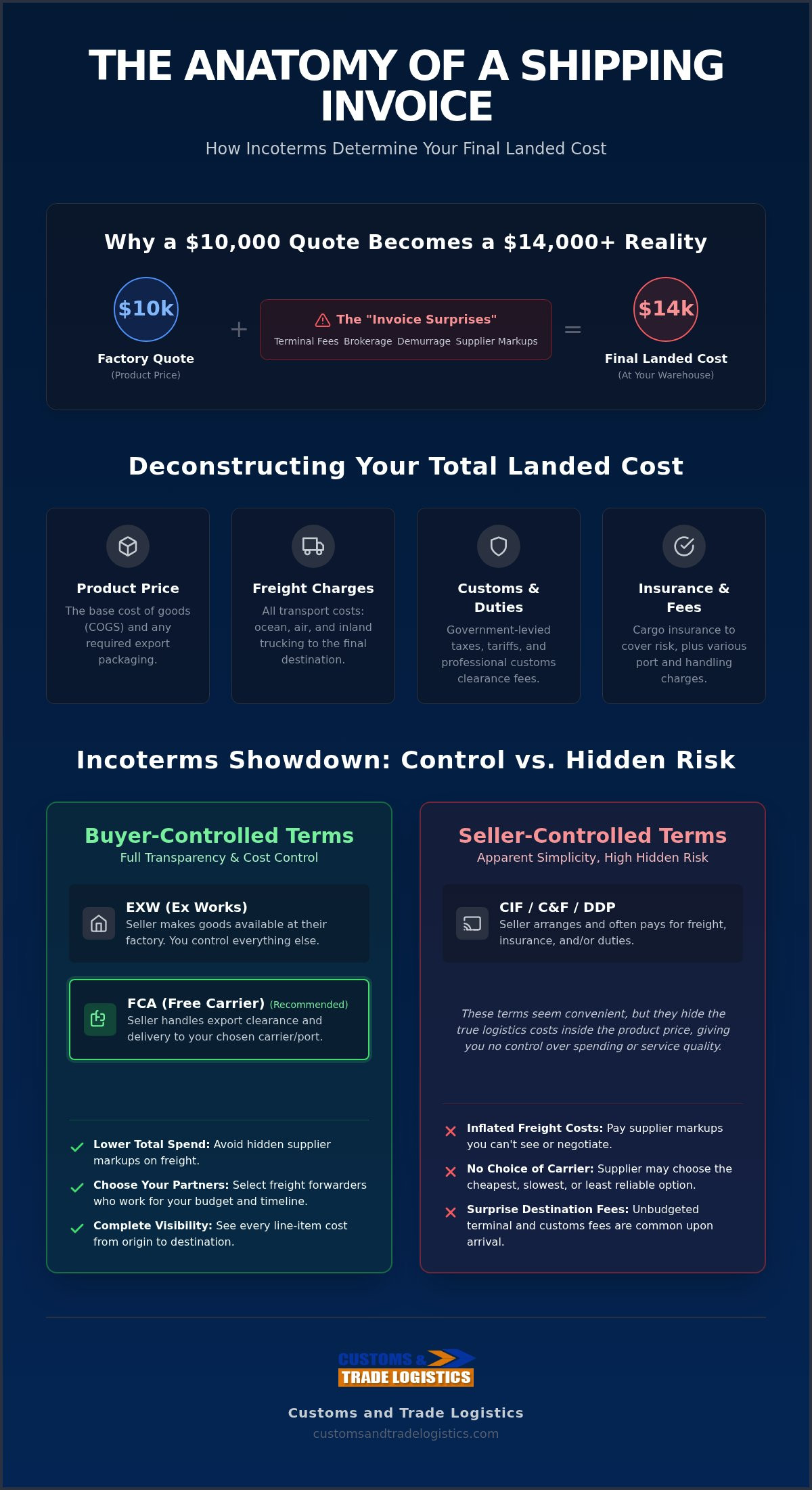
Why does a $10,000 factory quote so often turn into a $14,000 shipping invoice by the time the goods reach your warehouse? It's a common frustration for many US importers who don't fully realize how incoterms affect final landed cost until a surprise bill arrives. You aren't alone if you feel that your shipping invoices are unpredictable or that you lack control over the speed of your customs clearance. It's stressful to manage a business when you're constantly bracing for unexpected terminal fees and demurrage charges that eat into your bottom line.
This 2026 guide is designed to replace that anxiety with a clear sense of security. You'll learn the nuances of these international terms so you can move from being a passive participant to a strategic decision-maker. By mastering these rules, you can protect your margins and ensure your goods move through the port without costly delays. Think of this as a roadmap from a partner who has spent 35 years acting as a safe pair of hands for importers. We'll walk through the specific responsibilities of each term and provide a step-by-step look at how to structure your agreements for predictable, lower overall logistics spend.
Key Takeaways
- Learn why Incoterms serve as the financial blueprint for every shipping invoice and how incoterms affect final landed cost.
- Evaluate the pros and cons of terms like EXW and FOB to find the right balance between logistics control and your total responsibility.
- Identify the hidden terminal handling charges and customs brokerage fees that often hide within a supplier's standard quote.
- Follow a simple audit process to spot "lazy" shipping terms that might be draining your import margins without you realizing it.
- Discover how a dedicated customs broker acts as a safe pair of hands to manage the administrative burden of 2026 trade regulations.
The Connection Between Incoterms and Your Final Landed Cost
Understanding your landed cost is the difference between a profitable quarter and a surprise loss. Simply put, it's the total price of a product once it's arrived at your door, including every single fee along the way. Many businesses fall into the trap of focusing solely on the unit price quoted by a supplier. However, that quote is often just a fraction of the story. This is precisely how incoterms affect final landed cost; they act as the financial blueprint for every international shipping invoice you'll receive.
If you ignore these terms, a "cheap" unit price can quickly become an expensive shipment. Incoterms establish the "Transfer of Risk" point in global trade. This defines exactly when the responsibility for the goods, and the costs associated with them, moves from the seller to you. Choosing the wrong term means you might inherit costs you didn't budget for, or lose control over the logistics providers who handle your cargo. Risk transfer is more than just a legal hurdle; it's a financial tipping point. If your agreement says the risk transfers at the factory gate, you're on the hook for everything that happens next, including damage during loading or delays at the port.
What Components Make Up Landed Cost in 2026?
Calculating your total spend requires looking at the entire journey. In 2026, landed cost isn't just about the ocean freight. It's a combination of several moving parts that must be tracked diligently to protect your margins. These components include:
- Product price (COGS) and specific export packaging.
- Freight charges, covering ocean, air, and inland transport.
- Customs duties, taxes, and professional customs clearance services us.
- Cargo insurance and various handling fees at both ends of the journey.
Why Your Freight Quote Isn't Your Final Cost
Your initial freight quote is rarely the final number on your ledger. Many quotes exclude destination charges that only appear once the ship docks. These "line-item" surprises often stem from the specific Incoterm used in your contract. For instance, if your supplier chooses the service providers under a CIF agreement, they may select carriers based on their own convenience rather than your budget. You also have to consider currency fluctuations. If your costs are split between multiple currencies, the final landed cost can shift between the time of order and the time of delivery. By understanding how incoterms affect final landed cost, you can choose terms like FCA that allow you to pick your own partners and avoid supplier markups.
Analyzing Common Incoterms: Who Pays for What?
Choosing the right Incoterm is a bit like choosing a lane on a highway; it determines your speed, your visibility, and exactly how much you'll pay at the toll booth. While there are 11 different terms in the current framework, most US importers rely on a handful of common ones. Each of these terms shifts the financial burden between the seller and the buyer. Understanding these shifts is the only way to truly grasp how incoterms affect final landed cost. If you choose a term that seems easy but lacks transparency, you're essentially handing your checkbook to your supplier.
The Buyer-Controlled Terms: EXW and FCA
When you use EXW (Ex Works) or FCA (Free Carrier), you take the driver's seat. Under EXW, the seller simply makes the goods available at their factory. You handle everything else. While this sounds daunting, it often leads to a lower total spend because you aren't paying a supplier's hidden markup on shipping. This level of control is a cornerstone of successful import logistics for startups. It allows you to see the raw cost of the goods and the true price of the freight separately.
FCA is often the preferred "middle ground." Here, the seller is responsible for delivering the goods to a specific point, like a port or a forwarder's warehouse, and handling the export clearance. From that point on, you manage the journey. Using your own freight forwarder under these terms provides total transparency. You'll know exactly what you're paying for ocean freight and destination fees without any "fluff" added by the factory. If you're unsure which term fits your current volume, consulting with a dedicated logistics partner can help you run the numbers before you sign the contract.
The Seller-Controlled Terms: CIF and DDP
On the other side of the spectrum are terms like CIF (Cost, Insurance, and Freight) and DDP (Delivered Duty Paid). These are often marketed as "hassle-free" options. In a CIF agreement, the seller pays for the freight and insurance to the destination port. However, that "free" insurance is often the bare minimum required, and you may find yourself facing massive destination charges when the ship arrives. The seller chooses the carrier, which means they choose the rates you eventually pay through the unit price.
DDP is the ultimate "all-inclusive" trap, particularly for new Amazon sellers. The seller handles everything, including duties. While this feels easy, it carries a significant risk. As the Importer of Record, you are still legally liable for customs compliance. If your supplier misclassifies the goods to save on duties, US Customs holds you responsible, not them. This is a primary example of how incoterms affect final landed cost through potential fines and legal fees that never appeared on the initial quote. Relying on a supplier for DDP often results in a lack of visibility that can jeopardize your entire import margin.
Beyond the Freight Quote: Hidden Costs Influenced by Incoterms
Have you ever wondered why your final invoice includes charges that weren't on the initial quote? While a freight estimate gives you a baseline, the real surprises usually happen at the destination port. This is a primary example of how incoterms affect final landed cost; they determine who is responsible for the "last mile" of administrative and terminal fees. If these aren't clearly defined, you're essentially leaving your profit margins to chance. Beyond the basic transport, several "ticking clock" costs can quickly spiral if your Incoterm choice doesn't give you enough control over the timeline.
Terminal Fees and Port Charges
Terminal Handling Charges (THC) are often the most misunderstood line items on a destination invoice. These fees cover the movement of your container within the port, from the ship's side to the truck. If you use FOB terms, the seller typically handles the origin port charges, which protects you from unexpected fees before the goods even leave the country. Conversely, under DDU or DAP terms, you might receive a "handling" bill from a third-party agent you didn't choose. These agents often charge premium rates because they know you need your goods released. By choosing terms that allow you to pick your own logistics partners, you can negotiate these rates upfront.
Customs Entry and Brokerage Impacts
Your choice of Incoterm also dictates who manages the legal entry of your goods into the US. This choice directly influences custom brokerage service fees and the overall quality of your compliance. When you use DDP terms, the seller often hires a high-volume, low-touch broker to file the entry. While this seems convenient, it can complicate your status as the Importer of Record. If the broker makes a mistake in classification or valuation, US Customs holds you responsible for the fines, not the seller. Choosing your own broker ensures you have an advocate who understands your specific products and keeps your records audit-ready.
Finally, consider the impact of demurrage and detention. These are fees charged for keeping containers at the port or away from the terminal too long. Under seller-controlled terms like CIF, you often have no say in which carrier is used. This means you might only get two or three "free days" at the port before the charges start. When you control the freight via FCA or FOB, you can work with your forwarder to select carriers that offer more flexible terms. This foresight is another way how incoterms affect final landed cost by preventing hundreds, or even thousands, of dollars in avoidable penalties.
Strategic Selection: Negotiating Incoterms to Protect Profit Margins
How do you shift from simply knowing the rules to using them as a financial weapon? Protecting your margins starts with a proactive audit of your current supplier agreements. Many businesses fall into the habit of accepting "lazy" DDP terms because they seem easy. However, once you see how incoterms affect final landed cost, it becomes clear that this convenience often comes with a steep, hidden price tag. By following a few strategic steps, you can regain control of your supply chain and keep more of your hard-earned profit.
Start by comparing a supplier's CIF quote against a quote from your own freight forwarder using FCA terms. You'll often find that the "all-in" price from a factory includes a significant buffer for their own risk and profit. Negotiating for FOB terms is usually the best move for growing SMEs. It allows you to control the ocean leg of the journey, which is where the most significant savings are found. Finally, establish a relationship with a US-based customs broker before your ship even sails. This ensures your paperwork is compliant and your "Importer of Record" status is protected from the start.
When to Move Away from DDP
Are you overpaying for the illusion of simplicity? If you're an Amazon seller, you might find that specialized FBA freight forwarding services offer far better visibility than a supplier's standard shipping option. Moving away from DDP allows you to manage your own duty payments. This is vital for tax and duty recovery programs that you simply can't access when the seller handles the payment. When you act as your own Importer of Record, you gain the "audit-ready" transparency that long-term business growth requires.
Negotiating with Your China-Based Suppliers
Shifting terms with a long-term partner requires a delicate but firm touch. When requesting a change from CIF to FOB, use specific phrasing like: "We are centralizing our logistics to improve our inland tracking; could you please provide a quote for FOB [Port Name] for our next order?" This positions the change as an operational upgrade rather than a lack of trust. Understanding the local costs your supplier pays under FOB helps you negotiate a lower unit price, as they are no longer responsible for the international freight. Leveraging import from China logistics expertise allows you to speak their language and secure better terms. If you're ready to see the real numbers behind your current shipments, you can request a logistics audit from our team to identify where your margins are leaking.
Navigating Global Trade with Expert Customs Brokerage Support
Are you tired of feeling like your shipping invoices are a guessing game? Transitioning from a confused importer to a strategic global trader requires more than just a glossary of terms. It requires a partner who understands the deep mechanics of how incoterms affect final landed cost in the real world. While automation and software have their place, they often fail when a shipment faces a complex customs hold or an unexpected port delay. A professional customs broker serves as your primary defense against the "landed cost creep" that slowly erodes your business margins.
At Customs and Trade Logistics, we provide the stabilizing force your business needs. With 35+ years of industry experience, we've seen every type of logistical hurdle. We don't just file paperwork. We act as a protective shield for your bottom line. Our team ensures that the Incoterms you choose actually match your business's operational capabilities. This prevents the administrative burden from becoming a source of constant anxiety, allowing you to focus on growth rather than logistics fires.
The 'Safe Pair of Hands' Approach
Why choose a family-owned consultancy over a massive, automated platform? The answer lies in personalized care. We act as a knowledgeable bridge between small-scale operations and the complex global marketplace. You aren't just a ticket number to us. We provide the "safe pair of hands" that ensures your specific needs are met at every US port. Large platforms can calculate data, but they can't advocate for you when a carrier applies unfair terminal fees. Our seasoned mentors guide you through the process, ensuring you have total oversight of your movement and costs.
Getting Your Landed Cost Right the First Time
The best time to fix a shipping mistake is before the goods leave the factory. We help you calculate accurate duty and tax estimates long before you commit to a purchase. This foresight is a critical part of how incoterms affect final landed cost; knowing your numbers upfront prevents surprise bills later. By requesting a consultation to review your current shipping terms, you can identify where you might be overpaying for supplier-controlled freight. We take a steady, methodical approach to your logistics, moving step-by-step from the start of your journey to a successful delivery. If you're ready for peace of mind, reach out to Customs and Trade Logistics to secure your 2026 import strategy.
Securing Your Import Margins for 2026
Do you feel ready to take back control of your shipping invoices? We've explored how choosing terms like FOB or FCA can eliminate hidden markups and why having your own broker is the ultimate safeguard for your compliance. Understanding how incoterms affect final landed cost isn't just about saving money on freight; it's about building a predictable business model that can withstand the complexities of global trade. By auditing your current agreements and selecting terms that offer transparency, you're investing in the long-term health of your company.
You don't have to navigate these waters alone. As a family-owned consultancy with over 35 years of expertise, we specialize in helping US businesses master their China-to-US import logistics. We act as your safe pair of hands, ensuring every shipment is handled with the care your growth deserves. Are you ready to stop the surprise bills? Take control of your import costs with a professional customs brokerage consultation today. We're here to provide the steady guidance you need for a smooth and successful journey ahead.
Frequently Asked Questions
Which Incoterm is the most cost-effective for a first-time US importer?
FOB (Free on Board) is often the most cost-effective choice for those starting out. It allows you to control the international freight costs while your supplier manages the local export details in their country. By choosing your own forwarder, you avoid the hidden markups often found in "all-in" quotes. This balance ensures you don't overpay for convenience while keeping the process manageable for your team as you grow your operations.
Does DDP include all customs duties and brokerage fees in the final landed cost?
While DDP (Delivered Duty Paid) is marketed as covering everything, it's a common source of confusion regarding how incoterms affect final landed cost. The seller pays the duties, but you remain the Importer of Record. If the seller miscalculates taxes or uses an incorrect classification, US Customs holds you liable for the difference and any penalties. It's often safer to use terms that allow you to manage your own customs entry through a trusted broker.
What happens to my landed cost if I choose EXW instead of FOB?
Choosing EXW (Ex Works) instead of FOB typically increases your final landed cost because you become responsible for every expense from the factory door. This includes inland trucking in the origin country and export clearance fees. While the unit price looks lower, the added logistics coordination often eats into your margins. Most importers find that the small savings on unit price don't justify the extra administrative burden and risk of local delays.
Can a customs broker help me negotiate Incoterms with my supplier?
Yes, a professional customs broker is your best ally when negotiating terms with a supplier. They can provide a clear cost-benefit analysis between terms like CIF and FCA, helping you see where a supplier might be hiding profit in a shipping quote. By acting as a knowledgeable bridge, your broker ensures that the language in your contract protects your interests and matches your actual business capabilities before you commit to a purchase.
Why did I receive an extra bill for terminal handling if I used CIF terms?
You likely received an extra bill because CIF (Cost, Insurance, and Freight) only covers the journey to the arrival port, not the costs to get the goods off the ship. Terminal Handling Charges (THC) and destination port fees are frequently excluded from the supplier's initial quote. Sellers often use carriers that charge higher destination fees to keep the "freight" portion of the bill look lower. This is a classic example of why control over the carrier matters.
Is insurance always included in the final landed cost under Incoterms?
Insurance is only a mandatory requirement under the CIF and CIP terms. For all other Incoterms, it's an optional cost that you must decide to include in your budget. We always recommend adding cargo insurance to your calculations, regardless of the term you choose. Relying on a carrier's limited liability is a risk that can lead to a total loss if a container is damaged or lost at sea.
How do Incoterms affect my liability if goods are damaged during shipping?
Incoterms dictate exactly where your liability begins by establishing the "Transfer of Risk" point. If goods are damaged after this point, you are financially responsible for the loss. This is a critical factor in how incoterms affect final landed cost, as an uninsured accident can double your effective price per unit. Understanding this transition ensures you have the right coverage in place at the exact moment the risk moves from the seller to you.
Can I change the Incoterm on an existing purchase order to lower my costs?
You can certainly request a change to the Incoterm on a purchase order, provided your supplier agrees to the amendment. It's best to handle this change before the goods are loaded or the bill of lading is issued. Changing terms mid-shipment can lead to significant paperwork delays and extra fees at the port. Correcting your terms early allows your customs broker to ensure your entry documentation perfectly matches your revised commercial agreement.


