

If you're importing commercial goods this year, your customs bond isn't just a checkbox on a form; it's the only thing standing between a smooth delivery and a costly port hold. Most importers feel a sense of dread when a broker asks for a bond increase or when they see "insufficient bonding" on a shipment status. It's frustrating to navigate the gap between the total bond amount and the premium you actually pay. You're likely asking, "how much does a customs bond cost in 2026," especially as shifting tariffs change the math for businesses of all sizes.
We understand that these administrative hurdles can feel like a heavy burden. You want predictable budgeting and a "safe pair of hands" to ensure your shipments don't get stuck. This guide will show you the exact factors that determine your customs bond costs in 2026 and help you choose the most cost-effective bond for your business. We'll help you demystify the process so you can focus on growth instead of compliance.
We'll break down the math behind continuous versus single entry bonds, explain how 2026 tariff changes impact your liability, and provide a clear roadmap to keep your imports moving without overpaying. You'll gain the clarity you need for a stress-free import season.
Key Takeaways
- Distinguish between your bond coverage amount and the actual premium you pay so you don't face unexpected budgeting surprises.
- Master the standard 10% calculation used by CBP to determine your required bond level based on your annual duties and taxes.
- Learn exactly how much does a customs bond cost in 2026 by comparing the long-term savings of continuous bonds against the per-shipment fees of single entry options.
- Understand how 2026 tariff shifts and Section 301 duties can trigger "Sufficiency Notices" that require immediate bond increases.
- Discover why a professional logistics partner acts as a "safe pair of hands" to manage your compliance and protect your business from port delays.
Understanding the US Customs Bond: Why It Is Non-Negotiable in 2026
Imagine you're trying to clear a container at a busy port. Without a bond, that cargo stays on the dock while your storage fees climb. Essentially, a customs bond is a financial promise to the U.S. government. It functions as a critical safeguard. It ensures that U.S. Customs and Border Protection (CBP) receives every dollar of duties, taxes, and fees owed on your goods. Even if your business faces a sudden cash flow crisis or defaults, the government remains protected because the money is guaranteed.
One common point of confusion for new importers is the difference between a bond and insurance. While they might look similar on a balance sheet, they serve opposite masters. Insurance protects you from loss. A customs bond is a specific type of what is a surety bond that protects the government from you. If you fail to meet your legal obligations, the bond covers the debt. When you investigate how much does a customs bond cost in 2026, you're looking at the price of this professional guarantee.
The Three Parties Involved in Your Bond
To understand the structure, think of it as a triangle of accountability. First, there's the Principal. That's you, the importer of record. You're the one making the promise to follow trade laws. Second is the Obligee, which is CBP. They're the ones receiving the promise. Finally, there's the Surety. This is the insurance or bonding company that backs your promise with their financial weight. When you're calculating how much does a customs bond cost in 2026, you're essentially paying for the Surety to take on the risk of your potential default.
Commercial vs. Informal Entries
Is a bond always required? Not for every single package, but it is mandatory for almost everything moving through a business channel. In 2026, any commercial entry with a value exceeding $2,500 must have a bond. This is known as a formal entry. If you try to bypass this, you risk heavy fines or having your shipment seized at the border. Even for lower-value items, if they fall under the regulation of a partner government agency, such as the FDA, a bond becomes mandatory regardless of value.
Managing these requirements can feel like a heavy administrative burden. Most businesses rely on professional customs clearance services us to handle the technical paperwork. A veteran broker doesn't just file forms; they act as a mentor, ensuring your bond level matches your actual import volume. This proactive oversight prevents those dreaded port delays that can sink a small business's margins. The price of compliance is always lower than the cost of a seized shipment.
Calculating the Cost: Bond Amount vs. Annual Premium
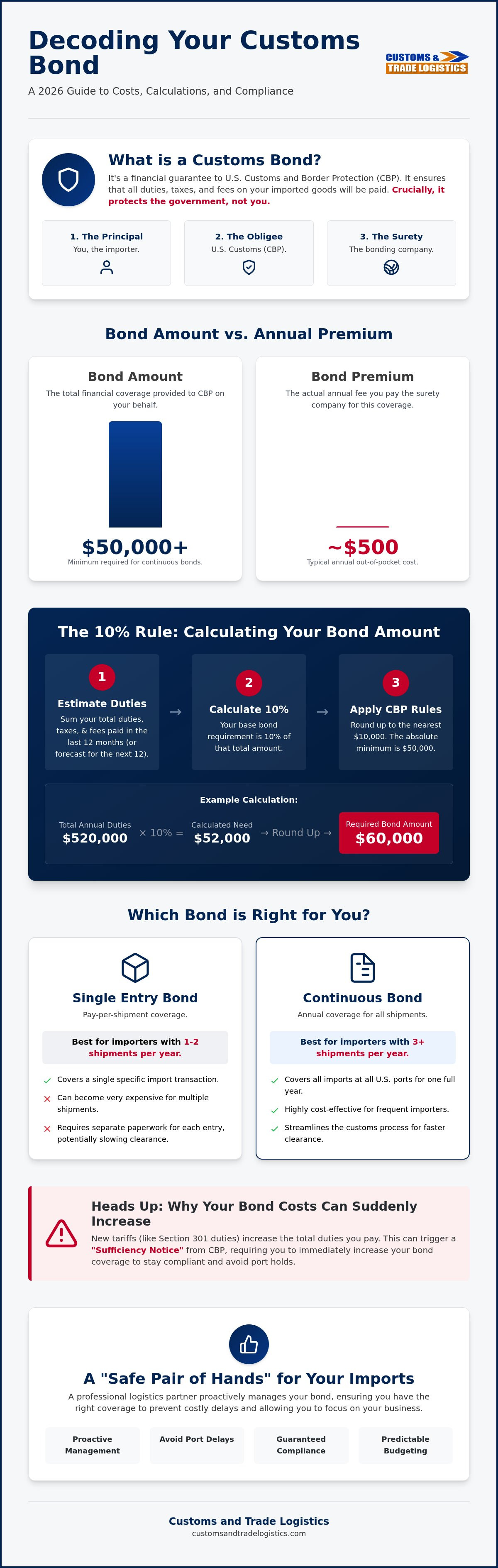
Many importers feel a wave of anxiety when they see a "bond amount" of $50,000 or more on their paperwork. Don't let that number startle you. To understand how much does a customs bond cost in 2026, you must first distinguish between your legal coverage and your actual out-of-pocket expense. The Bond Amount is the total financial guarantee the surety company provides to the government on your behalf. In contrast, the Bond Premium is the relatively small annual fee you pay to keep that guarantee active.
Think of the premium as a flat service fee. For most standard commodities, this is an annual payment that allows you to move goods without tying up your own cash as collateral. Because the surety company is taking on the risk of your potential default, they charge this premium to verify your compliance with CBP bond requirements. While the bond amount stays the same unless your import volume shifts, the premium is what actually impacts your yearly budget.
The 10% Rule for Continuous Bonds
CBP uses a specific formula to ensure your bond is large enough to cover your activities. For a continuous bond, the required amount is generally 10% of the total duties, taxes, and fees you paid during the previous 12-month period. If you're a new importer, you'll need to estimate these costs for the year ahead. It's also important to remember that the minimum bond amount for a continuous bond is $50,000. Even if your 10% calculation comes out to only $5,000, you'll still be required to carry the $50,000 minimum.
CBP rules also require you to round your bond amount up to the nearest $10,000 increment for any amount under $100,000. For example, if your calculated need is $52,000, your bond will be set at $60,000. In 2026, CBP considers a bond insufficient if the total duties and taxes paid reach or exceed 90% of the bond's face value within a rolling 12-month period. Keeping a close eye on this threshold prevents sudden shipment holds at the port.
Premium Pricing Factors
While the bond amount is set by regulation, your premium rate can vary based on several risk factors. Surety companies often look at your business's financial history or credit score to determine your reliability. If you're importing high-risk commodities like textiles, steel, or goods subject to anti-dumping duties, the surety might view your account as higher risk, which can lead to a higher premium.
Many importers find that their custom brokerage service fees already include the administrative work of filing and maintaining the bond. This integrated approach ensures that a "safe pair of hands" is watching your sufficiency levels year-round. If you're unsure if your current coverage matches your 2026 growth plans, it may be time to speak with a seasoned consultant who can help you audit your import history.
Single Entry vs. Continuous Bonds: A 2026 Cost Comparison
Choosing between a single entry bond (SEB) and a continuous bond is one of the most important financial decisions you'll make this year. It's not just about the immediate price. It's about how your choice affects your long-term growth and operational peace of mind. An SEB is designed for one-off shipments, covering a single transaction at a specific port. While it might seem cheaper for a one-time test shipment, the administrative burden of filing a new bond for every entry adds up quickly.
A continuous bond, however, covers all your entries at all U.S. ports for a full 12 months. For Amazon FBA sellers, this is almost always a non-negotiable requirement. Amazon's high-volume model depends on speed. A continuous bond ensures your goods move through the port without being flagged for manual bond processing. When asking how much does a customs bond cost in 2026, you'll find that the answer changes based on how often you plan to ship.
When to Choose a Single Entry Bond
If you only plan to import once or twice a year, an SEB might be the right fit. We often suggest following the "three-shipment rule." If you plan to import three or more times in a 12-month period, the total cost of multiple SEBs usually exceeds the annual premium for a single continuous bond. When calculating how much does a customs bond cost in 2026, many small businesses overlook the cumulative price of these individual filings.
- SEB Math: You'll typically pay a minimum fee plus a specific rate for every $1,000 of the shipment's value.
- ISF Hidden Costs: Don't forget that ocean shipments require an Importer Security Filing. Without a continuous bond, you must purchase a separate ISF bond for every entry. This extra step often costs as much as the SEB itself, effectively doubling your bonding expenses per shipment.
The Long-Term ROI of a Continuous Bond
For those building a brand, a continuous bond offers significant predictability in import logistics for startups. You pay one annual premium and don't have to worry about it for another 365 days. This allows you to scale your operations without the constant friction of new paperwork. It's a "safe pair of hands" approach that keeps your focus on selling rather than filing.
- Speed of Clearance: Because your bond is already active in the CBP system, your shipments often clear faster. There's no waiting for a surety company to approve a specific transaction.
- Convenience: Managing a single annual renewal is much easier than tracking individual bonds for every container. It reduces the risk of a clerical error causing a port hold.
- Budget Control: Knowing your fixed bonding cost for the year helps you maintain tighter control over your margins. It prevents the anxiety of unexpected fees popping up with every arrival.
The 2026 Tariff Landscape: How Policy Changes Drive Up Bond Costs
As you plan your annual budget, you'll find that the 2026 trade environment is more volatile than in previous years. Because your bond amount is directly tied to the duties you pay, any increase in tariffs leads to a higher required bond. Section 301 tariffs and restructured Section 232 duties mean that many importers are paying double or triple the duties they once did. This isn't just a tax problem; it's a bonding problem. If you're asking how much does a customs bond cost in 2026, you must factor in these surcharges, as they can push your bond liability past your current coverage limits.
CBP monitors your duty payments on a rolling 12-month basis. If your total duties and taxes reach 90% of your bond's face value, they'll issue a "Sufficiency Notice." This is a formal demand to increase your bond immediately. If your business deals with anti-dumping or countervailing duties (AD/CVD), this risk is even higher. These specialized duties can sometimes exceed the value of the goods themselves, causing a $50,000 bond to become insufficient overnight. High-tariff goods require more frequent bond reviews to ensure compliance.
Importing from China in 2026
Managing the ocean leg and duty exposure for import from China logistics requires a proactive strategy. With 35 years of experience in China-to-US trade, we've seen how sudden policy shifts can catch importers off guard. To prevent sufficiency issues, you should forecast your duty increases at least six months in advance. If you're launching a new product line from China that falls under a high-tariff HTS code, your bond may need an upgrade before the first container even arrives. We act as a "safe pair of hands" to help you navigate these complex calculations so your goods don't get stuck at the port.
Responding to a CBP Demand for Increase
When CBP determines your bond is no longer enough, they won't wait. You typically have a window of 15 to 30 days to secure a higher bond amount once you receive a notice. If you miss this deadline, CBP will move your bond to an "Insecure" status. This effectively shuts down your ability to clear cargo at any U.S. port. It's a stressful situation that can lead to massive storage fees and broken supply chains.
A seasoned broker does more than just file the new bond; they help you negotiate or justify the amounts to CBP. Sometimes, a "one-off" high-value shipment might trigger a notice that doesn't reflect your typical volume. In these cases, we can help provide the context CBP needs to keep your bond at a reasonable level. If you've recently received a notice or expect your duty payments to rise, you should audit your current bond sufficiency with an expert consultant today.
Securing Your Bond: The Value of a Professional Logistics Partner
You might be tempted to use a faceless digital platform to buy a bond quickly. While these automated tools offer speed, they often lack the oversight needed to protect your business from long-term compliance risks. Securing your bond through a professional customs broker is almost always more efficient. We already have your entry data, shipment history, and Tax ID on file. This integrated approach means we can spot potential issues before they become port holds. When you're trying to figure out how much does a customs bond cost in 2026, a dedicated partner ensures you aren't just buying a product, but investing in total management.
Working with a family-owned consultancy provides a level of personalized oversight that large insurance firms simply can't match. We act as a "safe pair of hands," monitoring your duty levels throughout the year. If we notice your imports are scaling faster than expected, we'll reach out to adjust your bond before CBP issues a warning. We also look for duty-saving opportunities, such as more accurate HTS classifications. By lowering your total duty liability, we effectively lower the bond amount you're required to carry, saving you money on your annual premium.
Beyond the Paperwork: Strategic Consulting
A bond shouldn't exist in a vacuum. It's a core part of your supply chain. We specialize in integrating bond management into broader FBA freight forwarding services. This is especially helpful for Amazon sellers who need to balance fast-moving inventory with strict CBP regulations. Our mentor-based approach means we don't just file forms; we educate you on why certain regulations apply to your specific goods. This transparency helps audit-proof your records, giving you peace of mind if the government ever requests a closer look at your import history.
Getting Started for 2026
If you're ready to secure your coverage, the process is straightforward. To apply, you'll generally need your company's legal name, your Tax ID (or Social Security Number for individuals), and a solid estimate of your total duties and taxes for the coming year. Don't worry if you're a first-time importer; we can help you calculate these estimates based on your planned shipment volume.
Most continuous bonds can be activated within a few business days once the application is submitted. If you're wondering how much does a customs bond cost in 2026 for a new venture, the best first step is to gather your product details and reach out for a consultation. We'll walk you through the 10% rule and ensure your bond is set at a sufficient level from day one. This proactive step prevents the anxiety of last-minute filings and keeps your 2026 growth on track.
Master Your 2026 Import Strategy
Navigating international trade shouldn't feel like a guessing game. By now, you understand that your bond is a strategic asset, not just a regulatory hurdle. You know that while the bond amount is set by CBP math, your actual premium is a manageable fee that keeps your supply chain moving. In a landscape of shifting tariffs and sufficiency notices, staying ahead of the 10% calculation is the best way to avoid costly port delays.
Whether you are an Amazon FBA seller or a growing small business, understanding how much does a customs bond cost in 2026 allows you to budget with total confidence. With over 35 years of family-owned expertise, we provide national coverage across all U.S. ports to act as your "safe pair of hands." We specialize in helping small businesses and Amazon sellers navigate the complexities of global trade without the stress.
If you want to ensure your coverage matches your growth, Contact Customs and Trade Logistics for a 2026 Bond Consultation today. Your business is ready for the global stage, and we're here to make sure the paperwork never holds you back.
Frequently Asked Questions
How much is a continuous customs bond premium in 2026?
The annual premium for a minimum $50,000 continuous bond typically ranges between $400 and $600. This fee is a small percentage of the total coverage amount, often between 0.5% and 2%. When calculating how much does a customs bond cost in 2026, remember that your specific premium depends on your commodity's risk level and your financial history. It's a flat annual fee that covers all your entries for 12 months, providing peace of mind for your budget.
Does a customs bond expire?
A continuous customs bond doesn't have a fixed expiration date but remains active as long as you pay the annual premium. It stays in force until either the importer or the surety company cancels it. In contrast, a single entry bond is valid only for one specific shipment. To keep your imports moving smoothly, you should ensure your annual renewal is processed on time to prevent any lapses in coverage that could trigger port holds.
What happens if my customs bond is insufficient?
If your bond amount falls below 10% of your total duties and taxes, CBP will issue a sufficiency notice. You'll typically have 15 to 30 days to increase your coverage. Failing to meet this deadline results in an "insecure" status, which means CBP will stop clearing your shipments at the port. This often leads to significant delays and expensive storage fees until a new, larger bond is secured and filed by your broker.
Can I import goods into the US without a customs bond?
You cannot legally import commercial goods valued over $2,500 into the U.S. without a customs bond. This requirement also applies to any shipment regulated by a partner government agency, such as the FDA or EPA, regardless of its dollar value. While informal entries under $2,500 might not need a bond, most businesses find that having a continuous bond is necessary to maintain a reliable and compliant supply chain while avoiding manual processing delays.
Is a customs bond the same as marine cargo insurance?
No, a customs bond and marine cargo insurance serve very different purposes. A bond is a financial guarantee that protects the U.S. government by ensuring duties and taxes are paid. Marine cargo insurance protects your business from financial loss if your goods are damaged, lost, or stolen during transit. While the bond is a legal requirement for most importers, insurance is a strategic choice to safeguard your investment in the cargo during the long ocean journey.
What is the minimum bond amount for a US importer?
The minimum amount for a continuous customs bond is $50,000. Even if your 10% duty calculation results in a lower figure, CBP requires this baseline coverage to ensure compliance. When investigating how much does a customs bond cost in 2026, keep in mind that this $50,000 figure refers to the coverage amount, not the premium you pay. Most small businesses find this minimum bond level provides ample coverage for their annual import activities.
How long does it take to get a continuous customs bond?
Securing a continuous bond is a relatively quick process that usually takes between one and five business days. Once you provide your Tax ID and estimated duty volume, your customs broker works with a surety company to file the bond electronically with CBP. Activation is often nearly instantaneous once the filing is accepted. It's best to start this process at least a week before your first shipment arrives to avoid any unexpected port delays.
Can I use one bond for multiple US ports?
Yes, a continuous customs bond covers all your import activities across every U.S. port of entry. This is one of the primary benefits for businesses that use multiple arrival points or distribute goods nationally. Whether your cargo arrives by ocean, air, or truck, a single continuous bond ensures you stay compliant everywhere. Conversely, a single entry bond only applies to one specific shipment at one specific port, making it much less flexible for growing businesses.


