

What if the difference between a profitable shipment and a costly customs hold isn't your product quality, but a single missing signature? It's a question that keeps many small business owners awake at night, especially with the 2025 suspension of the de minimis threshold and the introduction of new Section 301 tariffs in July 2026. Understanding the certificate of origin requirements for US imports has become more than just a paperwork exercise; it's a critical financial strategy. You're likely feeling the pressure of increased bonding requirements and the shift toward stricter importer responsibility. It's normal to feel overwhelmed by the technical density of trade regulations, but you don't have to manage it alone.
We believe that clarity is the best tool for any importer. This guide will help you master the nuances of origin documentation, from the nine essential data elements required under USMCA to the specific rules of the 2026 EU-US Turnberry Agreement. You'll gain a clear understanding of various CO types and a practical checklist to ensure your paperwork is audit-ready. We'll provide the roadmap you need to claim the lowest legal duty rate and keep your supply chain moving with total peace of mind.
Key Takeaways
- Learn how a Certificate of Origin functions as both an admissibility gatekeeper and a strategic tool for calculating accurate duty rates on your shipments.
- Distinguish between preferential and non-preferential origin to unlock duty-free access through USMCA while avoiding common quota and anti-dumping penalties.
- Master the specific certificate of origin requirements for US imports, including the nine essential data elements that have replaced traditional government forms in 2026.
- Discover why relying solely on your supplier's expertise can be a risk and how transshipment through third countries might accidentally void your duty savings.
- Understand how professional customs clearance services act as a protective layer, verifying your documentation before it reaches the port to prevent costly storage fees.
What is a Certificate of Origin and Why is it Critical for US Imports?
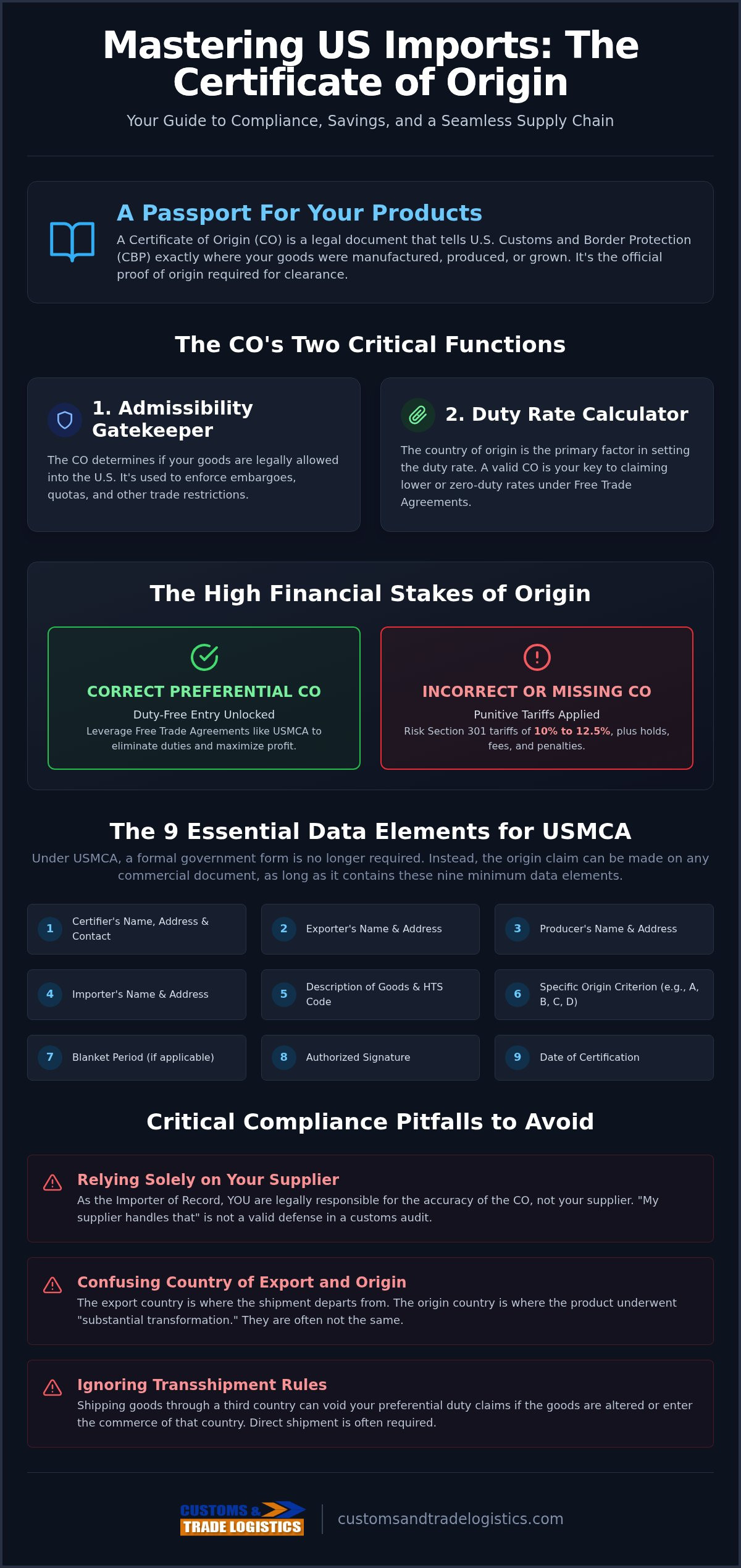
Think of a Certificate of Origin (CO) as a passport for your products. Just as your passport proves where you're from to let you cross a border, a CO tells U.S. Customs and Border Protection (CBP) exactly where your goods were manufactured, produced, or grown. Understanding What is a Certificate of Origin is the first step in protecting your supply chain from unexpected costs. This document serves two primary purposes: it determines if your goods are legally allowed to enter the country and sets the specific duty rate you'll pay at the port.
The 2026 trade landscape has made this verification more scrutinized than ever. With the June 2026 Executive Order strengthening customs enforcement, CBP is looking closer at every claim. It's easy to confuse the physical "Country of Origin Marking" on your packaging with the "Certificate of Origin" document. While the sticker on your box tells the consumer where the item was made, the CO is the legal evidence your broker uses to file your entry. Without it, you're essentially flying blind through a storm of regulations.
The Financial Impact of Origin Documentation
A valid CO is often the only thing standing between you and a massive tax bill. Under Free Trade Agreements like the USMCA, having the right documentation can trigger duty-free entry, saving you thousands of dollars per shipment. However, the stakes are higher this year. Since July 24, 2026, new Section 301 tariffs of 10% to 12.5% have been applied to goods from 60 countries following forced labor investigations. If your paperwork is vague, you might get hit with these punitive rates even if your goods didn't originate in those regions. Remember, the "Country of Export" is simply where the ship left the dock. The "Country of Origin" is where the actual transformation of the product happened. Confusing the two is a mistake your bottom line can't afford.
Who is Responsible for the Certificate of Origin?
While your exporter or producer usually generates the data for the CO, the legal weight sits squarely on your shoulders. As the Importer of Record, you have a "Reasonable Care" obligation to ensure all certificate of origin requirements for US imports are met with total accuracy. We often see small businesses fall into the trap of saying, "My supplier handles that." In the eyes of CBP, that's not a valid defense. If an audit reveals that your supplier provided incorrect origin data to save time, you're the one who pays the penalties and faces the customs holds. Meeting the certificate of origin requirements for US imports requires a proactive partnership between you and your manufacturer to ensure every detail is verified before the container ever leaves the factory floor.
Preferential vs. Non-Preferential Rules of Origin
Do you know why some shipments sail through customs while others get stuck in a web of anti-dumping duties? The answer lies in understanding Preferential vs. Non-Preferential Rules of Origin. Non-preferential rules are the standard baseline. They help the U.S. government track trade statistics and enforce quotas or trade remedies, such as the new Section 301 tariffs introduced in July 2026. If your goods don't qualify for a special trade deal, they fall into this category. These rules ensure that goods from countries subject to trade investigations are taxed correctly at the port.
On the other hand, preferential rules are your ticket to significant savings. These are the specific criteria found within Free Trade Agreements (FTAs) like the USMCA or the newly active EU-US Turnberry Agreement. When you meet these requirements, you can often reduce your duty rate to zero. It's the difference between a high-margin success and a break-even struggle. Meeting the certificate of origin requirements for US imports under these agreements is the only way to legally claim these lower rates.
The "Substantial Transformation" Test
How do you determine origin when parts come from three different countries? CBP looks for a "substantial transformation." This usually means the product has changed so much that it now falls under a different Harmonized Tariff Schedule (HTS) code. For example, if you import raw fabric but cut and sew it into a finished garment, a transformation has occurred. Simple assembly, like snapping two plastic parts together, usually doesn't count. If you're unsure where your manufacturing process stands, our team can provide Import From China Consulting to help verify your product's status before it ships.
Navigating Free Trade Agreements (FTAs) in 2026
In 2026, the USMCA remains the heavyweight of trade deals, but the landscape is shifting. The EU-US Turnberry Agreement, which entered force on July 1, 2026, has capped many tariffs at 15%. Each agreement has its own specific "Rules of Origin" chapter. These chapters specify exactly how much regional value content a product must have to qualify. While an FTA certificate is technically optional, it's financially essential. Without it, you're legally required to pay the higher "Most Favored Nation" rate. Mastering the certificate of origin requirements for US imports means knowing which agreement applies to your specific product type.
The simplest goods to document are "wholly obtained" products. These are items grown, mined, or fished entirely within one country. If you're importing minerals or unmanufactured agricultural products, your documentation trail is usually straightforward. The complexity begins when you deal with multi-component electronics or machinery. That's where proactive oversight becomes your best defense against customs audits and unexpected storage fees.
Essential Data Elements for a Valid US Certificate of Origin
One of the biggest surprises for new importers is the lack of a "standard" government form. Under the USMCA, the rigid NAFTA Form 434 was retired in favor of a flexible "certification of origin." This means you don't need a specific piece of green paper with a government seal. Instead, the certification can be a simple statement on your commercial invoice or a standalone document on company letterhead. While this flexibility simplifies the process, it places the burden of meeting all certificate of origin requirements for US imports entirely on the accuracy of your data.
The shift toward self-certification means that as long as the nine mandatory elements are present, the format is secondary. However, the language you use must be precise. For those looking for the official baseline, the International Trade Administration guidance on FTA Certificates of Origin provides a clear framework for these declarative statements. The most critical part of this document is the "Knowledge of the Certifier" statement, where the signer legally attests that the goods meet the rules of origin. A missing signature or an incorrect title can lead to an immediate rejection at the port, triggering the very delays and fees you're trying to avoid.
The 9 Mandatory Data Elements Checklist
To ensure your documentation is compliant, every certification must include these specific points:
- Certifier Identification: Clearly state if the certifier is the Importer, Exporter, or Producer.
- Certifier Details: Name, title, address, phone number, and email.
- Exporter Details: Contact information for the party sending the goods.
- Producer Details: Contact information for the manufacturer (or a statement that it's available upon request).
- Importer Details: Contact information for the Importer of Record.
- Description of Goods: A detailed description that matches your invoice.
- HTSUS Classification: The tariff code provided to at least the six-digit level.
- Origin Criteria: The specific rule (e.g., "Wholly Obtained") the product meets.
- Blanket Period: If the certificate covers multiple shipments of identical goods, specify a period of up to 12 months.
Documentation Formats: Paper vs. Electronic
Meeting the certificate of origin requirements for US imports is about more than just checking boxes. It's about creating a verifiable trail of evidence that proves your goods deserve the duty rates you're claiming. When you get the data elements right, you move from a position of uncertainty to one of professional confidence. This principle of meticulous documentation applies across all specialized logistics fields; for instance, you can explore International Ashes Repatriation to see how legal compliance is managed in other niche transport sectors.
Managing Compliance and Avoiding Common CO Pitfalls
We often hear clients say, "My supplier handles the paperwork, they're the experts." While your manufacturer knows their production line, they don't always understand the nuances of U.S. customs law. As the Importer of Record, you're the one legally on the hook for the accuracy of your entry. Relying blindly on a supplier is a common path to audits and heavy fines. You must verify that the certificate of origin requirements for US imports are met before the ship leaves the dock. Your supplier's mistake becomes your financial liability the moment the entry is filed.
Transshipment is another silent killer of duty savings. If your goods stop in a third country for processing or storage, they might lose their preferential origin status. For example, a product made in Mexico that's repackaged in a non-USMCA country before reaching the U.S. usually loses its duty-free eligibility. We also see many importers struggle with expired blanket periods. Remember, these certificates are only valid for 12 months. Using an old document is a fast way to trigger a "Request for Information" from CBP. Even for "Low Value" shipments under $2,500, which have slightly relaxed formal requirements, you still must be able to substantiate the origin if an officer asks questions.
Special Considerations for China Imports
Importing from China in 2026 requires a higher level of protective care. With the new Section 301 tariffs that took effect on July 24, 2026, origin verification is your best defense against punitive 10% to 12.5% rates. Professional import from China logistics now includes rigorous factory location checks to ensure your goods aren't caught in forced labor investigations. Verifying the exact province of manufacture is no longer optional; it's a necessity for smooth clearance across all U.S. ports.
Amazon FBA and E-commerce Origin Hurdles
Amazon sellers are frequent targets for origin audits because of the high volume of small-parcel shipments. When you utilize FBA freight forwarding services, you must ensure your origin documentation is integrated into your digital filing system from day one. Commingled inventory presents a unique risk. If your compliant goods are mixed with another seller’s non-compliant stock, you could face delays through no fault of your own. Keeping a clean, separate paper trail for every SKU is the only way to protect your account health. If you feel overwhelmed by these technical details, let Customs and Trade Logistics act as your safe pair of hands to review your documents before they reach the port.
How a Customs Broker Protects Your Origin Claims
Do you feel like you're trying to read a map in a language you don't speak? Navigating the certificate of origin requirements for US imports can feel exactly like that. This is where a customs broker steps in as your family mentor. We don't just file your entry; we review your documents before they ever reach the port. This proactive look ensures that your supplier's paperwork matches the reality of your shipment. By the time your container hits the dock, we've already cleared the path for a smooth arrival.
When you invest in professional customs clearance services us, you're buying more than a digital filing. You're securing origin verification that protects your duty-free claims. We often tell our clients that understanding custom brokerage service fees is best viewed as a form of insurance. Compared to the 12.5% Section 301 tariffs or the mounting storage fees of a customs hold, the cost of expert oversight is minimal. With 35+ years of experience, we've seen every possible origin dispute and know how to resolve them with CBP effectively.
Proactive Document Auditing
Our team looks for red flags that an automated system might miss. Does the HTS code on the Certificate of Origin match the commercial invoice exactly? Is the signature from an authorized party? We catch these errors early so they don't become expensive problems later. For products with complex manufacturing chains, we can even advise on "Binding Rulings." This is a formal decision from CBP that confirms your product's origin before you ship, giving you absolute certainty on your duty rates.
Your "Safe Pair of Hands" for Global Trade
As a family-owned consultancy, we understand that your business's growth depends on a reliable supply chain. We want to move you from feeling the administrative burden of compliance to enjoying the peace of mind that comes with total oversight. You shouldn't have to be a trade law expert to succeed in the global marketplace. We're here to be that bridge between your operations and complex regulations. If you're ready to ensure your next shipment meets all certificate of origin requirements for US imports, let's start a consultation today. We'll handle the complexities so you can focus on what you do best: growing your business.
Secure Your Duty Savings for 2026 and Beyond
The landscape of global trade is shifting, but your business doesn't have to be left behind. Mastering the certificate of origin requirements for US imports is your most effective strategy for navigating the 2026 tariff environment. By focusing on the nine mandatory data elements and verifying your factory's origin before the shipment leaves the dock, you turn a complex administrative hurdle into a competitive advantage. You've learned that accuracy isn't just about avoiding customs holds; it's about reclaiming the duty savings your business deserves.
At Customs and Trade Logistics, we bring 35+ years of industry experience to every shipment. As a family-owned consultancy, we specialize in helping small businesses and Amazon sellers manage the technical density of international operations with total peace of mind. We're here to act as your knowledgeable bridge to the global marketplace, ensuring your documentation is audit-ready and your costs are minimized. If you're ready to move forward with confidence, Get Expert Help with Your Import Documentation today. Your supply chain is in safe hands, and we're excited to help your business grow.
Frequently Asked Questions
Is a Certificate of Origin mandatory for every US import?
Not every shipment requires a formal certificate, but it's essential for claiming lower duty rates under agreements like the USMCA or the EU-US Turnberry Agreement. For standard entries, your commercial invoice might suffice to declare non-preferential origin. However, failing to meet specific certificate of origin requirements for US imports when claiming preference leads to paying the highest possible duty rate. It's always safer to have your documentation ready before the ship docks.
Can I sign the Certificate of Origin myself as the importer?
Yes, as the Importer of Record, you're legally allowed to sign the certification of origin under modern agreements like the USMCA. You must have "knowledge of the certifier," which means you possess the supporting evidence from the producer to prove the claim is true. While you don't always need the exporter's signature, you take on the full legal responsibility for the accuracy of the data provided to customs.
What happens if US Customs rejects my Certificate of Origin?
If CBP rejects your document, your goods will likely be held at the port until the error is corrected. You'll be forced to pay the full "Most Favored Nation" duty rate instead of the lower preferential rate you expected. Beyond the extra taxes, you may face daily storage fees and a formal audit of your past shipments. This can create a heavy administrative burden and significantly impact your profit margins for that quarter.
How long is a "Blanket" Certificate of Origin valid?
A blanket certification of origin is valid for a maximum period of 12 months. This document covers multiple shipments of identical goods, allowing you to avoid generating a new certificate for every container you import. It's a great time-saver for frequent shippers, but you must track the expiration date closely. Using an expired blanket certificate is a common mistake that leads to immediate customs rejections and unexpected delays at the port.
Does a Certificate of Origin expire?
Yes, these documents have specific lifespans. A certificate for a single shipment is tied to that specific entry and must be valid at the time of filing. Blanket certificates expire exactly one year from their effective start date. Additionally, you're required to keep all these documents in your records for at least five years. If CBP audits a shipment from 2024, you must still be able to produce the original valid certificate.
Do I need an official government stamp on my CO for US imports?
For modern trade deals like the USMCA or the 2026 Turnberry Agreement, you don't need a stamp from a Chamber of Commerce or a government agency. Self-certification is the standard for these agreements. However, some non-preferential certificate of origin requirements for US imports might still require a formal stamp if the goods come from countries without a specific free trade agreement. We recommend checking your HTS code requirements to be certain.
Can I use a digital signature on my USMCA certification?
Yes, digital signatures are fully accepted by CBP for USMCA and other modern certifications in 2026. You don't need to mail a physical paper document with a wet-ink signature across the ocean anymore. A secure PDF with a valid electronic signature is sufficient for your customs broker to file the entry. This digital shift helps speed up the clearance process and reduces the risk of paperwork being lost during transit.
What is the difference between a Manufacturer’s Affidavit and a CO?
A Manufacturer’s Affidavit is the detailed evidence that supports your claim, while the Certificate of Origin is the summary document presented to customs. The affidavit is an internal document where the producer swears the parts meet specific origin rules. You don't usually file the affidavit with CBP during the initial entry, but you must have it in your files to prove your CO is accurate if you're ever audited.


