

Would you hand over your business's financial future to a simple keyword search? Many importers do exactly that when they treat the Harmonized Tariff Schedule like a basic catalog rather than the complex legal document it is. With U.S. Customs and Border Protection collecting over $37 million in penalties in fiscal year 2025, the margin for error has never been thinner. You've likely felt the stress of a delayed shipment at the port or the headache of deciphering the latest 2026 tariff updates. It's overwhelming to feel like you're one wrong digit away from a permanent audit flag on your account.
We know that staying compliant feels like a moving target when you're managing global logistics. In this guide, we'll uncover the most common HTS classification mistakes that trigger CBP scrutiny and show you how to turn your compliance process into a strategic advantage. You'll learn how to navigate the General Rules of Interpretation and identify the specific errors that lead to gross negligence penalties. We're here to help you secure lower duty payments and achieve the peace of mind that comes from a truly bulletproof import strategy.
Key Takeaways
- Understand your legal role as the Importer of Record and why you are held accountable for accuracy even when using external assistance.
- Identify the most common HTS classification mistakes, including the high-risk habit of using foreign supplier codes without independent verification.
- Learn how modern customs enforcement uses automated flags to spot inconsistencies, which can lead to retroactive duty bills and significant financial penalties.
- Build a reliable compliance strategy by applying technical product specifications and the General Rules of Interpretation in the correct legal sequence.
- Discover how the seasoned expertise of a traditional customs broker helps you navigate complex regulations and ensures faster clearance at any U.S. port.
Why HTS Classification is the Silent Risk of Your Supply Chain
The Harmonized Tariff Schedule (HTS) is the official legal framework used to classify every item entering the United States. While it might look like a simple list of numbers and descriptions, it's actually a complex hierarchy maintained by the U.S. International Trade Commission. For many businesses, the 2026 version, currently in its 38th Edition, serves as the foundation for their entire international trade strategy. It's more than a number. It's a sworn statement to the federal government.
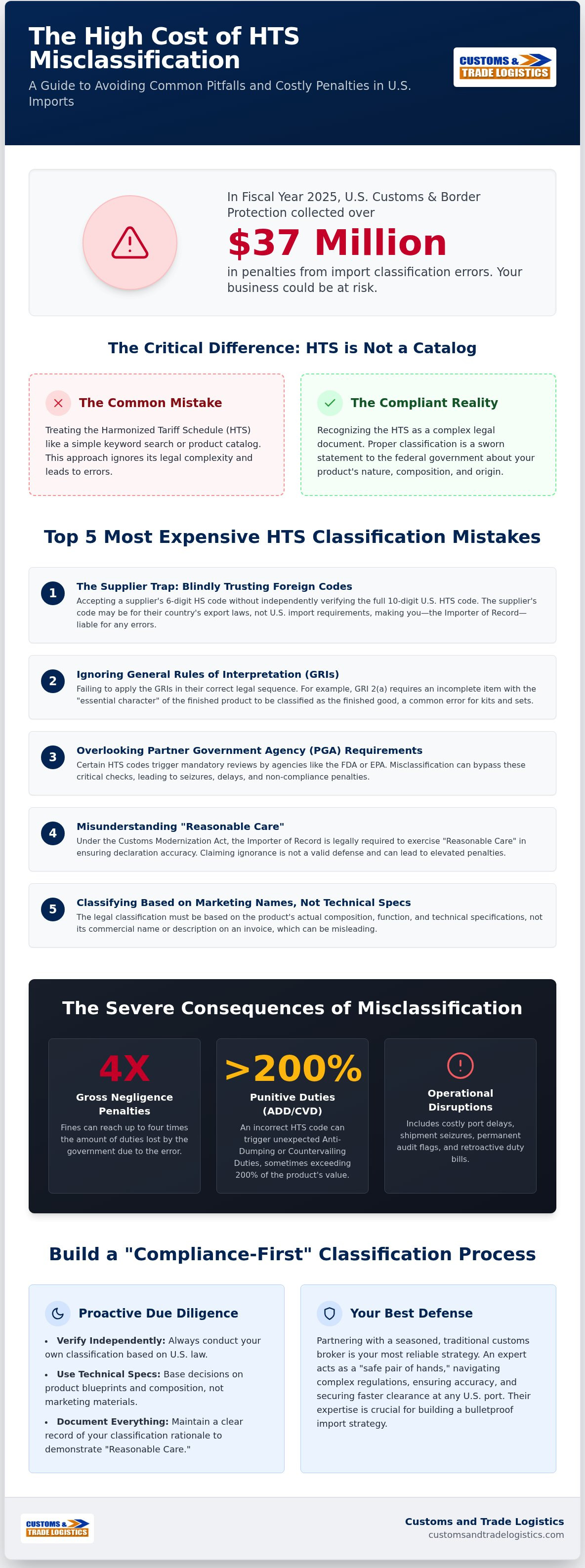
HTS codes do far more than just set your tax rate. They act as a primary risk signal for U.S. Customs and Border Protection (CBP). When you assign a code to your shipment, you're telling the government exactly what the product is, how it's made, and where it's from. This data determines if your goods are subject to Anti-Dumping Duties (ADD) or Countervailing Duties (CVD), which can sometimes exceed 200 percent of the product's value. Using the wrong code is one of the most common HTS classification mistakes that can lead to an unexpected financial crisis for your company.
The Legal Reality of Your Customs Declaration
The Customs Modernization Act, or "Mod Act," established a clear standard known as "Reasonable Care." This means you're legally required to take proactive steps to ensure your declarations are accurate. You can't simply claim "I didn't know" if CBP finds an error. Even if you hire a broker to assist with the paperwork, you remain the Importer of Record. You are the one legally responsible for the final classification.
CBP distinguishes between different levels of culpability under 19 U.S.C. § 1592. A simple clerical error might result in a minor correction, but negligence or gross negligence carries heavy weight. For example, if a mistake leads to a loss of revenue, a penalty for gross negligence can reach four times the amount of the lost duties. We act as a "safe pair of hands" to help you avoid these steep consequences through diligent oversight and long-standing expertise.
Beyond the Duty Rate: Admissibility and Compliance
HTS codes also dictate whether your goods are even allowed to enter the country. Specific codes trigger requirements from Partner Government Agencies (PGAs) like the FDA or EPA. If your classification doesn't match the technical specs of your product, you might bypass a necessary inspection. This leads to costly seizures or delays at the port. Additionally, correct classification is the only way to qualify for duty-free status under various Free Trade Agreements. The HTS serves as the universal language of global trade compliance.
The Top 5 Most Expensive HTS Classification Mistakes
Identifying the right code isn't just about looking at a picture and picking a description. It's a legal determination that carries significant financial weight. While there are thousands of subheadings to choose from, most errors stem from a few recurring oversights. Understanding these common HTS classification mistakes is the first step toward protecting your bottom line and ensuring your goods move through the port without a hitch.
The Supplier Trap: Why Their Code is Often Wrong
One of the biggest risks for new importers is trusting the classification provided by their factory. Your supplier likely uses a 6-digit Harmonized System (HS) code, which is the international standard for the first six digits. However, the U.S. requires a specific 10-digit HTS code. Suppliers often choose codes that simplify their own export paperwork or lower their domestic tax burden. If you rely on their suggestion without independent verification, you're essentially letting a third party make a legal declaration on your behalf. For reliable customs clearance services us, you must verify that the full 10-digit code matches U.S. requirements exactly.
The Danger of "Parts" vs. "Finished Goods"
Amazon sellers and e-commerce brands often fall into the trap of misclassifying bundles or unassembled items. Under General Rule of Interpretation (GRI) 2(a), an incomplete or unfinished article must be classified as the finished good if it has the "essential character" of the complete item. This is particularly tricky for "kits" or "sets" sold as a single unit. You can't simply pick the code for the most expensive item in the box without a formal analysis. To avoid costly surprises, you can seek legally binding advice or rulings from CBP to get a definitive answer before your shipment leaves the factory.
Beyond these primary traps, three other mistakes frequently lead to audits:
- Ignoring Section and Chapter Notes: Many importers skip the legal notes at the start of each chapter. These notes are legally binding and often override the general description of a heading.
- Overusing "Other" Categories: It's tempting to use a catch-all "Other" category when you're in a rush. However, CBP's automated systems flag shipments that use generic codes when a more specific heading is available.
- Failing to Update Annually: The HTS is not static. The 2026 schedule includes revisions that may have deleted or changed the codes you used last year. Using an expired code is a red flag for non-compliance.
Staying on top of these details requires a diligent eye. Partnering with a veteran advocate like Customs and Trade Logistics ensures that your classifications are double-checked by experts who understand the nuances of the 2026 tariff landscape.
The Hidden Costs of Misclassification: Fines and Audits
U.S. Customs and Border Protection doesn't just watch your shipments one by one. They use sophisticated AI and automated systems to track data patterns over time. If you use different codes for the same item across different ports, or if your codes don't match the technical specs on your commercial invoice, their system flags it immediately. It's one of the most common HTS classification mistakes that leads to a full-scale audit. In fiscal year 2025 alone, CBP completed 348 audits and collected $37.88 million in penalties and liquidated damages.
Financial consequences aren't limited to a single fine. You'll often face retroactive duty bills plus interest for every shipment you've brought in using that incorrect code. In severe cases, CBP issues liquidated damages. This is a penalty that can actually exceed the domestic value of the goods themselves. Beyond the money, one mistake creates a "Blacklist" effect. Once your company is flagged for non-compliance, your future shipments are much more likely to be pulled for physical inspection. This means every container you bring in faces higher costs and longer wait times indefinitely.
CBP Audits: The Multi-Year Lookback
CBP has the authority to audit your records for up to five years after a shipment enters the country. If they find a pattern of errors, they'll demand back-payment for every single entry during that entire window. If you're managing import from China logistics, this is especially dangerous. Misclassification can sometimes hide Anti-Dumping or Countervailing Duties, which leads to massive penalties that can bankrupt a small business. If you discover an error yourself, a "Prior Disclosure" can help limit these fines, but it's a delicate process that requires expert guidance to navigate safely.
Operational Delays and Demurrage
Beyond the fines, classification disputes stop your supply chain in its tracks. When a container is held for an HTS dispute, you're stuck paying demurrage and storage fees at the port. These daily costs add up fast, often reaching thousands of dollars before the issue is resolved. For e-commerce sellers using FBA freight forwarding services, these delays are catastrophic. A missed delivery window doesn't just mean a late shipment; it means stockouts and a damaged Amazon account health score. We act as your advocate to ensure every declaration is accurate before the ship even docks, keeping your inventory moving smoothly.
How to Build a "Compliance-First" Classification Process
Moving from a reactive approach to a proactive compliance strategy is the only way to secure your supply chain. Classification isn't a quick task to finish once the container is on the water; it's a foundational step that should happen during product development or sourcing. Building a repeatable workflow is the only way to catch common HTS classification mistakes before they reach a customs officer's desk. It starts with data and ends with a documented rationale that acts as your legal shield.
To build a bulletproof process, follow these five essential steps:
- Step 1: Gather Technical Specs. You need more than a product name. Collect material composition, weight, dimensions, and a clear description of the end-use.
- Step 2: Follow the Legal Hierarchy. Apply the General Rules of Interpretation in their specific order to find the correct heading.
- Step 3: Consult the CROSS Database. Search for previous CBP rulings on products similar to yours to see how the government has ruled in the past.
- Step 4: Maintain a SKU Database. Keep a central record of every SKU, the assigned HTS code, and the specific reasoning used to choose it.
- Step 5: Perform Internal Audits. Regularly review your past entries to ensure your classifications remain accurate as the tariff schedule updates annually.
Mastering the General Rules of Interpretation (GRI)
The GRIs are the legal "map" for classification. Many importers make the mistake of relying on GRI 1 alone, but you must understand its limitations. GRI 1 states that section and chapter titles are provided for ease of reference only; the actual legal classification is determined by the terms of the headings and any relative section or chapter notes. If your product is a mixture or made of multiple materials, GRI 3 provides the framework for determining the "essential character" of the item. You must apply the GRIs in numerical order to ensure a legally sound declaration.
Leveraging Customs Rulings (CROSS)
You don't have to guess how CBP will interpret a complex product. The Customs Rulings Online Search System (CROSS) contains thousands of binding decisions that provide a roadmap for your own classification. If you find a ruling that matches your product exactly, you can cite it in your entry for added security. For entirely new or highly technical products, you may even want to request a formal "Binding Ruling" to get a definitive answer. Working with a reliable import logistics partner to review these findings ensures you aren't misinterpreting the fine print. Without a clear rationale, you're defenseless against an audit, even if you avoid the most common HTS classification mistakes on the surface.
Ready to secure your imports with a veteran eye? Get a professional classification review from our team of experts today.
Why a Seasoned Customs Broker is Your Best Defense
Many importers view a customs broker as a simple data entry clerk. This is a dangerous misconception that often leads to expensive oversight. A "data entry" broker merely takes the information you provide and submits it to CBP without question. If you provide an incorrect code, they file it, and you are the one who faces the penalties. In contrast, a "consulting" broker acts as a proactive partner. We review your technical specs before the entry is filed, catching common HTS classification mistakes that an automated system would miss. This protective care is the difference between a smooth delivery and a costly port delay.
With over 35 years of industry experience, we've seen how the tariff schedule has evolved through trade wars and global shifts. We specialize in those "gray area" classifications where a product doesn't perfectly fit into a single heading. This level of oversight is especially critical for those navigating import logistics for startups, where every dollar counts and a single audit can stall growth before it begins. We don't just process paperwork; we act as a stabilizing force for your entire supply chain.
The Value of Human Expertise in a Digital World
Digital aggregators and AI tools are popular for their speed, but they often fail at nuanced HTS interpretation. Why do they struggle? AI lacks the ability to understand the "essential character" of a complex kit or the specific end-use that might move a product from one chapter to another. Personalized oversight reduces the risk of "clerical" mistakes that often trigger larger investigations. You need an advocate who understands your specific business needs, not just a faceless algorithm that guesses based on keywords.
Your "Safe Pair of Hands" for Global Trade
As a family-owned firm, we take a mentorship approach to global trade. We aren't just a service provider; we're a dedicated partner invested in your growth. Transitioning from guesswork to a structured compliance program provides the peace of mind you need to focus on your customers. We act as a knowledgeable bridge between your local operations and the global marketplace, ensuring that your goods clear customs without unnecessary friction. By identifying common HTS classification mistakes early, we save you from the stress of unexpected audits and retroactive duty bills.
Ready to move forward with confidence? Contact Customs and Trade Logistics for an HTS classification review today.
Securing Your Future with a Compliance-First Strategy
The 2026 customs landscape is more rigorous than ever before, making data accuracy your most valuable asset. By moving away from a reliance on supplier-provided codes and embracing a structured process based on the General Rules of Interpretation, you protect your business from unnecessary CBP scrutiny. Proactively addressing common HTS classification mistakes today prevents the financial and operational fallout of retroactive duty bills and port delays. It's about shifting from reactive guesswork to a strategy that supports long-term growth.
As a family-owned and operated brokerage with over 35 years of industry experience, we specialize in the nuances of China to US shipping logistics. We act as your "safe pair of hands," providing the personalized oversight and mentorship needed to navigate complex tariff terminology. You don't have to carry this administrative burden on your own. Let our experts handle your HTS classification and import logistics so you can scale your operations with total peace of mind. We're here to turn your compliance requirements into a stabilizing force for your business journey.
Frequently Asked Questions
What happens if I use the wrong HTS code on my customs entry?
Using the wrong code leads to penalties ranging from simple duty back-payments to liquidated damages. CBP categorizes errors as negligence, gross negligence, or fraud. For example, a gross negligence penalty can reach four times the loss of duties. Beyond fines, you face shipment delays at the port and a permanent risk flag on your account. This increases the frequency of future inspections and can disrupt your entire supply chain for years.
Can I use the HS code provided by my Chinese supplier?
You shouldn't rely solely on a supplier's code because it only covers the first six digits of the international standard. The U.S. requires a full 10-digit HTS code for legal entry. Suppliers often pick codes that favor their own export taxes rather than U.S. compliance. Relying on them is one of the most common HTS classification mistakes, as the Importer of Record is legally responsible for the final declaration and accuracy.
How often does the Harmonized Tariff Schedule change?
The HTS is updated annually, with the 2026 Edition currently in its 38th version. While the major structure stays consistent, specific revisions occur multiple times throughout the year to reflect new trade agreements or legislative changes. For instance, Revision 16 was the latest update as of mid-2026. You must verify your codes against the current schedule regularly to ensure you aren't using expired or deleted headings that could trigger a customs hold.
What is the difference between an HS code and an HTS code?
The HS code is a six-digit universal standard used by over 200 countries to categorize goods. The HTS code is the U.S. specific version that adds four extra digits for duty rates and statistical tracking. The first six digits are identical worldwide, but the remaining four are unique to the United States. You must use the full 10-digit HTS code on your entry documents to satisfy CBP requirements and ensure accurate duty calculations for your imports.
Is it possible to get a refund if I overpaid duties due to misclassification?
Yes, you can file a Post-Summary Correction (PSC) or a formal protest to reclaim overpaid duties. If your entry hasn't liquidated, a PSC is the faster route to fix the error. If it has liquidated, you generally have 180 days to file a protest. This process requires clear technical documentation and a legal rationale to prove that the original classification was incorrect and that a lower rate truly applies to your specific merchandise.
Does US Customs offer any tools to help with classification?
CBP provides the Customs Rulings Online Search System (CROSS), which is a database of thousands of past binding decisions. You can search for products similar to yours to see how officers have ruled on specific materials or functions. Additionally, the U.S. International Trade Commission maintains an interactive HTS search tool. While these are helpful, they don't replace the legal requirement of exercising reasonable care by having a professional review your specific product specifications.
What are the General Rules of Interpretation (GRI)?
The GRIs are the six legal principles that dictate how to classify any product. They must be applied in strict numerical order. GRI 1 is the most important, stating that classification is determined by the terms of the headings and relative section or chapter notes. If a product is made of multiple materials, GRI 3 helps determine its essential character. These rules ensure that every importer follows a consistent legal framework when declaring goods to the government.
How can a customs broker help me find the correct HTS code?
A seasoned broker acts as a consultant who analyzes your product's technical specs against the current 2026 tariff landscape. We look for opportunities where a product might qualify for a lower duty rate or a specific trade agreement. By performing a pre-entry review, we help you avoid common HTS classification mistakes and ensure your shipments move through all U.S. ports without the stress of unexpected audits, seizures, or the administrative burden of correcting past entries.


