

Could a single missing data point on a digital form really cost your business $120,000 in penalties and weeks of unexpected storage fees? As of July 8, 2026, that's the reality for importers who haven't mastered how to avoid CPSC customs holds under the new eFiling mandate. If you've ever felt the anxiety of a shipment stuck at a US port while the daily demurrage bills climb, you aren't alone. It's a heavy burden to manage, especially when you're struggling to get accurate testing data from overseas suppliers who might not grasp these new digital-first entry rules.
We understand that these regulatory shifts can feel overwhelming, but we're here to act as your seasoned mentor through the process. This guide will help you manage the 2026 requirements with professional assurance and a clear plan of action. You'll learn how to handle the seven required data elements, distinguish between GCC and CPC filings, and implement a streamlined workflow that keeps the Office of Import Surveillance (EXIS) from flagging your cargo. Let's ensure your consumer goods move through the port with the speed and security your business deserves.
Key Takeaways
- Understand why the July 8, 2026, mandate shifts compliance from a reactive request to a proactive digital requirement for all regulated consumer goods.
- Learn exactly how to avoid CPSC customs holds by submitting the seven required data elements through the Automated Commercial Environment (ACE) before your cargo reaches the port.
- Master the critical differences between General Certificates of Conformity (GCC) and Children’s Product Certificates (CPC) to ensure your documentation aligns perfectly with your commercial invoice.
- Discover how to build a resilient compliance workflow with your overseas suppliers, including the implementation of a digital certificate registry to prevent common labeling errors.
- See how partnering with a seasoned customs broker provides national port coverage and expert technical oversight to navigate the Office of Import Surveillance (EXIS) red flags.
Understanding CPSC Customs Holds in 2026: Why the Rules Have Changed
The landscape of importing consumer goods into the United States changed fundamentally on July 8, 2026. If you're an importer, you've likely interacted with the Consumer Product Safety Commission (CPSC), but their role at the border has shifted from occasional oversight to constant, digital monitoring. This change is driven by the Office of Import Surveillance (EXIS). This specialized arm of the CPSC works directly alongside U.S. Customs and Border Protection (CBP) at every major port. Their primary mission is to intercept unsafe products before they reach store shelves or Amazon warehouses. Understanding this partnership is the first step in learning how to avoid CPSC customs holds that can paralyze your supply chain.
We've seen how the collaboration between CPSC and CBP has intensified. They now use sophisticated risk-based scoring to target shipments in real-time. High-scrutiny categories like toys, children's apparel, and sleepwear are under the microscope. If your documentation isn't ready the moment your goods arrive, the digital system flags the entry for manual review. This often results in a physical inspection or a request for testing data that can stop your shipment's progress for days or even weeks.
The July 8, 2026, eFiling Mandate Explained
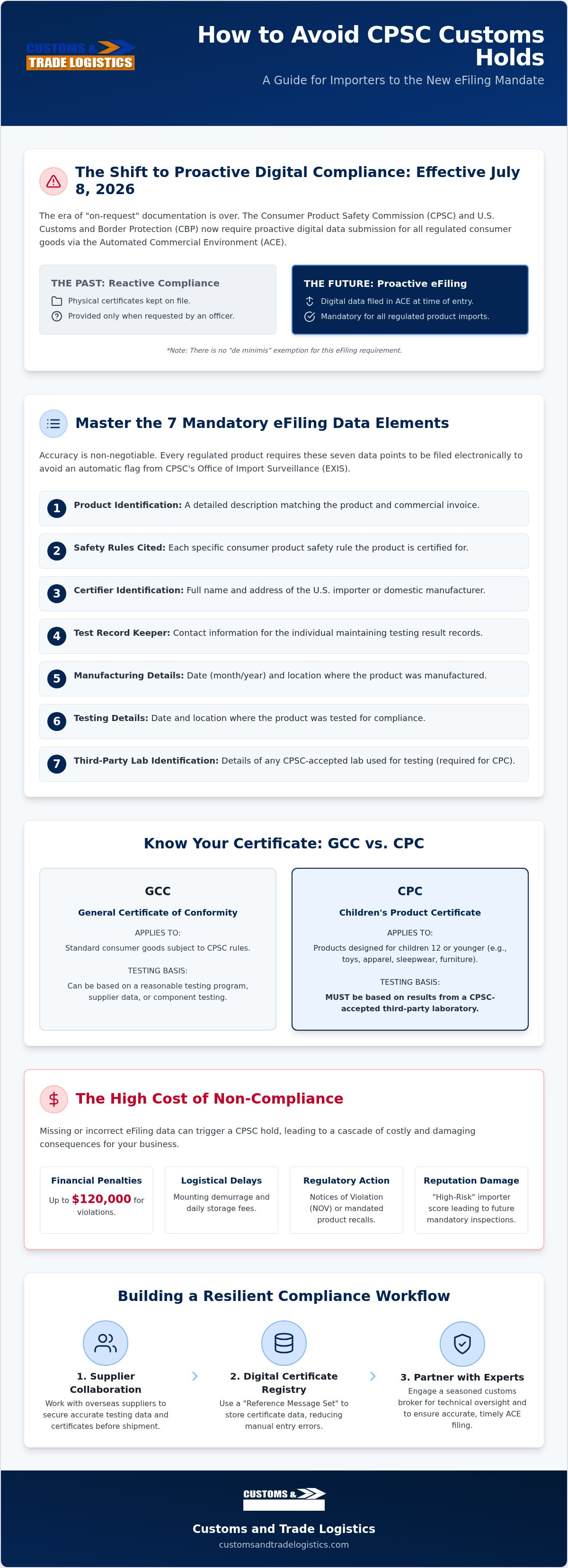
The new Final Rule requires every commercial importer to submit specific certificate data electronically through the Automated Commercial Environment (ACE). In the past, you might have kept your General Certificates of Conformity (GCC) or Children’s Product Certificates (CPC) in a folder, only producing them if an officer asked. That era of "on-request" documentation is over. You must now file this data at the time of entry. This digital requirement applies to all regulated products regardless of shipment size. Crucially, there's no "de minimis" exemption. Even small-value shipments that previously bypassed some customs hurdles now require a full digital filing to move through the port without delay.
The Consequences of Non-Compliance
When a shipment is flagged by EXIS due to missing or incorrect data, the financial impact is immediate. A CPSC hold is a logistical bottleneck that leads to mounting demurrage and storage fees. Beyond these daily costs, the CPSC can issue a Notice of Violation (NOV) or even mandate a full product recall if the testing data is found to be insufficient. Perhaps the greatest long-term risk is your "importer risk score." The CPSC uses this new eFiling data to build profiles. If you consistently fail to provide accurate data, your business may be labeled as "high-risk." This leads to mandatory inspections for every future shipment. Knowing how to avoid CPSC customs holds through proactive filing is the only way to protect your bottom line and your reputation as a reliable importer.
The New eFiling Mandate: Master the 7 Required Data Elements
Mastering the digital data requirements is the most effective way to learn how to avoid CPSC customs holds. You must now distinguish between a General Certificate of Conformity (GCC) for standard consumer goods and a Children’s Product Certificate (CPC) for items like toys or nursery furniture. While a GCC can be based on a reasonable testing program, a CPC requires specific results from a CPSC-accepted third-party laboratory. If you don't have these details ready before your cargo hits the water, you're already behind.
Your customs broker needs this data to file your entry in the Automated Commercial Environment (ACE). We often suggest using a "Reference Message Set" for repeat importers. Instead of typing out the full details for every shipment, you can store your certificate data in a digital registry and simply reference a unique ID. This proactive strategy reduces manual entry errors and ensures the CPSC system verifies your compliance instantly. If you need help setting up this digital workflow, our customs clearance services can guide you through every technical step.
A Checklist of the 7 Mandatory Data Elements
The CPSC requires seven specific data points for every regulated product. Accuracy is non-negotiable. Even a slight mismatch between your SKU description and your certificate can trigger an EXIS red flag. Ensure your records include:
- Product Identification: A detailed description and the specific SKU or model number.
- Safety Citations: A list of every CPSC safety rule and standard the product must meet.
- Importer Information: The name, full mailing address, and phone number of the U.S. importer or domestic manufacturer.
- Record Keeper Contact: Contact information for the individual responsible for maintaining your testing records.
Date and Location Details for Compliance
The final three elements focus on the "where" and "when" of your production cycle. You must provide the exact city and country where the product was manufactured, along with the date production was completed. Similarly, you need the date and the specific city and country where the product was tested for compliance. If your product requires a CPC, you must also identify the third-party laboratory that performed the testing. Gathering this from overseas suppliers can be difficult, so we recommend requesting these details during the production phase. Managing these specifics early is a cornerstone of how to avoid CPSC customs holds and ensuring a smooth journey through US ports.
Top 5 Reasons for CPSC Shipment Detention (and How to Avoid Them)
Why is your shipment stuck? Often, it isn't a safety failure but a paperwork oversight. Learning how to avoid CPSC customs holds requires a sharp eye for detail before the cargo ever leaves the factory. Most detentions occur because the digital data doesn't perfectly mirror the physical goods. For example, if you're importing children's products, missing or incomplete tracking labels are an immediate red flag for EXIS investigators. These labels must be permanent and include the manufacturer name, location, and date of production. If they aren't there, the CPSC system assumes the product is non-compliant.
We've identified five primary triggers for detention that every importer should watch for:
- Tracking Label Omissions: Especially critical for toys and nursery items.
- Invoice Discrepancies: When the product description on your commercial invoice doesn't match your compliance certificate.
- Unrecognized Laboratories: Testing your goods at a facility that isn't on the CPSC-accepted list for your specific product category.
- The "2026 Trap": Failing to submit your eFiling data through ACE at the time of entry, as mandated since July 8, 2026.
- Vague SKU Descriptions: Using generic terms like "Apparel" instead of specific model names that correlate to your test reports.
Administrative Errors: The Silent Killer of Logistics
In the new digital landscape, "close enough" isn't sufficient for SKU descriptions. If your supplier’s lab reports cite "Model Blue-A" but your certificate lists "Item 123," the Automated Commercial Environment (ACE) will trigger a hold for manual review. Ensuring your supplier’s lab reports exactly match your certificate citations is a tedious but vital task. Utilizing professional import paperwork assistance can prevent these simple filing mistakes that lead to weeks of delays. We act as a safe pair of hands, verifying every citation before it reaches the port.
What to Do if Your Shipment is Held
If you receive a notice that your shipment is held, don't panic. You first need to determine if it's a "Conditional Release" or a formal "Detention." A conditional release allows you to move the goods to your warehouse, though you cannot sell or distribute them until cleared. A detention means the cargo stays at the port under CBP control. You typically have a narrow 5-day window to respond to a CPSC request for documents. This is the moment to involve a customs consultant. We can help you negotiate with EXIS investigators and provide the necessary evidence to resolve a Notice of Violation (NOV) quickly. Understanding how to avoid CPSC customs holds through these recovery steps can be the difference between a minor hiccup and a total inventory loss.
Building a Compliance Workflow: From Factory Testing to ACE Entry
How can you bridge the gap between a factory floor in Ningbo and a digital filing in the ACE system? Creating a reliable routine is the most effective way to manage how to avoid CPSC customs holds. It isn't enough to simply have the right data; you need a workflow that ensures this data is ready before your goods are even loaded onto a container. This starts with a pre-shipment document audit. By reviewing your certificates against your commercial invoices 72 hours before departure, you catch the SKU mismatches and labeling errors that typically trigger EXIS inspections.
We recommend implementing a "Digital Certificate Registry" for your business. This centralized database allows you to store and organize your GCCs and CPCs by product line. When it’s time to ship, you or your broker can quickly pull the necessary Reference Message Sets. This methodical approach replaces the last-minute scramble for lab reports and gives you total oversight of your compliance status across all US ports.
Supplier Management for CPSC Compliance
Your compliance is only as strong as your supplier's testing protocols. Have you vetted your China-based lab to ensure it’s actually CPSC-accepted for your specific product category? We suggest standardizing the format of your GCCs and CPCs across your entire supply chain so that every document follows the same structure. This makes it easier for your team to verify the seven mandatory data elements we discussed earlier. A compliant supply chain is one where data moves as fast as the physical goods.
Integrating Compliance into Your Logistics
Successful importing from China logistics requires a compliance-first mindset. You must coordinate closely with your freight forwarder to ensure that the electronic data reaches your broker well before the vessel arrives. For repeat shipments, setting up a Reference Message Set in ACE saves significant time and reduces the risk of manual entry errors. If you're a new importer, training your team on the customs paperwork for small business basics is a vital investment in your company's growth. If you find the technical side of these 2026 mandates overwhelming, our customs clearance services provide the "safe pair of hands" you need to keep your cargo moving without delay.
Partnering for Compliance: How Professional Brokerage Prevents CPSC Delays
Why struggle with the technicalities of the Automated Commercial Environment (ACE) when you can have a dedicated advocate on your side? A customs broker does more than just submit paperwork; they act as your technical liaison between the CPSC and CBP. When an EXIS investigator has a question about your testing laboratory or SKU description, your broker is the one who provides the immediate, professional answers that keep your cargo moving. This level of oversight is a vital part of how to avoid CPSC customs holds that can otherwise last for weeks. By managing the digital communication, we lift the administrative burden off your internal team, allowing you to focus on growing your brand.
One of the most significant advantages of working with a seasoned broker is Remote Location Filing (RLF). This technology allows us to handle your CPSC entries at any US port of entry from a single, centralized office. Whether your goods arrive in Los Angeles, Savannah, or New York, you receive the same consistent, high-quality service. As the 2026 mandate makes digital accuracy mandatory, specialized customs clearance services us importers rely on have become an essential tool for maintaining a healthy supply chain. We ensure your Reference Message Sets are perfectly configured, preventing the data mismatches that trigger manual inspections.
Customs and Trade Logistics: Your 2026 Compliance Partner
With 35+ years of industry experience, we've helped thousands of businesses navigate the shifting tides of US import regulations. We aren't a faceless corporation; we're a family-owned and operated consultancy that values personal connection. This approach is particularly beneficial for those using Amazon FBA freight forwarding services, where the risk of CPSC holds is notoriously high. We understand the specific pressures Amazon sellers face, from strict delivery windows to the fear of blocked listings. We act as your "safe pair of hands," ensuring every certificate and label meets the rigorous 2026 standards before your shipment ever reaches the water.
Ready to Streamline Your Imports?
The transition from an "anxious importer" to a "compliant brand" doesn't have to be a lonely journey. If you're unsure if your current testing protocols meet the new mandate, we can help. We offer CPSC compliance audits for your current SKUs, identifying potential red flags in your GCCs or CPCs before they become costly port delays. Mastering how to avoid CPSC customs holds is about being proactive rather than reactive. When you're ready to secure your supply chain and move your goods with confidence, Contact Customs and Trade Logistics for a consultation. Let’s make sure your 2026 import season is your most successful one yet.
Securing Your Supply Chain for 2026 and Beyond
July 8, 2026, represents a fundamental shift in how consumer goods enter the United States. You now have the checklist for the seven mandatory data elements and a blueprint for building a factory-to-port workflow. Mastering how to avoid CPSC customs holds is no longer a matter of luck; it's the result of proactive data management and clear communication with your overseas suppliers. By implementing a digital certificate registry and auditing your paperwork before it reaches the port, you can eliminate the administrative errors that trigger costly EXIS inspections.
You don't have to navigate these complex technical requirements alone. With 35+ years of customs brokerage expertise, we specialize in China to US import compliance and provide national port coverage to keep your cargo moving. As a family-owned business, we pride ourselves on being the "safe pair of hands" that treats your success as our own. Ensure your 2026 compliance with an expert customs broker today. We’re ready to help you turn these new regulatory hurdles into a seamless, competitive advantage for your brand.
Frequently Asked Questions
Do I need to eFile CPSC certificates for every single shipment?
Yes, you must eFile for every shipment containing regulated consumer products. Since the July 8, 2026, mandate, there's no value-based exemption, meaning even low-value "de minimis" shipments require electronic data submission. If your goods fall under one of the 600 plus flagged HTS codes, the CPSC expects a digital certificate at the time of entry. Consistent filing is the best way to maintain a low risk score and ensure your cargo moves through US ports without manual intervention.
What is the difference between a GCC and a CPC?
The primary difference lies in the testing requirements and the target audience for the product. A General Certificate of Conformity (GCC) is for non-children's products that are still regulated, such as certain apparel or mattresses. A Children’s Product Certificate (CPC) is strictly for items intended for children aged 12 or younger. While a GCC can be based on a reasonable testing program, a CPC must be supported by results from a CPSC-accepted, third-party laboratory.
Can I file my own CPSC certificates in ACE without a broker?
While an importer is legally responsible for the accuracy of the data, the actual filing is typically handled by a licensed customs broker through specialized software connected to the Automated Commercial Environment (ACE). Filing on your own requires a direct interface with CBP systems, which is a significant technical hurdle for most small businesses. Partnering with an expert ensures your Reference Message Sets are correctly formatted, which is a key strategy for how to avoid CPSC customs holds.
What happens if my supplier in China provides an invalid test report?
If a supplier provides an invalid or outdated report, your shipment will likely be flagged for detention by the Office of Import Surveillance (EXIS). The CPSC won't accept reports from laboratories that aren't specifically certified for the safety standards your product must meet. This error can lead to a Notice of Violation and mandatory re-testing at a US facility. We recommend vetting your China-based labs early in the production cycle to prevent these administrative bottlenecks at the port.
How long does a typical CPSC customs hold last?
A typical hold can range from a few days to several weeks depending on the complexity of the issue. Once the CPSC issues a detention notice, you generally have five business days to provide the requested documentation. If a physical inspection or laboratory sampling is required, the delay can easily extend beyond 14 days. During this time, your cargo remains at the port, where daily storage and demurrage fees will continue to accumulate while you wait for a resolution.
Are small businesses exempt from the July 2026 eFiling mandate?
Small businesses are not exempt from the 2026 eFiling mandate. The Consumer Product Safety Commission (CPSC) requires all commercial importers, regardless of company size or shipment volume, to comply with the digital filing rules. This is particularly important for Amazon sellers and startups who may be accustomed to less rigorous documentation for small parcels. Every regulated item must have its certificate data transmitted through ACE to ensure a smooth entry process at all US ports of entry.
Which products are most likely to be targeted for CPSC review?
High-risk categories such as toys, children's sleepwear, durable nursery furniture, and mattresses receive the most scrutiny. Additionally, products like power tools, bicycles, and certain types of apparel are frequently targeted. The CPSC uses a risk-based scoring system that flags specific HTS codes known for safety violations. Understanding these high-scrutiny categories is essential for learning how to avoid CPSC customs holds through meticulous pre-shipment auditing and robust laboratory testing protocols that meet US standards.
How much does it cost if my shipment is detained by CPSC?
The total cost of a detention includes daily port storage fees, equipment demurrage, and potential exam site transport charges. These expenses often reach hundreds of dollars per day. If a formal violation is found, the CPSC can issue civil penalties, which currently cap at $120,000 per individual violation. For a series of related violations, penalties can escalate into the millions. Avoiding these financial burdens requires a compliance-first approach to your international freight logistics and documentation management.


