

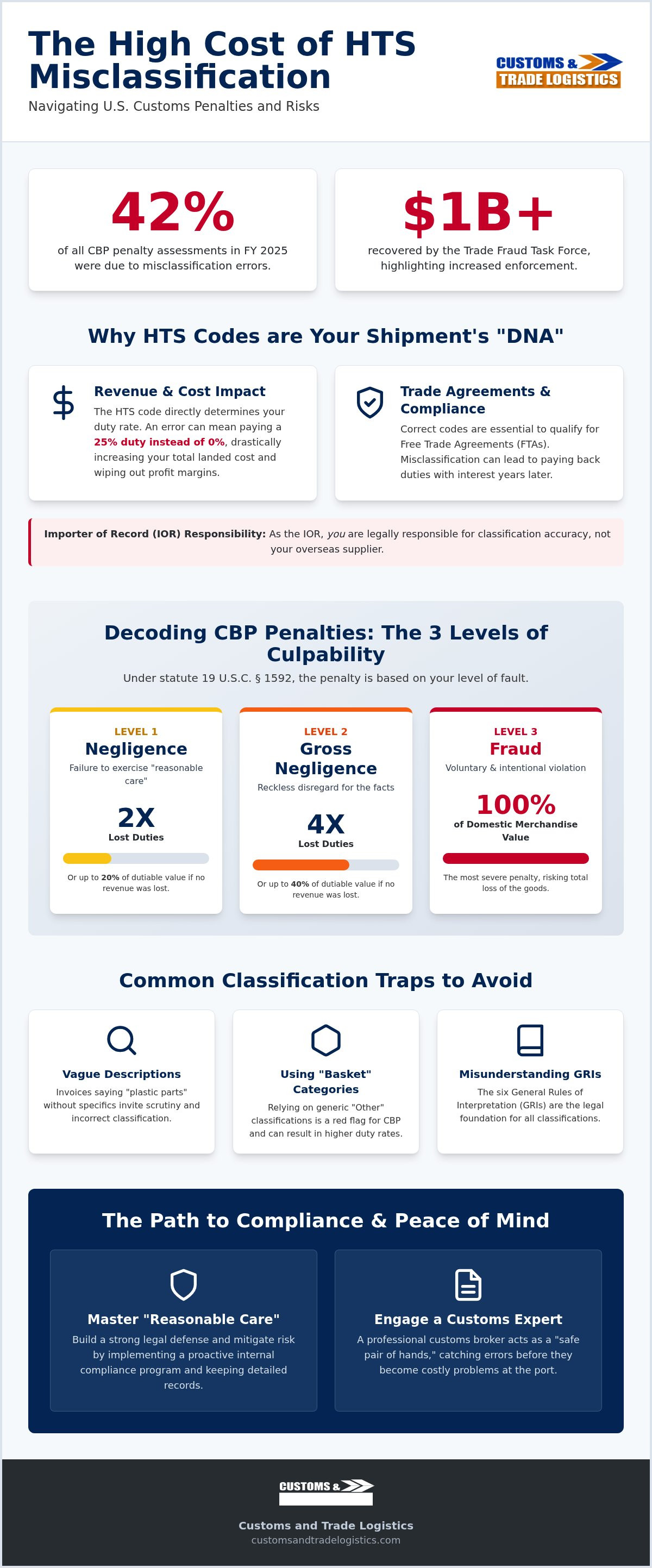
Did you know that misclassification errors accounted for 42% of all CBP penalty assessments in fiscal year 2025? It's a staggering figure that highlights just how easy it's to trip up on complex tariff schedules. You've likely felt that knot in your stomach when submitting a customs entry, wondering if a single digit could trigger a massive fine or a shipment seizure. We understand that anxiety because we've seen how overwhelming the global marketplace can feel for growing businesses trying to do the right thing.
The good news is that you don't have to navigate these waters alone. This guide will help you understand the financial and legal risks, specifically the penalties for incorrect HTS classification, and show you how to protect your business through the legal standard of reasonable care. With the Trade Fraud Task Force already recovering over $1 billion by July 2026, the stakes have never been higher for importers to get it right. We'll break down the 2026 penalty multipliers for negligence, explain how the government uses the False Claims Act, and provide a clear path to ensuring smooth customs clearance and total peace of mind for your operations.
Key Takeaways
- Understand why U.S. Customs views the HTS code as your shipment's "DNA" and why they prioritize classification for revenue and trade enforcement.
- Learn how the hierarchy of culpability determines specific penalties for incorrect HTS classification, ranging from simple negligence to serious fraud.
- Discover the operational risks of misclassification, including the threat of shipment seizures and the long-term administrative burden of increased customs audits.
- Master the "reasonable care" standard to build a strong legal defense and protect your business with a proactive internal compliance program.
- Find out how a professional customs broker acts as a "safe pair of hands" to catch errors on commercial invoices before your goods arrive at the port.
The High Stakes of HTS Classification in US Trade
Think of the Harmonized Tariff Schedule (HTS) as the genetic code of your imported goods. Every product entering the country must be assigned a specific 10-digit number that tells U.S. Customs and Border Protection (CBP) exactly what it's, how it's made, and what it's used for. Why does CBP care so much about these numbers? It's not just about paperwork; it's about revenue and national security. Accurate classification ensures the government collects the correct amount of duties and that restricted or dangerous items don't slip through the cracks.
A common mistake we see with growing businesses is trusting the classification provided by their overseas manufacturer. While your supplier knows their product, they often don't understand the legal nuances of the Harmonized Tariff Schedule of the United States. If the code is wrong, the manufacturer doesn't pay the price; you do. As the Importer of Record (IOR), you are legally responsible for every declaration made to Customs. If you blindly follow a supplier's suggestion, you risk facing severe penalties for incorrect HTS classification that can quickly wipe out your profit margins.
Why HTS Codes Matter for Your Bottom Line
How much will your shipment actually cost? Your HTS code determines the duty rate, which directly impacts your total landed cost. A simple error could mean paying a 25% duty instead of 0%. HTS classification is the legal declaration of a good's identity for US Customs. Beyond taxes, these codes determine if your goods qualify for Free Trade Agreements (FTAs). This allows you to import duty-free or at a reduced rate, giving you a significant competitive advantage. If you misclassify an item, you might miss out on these savings or, worse, be forced to pay back duties with interest years later.
Common Reasons for Misclassification
Why do so many businesses get this wrong? It usually starts with a lack of oversight or a misunderstanding of how the tariff system works. Here are the most frequent pitfalls we see:
- Vague product descriptions: If your commercial invoice just says "plastic parts," it's impossible to classify accurately. Specificity is your best friend.
- Using "basket" categories: It's tempting to use a general "Other" category when you're in a rush. However, CBP monitors these codes closely, and they often carry the highest duty rates.
- Misunderstanding the General Rules of Interpretation (GRIs): These are the six legal principles used to classify every product. Without a solid grasp of these rules, it's easy to pick a code that seems right but is legally indefensible.
Falling into these traps doesn't just cause delays. It creates a pattern of non-compliance that alerts CBP to dig deeper into your history, leading to even more penalties for incorrect HTS classification across your entire product line.
Decoding CBP Penalties: From Negligence to Fraud
When things go wrong at the port, U.S. Customs and Border Protection (CBP) relies on a specific piece of legislation to enforce the rules: 19 U.S.C. § 1592. This statute is the primary tool used to assess CBP penalties for violations. It's designed to ensure that importers aren't just guessing their tariff codes but are actively trying to be accurate. The severity of the fine depends on your level of culpability, which is essentially how much blame you deserve for the error. Whether you made a simple mistake or intentionally bypassed a tariff, the government has a structured way to calculate your liability.
The Three Levels of Culpability
CBP divides mistakes into three categories based on the importer's intent and diligence. Understanding these tiers is vital because they determine the multiplier applied to any lost revenue:
- Negligence: This occurs when you fail to exercise reasonable care, such as not double-checking a supplier's code or failing to keep proper records. In 2026, the fine for negligence can reach up to two times the amount of lost duties. If there's no revenue loss, the penalty can be up to 20% of the goods' dutiable value.
- Gross Negligence: This applies if you acted with actual knowledge of the error or showed a reckless disregard for the facts. Penalties jump significantly here, reaching up to four times the lost duties or 40% of the dutiable value in non-revenue-loss cases.
- Fraud: This is a voluntary and intentional violation. If CBP proves fraud, the penalty can equal the full domestic value of the merchandise, often resulting in the total loss of the shipment and the business's reputation.
Statutory Limits and Mitigation
How does CBP decide if you deserve a break? They look closely at your prior compliance history. If it's your first mistake and you've been generally diligent, they may be more open to mitigation. However, you should be aware that CBP can look back five years to audit past entries for classification errors. This look-back period means a single mistake repeated over dozens of shipments can snowball into a massive financial liability.
The most effective way to protect yourself is through a "Prior Disclosure." If you find an error before CBP starts a formal investigation, you can report it yourself. For negligence or gross negligence, this often reduces the penalties for incorrect HTS classification to just the interest on the duties owed. It's a powerful way to show good faith and maintain a positive relationship with customs. If you're feeling overwhelmed by these legal tiers, partnering with a team that offers expert customs clearance services can provide the oversight you need to stay compliant.
Beyond the Fine: The Operational Impact of Wrong Codes
While the financial sting of a fine is painful, the operational paralysis that follows a classification error can be even more damaging. When U.S. Customs and Border Protection (CBP) flags a shipment for misclassification, they don't just send a bill. They often stop the flow of your goods entirely. If CBP suspects that a wrong code was used to bypass anti-dumping duties or trade restrictions, they may seize the entire shipment. This isn't just a delay; it's a total loss of inventory that can take months or even years to resolve through the legal system.
One single error can also trigger a "Focused Assessment." This is essentially a comprehensive audit of your entire import history. Once you're on the radar for penalties for incorrect HTS classification, CBP may examine every entry you've made over the last five years. This administrative burden requires hundreds of hours of staff time to produce records, which pulls your team away from growing the business. In extreme cases, persistent errors lead to the loss of your import bond or your ability to clear goods at specific ports, effectively shutting down your supply chain. The importance of correctly classifying your products cannot be overstated when your brand's reputation and customer trust are on the line.
The PGA Ripple Effect
HTS codes do more than set duty rates; they act as a digital signal to Partner Government Agencies (PGAs). When you enter a code, it automatically triggers reporting requirements for agencies like the FDA, USDA, or EPA. If you use the wrong code, you might accidentally flag your shipment for restricted materials it doesn't even contain. This leads to mandatory lab testing to verify the product's composition. While your goods sit in a lab, you're racking up storage fees and missing delivery deadlines. A simple typo on a commercial invoice can turn a routine entry into a regulatory nightmare involving multiple federal agencies.
E-commerce and Amazon FBA Consequences
For high-volume e-commerce sellers, a "set it and forget it" approach to classification is a dangerous game. Amazon's inventory systems rely on a predictable flow of goods. If your shipment is seized or held due to penalties for incorrect HTS classification, your "In-Stock" rate plummets, and your search rankings often follow. Amazon seller account health is directly tied to your ability to fulfill orders. If customs delays become a pattern, you risk losing your selling privileges entirely.
Many successful sellers mitigate this risk by utilizing professional FBA freight forwarding services to manage the transition from the factory to the warehouse. These experts ensure that every digit of the HTS code is verified before the cargo leaves the origin port. In the fast-paced world of FBA, you can't afford to have your capital tied up in a customs warehouse because of a preventable coding error.
Demonstrating 'Reasonable Care' to Mitigate Risk
"Reasonable care" isn't just a suggestion; it's a legal requirement that serves as your primary shield against the harshest penalties for incorrect HTS classification. When CBP audits your business, they aren't just looking for mistakes. They're looking for your process. If you can prove you took logical, documented steps to find the right code, you can often mitigate a penalty from "Gross Negligence" down to simple "Negligence" or even have it waived entirely. It's about showing the government that you're a diligent partner, not a reckless operator.
One of the most effective ways to prove diligence is by maintaining an Internal Compliance Program (ICP). You don't need a massive legal team to do this. For most small businesses, an ICP is simply a written manual that outlines how you classify products, who is responsible for the data, and where you keep your records. If you're ever unsure about a complex product, you can even request a "Binding Ruling" from CBP. This is a formal, written decision that provides you with a legally protected HTS code for your specific item. It's the ultimate "get out of jail free" card for tricky classifications.
A Checklist for Compliant Importers
Staying compliant requires a proactive approach rather than a reactive one. Use this checklist to ensure your records are audit-ready:
- Review your partners: Audit your customs clearance services us to ensure your provider has specific HTS expertise in your industry.
- Build spec sheets: Maintain detailed files for every SKU, including material compositions, photos, and intended use. Knowing if a part is 60% steel or 60% aluminum can change the duty rate entirely.
- Conduct self-audits: Every quarter, pick five random past entries and re-verify their codes. Document this review to show CBP you're actively monitoring your own compliance.
When to Seek Professional Guidance
There are times when the "DIY" approach to classification becomes too risky for your bottom line. If you're importing technologically complex goods or items subject to Section 301 tariffs, the cost of a mistake is simply too high. We strongly advise importers to consult a specialist when import from China logistics involve multiple component materials. This expert oversight is the best way to avoid penalties for incorrect HTS classification and keep your supply chain moving without interruptions.
Ready to secure your business with a compliant import strategy? Reach out to our team at Customs and Trade Logistics to ensure your shipments are handled with the seasoned care they deserve.
How Professional Customs Brokerage Protects Your Bottom Line
Think of a professional customs broker as a "safe pair of hands" that acts as a vital buffer between your business and the complexities of U.S. Customs. While digital freight platforms often rely on automated systems that might miss subtle coding nuances, a seasoned consultant brings a human eye to every entry. We don't just file paperwork; we scrutinize your commercial invoices to catch errors before your goods even reach the port. This proactive oversight is your first line of defense against the penalties for incorrect HTS classification that can derail a profitable quarter.
With 35+ years of industry experience, our team has developed a keen eye for "red flag" HTS codes that frequently trigger CBP audits or PGA inspections. We've seen how a single misstep can lead to years of administrative headaches. By integrating compliance into your custom brokerage service fees, you aren't just paying for a transaction. You're investing in an insurance policy for your supply chain. This expert guidance ensures that your total landed costs remain predictable and that you never pay more in duties than the law requires.
The CTL Difference: Family-Owned Oversight
As a family-owned consultancy, we pride ourselves on providing a level of personalized review that large, impersonal firms simply can't match. We understand that every shipment represents a significant investment for your company. This is especially true for those navigating import logistics for startups, where the learning curve for HTS rules is steepest. We act as a seasoned mentor, walking you through the nuances of US import regulations and ensuring that your very first entry is as compliant as your thousandth. Our goal is to lift the administrative burden from your shoulders so you can focus on growth.
Taking the Next Step Toward Compliance
Are you ready to transition from "guessing" your tariff codes to maintaining a verified, audit-ready classification database? The journey to total peace of mind starts with a single, thorough review of your current processes. By moving away from a reactive strategy, you significantly reduce the stress of international trade and protect your business from the long-term financial impact of penalties for incorrect HTS classification. Expert oversight turns a complex regulatory requirement into a streamlined, predictable part of your business operations.
Don't wait for a CBP notice to arrive before you take action. Contact Customs and Trade Logistics today for a comprehensive compliance review. Let us show you how a partnership rooted in expertise and personal connection can stabilize your global operations and secure your bottom line for years to come.
Securing Your Growth with Proactive Compliance
Understanding that HTS classification is a legal responsibility, not just a tax code, is the first step toward protecting your business. We've explored how the hierarchy of culpability works and why maintaining an internal compliance program is your best defense against audits. By prioritizing reasonable care, you move from the risk of shipment seizures to the security of a smooth, predictable supply chain. Avoiding the heavy penalties for incorrect HTS classification requires more than just luck; it requires a documented process and expert oversight.
With over 35 years of industry-leading expertise, our family-owned team is here to act as your dedicated advocate across all US ports of entry. We specialize in demystifying these regulations so you can focus on scaling your operations without fear. Secure your supply chain with expert customs brokerage from Customs and Trade Logistics. You have the tools to import with confidence, and we're here to ensure you never have to walk that path alone.
Common Questions About HTS Compliance and Penalties
What is the most common penalty for an incorrect HTS code?
The most frequent penalty falls under the category of negligence, which occurs when an importer fails to exercise reasonable care. For these violations, CBP typically assesses a fine of up to two times the amount of lost duties. If the error didn't result in a loss of revenue, the penalty can still reach up to 20% of the merchandise's dutiable value. These assessments are designed to encourage more diligent record-keeping and classification practices.
Can I be jailed for using the wrong HTS code?
While most HTS errors result in civil financial penalties, criminal charges including jail time are possible in cases of documented fraud. If CBP and the Department of Justice prove that an importer intentionally and voluntarily provided false information to evade duties, the case can move beyond fines into criminal prosecution. For the vast majority of businesses making honest mistakes, the consequences remain strictly financial and administrative rather than criminal.
How does CBP find out if I used the wrong classification?
CBP identifies misclassifications through a combination of automated data mining, physical inspections, and comprehensive audits. In the first four months of 2025 alone, CBP completed 200 audits that uncovered $134 million in lost duties. Their systems are designed to flag statistical anomalies or "basket" codes that don't match the product description on the commercial invoice. Additionally, the Trade Fraud Task Force actively investigates transshipment and country-of-origin fraud using advanced analytics.
What should I do if I discover I’ve been using the wrong HTS code for years?
You should immediately file a "Prior Disclosure" before CBP initiates a formal investigation. This voluntary reporting allows you to correct the record for the five-year look-back period while significantly reducing your liability. In cases of negligence, a valid disclosure often reduces the penalties for incorrect HTS classification to just the interest on the unpaid duties. It's the most effective way to show good faith and protect your business from the highest statutory fines.
Is the importer or the freight forwarder responsible for HTS errors?
The legal responsibility rests entirely with the Importer of Record, not the freight forwarder or the overseas manufacturer. While you may rely on partners for advice, the Customs Modernization Act of 1993 clearly states that the importer is responsible for using reasonable care to provide accurate information. If an error occurs, CBP will issue the penalty to your business. This is why choosing a partner with deep regulatory expertise is a critical business decision.
How much does a CBP penalty usually cost a small business?
The cost varies based on the value of your goods and the amount of duty evaded, but the impact is often substantial. In fiscal year 2025, misclassification and undervaluation errors led to over $600 million in collected penalties. For a small business, a single negligence penalty could equal double the duties owed plus the original duty amount. These unexpected costs can quickly drain your operating capital and affect your ability to secure future import bonds.
Can I appeal a CBP penalty for misclassification?
You can appeal a penalty by filing a "Petition for Relief" within 60 days of receiving the notice. This process allows you to present mitigating factors, such as a clean prior compliance history or evidence that you relied on professional advice. CBP has the authority to remit or mitigate the fine if you can demonstrate that you acted in good faith. Successful appeals often hinge on having a well-documented audit trail that proves your classification process.
Does using a customs broker guarantee I won’t get penalized?
Using a customs broker does not provide a legal guarantee against fines, but it's a vital component of your "reasonable care" defense. If you can show that you provided your broker with full, accurate product information and followed their expert advice, CBP is much less likely to pursue penalties for incorrect HTS classification at the gross negligence or fraud levels. A broker acts as a professional safeguard, helping you navigate the complexities of the 2026 tariff schedules.


