

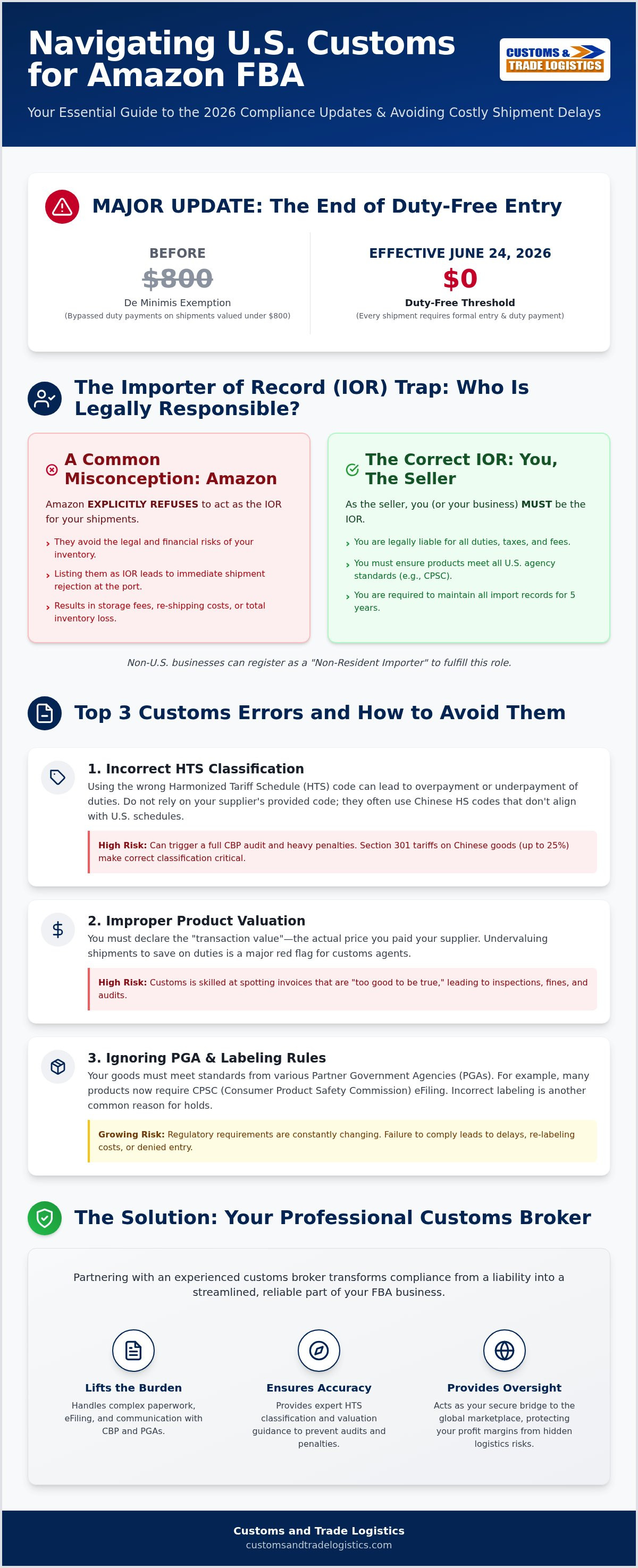
If you're still relying on the old $800 de minimis exemption to bypass duty payments, your Amazon FBA inventory is likely headed for a costly standoff with U.S. Customs. As of June 24, 2026, the permanent suspension of duty-free thresholds means every single shipment now requires a formal entry and duty payment. It's a daunting shift that has left even experienced importers feeling overwhelmed by new paperwork and unexpected fees.
We understand the anxiety that comes with a "Held for Inspection" notification. You've invested time and capital into your brand, and the last thing you need is a compliance failure that triggers an Amazon account suspension. Many common customs issues for Amazon FBA sellers are completely avoidable when you have the right oversight. This guide will help you handle these changes with confidence, protecting your business from the delays that stall your growth.
We'll walk through the essential 2026 updates, including the new CPSC eFiling requirements and the critical role of the Importer of Record. You'll learn how to turn customs compliance from a hidden hurdle into a reliable, manageable part of your logistics strategy.
Key Takeaways
- Understand why Amazon refuses the Importer of Record role and how to accept this legal responsibility to avoid shipment rejection.
- Identify the most common customs issues for Amazon FBA sellers, from incorrect HTS classification to the new 2026 CPSC eFiling requirements.
- Learn how to accurately value your inventory to prevent overpaying duties or triggering costly audits by U.S. Customs and Border Protection.
- Uncover the hidden risks of supplier-provided "door-to-door" shipping and why end-to-end oversight is vital for protecting your profit margins.
- Discover how partnering with an experienced customs broker can lift the administrative burden and provide a secure bridge to the global marketplace.
The Importer of Record (IOR) Trap: Amazon's Biggest Misconception
Many new sellers assume that because Amazon provides the platform and the warehouse, they'll also handle the legalities of getting products across the border. This is a dangerous assumption that can stall your business before it even begins. In reality, the Importer of Record (IOR) is the person or entity officially responsible for ensuring that imported goods comply with all local laws and regulations. One of the most common customs issues for Amazon FBA sellers is the belief that Amazon will step into this role. They won't. Amazon explicitly refuses to act as the IOR for third-party shipments because they don't want the legal or financial risks associated with your inventory.
If you list Amazon as the IOR on your shipping documents, the consequences are immediate and expensive. Customs will likely reject the shipment at the port of entry. This leads to mounting storage fees, the cost of re-labeling or re-shipping the goods, and in extreme cases, the total destruction of your inventory. To do this correctly, you must list your own business name or a designated representative as the IOR, ensuring the paperwork matches your tax and bond information exactly.
Legal Liabilities of the IOR
Taking on the mantle of IOR isn't just a formality; it's a significant legal commitment. You're responsible for the accurate payment of all duties, taxes, and fees. You also must ensure that your products meet the standards of every relevant government agency. Using the Harmonized System of classification correctly is just one part of the IOR's duty to provide accurate data to the government. Beyond the initial entry, you're required to maintain all import records for five years after the date of entry. The Importer of Record bears full financial liability for all penalties, liquidated damages, and duty underpayments identified by customs authorities.
Setting Up as a Non-Resident Importer
If your business is based outside the United States, you can still act as your own IOR by setting up as a Non-Resident Importer. This process requires you to obtain a U.S. Customs Bond and a Customs Assigned Importer Number. Because you aren't physically present in the U.S., you'll need a U.S.-based agent or a Power of Attorney (POA) to sign documents on your behalf. Avoiding these common customs issues for Amazon FBA sellers is much easier when you have a seasoned partner. A professional customs broker acts as your "safe pair of hands," facilitating the paperwork and ensuring your global brand has a secure, compliant bridge into the American marketplace.
Classification and Valuation: Avoiding Overpayment and Audits
If the Importer of Record is the "who" of your shipment, classification and valuation represent the "what" and "how much." Getting these details wrong is one of the most common customs issues for Amazon FBA sellers. U.S. Customs and Border Protection (CBP) uses the Harmonized Tariff Schedule (HTS) to determine exactly how much duty you owe. If you misclassify a product, you aren't just risking a small mistake; you're potentially triggering a full CBP audit. These audits are intrusive, time-consuming, and can lead to heavy penalties that far outweigh any initial savings from a lower duty rate.
In 2026, Section 301 tariffs on Chinese goods remain a major factor for FBA businesses. Most products fall under a 25% additional duty, while others face a 7.5% rate. Because these costs are so high, the temptation to undervalue shipments is strong. However, customs agents are experts at spotting "too good to be true" invoices. You must report the transaction value, which is the actual price you paid the supplier, not the retail price you plan to charge on Amazon. For a deeper look at these requirements, you can review CBP tips for new importers to ensure your documentation is up to standard.
Mastering HTS Code Selection
Don't fall into the trap of using whatever HTS code your Chinese supplier puts on the invoice. Suppliers often use Chinese HS codes, which don't always align with the U.S. tariff schedule. You might also hear about "tariff engineering," which involves slightly modifying a product to fit into a lower duty category. While legal, this requires precise execution and deep industry knowledge to avoid being flagged as fraud. It's often safer to use professional customs clearance services us to verify your codes before the ship leaves the dock. A quick consultation with an experienced broker can prevent a simple clerical error from turning into a legal nightmare.
Anti-Dumping and Countervailing Duties (AD/CVD)
Some products carry extra "hidden" duties designed to protect U.S. industries from unfair foreign competition. These Anti-Dumping and Countervailing Duties (AD/CVD) often target commodities like steel, aluminum, wooden bedroom furniture, and certain electronics. Unlike standard duties, AD/CVD rates can be massive, sometimes exceeding 100% of the product's value. If you don't account for these in your landed cost calculations, you'll face a bill that wipes out your entire profit margin. Anti-Dumping and Countervailing Duties are a common cause of unexpected FBA business bankruptcy. Always check if your product category is under an active AD/CVD order before finalizing your purchase order.
Partner Government Agencies (PGA) and Labeling Failures
While U.S. Customs and Border Protection (CBP) acts as the primary gatekeeper at the border, they aren't the only ones watching your shipment. Many common customs issues for Amazon FBA sellers stem from the regulations of Partner Government Agencies (PGAs). These include the FDA for cosmetics and food, the FCC for electronics, and the CPSC for toys and children's goods. CBP enforces the rules for these agencies, meaning your shipment can be perfectly classified on the Official Harmonized Tariff Schedule but still get flagged for a lack of agency-specific documentation. If a PGA isn't satisfied, your goods won't move an inch.
Labeling is another area where small errors lead to big headaches. You must distinguish between Amazon's FNSKU requirements and federal law. While Amazon needs your barcode for warehouse tracking, U.S. law requires a permanent, legible "Country of Origin" marking on every product and its outermost packaging. If the "Made in China" label is hidden, missing, or easily peeled off, Customs may require you to re-label the entire shipment under supervision. This process is incredibly expensive and adds weeks of delays to your FBA timeline.
Navigating FDA and FCC Requirements
Electronics and beauty products carry the highest administrative burden. If you're importing gadgets with radio frequencies, you must provide compliance data to the FCC. For health and beauty sellers, FDA registration for both the manufacturer and the importer is mandatory. It's not enough to have a safe product; the paperwork must be filed correctly in the Automated Commercial Environment (ACE). Your customs broker plays a vital role here by pre-filing this PGA data. By submitting these details before the ship docks, they ensure a smooth transition from the sea to the Amazon fulfillment center.
Compliance with the Consumer Product Safety Act
Toys and children's items face the most intense scrutiny in 2026. As of July 8, 2026, importers of regulated consumer products must electronically file Certificate of Compliance data at the time of entry with the U.S. Consumer Product Safety Commission (CPSC). You'll need a Children’s Product Certificate (CPC) backed by testing from a CPSC-accepted laboratory. Beyond testing, durable nursery products must include permanent tracking labels so consumers can be reached in case of a recall. Investing in proactive import compliance for small business isn't just about following rules. It's about protecting your brand from a total inventory loss and ensuring your business stays on the right side of federal law.
Logistics Coordination: The Factory-to-Port Journey
Accepting a "door-to-door" shipping quote from your supplier sounds like the easiest way to manage your business. In reality, it's often a trap. These quotes frequently exclude customs duties, port fees, and terminal handling charges. When the ship arrives, you're hit with thousands of dollars in surprise costs. This lack of transparency is one of the most common customs issues for Amazon FBA sellers. Navigating the complexities of import from China logistics requires a partner who sees the whole board, from the factory floor to the final Amazon warehouse delivery. Without specialized oversight, you're left guessing when your inventory will actually be available for sale.
Continuous vs. Single Entry Bonds
Every formal entry into the U.S. requires a customs bond. This acts as a financial guarantee to the government that you'll pay your duties. For regular importers, a continuous bond is the standard choice. It covers all your shipments at all U.S. ports for an entire year. In 2026, the cost for a continuous bond typically ranges between $400 and $1,200. If you import more than three times a year, the math almost always favors the continuous option. You also avoid the administrative hassle of securing a new bond for every individual container.
| Feature | Single Entry Bond | Continuous Bond |
|---|---|---|
| Best For | Occasional importers (1-2 times/year) | Regular FBA sellers (3+ times/year) |
| Efficiency | Must be applied for per shipment | One-time annual setup |
| Cost Structure | Varies based on shipment value and duties | Fixed annual fee ($400 to $1,200) |
| Port Flexibility | Limited to a single port of entry | Covers all U.S. ports of entry |
Managing the China-to-USA Shipping Chain
If you're shipping LCL (Less than Container Load), your goods share space with other importers. This is a budget-friendly option, but it comes with a catch. If just one pallet in that container has compliance problems, the entire container can be held for exam. You can't control what other people ship, but you can control your own filings. The Importer Security Filing (ISF), or "10+2" rule, must be transmitted at least 24 hours before your cargo is loaded onto the vessel in China. Missing this deadline triggers an automatic $5,000 fine. A reliable partner for FBA freight forwarding services ensures your ISF is filed accurately and on time. Don't leave your profit margins to chance; reach out to a professional to secure your logistics chain today.
The Solution: Leveraging Professional Customs Brokerage
Dealing with the border shouldn't feel like a solo battle against a faceless bureaucracy. While large digital platforms offer automation, they often lack the human intuition needed when a shipment is actually stuck. A family-owned broker acts as a mentor, offering the "safe pair of hands" that small businesses need to thrive. With 35+ years of experience, we've seen how port-specific nuances and shifting regulations create common customs issues for Amazon FBA sellers. Our role is to lift that administrative burden. We handle the granular procedural details so you can focus on scaling your brand.
By letting experts manage your paperwork, you replace anxiety with a sense of security. We don't just file entries; we provide a stabilizing force for your entire supply chain. Whether it's verifying a difficult HTS code or coordinating with a supplier in China, our team acts as a knowledgeable bridge between your small-scale operation and the global marketplace. This partnership ensures that no stage of your journey is overlooked or rushed.
Why Experience Matters in 2026
The 2026 trade environment is more complex than ever, especially with the end of de minimis exemptions and new eFiling requirements. Automated platforms might flag an error, but an experienced broker knows how to fix it before it becomes a penalty. Choosing to invest in custom brokerage service fees isn't just a business cost; it's a strategic move to protect your inventory from seizure. We provide personalized consulting that looks at your specific products, identifying risks that a computer algorithm would miss. This methodical approach ensures your goods move through the port with steady, reassuring progress.
Getting Started with a Customs Partner
Transitioning to a professional, compliant setup is simpler than most sellers realize. The process begins with a Power of Attorney (POA), which legally allows your broker to file documents on your behalf. From there, we'll guide you through the bond application and establish a communication flow between your factory and our team. This ensures every document is vetted for accuracy before the cargo even leaves the dock. To help you stay organized, here is a final checklist for a successful 2026 FBA import strategy:
- Verify IOR Status: Confirm your business is correctly listed as the Importer of Record.
- Audit Classifications: Double-check HTS codes to avoid Section 301 or AD/CVD surprises.
- Check Labeling: Ensure permanent "Country of Origin" markings are on every unit.
- Secure a Bond: Maintain a continuous bond to cover all U.S. ports of entry.
- Pre-File Data: Ensure ISF and PGA data are filed well before arrival to prevent holds.
You don't have to face these challenges alone. By partnering with a dedicated advocate, you can resolve common customs issues for Amazon FBA sellers before they impact your bottom line. Contact Customs and Trade Logistics today for a personalized consultation and experience the peace of mind that comes with expert oversight.
Secure Your Amazon FBA Future in 2026
Navigating the border doesn't have to be a source of constant stress for your business. By owning your role as the Importer of Record and ensuring your HTS classifications are precise, you eliminate the most common customs issues for Amazon FBA sellers. The regulatory landscape is shifting quickly, especially with the 2026 CPSC eFiling requirements and the end of de minimis exemptions, but these changes are manageable with the right oversight. You've worked hard to build your brand; don't let a simple paperwork error or a missed ISF deadline stall your growth.
At Customs and Trade Logistics, we bring 35+ years of customs brokerage expertise to every shipment. As a family-owned team specialized in China-to-USA FBA logistics, we act as a dedicated partner for small and medium businesses. We take the administrative burden off your plate so you can focus on what you do best. Let our family-owned team manage your FBA imports today and feel the relief of having a safe pair of hands guiding your inventory home. Your success in the global marketplace is within reach, and we're here to help you get there.
Frequently Asked Questions
Can Amazon act as my Importer of Record for US Customs?
No, Amazon refuses the Importer of Record (IOR) role for all third-party sellers. You are legally responsible for all compliance, duties, and taxes related to your inventory. If you list Amazon incorrectly on your documents, your shipment will be rejected at the port. This mistake often results in expensive re-labeling or the destruction of your goods. It's vital to have your own U.S. Customs Bond and Importer Number set up before arrival.
What happens if my FBA shipment is seized by US Customs?
If your shipment is seized, you'll receive an official Notice of Seizure from CBP. This document outlines why your goods were taken and your options for petitioning their release. You must act quickly to provide evidence of compliance or pay any assessed fines. This is one of the most stressful common customs issues for Amazon FBA sellers, often requiring expert brokerage assistance to resolve and protect your business from total loss.
Do I need a continuous customs bond for small Amazon FBA shipments?
You need a bond for every formal entry into the U.S. While a single entry bond is possible for a one-time shipment, a continuous bond is the standard for serious sellers. If you plan to import inventory more than three times a year, the continuous bond is much more cost-effective. It covers all your shipments at all U.S. ports for a full twelve-month period, offering a smoother experience for your growing brand.
What are the most common reasons for customs delays for China imports?
Delays are frequently caused by missing ISF filings, incorrect HTS codes, or "Country of Origin" labeling failures. In 2026, we also see significant hold-ups due to heightened UFLPA scrutiny and CPSC eFiling errors. These common customs issues for Amazon FBA sellers can often be avoided by vetting your paperwork 24 hours before the ship leaves China. Proactive coordination between your factory and broker is the best defense against these costly port bottlenecks.
How do I find the correct HTS code for my Amazon product?
While you can search the Official Harmonized Tariff Schedule database, the descriptions are often technical and confusing. Don't simply trust the code your supplier provides; they often use Chinese HS codes that don't match U.S. requirements. A licensed broker will analyze your product's material and function to find the exact match. This prevents overpaying duties and protects you from the risk of an intrusive and expensive future CBP audit.
Is a customs broker the same thing as a freight forwarder?
No, they serve different but complementary roles. A freight forwarder is the "travel agent" for your cargo, booking space on ships or planes. A customs broker is the "legal advocate" who ensures your goods comply with federal laws and clears them through the border. For a seamless experience, many sellers choose a partner who offers both international logistics and specialized customs clearance to manage the entire chain from factory to fulfillment center.
What is the ISF 10+2 rule and does it apply to FBA sellers?
Yes, the ISF 10+2 rule applies to all ocean freight entering the U.S. It requires ten specific data points about the shipment and two from the vessel carrier. This information must be filed at least 24 hours before the cargo is loaded in the foreign port. Failure to file on time leads to an automatic $5,000 penalty and can trigger a mandatory physical inspection of your goods, causing significant delays and extra costs.
How much are typical customs brokerage service fees for Amazon sellers?
Brokerage fees depend on the complexity of your shipment and the number of different products you're importing. While you'll pay for the formal entry and bond, these costs are a minor investment compared to the risk of storage fees or fines. A professional broker provides the mentorship and oversight needed to ensure your landed cost stays predictable. It's about buying peace of mind and total management for your growing Amazon business.


