

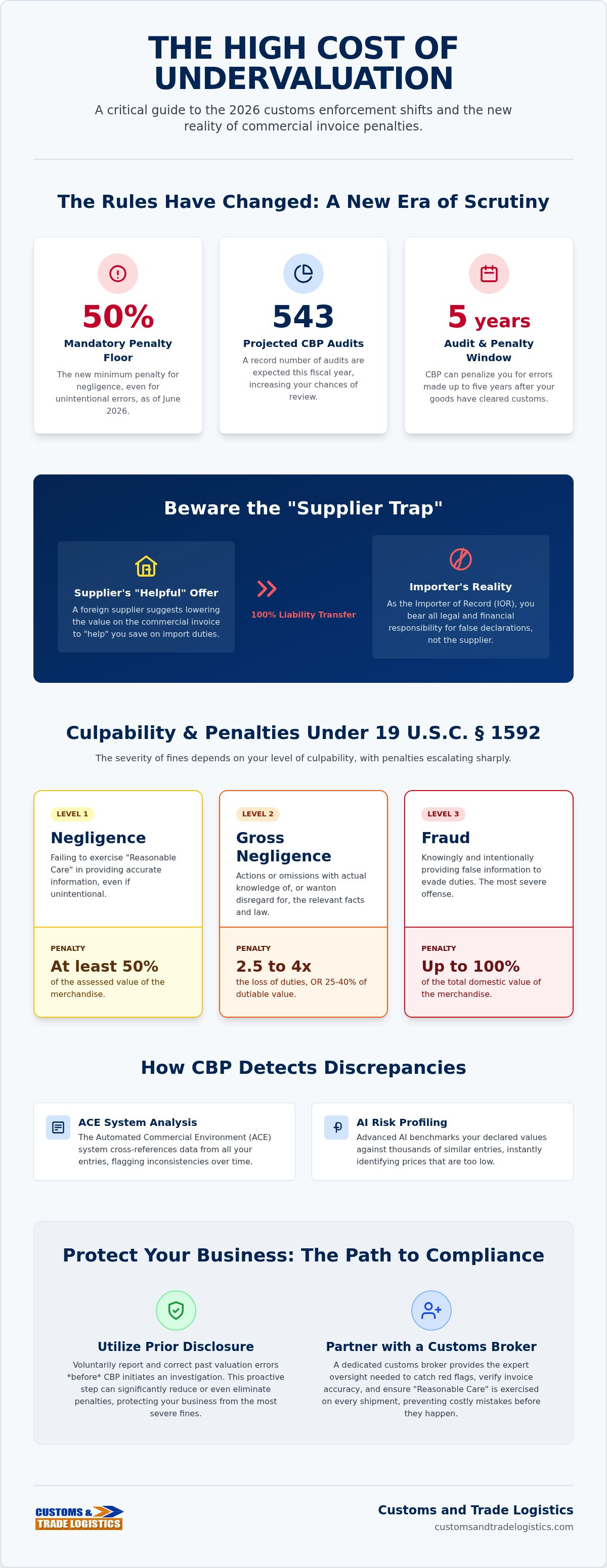
The days of "slap-on-the-wrist" warnings for customs errors are officially over. As of June 2026, a new Executive Order has established a mandatory penalty floor, meaning you could face at least 50% of the assessed value for violations, even for an honest mistake. Understanding the reality of undervaluation on commercial invoice penalties is no longer just about avoiding a minor fee; it's about the very survival of your supply chain. With CBP audits projected to hit a record 543 cases this fiscal year, the government is looking closer at your paperwork than ever before. It's a high-stakes environment where the old ways of "estimating" values simply won't cut it anymore.
We know how heavy this administrative burden feels, and it's completely natural to worry about a single error leading to seized shipments or a total ban on your importing privileges. You've worked hard to build your business, and you deserve to feel secure in your operations. This guide will walk you through the specific fine structures triggered by the latest 2026 enforcement shifts and show you how to calculate your import values with total precision. We'll also explore the steps you can take to fix past reporting errors before they turn into permanent red flags on your record, giving you the peace of mind to focus on your growth.
Key Takeaways
- Recognize why following a supplier’s advice to lower invoice values is a dangerous trap that places all legal and financial liability on your business.
- Identify the three levels of culpability under 19 U.S.C. § 1592 and how the 2026 enforcement shifts have drastically increased undervaluation on commercial invoice penalties.
- Learn how the ACE system and AI risk profiling allow CBP to benchmark your prices against thousands of similar entries in seconds.
- Explore the "Prior Disclosure" process to fix valuation errors voluntarily, which can protect your business from the most severe fines and shipment delays.
- Understand how a dedicated customs broker provides the oversight needed to catch red flags on your commercial invoices before they reach a port of entry.
What is Undervaluation and Why Does US Customs Care?
What exactly is undervaluation? At its simplest, it's declaring a price for your goods on your entry documents that's lower than what you actually paid your supplier. While it might seem like a way to shave off a few dollars in duties, U.S. Customs and Border Protection (CBP) views this as a direct theft of federal tax revenue. Every dollar underreported is a dollar of duty unpaid. This makes the commercial invoice more than just a receipt; it's a sworn legal declaration to the U.S. government regarding the Customs valuation of your cargo.
Many SMBs and Amazon sellers fall into what we call the "Supplier Trap." A foreign supplier might suggest "helping" you by writing a lower value on the invoice to reduce your import costs. They might even do it without asking. While their intentions might seem helpful, they aren't the ones who will face undervaluation on commercial invoice penalties. They have no skin in the game once the cargo leaves their port, but you certainly do. CBP treats these "favors" as fraudulent activity, and as the importer, you're the one left holding the bill.
The Legal Responsibility of the Importer of Record
Who is responsible if the numbers are wrong? In the eyes of the law, the liability rests entirely with the Importer of Record (IOR). Under the Customs Modernization Act, you're required to exercise "Reasonable Care" to ensure all entry information is correct. This means you can't simply point at your supplier and say, "I didn't know." CBP expects you to have systems in place to verify your data. If you're an Amazon seller using a DDP (Delivered Duty Paid) model, you're under even more scrutiny under the 2026 enforcement rules. Ignorance isn't a defense; it's often viewed as a lack of due diligence.
Common Myths About Lowering Invoice Values
It's easy to get lulled into a false sense of security by common industry myths. Let's look at the reality of how enforcement works today.
- Myth: Customs only cares about high-value containers. Reality: Since the suspension of the de minimis exemption in June 2026, CBP is now scrutinizing low-value shipments with the same intensity as bulk cargo.
- Myth: If the goods cleared the port, I'm safe. Reality: Clearance is just the first step. CBP has a five-year window to initiate an audit or issue a penalty action.
The latest 2026 regulations mean that even a first-time mistake can lead to a penalty floor of 50% of the assessed value. Protecting your business requires moving beyond these myths and embracing total compliance from day one.
The Financial and Legal Penalties for Undervaluing Imports
When CBP identifies a discrepancy in your filings, they turn to a specific part of the law known as 19 U.S.C. § 1592. This statute is the government's primary tool for enforcing compliance and collecting unpaid duties. It's vital to understand that the government doesn't just look at the missing tax. They calculate fines based on the "Domestic Value" of your goods. This is the price they'd sell for in the U.S. market, not just your purchase cost. This distinction often catches importers off guard because the resulting fines can be exponentially higher than the original savings you hoped to gain.
The severity of undervaluation on commercial invoice penalties depends on your level of culpability. CBP distinguishes between simple mistakes and intentional deception. Even if your goods are duty-free, you can still face "Non-Revenue" penalties for making a false statement on a legal document. The government views accurate data as essential for national security and trade statistics, so they'll penalize you even if they didn't technically lose money on the entry.
Penalty Tiers: Negligence to Fraud
Under the enforcement rules established on June 3, 2026, CBP has significantly less room to be lenient. A simple case of Negligence, which is failing to exercise reasonable care, can now trigger a penalty floor of at least 50% of the assessed amount. This shift means that even first-time offenders face a steep financial climb. If you're worried about your current documentation, our customs clearance services can help you audit your records before they reach a port of entry.
Gross Negligence involves acting with actual knowledge or a reckless disregard for the facts. Fines in this category can reach up to four times the loss of duty. At the highest level is Fraud, where the government proves you voluntarily and intentionally undervalued your goods. The penalties here are staggering, often reaching 100% of the domestic value of the entire shipment. In these cases, you aren't just paying a fine; you're essentially losing the entire value of your inventory to the government.
Beyond the Fines: The Hidden Costs of Non-Compliance
The damage doesn't stop at your bank account. CBP has the authority to seize and forfeit your goods, meaning they keep your inventory permanently. You might also lose your import privileges entirely, effectively shutting down your business operations. Even if you stay in business, your continuous bond premiums will likely skyrocket. Insurance companies view a customs penalty as a massive risk, and they'll charge you accordingly to maintain your coverage. This "compliance tax" can follow your business for years, making every future shipment more expensive and more likely to be flagged for inspection.
How US Customs Detects Valuation Discrepancies in 2026
How does CBP find the needle in the haystack? They don't do it by hand. They use the Automated Commercial Environment (ACE), a sophisticated digital brain that acts as a central hub for all U.S. trade data. In 2026, this system is more powerful than ever, utilizing AI-driven risk profiling to scan every entry for anomalies in real-time. If your declared value is significantly lower than the historical average for that specific product, the system automatically triggers a flag. This is often the starting point for undervaluation on commercial invoice penalties. It's also why a shipment can be "cleared" and move through the port today, only to be audited months later when the data is cross-referenced against global benchmarks.
You might first hear from CBP through an "Informed Compliance" letter or a Form 28 Request for Information. Think of a Form 28 as a knock on the door from a specialist who wants to see the proof behind your numbers. They'll ask for bank statements, contracts, or proof of payment to ensure the price on the paper matches the money that actually left your account. If those numbers don't align, the audit process begins in earnest.
Data Cross-Referencing and Benchmarks
CBP maintains extensive global trade databases and frequently references manufacturer pricing lists from major exporting regions like China. They're specifically trained to look for "Round Numbers." If you're importing a complex mechanical part and the unit price is exactly $1.00, it looks suspicious to an algorithm designed to spot "too good to be true" pricing. They also focus on relationship testing. If you're buying from your own factory or a related party, they'll scrutinize whether the price was influenced by that relationship rather than being a fair market transaction. They want to see that you're paying what any other buyer would pay in an open market.
Physical Inspections and Lab Testing
Sometimes, the digital data isn't enough to tell the whole story. CBP may order an intensive exam to verify that the material quality matches the declared value. For example, if you're importing high-end apparel but declaring a "scrap fabric" value, they might send samples to a lab to verify the thread count or material composition. They also cross-reference manifest data from carriers. If the weight or volume on the shipping manifest doesn't align with the quantity on your invoice, it's an immediate red flag. Navigating these technical triggers is a core part of working with professional Customs Clearance Services in the US to ensure your business stays on the right side of the law.
Correcting Course: Reasonable Care and Prior Disclosure
What happens if you look through your records and find an error before CBP does? It's a heavy weight to carry. If you discover that a supplier has been "helping" you by lowering prices on your invoices without your consent, your first instinct might be to panic. However, the U.S. government actually provides a path for you to fix these mistakes while protecting your business from the most severe undervaluation on commercial invoice penalties. This path is known as Prior Disclosure, and it's your most effective tool for maintaining a clean record.
By coming forward voluntarily, you demonstrate that you're acting in good faith. CBP values transparency, and the law rewards it by significantly limiting the fines they can assess. Instead of facing the mandatory penalty floors established in June 2026, a successful disclosure often reduces your liability to just the unpaid duty plus interest. It's a way to hit the reset button and ensure your business remains a "safe pair of hands" in the eyes of the port directors. If you're unsure how to begin this process, you can consult with a compliance expert to review your entry history.
The Prior Disclosure Process
Navigating a disclosure requires a methodical approach to ensure you don't miss any details that could invalidate your "Safe Harbor" status. You'll need to follow these four specific steps:
- Step 1: Identify the scope. Review your imports from the last five years to find every affected entry. CBP expects a comprehensive report, not a partial one.
- Step 2: Calculate the debt. Determine the exact amount of duty owed based on the correct transaction value, then add the applicable interest.
- Step 3: Submit the disclosure. Present your findings to the Port Director before CBP notifies you of an investigation or audit.
- Step 4: Secure the benefit. Once accepted, your legal "Safe Harbor" status protects you from the massive multipliers used in negligence or fraud cases.
Building a Compliance Manual for Your Business
Fixing the past is important, but preventing future errors is how you truly scale. We recommend establishing a formal compliance manual that includes standard operating procedures (SOPs) for invoice verification. This manual should mandate that your sourcing team rejects any "deals" from suppliers that involve undervaluing goods. It's also vital to maintain a five-year record-keeping trail for every transaction, as CBP can request these documents at any time. For those just beginning their journey, our guide on Import Logistics for Startups provides a strong foundation for building these compliant systems from the ground up.
How a Customs Broker Protects Your Business from Valuation Risks
Why do so many importers feel like they're walking a tightrope with every shipment? It's usually because the complexity of customs regulations feels designed to catch you off guard. This is where a customs broker becomes your most vital partner. Think of us as a "safe pair of hands" with 35 plus years of experience navigating the shifting tides of trade law. We don't just file your paperwork; we act as a protective filter between your supplier's documents and the government's scrutiny. By reviewing your files before they ever reach a port of entry, we can identify discrepancies that would otherwise trigger undervaluation on commercial invoice penalties.
Our team understands the nuances of the six primary valuation methods used by CBP. While "Transaction Value" is the most common approach, it isn't always straightforward. We help you account for assists, royalties, and packing costs that must be included in your declaration. If you receive a Form 28 Request for Information, we step in as your advocate. We know how to present your data in a way that satisfies auditors and proves you've exercised the reasonable care required by law. This advocacy is the difference between a quick resolution and a long, expensive investigation.
The CTL Advantage for SMBs and Amazon Sellers
We take pride in being more than a service provider; we're mentors to the businesses we serve. Many SMBs and Amazon sellers feel overwhelmed by the scale of international trade, so we focus on demystifying the "why" behind every rule. We provide specialized expertise in Import From China Logistics, helping you spot the specific supplier behaviors that often lead to valuation flags. Our goal is to ensure your business is built on a foundation of compliance, which starts with calculating accurate custom brokerage service fees and duty rates during your initial budgeting phase.
Securing Your Future as a Global Importer
The ultimate benefit of working with an experienced broker is the peace of mind that comes from a truly audit-ready supply chain. When your documentation is consistently accurate, you build a positive "importer profile" within the ACE system. Over time, this reliability leads to faster clearances and fewer detentions at the port. You won't have to stay up at night worrying about undervaluation on commercial invoice penalties because you'll know your filings are backed by decades of expertise. If you're ready to move from anxiety to security, contact Customs and Trade Logistics for a compliance consultation today. Let's work together to protect your growth and keep your goods moving smoothly across the border.
Building a Resilient and Compliant Import Future
The landscape of international trade has shifted toward a high-tech, zero-tolerance approach. With AI-driven risk profiling and record-breaking audit numbers, simply hoping for the best is no longer a viable business strategy. You've seen how the latest 2026 regulations have tightened the net around reporting errors, making it essential to address any discrepancies before they lead to severe undervaluation on commercial invoice penalties. Whether you're an Amazon seller navigating China-to-US logistics or an SMB scaling your operations, the key to longevity is transparency and precision in every filing.
At Customs and Trade Logistics, we act as your dedicated advocate and mentor. We bring over 35 years of industry experience and a family-owned commitment to your success, ensuring your supply chain remains a stabilizing force rather than a source of stress. You don't have to navigate these complex valuation rules alone. Protect your business with a compliance review from Customs and Trade Logistics. Taking the first step toward compliance today ensures your business stays audit-ready and profitable for years to come.
Frequently Asked Questions
Can I go to jail for undervaluing a commercial invoice?
Yes, criminal prosecution is possible if the government proves you intentionally committed fraud to evade duties. While most undervaluation on commercial invoice penalties are civil in nature, egregious cases involving conspiracy or systemic tax evasion can lead to imprisonment. CBP works closely with the Department of Justice to prosecute importers who willfully violate the law. It's always better to be transparent than to risk your personal freedom over a shipment.
What happens if my supplier sends a lower invoice without my permission?
You remain legally liable for the accuracy of the declaration as the Importer of Record. CBP expects you to exercise reasonable care, which includes verifying that your supplier's invoice matches the actual price you paid. If you discover a discrepancy, you should notify your customs broker immediately to correct the entry. Relying on a supplier's "favor" can lead to seizures and audits that you'll have to defend on your own.
Is there a "minimum" amount of undervaluation that Customs ignores?
No, there is no official "safe" margin for error. Since the 2026 enforcement shifts, CBP's AI systems scan every entry for even minor price anomalies. While a five-dollar difference might not trigger a full-scale audit, a pattern of small discrepancies will flag your business for future scrutiny. The government views any missing revenue as a violation, so precision is your only true protection against unexpected fines and delays.
How long does US Customs have to penalize me for an old shipment?
CBP generally has a five-year window from the date of the violation to initiate a penalty action or audit. This is why maintaining a thorough record-keeping trail is a legal requirement under the Mod Act. If you can't produce the original proof of payment for a shipment from three years ago, you may struggle to defend yourself against a valuation challenge. We recommend keeping all digital and physical records for at least six years.
What is the difference between a Prior Disclosure and a simple correction?
A Prior Disclosure is a formal legal mechanism used to report past errors that CBP hasn't discovered yet, offering protection against heavy fines. In contrast, a simple correction or "Post Summary Correction" is typically used for minor data adjustments on entries that haven't been liquidated. Using the disclosure path provides a "safe harbor" that can reduce undervaluation on commercial invoice penalties to just the interest owed on the unpaid duties.
Does undervaluing affect my Amazon FBA account status?
Yes, it absolutely can. Amazon requires sellers to comply with all federal laws, and a shipment seizure or a customs ban can lead to a permanent suspension of your seller account. If your inventory is stuck in a port exam, your out-of-stock rates will skyrocket, damaging your "Buy Box" eligibility. Staying compliant isn't just about avoiding government fines; it's about protecting the health and reputation of your storefront on the global marketplace.
How much are the interest charges on unpaid customs duties in 2026?
Interest rates on unpaid duties are calculated based on the IRS underpayment rate and are adjusted quarterly. In 2026, these charges accrue from the date of the initial entry until the debt is fully paid. These costs can add up quickly, especially during a multi-year audit process. When you submit a Prior Disclosure, paying this interest is a mandatory step to secure your penalty mitigation and clear your record with the Port Director.
Can a customs broker help me if I already received a penalty notice?
Yes, we can act as your advocate by filing a petition for mitigation or relief. We review the facts of your case to determine if you acted with "reasonable care" and present a professional defense to CBP. While we can't make a penalty disappear if a violation occurred, we can often help reduce the total fine amount by demonstrating your commitment to future compliance. Having a seasoned partner ensures you don't face the government alone.


