

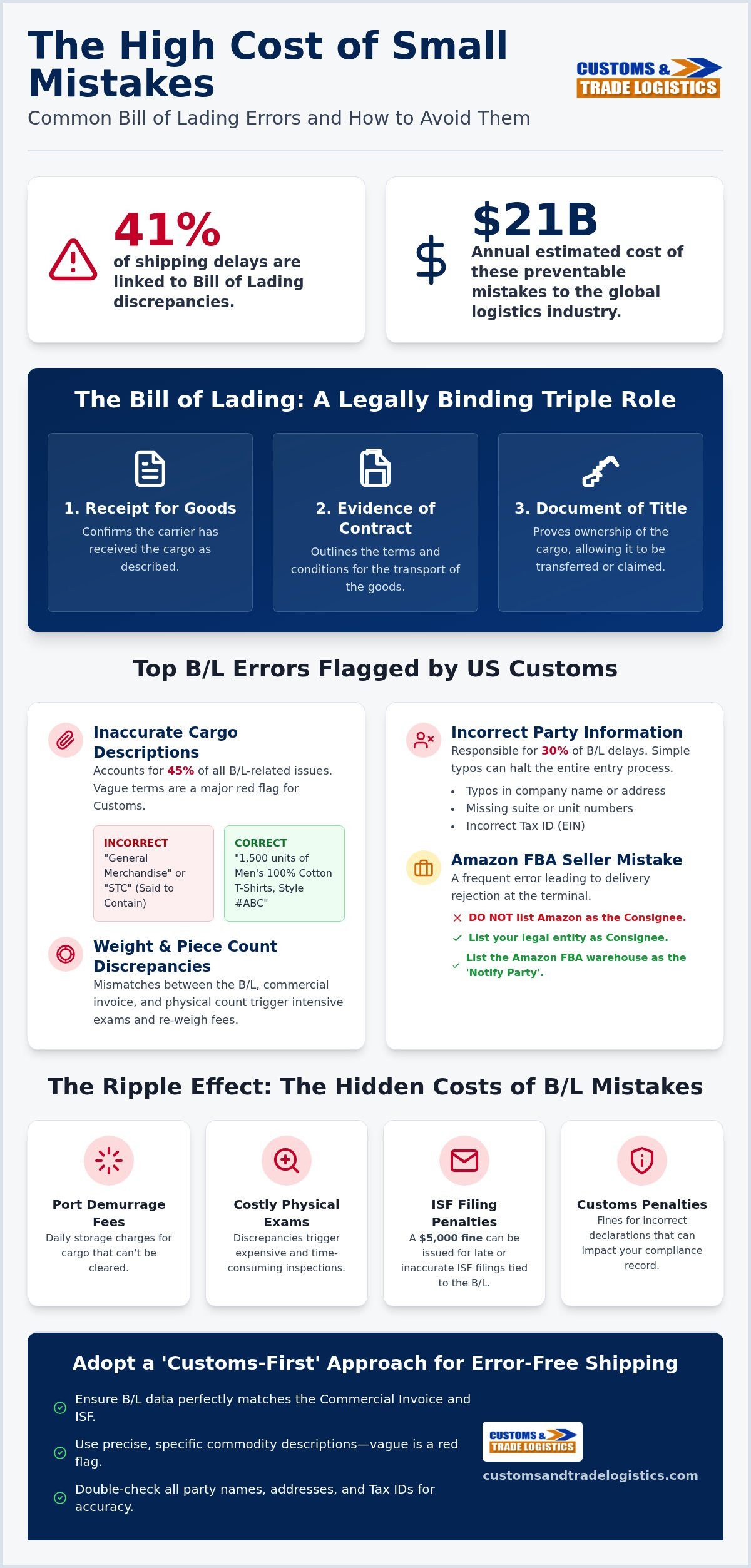
Did you know that roughly 41% of international shipping delays are linked to bill of lading discrepancies? According to UNCTAD data from early 2026, these preventable mistakes cost the global logistics industry an estimated $21 billion annually. It's incredibly frustrating to watch your cargo sit at the port while demurrage fees climb, especially when the holdup is caused by common errors on bill of lading documents. You've worked hard to coordinate your import, and the last thing you need is the anxiety of a US Customs penalty or a $5,000 fine for a late ISF filing.
We want to help you turn that stress into security. You'll learn how to spot the documentation mistakes that trigger Customs holds so you can protect your shipments from expensive administrative errors. We'll walk through the most frequent pitfalls, from inaccurate cargo descriptions to consignee errors, and show you how a "Customs-first" approach ensures your 2026 supply chain stays on schedule. Let's look at how you can maintain a clean, error-free shipping process and keep those logistics costs under control.
Key Takeaways
- Understand that your Bill of Lading is a legally binding contract and document of title, not just a simple receipt for goods.
- Learn why vague commodity descriptions are no longer accepted and how to provide the precise party details US Customs demands.
- Identify the specific differences between Straight, Order, and Sea Waybill documents to choose the right fit for your operation.
- Discover how to protect your bottom line from the most common errors on bill of lading forms that trigger expensive port storage fees.
- Gain peace of mind by letting a seasoned mentor handle the complex administrative details of your international shipments from start to finish.
Understanding the Bill of Lading: Why Accuracy Matters in 2026
What exactly is a bill of lading? At its core, this document is a legally binding contract between the shipper and the carrier. It performs a "triple role" in your logistics journey. First, it's a receipt for the goods being moved. Second, it serves as evidence of the carriage contract. Finally, and perhaps most importantly, it's a document of title. A Bill of lading essentially proves who owns the cargo while it's in transit. The Bill of Lading is the foundational document for all US Customs entries. By late 2026, the industry has seen a massive shift toward eBOL (Electronic Bill of Lading) standards. This digital transition means that accuracy is no longer just a goal; it's a mandatory requirement for automated processing. Even tiny typos can now cause systemic failures in digital manifests, leading to the very common errors on bill of lading forms that stall your business.
The Legal Weight of Your Shipping Documentation
Think of your B/L as the "deed" to your shipment. Because it acts as a title document, it determines who legally owns the goods while they're crossing the ocean. If your information is incorrect, you might find yourself unable to release the cargo to your customer or, worse, unable to file an insurance claim if something goes wrong. You'll usually encounter two types: negotiable and non-negotiable. A negotiable B/L allows the transfer of ownership while the goods are still moving, while a non-negotiable one (like a Straight Bill of Lading) delivers goods only to a specific consignee. Getting these details right is vital for protecting your financial interests.
The Role of the B/L in the US Customs Entry Process
How does US Customs view your paperwork? They use the B/L to verify the data in your Manifest and your Importer Security Filing (ISF). If the weight, piece count, or description on your B/L doesn't perfectly match your Commercial Invoice, it's an immediate red flag for inspectors. These discrepancies often trigger expensive physical exams that can set your timeline back by weeks. To navigate these complexities, many importers rely on professional customs clearance services us to ensure every document is synchronized. Avoiding common errors on bill of lading submissions starts with a thorough review of how these documents interact with your overall Customs entry. Don't let a simple clerical oversight turn into a costly logistics delay.
Data Inaccuracies: The Most Common Description and Party Errors
Did you know that inaccurate cargo descriptions are the leading cause of documentation delays? According to Drewry data from early 2026, these errors account for 45% of all B/L-related issues. Many importers still use vague terms like "General Merchandise" or "STC" (Said to Contain), but US Customs now demands much higher specificity. If your B/L doesn't clearly state what's inside the container, you're inviting an intensive physical inspection. Accurate classification starts with a clear understanding of the physical commodity. This precision prevents your shipment from being flagged as a high-risk security threat.
Errors in consignee or shipper information are responsible for 30% of B/L delays. Simple typos in a company name, a missing suite number, or an incorrect Tax ID (EIN) can halt the entire entry process. We also see frequent confusion between piece counts and handling units. Are you shipping 10 pallets or 500 cartons? If the B/L says "10 units" but the manifest shows "500," Customs will suspect a discrepancy. "Estimating" your cargo's weight is another trap. Carriers will re-weigh your freight, and if the numbers don't match, you'll face re-weigh fees and potential Customs holds. If you're feeling overwhelmed by these details, our team can provide expert document oversight to keep your cargo moving.
The "Notify Party" Mistake for Amazon FBA Sellers
Are you an Amazon seller importing from China? One of the most frequent common errors on bill of lading forms involves the Consignee field. Amazon should never be listed as the Importer of Record (IOR) or the primary Consignee. Instead, you must list your own legal entity as the Consignee and Amazon as the "Notify Party." Listing an FBA warehouse incorrectly often leads to immediate delivery rejection at the terminal. Navigating these requirements is much simpler when you partner with specialized FBA freight forwarding services that understand Amazon's strict receiving protocols.
Classification and Freight Class Errors
Have you ever received a surprise invoice from a carrier for "re-classification"? This usually happens when the Freight Class on the B/L doesn't match the actual density or value of the goods. For the domestic US legs of your journey, including accurate NMFC (National Motor Freight Classification) codes is essential. These codes determine your shipping rates. If you use the wrong class, the carrier will adjust the bill upward, often adding administrative penalties. Getting this right the first time protects your margins and prevents billing disputes that can sour your relationship with carriers.
Procedural Pitfalls: Wrong B/L Types and Inconsistent Dates
Are you choosing the right legal framework for your cargo? Selecting the wrong B/L type is a procedural trap that often catches even experienced shippers. Whether you use a Straight B/L, an Order B/L, or a Sea Waybill depends entirely on your relationship with the supplier and your payment terms. Another critical detail is the "Clean Shipped on Board" date. This date must align perfectly with the actual vessel departure. If the dates are inconsistent, your bank will likely reject your payment documents. This is especially true for Letter of Credit transactions where banks demand absolute precision. These common errors on bill of lading entries are simple clerical slips, yet they lead to massive financial headaches.
Don't overlook the physical requirements of the document. Missing signatures on a negotiable B/L will stop a shipment in its tracks. If you fail to properly endorse the back of the document, the carrier cannot legally transfer the title to you. We also see frequent confusion regarding freight charge terms. If your B/L is marked "Collect" when it should be "Prepaid," your cargo will sit at the terminal while you scramble to resolve the payment dispute. A 2025 survey by the International Chamber of Commerce found that 34% of forwarders have faced disputes exactly like this due to incorrect terms on the B/L. Identifying common errors on bill of lading types starts with understanding which document fits your transaction.
Comparison: Sea Waybill vs. Original Bill of Lading
Choosing between a Sea Waybill and an Original B/L is a balance between speed and security. A Sea Waybill is excellent for trusted partnerships because it allows for "express release" without needing physical documents at the destination. However, it offers less protection if the payment hasn't been secured. An Original B/L provides high security as a document of title, but it carries the risk of being lost in the mail, which can delay your cargo for weeks.
| Feature | Sea Waybill | Original Bill of Lading |
|---|---|---|
| Speed | Fast (Digital Release) | Slower (Physical Courier) |
| Security | Lower (Trust-based) | High (Title Document) |
| Transferable | No | Yes (if "To Order") |
The Danger of "To Order" Bills of Lading
"To Order" B/Ls are the backbone of trade finance. They allow you to use your cargo as collateral for a bank loan or a Letter of Credit. The risk lies in the endorsement process. If the shipper or the bank misses a single stamp or signature on the back of the document, the title cannot be transferred. These endorsement errors frequently stall import from China logistics, leaving containers stuck at the port while the paperwork is couriered back and forth across the ocean. We recommend a "pre-flight" check of every signature before the vessel even leaves the port of origin.
The Hidden Costs of B/L Mistakes: Delays, Penalties, and Demurrage
A simple typo on your paperwork isn't just a clerical error; it's a significant financial liability. When common errors on bill of lading documents occur, the costs escalate with terrifying speed. Consider demurrage, the fee carriers charge for containers left sitting inside the terminal. As of January 1, 2026, Maersk increased import demurrage in Newark by $20 for dry containers and up to $40 for reefers. In Miami and Port Everglades, free time was reduced to just two working days. If your paperwork is stuck in a correction cycle for even 48 hours, you're already paying hundreds of dollars in avoidable fees. These charges often exceed the original freight rates if the documentation isn't resolved quickly.
Beyond carrier fees, you face the strict scrutiny of US Customs. Discrepancies between your B/L and other entry documents are prime triggers for intensive physical inspections. These exams are expensive, and you are responsible for the drayage and labor costs involved. If your B/L error leads to an inaccurate or late Importer Security Filing (ISF), you could be looking at a $5,000 penalty per violation. A June 3, 2026, executive order mandates that by September 1, 2026, CBP must establish a minimum penalty floor of no less than 50% of the assessed penalty. This means the government is taking a much more aggressive stance on documentation accuracy than in previous years.
The Domino Effect on Your Supply Chain
The impact of a documentation error doesn't stop at the port. One small mistake creates a cascade of failures throughout your entire operation. Your trucker cannot pick up the load without a surrendered B/L, which causes you to miss delivery appointments at the warehouse. For Amazon sellers, this often results in rejected shipments and damaged performance metrics. It's a painful reality where a $50 administrative typo can easily lead to $2,000 in port storage fees and weeks of lost sales. This reputational risk with retail partners is often harder to recover from than the immediate financial loss.
Mitigating Risk Through Professional Oversight
How do you protect your bottom line from these hidden expenses? A seasoned Customs Broker acts as your first line of defense against documentation errors. We provide a "Pre-Alert" review, checking your draft B/L before the carrier finalizes it to catch errors before they become expensive manifest corrections. This proactive oversight is a stabilizing force for your business. Understanding these logistics expenses is a key part of your business plan, and you can learn more about understanding custom brokerage service fees to help with your 2026 budgeting. If you want to eliminate the stress of documentation, you can partner with our expert team today to secure your shipments and keep your cargo moving.
Eliminating Errors with Customs and Trade Logistics
How do you move from constant documentation anxiety to a sense of total shipping security? The answer lies in having a "safe pair of hands" to manage the heavy administrative lifting. At Customs and Trade Logistics, we bring over 35 years of family-owned expertise to every shipment we handle. We don't just process paperwork; we act as a seasoned mentor for your business. Our team provides a comprehensive document review designed to catch the common errors on bill of lading forms before they ever reach a Customs officer. We understand that for a small business, a single mistake isn't just a typo, it's a direct hit to your bottom line.
Our service provides end-to-end management that starts at the factory floor in China and continues until the cargo reaches your customer's door. We specialize in navigating the specific challenges of US Customs ports nationwide, ensuring that your goods move through the system without unnecessary friction. If you're just starting your journey in global trade, we offer specialized import logistics for startups to help you build a scalable, compliant supply chain from day one. By catching common errors on bill of lading entries early, we save you from the expensive storage fees and penalties that stall so many other importers.
Why Small Businesses Trust Our Expertise
Why do so many Amazon sellers and e-commerce brands choose a family-owned consultancy over a large, digital-only forwarder? The difference is the personal connection. Large platforms often rely on automated systems that can't account for the nuances of specific commodities or shifting Customs regulations. When you work with us, you get direct access to experts who know your business and your goals. We demystify the complex world of international trade, replacing confusion with clear, actionable guidance. We take pride in being a stabilizing force that allows you to focus on growth while we handle the technical compliance details.
Next Steps: Securing Your 2026 Shipments
Are you ready to stop worrying about your next shipment getting stuck at the port? True peace of mind comes from knowing that every detail has been verified by a professional eye. We invite you to schedule a consultation to review your current logistics processes and identify areas where you can reduce risk. Whether you're importing a single container or managing a high-volume FBA operation, a professional audit of your documentation can save you thousands in future fees. Don't let a simple clerical oversight slow down your success in 2026. Contact Customs and Trade Logistics for a paperwork audit today and experience the relief of expert coordination.
Securing Your Supply Chain for 2026 and Beyond
Your shipping documentation is more than just paperwork; it's the legal backbone of your business's growth. By mastering the nuances of the bill of lading, you protect your bottom line from the rising costs of demurrage and the increased scrutiny of US Customs. We've seen how tiny discrepancies can lead to massive delays, but these risks are entirely manageable with the right oversight. Avoiding common errors on bill of lading forms ensures your cargo moves smoothly from the factory to the final customer without the anxiety of unexpected storage fees.
You don't have to navigate these complex regulations alone. With 35+ years of family-owned experience, our team acts as a dedicated mentor for your international operations. We specialize in navigating every US Customs port nationwide, offering specific expertise for Amazon FBA logistics and imports from China. We're here to be your "safe pair of hands," providing the diligent care your shipments deserve. Let our experts handle your import paperwork and avoid costly delays. We look forward to being a stabilizing partner in your long-term success.
Frequently Asked Questions
What happens if there is a typo on my Bill of Lading?
Typos can trigger immediate Customs holds or delivery rejections at the terminal. Even a small error in a company name or address prevents the carrier from legally releasing the cargo to the consignee. These mistakes often lead to expensive manifest correction fees and mounting port storage charges while you wait for the document to be amended. It's a prime example of how common errors on bill of lading forms can snowball into major logistics delays.
Can I change the Bill of Lading after the ship has departed?
Yes, you can request a manifest correction, but it becomes more difficult and expensive once the vessel is at sea. The carrier must update their internal system and notify Customs at the port of discharge. This process often involves a manifest amendment fee and can take several days to process. If the original paper B/L has already been issued, you'll need to return all physical copies before a new one is printed.
Why does US Customs care about the Bill of Lading piece count?
US Customs uses the piece count to verify that the cargo matches the manifest and the Importer Security Filing (ISF). Discrepancies in the number of cartons or pallets are major red flags for smuggling or misdeclaration. If your B/L says 500 cartons but the exam shows 510, you'll likely face an intensive physical inspection and potential penalties for reasonable care violations. Accuracy is vital for national security and compliance.
What is the difference between a House B/L and a Master B/L?
A Master B/L is issued by the actual carrier, the shipping line, to the freight forwarder. A House B/L is issued by the freight forwarder to you, the actual shipper. While both are legal documents, you'll typically use the House B/L for your US Customs entry. Understanding this distinction helps you track who currently holds the title to your goods and who is responsible for the cargo's movement during transit.
How much does it cost to correct a Bill of Lading error?
While we don't set these fees, carriers typically charge manifest amendment fees ranging from $50 to $150 per correction. However, the real cost lies in the secondary charges. If the correction takes three days, you could face hundreds of dollars in demurrage fees. Additionally, if the error leads to a late ISF filing, US Customs can assess a $5,000 penalty. Proactive document review is always the more affordable option for your business.
Is an electronic Bill of Lading (eBOL) as legally valid as a paper one?
Yes, by 2026, eBOLs are fully recognized as legally binding documents of title under international trade law. They offer the same legal protections as paper versions but move much faster through the digital supply chain. Using electronic formats helps eliminate many common errors on bill of lading documents caused by manual data entry. Most major US carriers have now fully adopted these digital standards to improve processing speed and accuracy.
Who is responsible for creating the Bill of Lading?
The carrier or their agent typically creates the Bill of Lading based on the shipping instructions provided by the shipper or freight forwarder. For vessels navigating specific routes, you can check out Adimar Shipping, Inc. to see how specialized ship agencies manage these requirements for Panama Canal transits. However, as the Importer of Record, you are ultimately responsible for the accuracy of the information. You must verify that the description, weight, and party details are correct before the document is finalized. Catching errors before the vessel departs prevents expensive corrections once the cargo is in transit.
Documentation errors are a leading cause of Amazon FBA delivery rejections. If the B/L incorrectly lists Amazon as the Importer of Record or provides the wrong warehouse address, the facility will refuse the shipment. This forces the trucker to return the cargo to a local warehouse, leading to double-handling fees and missed delivery windows. Getting these details right is essential for maintaining your seller performance metrics and avoiding costly stockouts in your store.


