

What if a simple clerical error on your shipping documents could cost you more than the profit on your entire container? It's a sobering thought for any importer, but in 2026, the reality of U.S. Customs enforcement makes it a very real possibility. You likely already know that the Importer Security Filing (ISF) is a non-negotiable part of ocean freight, and the anxiety of seeing a mistake after hitting "submit" is enough to keep anyone up at night. Whether it's an incorrect HTS number or a late update, knowing how to amend an ISF filing is your best defense against cargo holds and steep liquidated damages.
We understand how overwhelming these regulations feel, but an error doesn't have to be a business-ending event. This guide provides the exact steps to correct 10+2 errors and avoid the standard $5,000 CBP penalty. We'll walk you through the amendment deadlines, the formal mitigation process, and how to handle subsequent violations with professional confidence. By the end of this article, you'll have a reliable process to ensure your shipments remain compliant and your bottom line stays protected. We're here to help you turn a stressful compliance hurdle into a manageable part of your logistics journey.
Key Takeaways
- Master the "10+2" data elements required by CBP to ensure your initial submission is as accurate as possible from the start.
- Discover the specific scenarios, such as Bill of Lading updates or factory changes, that require you to know how to amend an ISF filing before your cargo reaches the port.
- Protect your business from the standard $5,000 liquidated damages penalty by identifying errors early and following the proper electronic correction steps.
- Understand the 2026 enforcement landscape and how to navigate the formal mitigation process to successfully lower fines if a mistake has already occurred.
- Establish a "72-hour" internal deadline and leverage professional oversight to create a reliable, stress-free compliance process for all future shipments.
What is an ISF Amendment and Why is it Necessary?
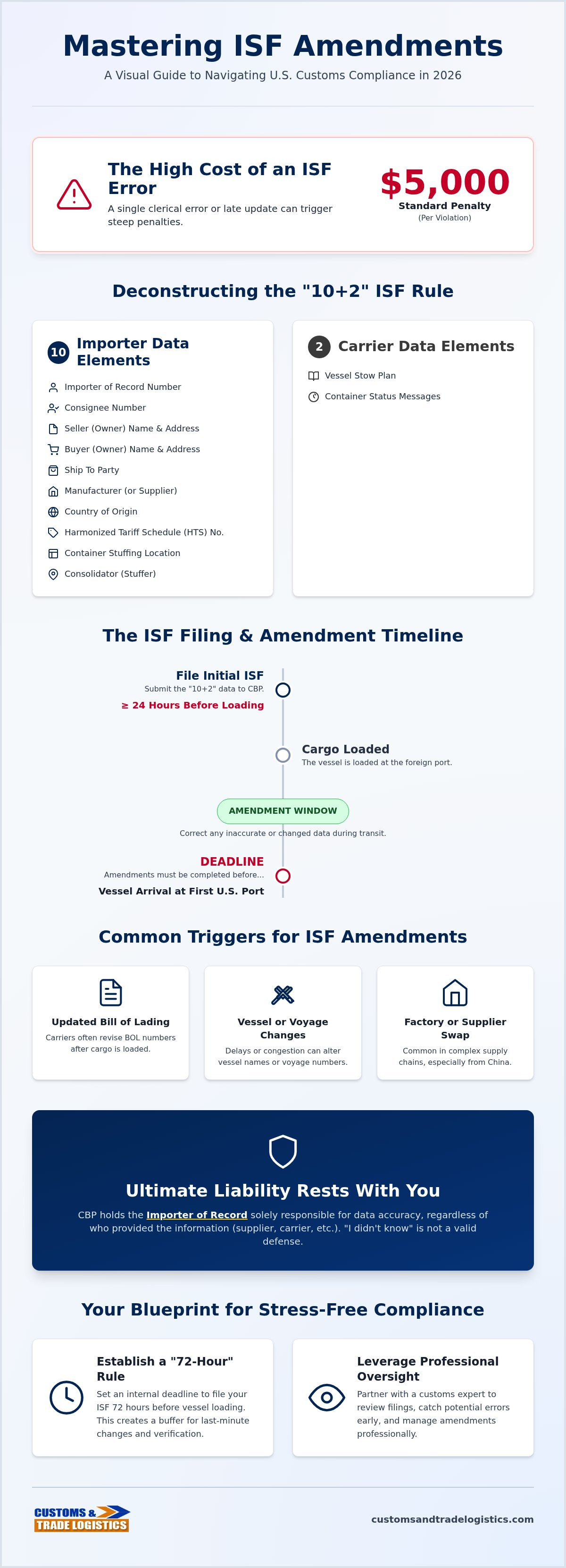
ISF is a mandatory security document required by CBP for all ocean freight arriving in the US. Think of it as a digital manifest that tells the government exactly what's inside your containers before they cross the horizon. This filing, often called the "10+2" rule, ensures that U.S. Customs and Border Protection (CBP) has visibility into cargo before it ever leaves a foreign port. The data required includes:
- Importer and Consignee details: Who is buying and receiving the goods.
- Origin info: The manufacturer, country of origin, and container stuffing location.
- Product data: The Harmonized Tariff Schedule (HTS) number and buyer/seller information.
- Carrier details: The vessel stow plan and container status messages.
It's vital to distinguish between a late filing and an amendment. A late filing occurs when the initial submission misses the deadline, which usually triggers an immediate red flag. Learning how to amend an ISF filing, however, is about correcting data that was submitted on time but has since changed or was discovered to be inaccurate. Fixing these mistakes before they're flagged by an officer is the key to maintaining a clean compliance record.
The 24-Hour Rule vs. The Amendment Window
CBP requires the initial ISF to be filed at least 24 hours before the cargo is loaded onto the vessel at the foreign port. This is the most critical compliance metric. The legal foundation for these requirements stems from the SAFE Port Act of 2006, which granted CBP the authority to collect this data for security screening. While the loading deadline is strict, there's a degree of flexibility for corrections. You can generally amend your filing up until the vessel reaches the first U.S. port. This window is essential for maintaining smooth customs clearance services us timelines, as it allows you to align your filing with the final Bill of Lading once the ship is underway.
Who is Legally Responsible for Corrections?
In 2026, the Importer of Record remains the party with ultimate liability for data accuracy. Even if your supplier or carrier provides the specific details, CBP holds you responsible for what's submitted under your bond. If the manufacturer changes at the last minute or the HTS code is incorrect, you must initiate the fix. CBP doesn't view "I didn't know" or "my supplier gave me the wrong info" as a valid defense. Knowing how to amend an ISF filing proactively shows you're acting as a diligent partner in global trade. It positions you as a "safe pair of hands" in the eyes of the government, which can be a deciding factor if they ever review your shipment for potential penalties.
Common Scenarios Requiring an ISF Correction
Shipping data is rarely static. Between the time you file your ISF and the moment the vessel arrives, several variables can shift. The most frequent reason you will need to know how to amend an ISF filing is an updated Bill of Lading (BOL) number. Carriers often issue a preliminary BOL that is later revised once the cargo is actually loaded. If the number on your filing doesn't match the final manifest, it's an automatic mismatch in the CBP system. Similarly, vessel names or voyage numbers can change due to port congestion or mechanical delays, requiring a quick update to keep your filing valid. The Importer Security Filing (ISF) rule exists to provide security, but CBP understands that logistics reality involves these types of changes.
The China Import Challenge
When you are sourcing goods from overseas, communication gaps can lead to significant data discrepancies. It's common for a factory in Ningbo to move production to a different facility at the last minute or for a trading company to swap suppliers without immediate notice. Because import from China logistics involves so many moving parts, proactive oversight is essential. If the manufacturing location or the country of origin changes after you've submitted your "10+2" data, you must amend the filing. In 2026, ports are increasingly proactive about initiating liquidated damages claims for these specific mismatches, making it vital to verify factory details before the container hits the water.
Amazon FBA and E-commerce Pitfalls
E-commerce sellers face a unique set of challenges, particularly when shipping to multiple Amazon fulfillment centers. A frequent error involves the "Consignee" or "Ship-to" address. If Amazon changes your designated warehouse after the ISF is filed, the data no longer reflects the actual destination of the goods. Integrating your ISF process into your FBA freight forwarding services workflow helps catch these errors early. Automated filing systems sometimes miss granular SKU-level data or use outdated warehouse addresses, which can lead to expensive cargo holds. If you're feeling overwhelmed by these technical requirements, reaching out to a trusted customs partner can provide the "safe pair of hands" needed to keep your supply chain moving. Correcting these errors before the ship reaches the U.S. port is the most effective way to avoid the headache of a formal penalty.
Step-by-Step Guide: How to Amend an ISF Filing
Found a mistake on your submission? Don't panic. Correcting the record is a routine part of international trade, provided you act before the cargo arrives. The first step in learning how to amend an ISF filing is conducting a side-by-side comparison between your initial submission and the final, carrier-issued Bill of Lading. Mismatched container numbers or house bill details are the most common culprits. Once you identify the discrepancy, contact your customs broker to initiate the electronic amendment through the Automated Broker Interface (ABI).
Your broker will typically use the "Replace" function within the ABI to swap out inaccurate data with the correct information. Unlike the "Add" function, which is used for entirely new data sets, the replace function maintains the integrity of your original filing date while updating the specific 10+2 elements. After the transmission is sent, your most important task is verifying the update. You must ensure you receive a new "Accepted" status from CBP. Without this confirmation, your previous, incorrect filing remains the record of truth in the eyes of the government.
Gathering Supporting Documentation
To ensure the amendment is 100% accurate, you'll need the final commercial invoice and packing list. These documents serve as your "source of truth" for HTS codes and manufacturer details. It's also a best practice to keep a brief log explaining why the amendment was necessary. Whether it was a factory change or a carrier clerical error, having this narrative on hand is invaluable during future audits. This level of diligence proves you're a responsible importer who prioritizes compliance over convenience.
Timing Your Amendment for Success
The "Golden Rule" of ISF compliance is to amend before the vessel reaches the first U.S. port. Amending while the ship is still at sea is generally viewed as a good-faith effort to provide accurate data. Understanding liquidated damages and penalty mitigation is crucial here; fixing errors early is the most effective way to avoid the $5,000 fine. If you discover an error after the ship has docked, the scrutiny increases significantly, and the mitigation process becomes much more complex.
Keep in mind that while minor corrections are part of the shipping process, frequent amendments can impact your custom brokerage service fees and overall processing costs. Most brokers include basic filing in their packages, but labor-intensive corrections may incur additional administrative charges. Staying organized and submitting the right data the first time is always the most budget-friendly strategy for your business in 2026.
Liquidated Damages and Penalty Mitigation
The financial weight of a U.S. Customs penalty is enough to strain any small business's resources. CBP calculates these "liquidated damages" at a flat rate of $5,000 per inaccurate filing. In the 2026 enforcement reality, ports are no longer required to issue warnings before assessing a claim, meaning a single mistake can lead to an immediate bill. If your shipment contains multiple errors, such as being both late and inaccurate, those fines can stack up to a maximum of $10,000 per shipment. First-time offenders can often have fines reduced to $1,000-$2,500 through a formal petition. This is why knowing how to amend an ISF filing quickly is your most valuable defense against escalating costs. It shows the government that you're a proactive importer who takes compliance seriously.
The Petition for Relief Process
If you receive a penalty notice, don't ignore it. The clock starts ticking immediately, and you typically have a 30-60 day window to file a formal response. Your goal is to draft a clear narrative that highlights your cooperation and the specific "Remedial Actions" you've taken to prevent future mistakes. CBP officers look for factors like whether this is a first-time offense and how quickly you corrected the record. Showing that you mastered how to amend an ISF filing as soon as the error was discovered acts as proof of your commitment to compliance. A well-crafted petition, supported by your broker's expertise, can be the difference between a business-ending fine and a manageable settlement that keeps your operations running.
Hidden Costs: Holds and Inspections
The $5,000 fine is only the visible part of the iceberg. Late amendments often trigger Non-Intrusive Inspections (NII), where your container is pulled aside for X-ray or physical review. While your cargo sits in the inspection area, you're still responsible for mounting demurrage and pier storage fees. These daily costs can quickly exceed the actual penalty amount and eat into your profit margins. Maintaining a clean compliance history protects your supply chain long-term, ensuring your goods move through the port without unnecessary delays or added expenses. If you're currently facing a penalty notice or need help with a correction, our team can help you navigate the CBP mitigation process with the care and expertise your business deserves.
Professional Compliance: Preventing Future ISF Stress
The best way to handle a U.S. Customs penalty is to ensure it never happens in the first place. While you now know how to amend an ISF filing, relying on amendments as a primary strategy is risky. Instead, we recommend establishing a strict "72-hour" internal deadline for all data collection. By requiring your suppliers to provide 10+2 details three days before the cargo is scheduled to load, you create a vital buffer for verification. This proactive approach allows you to cross-reference factory names and HTS codes without the pressure of a departing vessel, turning the ISF into the first step of your logistics flow rather than a last-minute scramble.
For many businesses, especially those just starting, the complexity of global trade can feel like a heavy administrative burden. Utilizing expert consulting for import logistics for startups helps you build a clean compliance record from day one. Standardizing your documentation flow ensures that every partner in your supply chain knows exactly what's required and when. When your paperwork is organized, your cargo moves faster, and your risk of liquidated damages drops significantly.
Why a Seasoned Broker is Your Best Defense
There's no substitute for human oversight in a world of automated systems. While software can file data, it often lacks the intuition to spot a missing digit in a Bill of Lading or an outdated warehouse address. With 35+ years of experience navigating port-specific CBP nuances across the country, our family-owned firm acts as your "safe pair of hands." We've seen how subtle changes in enforcement can impact different ports in 2026, and we use that veteran knowledge to protect your shipments. Think of your broker not just as a service provider, but as a mentor who helps your e-commerce brand grow with confidence.
Next Steps for At-Risk Importers
If you've struggled with filing errors in the past, it's time for a change. Start by conducting a thorough "Compliance Audit" of your current shipping pipeline to identify where communication breaks down. Set up automated alerts for ISF amendment deadlines so you're never caught off guard by a vessel's arrival. Most importantly, don't wait for a penalty notice to seek professional help. If you're unsure about your current process, Contact Customs and Trade Logistics today for a professional review of your ISF workflow. We'll help you master how to amend an ISF filing when necessary and build a bulletproof strategy for everything that follows.
Securing Your Supply Chain for 2026 and Beyond
Mastering the details of your "10+2" data is more than just a regulatory hurdle; it's a vital part of protecting your business's financial health. We've explored how identifying errors early and knowing exactly how to amend an ISF filing can save you from $5,000 liquidated damages and costly cargo holds. Remember that CBP enforcement is stricter than ever in 2026, but these challenges are manageable with the right systems in place. Whether you're dealing with factory changes in China or updated Bill of Lading numbers, acting with speed and precision is your best defense.
Don't let administrative paperwork slow down your growth. With 35+ years of customs brokerage experience, our family-owned team acts as a dedicated advocate for your success. We specialize in China-to-US import logistics and provide the personalized care you won't find with automated platforms. Let our experts manage your ISF compliance today and enjoy the peace of mind that comes with a "safe pair of hands." You've built a great business; let's work together to keep it moving forward.
Frequently Asked Questions
Can I amend my ISF after the ship has already departed?
Yes, you can amend your filing after departure. Most importers wait until the ship is at sea to receive the final Bill of Lading from the carrier. You typically have until the vessel reaches its first U.S. port of call to submit updates. Correcting data during transit is considered a good-faith effort to maintain accuracy and is much safer than waiting until the cargo hits the pier.
Is there a grace period for late ISF filings in 2026?
There is no formal grace period for late filings in 2026. U.S. Customs has moved toward strict enforcement to ensure national security. If you miss the 24-hour pre-loading deadline, a $5,000 liquidated damages claim can be issued immediately. While you can still file late, you'll likely need to navigate the mitigation process to reduce the resulting penalty. Staying ahead of the clock is your only guaranteed protection.
What is the difference between an ISF fine and liquidated damages?
Technically, "liquidated damages" refers to the $5,000 claim filed against your bond for a contract breach. An "ISF fine" is the colloquial term for the final payment you make after a petition for relief. Learning how to amend an ISF filing before CBP discovers the error is the most effective way to avoid these technical claims entirely. Acting as your own advocate ensures your compliance record stays clean.
Will an ISF amendment trigger a mandatory cargo inspection?
An amendment doesn't automatically trigger an inspection, but the timing is influential. Routine updates made while the vessel is mid-ocean are rarely flagged. However, if you change high-risk data like the country of origin or HTS codes right before arrival, CBP may pull the container for a Non-Intrusive Inspection. Their goal is to verify that the cargo matches the new data before it's allowed to leave the terminal.
How much does it cost to have a broker file an ISF amendment for me?
Brokerage fees for amendments depend on your specific service contract. While the initial filing is a standard charge, amendments often involve extra labor to verify new documents and resubmit data through the electronic system. Some firms charge a flat administrative fee per correction. It's a small price to pay compared to a $5,000 fine, but maintaining accurate data from the start is always the most cost-effective approach for your business.
What happens if my supplier provides incorrect data for the ISF?
You are legally responsible for all data submitted under your importer bond. Even if a factory in China provides the wrong stuffing location or manufacturer details, CBP holds you liable for the accuracy of the filing. This is why mastering how to amend an ISF filing is so important. You must cross-reference all supplier data with your final packing list to catch these discrepancies before they turn into expensive legal violations.
Can I get a late ISF penalty waived entirely if I amend it quickly?
It's very difficult to get a penalty waived entirely, but you can certainly have it reduced. For a first-time offense where you amended the error quickly, CBP often mitigates the $5,000 claim down to $1,000 or $2,500. This reduction isn't automatic; you must file a formal petition for relief. Showing that you took immediate remedial action is the strongest argument you can make to the port director.
Do Amazon FBA sellers have different ISF amendment requirements?
Amazon sellers follow the same rules as other importers, but their "Ship-to" data is more prone to changes. If Amazon reroutes your container to a different fulfillment center after you've filed, you must update the consignee address immediately. Accurate data is essential for smooth FBA operations. Any mismatch between your filing and the actual delivery location can cause delays that lead to stockouts and lost revenue on the platform.


