

What if the biggest risk to your supply chain isn't a global shipping delay, but the person managing your paperwork? If you're constantly chasing down your current broker for updates or finding "hidden" fees on every invoice, you've likely realized that your business has outgrown its current partnership. Many importers hesitate to move because they fear a messy transition will trigger a US Customs audit or leave containers stranded at the port. Learning how to change customs broker doesn't have to be a gamble. It's a strategic upgrade that can safeguard your operations while providing the professional oversight you've been missing.
You deserve a partner who acts as a safe pair of hands, offering the proactive support and transparent pricing your growth requires. It's possible to switch to a more reliable firm without disrupting your flow of goods. In this 2026 transition guide, we'll walk you through the exact steps to revoke your current Power of Attorney and set up new electronic filings under the latest CBP requirements. You'll discover how to vet a new partner and ensure your compliance remains airtight, turning a stressful hurdle into a seamless move toward a more secure future and total peace of mind.
Key Takeaways
- Identify the critical red flags, such as hidden service fees and communication gaps, that signal your business has outgrown its current brokerage partnership.
- Master the exact step-by-step timeline for how to change customs broker to ensure a seamless transition that keeps your shipments moving through the port.
- Understand your legal rights regarding the Customs Power of Attorney (POA) and how to properly revoke it without risking compliance penalties.
- Learn the essential criteria for vetting a new partner, prioritizing firms with 35+ years of experience and a mentor-led approach to global trade.
- Discover how a structured "cut-over" strategy can eliminate administrative friction and provide the transparent, proactive support your supply chain deserves.
Recognizing When It Is Time to Switch Your Customs Broker
Is your current broker helping your business grow, or are they just another obstacle in your path? Many importers stick with a subpar provider because they don't know how to change customs broker without causing a catastrophe. However, staying with a partner who misses deadlines or ignores your calls is a choice that carries real financial weight. When communication breaks down, your supply chain velocity stalls, and your bottom line suffers. You shouldn't feel like you're an inconvenience to the person handling your legal compliance.
The Hidden Costs of a Bad Broker Relationship
A broker's mistakes rarely stay on paper; they manifest as physical delays and expensive bills. If your shipments are frequently flagged for exam or held up because of missing documentation, you're likely paying for it through demurrage and port storage fees. These costs add up quickly, often exceeding the price of the brokerage service itself. Even more dangerous is the risk of incorrect HTS classification. US Customs holds the importer of record responsible for every entry, so a broker's negligence can lead to heavy penalties and increased audit scrutiny. You shouldn't have to micromanage your logistics partner just to stay compliant; they should be the ones providing you with a sense of security.
When Your Business Outgrows Your Current Logistics Support
What worked for your first three shipments might not sustain a high-volume operation. As you scale, especially if you're importing from China or selling via Amazon FBA, your needs become more complex. You need more than just a data-entry clerk. You need a mentor who understands the nuances of global trade and acts as a stabilizing force for your operations. Learning how to change customs broker is often the first step toward reclaiming your time and peace of mind.
Consider these common signs that it's time for an upgrade:
- Generic Support: You're routed to a helpdesk rather than a dedicated expert who knows your business history.
- Lack of Specialization: Your broker struggles with the specific requirements of Amazon warehouses or complex entries from China.
- Hidden Fees: Your invoices are filled with "miscellaneous" charges that were never discussed or explained.
Choosing a family-owned firm with over 35 years of experience offers a level of care that faceless digital forwarders often lack. A seasoned partner doesn't just file entries; they provide the consulting necessary to navigate shifting regulations. If you're feeling overwhelmed by the scale of your international operations, it's a sign that you need a more supportive bridge to the global marketplace and a dedicated advocate who values personal connection.
The Legal Mechanics: Understanding the Power of Attorney (POA)
A Customs Power of Attorney (POA) is the legal engine that allows a broker to act on your behalf. Without this document, a broker can't file entries, clear cargo, or communicate with US Customs and Border Protection (CBP). Many importers worry that signing a POA binds them to a provider forever, but that's a common misconception. A POA is a grant of authority, not an exclusive or permanent contract. You have the legal right to revoke this authority at any time if the service no longer meets your standards. Understanding this foundation is the first step in learning how to change customs broker with confidence and clarity.
How to Properly Revoke a Customs Power of Attorney
Ending the relationship requires a formal "Notice of Revocation." This isn't just a casual email; it's a legal notification that protects your business from unauthorized filings. You should draft a formal letter on your company letterhead that includes your specific IRS or Importer Number and a clear statement that the POA is revoked effective immediately or on a specific "cut-over" date. Knowing exactly how to change customs broker legally protects you from administrative gaps during the transition period.
To ensure the process is airtight, follow these steps:
- Include your full legal company name and tax ID.
- State the specific date the revocation takes effect.
- Send the document via a traceable method, such as certified mail or a courier service with a signature requirement.
Once the broker receives this notice, they're barred from filing new entries in your name. However, CBP regulations still require the former broker to maintain records of past entries for five years. Clear, documented communication ensures there's no confusion about who's responsible for your cargo at any given moment.
Setting Up Your New POA for Success
Establishing a new partnership requires providing your new broker with the authority to move your goods. You'll need to decide between a "Limited" POA, which restricts authority to specific ports, and a "General" POA, which offers broader national coverage. Most growing businesses prefer the General POA to ensure their Customs Clearance Services in the US remain uninterrupted across all ports of entry. When you're ready for a more reliable partnership, you can consult with our team to streamline this paperwork and secure your supply chain.
To set up the new POA, you'll need your corporate tax ID and proof of signing authority, usually from a corporate officer. This simple document acts as your shield, ensuring that your new partner has the legal standing to defend your interests and manage your compliance with the care your business deserves. By coordinating the start of the new POA with the revocation of the old one, you create a seamless bridge that keeps your supply chain moving without a single day of downtime.
Vetting Your Next Partner: What to Look for in a New Broker
Choosing a new partner is the most critical stage of learning how to change customs broker successfully. You aren't just looking for someone to file paperwork; you're looking for a dedicated advocate who understands the stakes of your business. A licensed broker is a baseline requirement, but true expertise comes from decades of navigating shifting trade wars and regulatory updates. Prioritizing a firm with over 35 years of experience ensures that your shipments are managed by someone who has seen every possible port delay and knows how to resolve it before it costs you money.
The Value of a Family-Owned Mentorship Approach
Large logistics conglomerates often treat small and medium businesses as numbers in a queue. You might get a different agent every time you call, leading to fragmented communication and repeated errors. In contrast, a family-owned firm offers a "safe pair of hands" and a consistent point of contact. This mentorship is especially vital for import logistics for startups, where the learning curve for global trade is steep. Having a seasoned veteran to bridge the gap between your operations and the global marketplace replaces anxiety with a sense of security.
When vetting your next partner, consider these essential qualities:
- Proactive Communication: Do they reach out with updates, or do you have to hunt them down?
- Niche Expertise: Can they handle the specific complexities of imports from China or the rapid pace of e-commerce logistics?
- Fee Transparency: A reliable broker provides clear, upfront information about custom brokerage service fees without burying costs in "administrative" fine print.
Technical Capabilities and Compliance Standards
Your business needs a partner with national reach. While some brokers only operate in specific regions, you need the flexibility to clear cargo at any US Customs port as your sourcing evolves. Beyond just filing entries, look for a broker who offers proactive consulting on HTS codes and duty-saving strategies. This level of oversight protects you during audits and ensures you aren't overpaying on tariffs. As you research how to change customs broker, focus on firms that value personal connection as much as technical compliance. A clean record with US Customs and a history of successful audits aren't just proof points; they're the foundation of a partnership that lets you sleep at night while your goods are in transit.
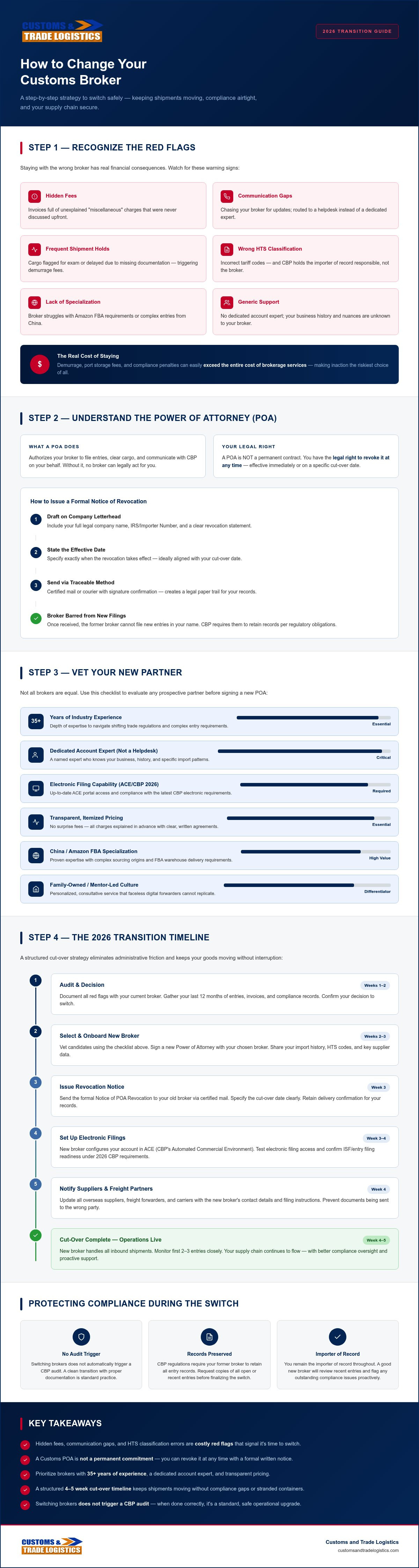
Step-by-Step: The 2026 Transition Timeline to Avoid Delays
Switching your logistics partner is a methodical process that rewards careful planning. It's like a relay race where the baton must be passed at exactly the right moment to maintain speed. When you're determining how to change customs broker, you need to look beyond the paperwork and focus on the timeline. A rushed transition leads to errors, but a deliberate one ensures your cargo never stops moving. This five phase approach acts as your roadmap to a more reliable partnership.
- Phase 1: Secure Your New Advocate. Research and select your new broker before you notify your current provider. This ensures you have a "safe pair of hands" ready to catch your shipments before you let go of the old ones.
- Phase 2: Set the Cut-Over Date. Choose a specific date for the transition. This is typically a window between major arrivals where no cargo is currently sitting at a US port.
- Phase 3: Synchronize the Paperwork. Execute the new Power of Attorney and the Revocation of the old authority simultaneously. This prevents any legal gaps where no one has the authority to act on your behalf.
- Phase 4: Knowledge Transfer. Move your HTS databases and historical entry records to the new firm. This allows your new mentor to understand your compliance history and sourcing patterns.
- Phase 5: The Live Test. Confirm that the new broker has successfully filed their first entry. Once this clears, the transition is complete and you can move forward with total peace of mind.
Managing Live Shipments During the Switch
The golden rule of a smooth transition is to avoid switching mid-stream. If a shipment has already reached a US port, it's best to let the old broker finish the job. They already have the documentation and are familiar with that specific entry. For all upcoming cargo, ensure your new broker handles the Importer Security Filing (ISF) well before the ship leaves the foreign port. You must also communicate this change to your foreign suppliers. Providing them with the new broker's contact info prevents documentation errors that could lead to costly delays. If you're ready to start this process, you can request a transition consultation to see how we manage the heavy lifting for you.
Data Migration: What to Take With You
You aren't just moving your business; you're moving your history. Request your HTS classification list and at least seven years of entry data from your current broker. This isn't just helpful for your new partner; it's a legal requirement for your records. Ensure your Continuous Import Bond remains valid and accessible so the new broker can attach it to future entries. For those utilizing FBA freight forwarding services, provide your new broker with your specific Amazon warehouse requirements. This level of detail ensures that your new partner can provide the proactive support and specialized consulting your growth requires.
Making the Switch to Customs and Trade Logistics
Choosing to move your business to a new logistics partner is more than just a paperwork update; it's a commitment to your company's future stability. At Customs and Trade Logistics, we offer a "safe pair of hands" built on over 35 years of dedicated industry experience. We recognize that while you may now understand the mechanics of how to change customs broker, the actual execution requires a partner who can manage the technical details while you focus on growth. Our team provides national coverage across all US Customs ports, ensuring that your transition is handled with the precision and care that only a veteran consultancy can provide.
Our Commitment to Your Growth
We pride ourselves on acting as a vital bridge between small-scale operations and the global marketplace. As a family-owned and operated firm, our success is directly tied to yours. We don't just file entries; we act as mentors who help you navigate the intimidating world of international trade. This personal investment is exactly why our clients stay with us for decades. They value the reliability and relief that comes from having a steady, professional force managing their administrative burdens. Our specialized expertise allows us to proactively optimize your entire import from China logistics, looking for efficiencies and duty-saving strategies that generic helpdesks often overlook.
Ready to Upgrade Your Logistics?
If you're ready to replace communication breakdowns and hidden fees with transparent pricing and proactive support, we're here to help. Our onboarding process is methodical and designed to minimize friction for your internal team. We take over the coordination of the "cut-over" date and ensure that your electronic filings are airtight from day one. Don't let the fear of a complex transition keep you tied to a broker that no longer serves your needs. When you partner with us, you're joining a community of importers who value personal partnership and technical excellence.
Schedule a consultation today to discuss your current volume and pain points. Let us show you how to change customs broker smoothly, providing you with a clear path to peace of mind in today's unpredictable trade environment. We'll handle the heavy lifting of the transition so you can get back to what you do best: growing your business.
Securing a Smoother Future for Your Global Trade
Moving to a new brokerage partner is a strategic step toward reclaiming your time and protecting your profit margins. A Power of Attorney is a tool you control, and a methodical timeline is your primary defense against port bottlenecks. Learning how to change customs broker is the final hurdle between your current frustrations and a future of clear communication. You deserve a partner who values your business as much as you do. Don't let the fear of a complex process keep your supply chain in limbo.
At Customs and Trade Logistics, we provide the stabilizing force your operations need to thrive. With 35+ years of industry experience, national port coverage, and a family-owned perspective, we act as a dedicated bridge to the global marketplace. Ready for a reliable partner? Contact Customs and Trade Logistics today for a seamless transition. We're here to be your safe pair of hands, ensuring your supply chain remains secure and your growth remains uninterrupted. Let's build a more resilient future together.
Frequently Asked Questions
Can I have more than one customs broker at the same time?
Yes, you can. Many importers use different brokers for specific ports or modes of transport. However, it's often more efficient to consolidate with one trusted partner who understands your entire compliance history. Having a single point of contact reduces the risk of miscommunication and ensures consistent HTS classification across all your entries. This centralization provides a clearer overview of your logistics and helps your mentor identify long-term savings for your business.
How much does it cost to switch customs brokers?
Most customs brokers don't charge a specific "switching fee" to onboard new clients. Your primary costs will be the standard service fees for filing entries and any administrative time your team spends gathering historical data. It's important to request a transparent fee schedule from your new partner to avoid unexpected charges during the first few months. A reliable firm will be upfront about their costs to ensure you feel a sense of security.
Will my shipments be delayed if I change brokers mid-transit?
Shipments typically aren't delayed if you coordinate the transition correctly. The best practice is to let the original broker clear any cargo already at the port while your new partner handles ISF filings for upcoming shipments. If you're wondering how to change customs broker without disruption, timing the revocation of your old Power of Attorney between major arrivals is the most effective strategy. This proactive approach keeps your supply chain moving steadily and safely.
What documents do I need to provide to a new customs broker?
You'll need to provide a signed Power of Attorney, your IRS or Importer Number, and a copy of your Continuous Bond. Additionally, sharing your HTS classification database and past entry records helps your new mentor maintain compliance. Providing these documents early allows your new partner to review your history and identify potential duty-saving opportunities before your first shipment arrives. This thorough preparation ensures your new safe pair of hands is ready for action immediately.
How do I revoke a Power of Attorney with my old broker?
You revoke a Power of Attorney by sending a formal Notice of Revocation on your company letterhead. This document must clearly state your intent to end the broker's authority and include a specific effective date. Sending this via a traceable method, such as certified mail, ensures you have legal proof that the relationship has ended. This step protects your business from unauthorized filings and provides total resolution as you move to a new partner.
Is a customs broker the same as a freight forwarder?
No, these roles serve different functions in your supply chain. A freight forwarder manages the physical movement and logistics of your goods, while a customs broker focuses on legal compliance and clearing cargo through US Customs. While some firms offer both, choosing a specialist for customs clearance ensures you have a dedicated advocate focused specifically on HTS codes. This specialized oversight is vital for navigating the complex administrative requirements of international trade and national ports.
How long does the process of changing brokers typically take?
The administrative portion of the switch can happen in as little as 24 to 48 hours. However, the full transition, including data migration and supplier coordination, usually takes one to two weeks. Starting the process early allows your new partner to conduct a thorough review of your sourcing patterns and ensure all electronic filings are ready before your next vessel departs. This methodical pacing ensures no stage of your transition feels rushed or overlooked by your team.
What happens to my Continuous Bond when I switch brokers?
Your Continuous Bond remains valid and travels with you to your new broker. You don't need to purchase a new bond as long as your current one is active and has sufficient coverage. You simply provide the bond number and a copy of the bond to your new partner, who will then associate it with your new entries at any US port. This continuity prevents gaps in your coverage and maintains your professional standing.


