

What if the only thing standing between your shipment and a costly seizure at the docks isn't a tax, but a simple financial handshake? Many business owners searching for an importer's guide to customs bonds find themselves staring at a Customs and Border Protection (CBP) form, wondering if they really need to pay for a bond on top of their duties. It's completely natural to feel anxious about these unpredictable costs, especially when the line between insurance and compliance feels so blurry.
We understand you're looking for a partner to help you navigate these regulations. You've worked hard to source your products, and the last thing you need is a surprise fine or a shipment stuck in limbo. We're here to demystify the process and act as your seasoned mentor through the 2026 trade landscape. Our goal is to replace that administrative burden with a sense of security.
In this guide, you'll discover exactly when a customs bond is mandatory and when you can skip it. We'll provide a clear yes or no answer based on the current $2,500 threshold and show you the cheapest way to stay compliant without overpaying. You'll learn the difference between single entry and continuous bonds, ensuring your goods move smoothly through any U.S. port while you focus on growing your business.
Key Takeaways
- Learn how a customs bond functions as a three-party guarantee that protects your business from shipment seizures and ensures all federal duties are covered.
- Identify exactly when a bond becomes mandatory, including the critical $2,500 formal entry threshold and special rules for regulated goods.
- Compare Single Entry versus Continuous Bonds to find the most budget-friendly option for your specific import volume and frequency.
- Avoid the "bond traps" and silent fines that derail many businesses by using this importing through the port of Baltimore guide to navigate current CBP regulations.
- Gain peace of mind with a clear, step-by-step roadmap to securing your bond and ensuring your freight moves smoothly through any U.S. port.
What Is a Customs Bond? Understanding the Three-Party Guarantee
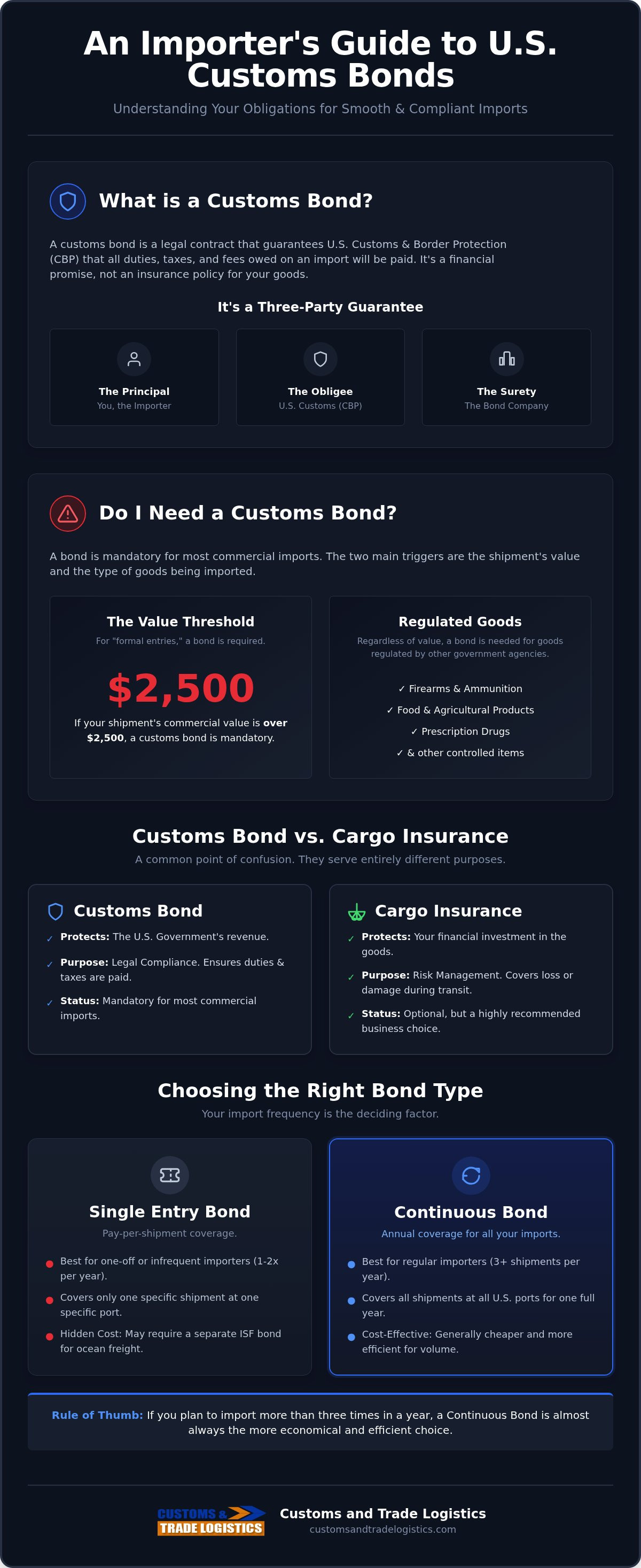
A customs bond is essentially a legal contract that guarantees the U.S. government will receive all duties, taxes, and fees owed on imported goods. If you're using this importing through the port of Baltimore guide to get your business started, understanding this bond is your first step toward total compliance. It's not a tax, but a promise. It acts as a financial bridge between your business and federal regulations, ensuring that international trade remains orderly and predictable.
Think of it as a Surety Bond, which involves three distinct parties working together. First, there's the Principal, which is you, the importer. You're the one making the promise to follow the rules and pay what's owed. Second, there's the Obligee, which is U.S. Customs and Border Protection (CBP). They're the ones receiving the promise. Finally, there's the Surety, the company that backs your promise with their financial weight. After 35 years of helping small businesses, we've found that visualizing this triangle makes the legal jargon much easier to digest.
The Role of the Surety Company
The surety company acts as a professional co-signer for your financial obligations. CBP requires this because they need to know that even if a business disappears or faces a financial crisis, the government won't lose out on revenue. If you don't pay your duties, the surety pays CBP immediately. However, this isn't a "get out of jail free" card. The surety will then seek full reimbursement from you. Because this is a serious financial commitment, CBP only accepts bonds from licensed U.S. surety companies that meet strict federal standards.
Customs Bond vs. Cargo Insurance
One of the most common mistakes we see is importers thinking a bond protects their merchandise. It doesn't. A customs bond protects the government's wallet, not yours. If your container falls off a ship or gets damaged during transit, the bond won't pay you a dime. It's a tool for compliance, not for recovery of lost assets.
Cargo insurance is what you need to protect your own investment. While the bond is a legal requirement for most commercial shipments, insurance is a business choice. We always tell our clients that a secure shipping chain requires both. The bond keeps you legal and keeps your freight moving, while insurance gives you peace of mind that a logistical accident won't bankrupt your company. When you're importing through the port of Baltimore guide or any other major entry point, having both layers of protection is simply smart business.
Continuous vs. Single Entry Bonds: Choosing the Right Type
How many times do you plan to ship goods into the United States this year? This is the first question we ask our clients because the answer determines your most cost-effective path. While using this importing through the port of Baltimore guide to plan your logistics, you'll need to decide between a Single Entry Bond (SEB) and a Continuous Bond. Think of it like buying a single-use ticket versus an annual pass; the right choice depends entirely on your frequency and long-term goals.
For official CBP Bond Information, the government provides technical breakdowns, but the practical choice for most small businesses comes down to the "break-even" point. Generally, if you're importing more than three or four times in a twelve month period, a continuous bond becomes the cheaper and more efficient option. We've spent 35 years helping importers find that sweet spot where compliance meets budget-friendly operations.
When to Choose a Single Entry Bond
A Single Entry Bond is often the right move for a startup testing the market with a one-off shipment. If you've only ordered a single container to see if a product sells, you don't need a year-long commitment. However, keep in mind that an SEB only covers one specific entry at one specific port. If you're shipping via ocean freight, there's a hidden complication: the ISF factor. CBP requires an Importer Security Filing (ISF) for ocean shipments, which usually demands its own separate bond if you're using an SEB. These repetitive paperwork requirements and extra filing fees can quickly eat into your margins.
The Benefits of a Continuous Customs Bond
If you're building a brand or utilizing FBA freight forwarding services, a continuous bond is almost always the superior choice. This bond stays on file for a full year and covers every shipment you bring into any U.S. port. It streamlines the entire process, allowing your goods to move through customs without the delay of securing a new bond for every arrival.
When you work with a partner for your customs clearance services us, they can manage this bond automatically on your behalf. This "set it and forget it" approach provides immense relief to business owners who already have enough on their plates. If you aren't sure which bond type fits your current volume, you can consult with our family-run team to get a clear, honest recommendation for your business.
Do I Need a Customs Bond? Mandatory Requirements for US Importers
Determining if you need a bond doesn't have to be a guessing game. The primary rule is simple: if your commercial shipment is valued over $2,500, it's considered a formal entry and a bond is mandatory. Even if you're using an importing through the port of Baltimore guide to plan a smaller shipment, you might still need one if your goods fall under the oversight of other government agencies. Items like food, textiles, or chemicals often require a bond regardless of their dollar value because of the extra regulatory scrutiny they receive.
It's also important to distinguish between personal and commercial imports. If you're buying a single piece of furniture from overseas for your own home, you typically won't need a bond unless the value is exceptionally high. However, as soon as you import items to sell or for business use, CBP views you as a commercial entity. For more details on these legal necessities, the U.S. Customs and Border Protection guide provides a deep dive into the statutory requirements for all U.S. arrivals.
Formal vs. Informal Entries
The difference between a formal and informal entry usually comes down to that $2,500 threshold. Informal entries are simpler and often don't require a bond, but most import logistics for startups quickly cross into formal entry territory as business scales. A licensed broker determines your entry type by looking at your Harmonized Tariff Schedule (HTS) code. This code tells the broker if your goods are subject to anti-dumping duties or other agency rules that trigger a mandatory bond requirement regardless of the shipment's value.
Special Requirements for Amazon FBA Sellers
If you're an Amazon seller, the rules are even more specific. Amazon will not act as the Importer of Record (IOR) for your goods. This means you are legally responsible for all duties and compliance. Because FBA inventory replenishment often involves high-volume shipments, a continuous bond is almost always necessary. Without one, your freight can face significant port delays. These bottlenecks don't just cost money; they can kill your Buy Box ranking and damage your overall seller health. We've spent decades acting as a safe pair of hands for e-commerce brands, ensuring their paperwork is flawless so their inventory never stops moving.
Finally, remember that ocean freight has its own set of rules. If your goods are arriving by sea, you must file an Importer Security Filing (ISF). CBP requires a bond to secure this filing. This is another reason why a continuous bond is often the most efficient choice for businesses that rely on maritime shipping to keep their costs down.
How to Get a Customs Bond: A Step-by-Step Guide
Securing your financial passport doesn't have to be a bureaucratic nightmare. We've spent over 35 years simplifying this process for small business owners who just want to get their products to market. Whether you're a startup using this importing through the port of Baltimore guide or an established brand scaling up, the steps to secure a bond remain consistent and manageable with the right mentor by your side.
- Step 1: Identify your Importer of Record (IOR) number. For most U.S. based businesses, this is simply your Employer Identification Number (EIN). If you're a sole proprietor, your Social Security Number (SSN) will serve the same purpose.
- Step 2: Estimate your annual duties and taxes. Look at your projected sales and shipment volumes for the next 12 months. This data is critical for calculating how much bond coverage you'll actually need.
- Step 3: Partner with a licensed customs broker. While you could try to go directly to a surety company, a broker understands the nuances of CBP requirements and can expedite the application.
- Step 4: Sign the Customs Power of Attorney (POA). This legal document authorizes your broker to file entries and manage bond paperwork on your behalf.
- Step 5: Receive your bond number. Once the surety approves your application, your bond number is recorded in the CBP system, and you're ready to start importing across all U.S. ports.
The Role of Your Customs Broker
Think of your broker as a dedicated advocate who handles the heavy lifting. Buying a bond through your broker is significantly faster than trying to navigate a surety company's underwriting department on your own. We ensure your bond amount meets CBP sufficiency requirements from day one so you don't face unexpected rejections. To keep your business overhead predictable, we often bundle custom brokerage service fees with your bond costs. This creates a streamlined accounting process that lets you focus on your customers rather than paperwork.
Calculating Your Bond Amount
CBP follows a specific 10% rule for continuous bonds. The minimum bond amount is $50,000, which covers you for up to $500,000 in total annual duties, taxes, and fees. If your business grows faster than expected and your duty liability exceeds that $500,000 mark, you'll need to increase your bond coverage. This is sometimes called bond stacking, and it's a sign of a healthy, growing business. Bond sufficiency is monitored by CBP and must be updated if import volumes spike. If you're ready to move forward, our family-run team can help you secure your customs bond with professional care and personal attention.
Avoiding Common Pitfalls and 'Bond Traps' in 2026
The trade landscape in 2026 is stricter than ever, and well meaning business owners often fall into "bond traps" that lead to costly delays. One of the most significant risks is bond insufficiency. If your sales take off and your duty payments exceed your bond's limit, CBP won't just send a polite reminder. They can block your shipments entirely, leaving your inventory stranded at the docks. This is why this importing through the port of Baltimore guide emphasizes proactive management over reactive fixes. You need a partner who monitors your volume and adjusts your coverage before the government steps in.
Another danger is the silent ISF fine. For ocean freight, failing to file an Importer Security Filing (ISF) correctly can result in a staggering $5,000 penalty per shipment. If you're relying on a single entry bond and forget to secure the mandatory ISF bond that goes with it, you're essentially inviting these fines. Many startups realize too late that the "cheapest" bond option ended up being the most expensive after penalties are tallied. A continuous bond avoids this trap by covering ISF obligations automatically, providing a much needed safety net for your operations.
As your business matures, you'll likely look to diversify your supply chain. Moving from import from China logistics to a multi-origin strategy requires a bond that can handle different regulatory requirements and entry types. A continuous bond provides this flexibility, allowing you to source from various countries without filing new paperwork for every single arrival. It's about building a scalable foundation that grows with your brand.
ISF 10+2 Compliance
The link between your bond and the Importer Security Filing is critical for any sea arrival. CBP requires specific data points to be filed 24 hours before your goods are even loaded onto a vessel. By using a continuous bond, you ensure that these filings are backed by a valid guarantee every time. We call this the "Safe Pair of Hands" approach. It's designed to prevent late filing penalties and ensure your cargo moves from the ship to the warehouse without a single administrative hiccup.
Why a Family-Owned Brokerage Makes the Difference
In an industry filled with digital-only platforms, personalized oversight is a rare and valuable asset. We've spent over 35 years navigating the changing tides of U.S. Customs regulations, and we know that every business has unique needs. You aren't just a shipment number to us; you're a partner. You get direct access to experts who know your business by name and can spot potential compliance issues before they become expensive problems. Having a mentor who treats your business like their own is the ultimate advantage in this importing through the port of Baltimore guide.
Secure Your Global Growth with Confidence
A customs bond is more than just a legal requirement; it's a vital tool that keeps your supply chain moving without interruptions. Whether you're navigating the $2,500 threshold for the first time or upgrading to a continuous bond for your expanding e-commerce brand, having the right financial guarantee in place is non-negotiable. As you use this importing through the port of Baltimore guide to scale your operations, remember that staying ahead of CBP regulations is the best way to avoid seizures and unexpected fines.
With 35+ years of industry experience, our family-owned team provides the personalized oversight that digital platforms simply can't match. We offer expert handling across all U.S. ports and provide specialized support for Amazon and e-commerce importers who need a safe pair of hands. Let our family-owned team secure your customs bond today; contact Customs and Trade Logistics for a personalized consultation. You've worked hard to build your business, and we're here to ensure your international journey is smooth and successful. You don't have to handle the administrative weight alone.
Frequently Asked Questions
Can I import to the US without a customs bond?
You can import without a bond only if your shipment is an informal entry valued at $2,500 or less. However, this exception doesn't apply if your goods are subject to regulations from agencies like the FDA or USDA. For most businesses using this importing through the port of Baltimore guide, shipments quickly exceed this value. In those cases, a bond becomes a mandatory legal requirement to ensure all federal duties are paid.
How much does a continuous customs bond cost in 2026?
The cost of a continuous bond is based on the total duties, taxes, and fees you expect to pay over a twelve-month period. CBP requires a minimum bond amount of $50,000, which generally covers up to $500,000 in annual duty liabilities. The premium you pay to the surety is a small percentage of this total amount. This investment is typically much more efficient than paying for individual single entry bonds if you import frequently.
How long does it take to get a customs bond activated?
Activation times vary depending on the bond type you choose. A single entry bond can often be secured within one to two business days through your broker. Continuous bonds require more oversight and typically take between five and ten business days for CBP to process and approve. We recommend starting the application at least two weeks before your cargo departs to ensure your paperwork is ready before the ship docks at any U.S. port.
Does a customs bond expire, or do I need to renew it?
Continuous bonds do not have a fixed expiration date and will remain active as long as the annual premium is paid to the surety company. They are continuous because they cover all your entries across all U.S. ports for a full year. Single entry bonds, conversely, are designed for one specific shipment and lose their validity once that entry is liquidated. Most growing brands prefer the continuous option for its simplicity and long-term reliability.
What is the difference between a customs bond and an import license?
A customs bond is a financial guarantee that you'll pay required duties, while an import license is a specific authorization to bring certain types of goods into the country. Most products don't require a license to enter the U.S., but almost all commercial shipments require a bond. Think of the bond as your financial passport and the license as a special permit for restricted items like alcohol, firearms, or certain plants.
Do I need a bond if I am importing from China specifically?
Yes, the requirement for a bond is based on the value and nature of the goods rather than the country of origin. However, importing from China often involves higher tariff rates, which can push your shipment value over the $2,500 threshold quickly. This makes a bond practically mandatory for most China-to-U.S. trade. Using this importing through the port of Baltimore guide helps you plan for these costs and ensures your bond amount is sufficient.
What happens if I don’t have a bond when my shipment arrives at the port?
If your shipment arrives without a valid bond, Customs and Border Protection will refuse to release the cargo. Your freight will sit at the terminal, where it will begin accruing expensive daily storage fees known as demurrage. If the bond isn't secured within a specific timeframe, the government may move the goods to a general order warehouse or even seize the shipment. This creates a stressful and costly logistical bottleneck for any business.
Can an individual get a customs bond, or do I need a registered business?
You don't need a registered corporation to obtain a customs bond. Individuals can act as the Importer of Record by using their Social Security Number as their identification number. If you have a registered business, you'll use your Employer Identification Number (EIN) instead. Both options allow you to secure the necessary guarantee, though most professional importers eventually transition to a business EIN to keep their personal and commercial liabilities separate.


