

Could your "pay-as-you-go" approach to customs bonds be the very thing holding your supply chain back? For many growing importers, the $50 or $75 spent on a single entry bond feels like a minor cost of doing business. You’re focused on getting your products through the port, and a one-time fee seems safer than a yearly commitment. We understand that caution. It’s the same care you put into every other part of your brand. However, as your volume increases, those "minor" fees and the extra paperwork for ISF bonds start to add up, both in dollars and lost hours. Knowing exactly when to switch from single entry to continuous bond is a vital maturity milestone for any serious importer.
It's natural to stick with what's familiar, especially when customs regulations feel like a complex maze. This guide will show you the precise mathematical tipping point where a continuous bond becomes the cheaper, faster option for your business. We'll break down the ROI formula, explain how to eliminate ISF bond friction, and help you turn unpredictable surcharges into a steady, manageable annual cost that protects your bottom line.
Key Takeaways
- Identify the "Rule of Three" mathematical tipping point where an annual bond becomes more cost-effective than per-shipment fees.
- Discover how to eliminate the hidden costs and extra paperwork associated with separate ISF bonds for ocean-bound cargo.
- Learn exactly when to switch from single entry to continuous bond to prevent "bond-on-hold" delays and secure national coverage across all U.S. ports.
- Simplify your administrative workflow by replacing per-transaction filings with a single, predictable annual bond that acts as a utility for your business.
- Follow a clear, two-step process to analyze your historical import data and select the right bond size for your brand's current growth trajectory.
Understanding the Basics: Single Entry vs. Continuous Customs Bonds
A customs bond isn't insurance for your cargo. Instead, it's a financial guarantee to U.S. Customs and Border Protection (CBP) that all duties, taxes, and fees will be paid. If an importer fails to meet these obligations, the surety company that issued the bond steps in to cover the debt. This arrangement is based on Surety Bond Basics, creating a three-party contract between you, the surety, and the government. While CBP requires a bond for any commercial import valued over $2,500, regulated goods like food or medical devices often require one regardless of their dollar value.
How a Single Entry Bond Works
Think of the Single Entry Bond (SEB) as a "pay-as-you-go" ticket. It covers one specific shipment entering through one specific port. The cost is typically calculated based on the total value of your goods plus the estimated duties and taxes. If you're importing via ocean freight, there's an extra step. You'll need to secure a separate Importer Security Filing (ISF) bond for every single shipment. This creates a repetitive administrative cycle. You have to apply for, pay for, and track a new bond every time you place an order. Understanding when to switch from single entry to continuous bond helps you avoid this cycle as your order frequency increases.
The Mechanics of a Continuous Bond
A continuous bond acts more like an annual subscription. Once it's on file, it covers every entry you make at every U.S. port for a full 12-month period. These bonds are generally set at a minimum of $50,000, which is the amount of coverage provided to the government, not the price you pay. One of the biggest reliefs for ocean importers is that a continuous bond automatically satisfies the ISF bond requirement. You don't have to file separate paperwork or pay extra fees for ISF coverage on each container.
Deciding when to switch from single entry to continuous bond is often the first major hurdle for a growing brand. It’s a transition from reactive, shipment-by-shipment logistics to a proactive strategy. By having a bond already active and on file, you remove a significant variable from the customs clearance process, ensuring your goods move through the port without waiting for bond approval. This shift provides a sense of security, knowing your administrative foundation is solid for the year ahead.
The Financial Tipping Point: When the Math Favors a Continuous Bond
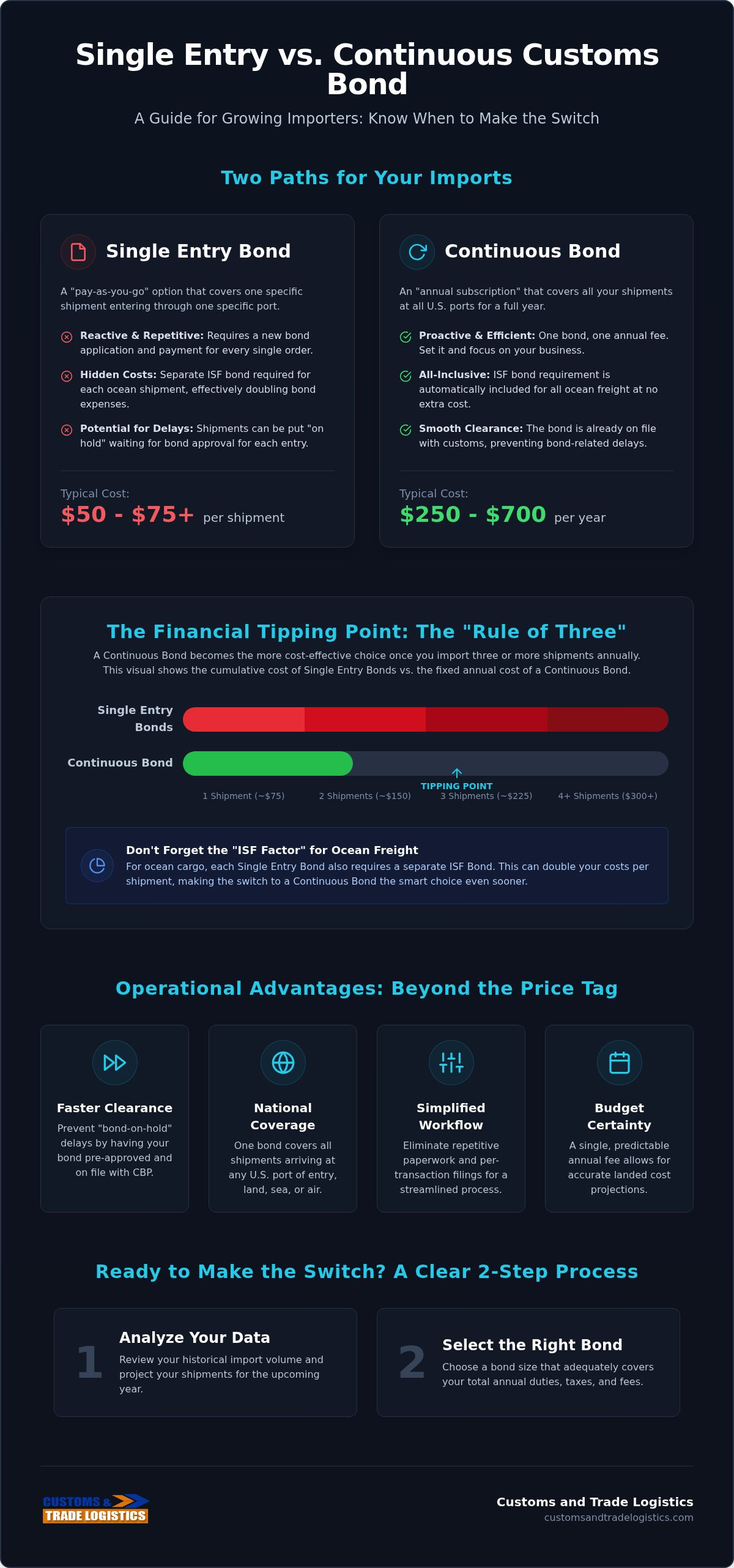
How many shipments do you plan to bring in this year? If the answer is three or more, the math usually points toward one clear conclusion. In the industry, we often call this the "Rule of Three." While a single entry bond might seem cheaper at $50 or $75 per shipment, those fees are only the tip of the iceberg. When you factor in the additional costs and administrative time, the break-even point arrives much sooner than most first-time importers expect.
Comparing the Direct Costs
A single entry bond is typically priced at a rate per $1,000 of the shipment's value, but it always comes with a minimum fee. If you're importing high-value goods, these costs can skyrocket quickly. For ocean freight, the "ISF Factor" is the real margin-killer. Every ocean shipment using a single entry bond requires a separate ISF bond. This effectively doubles your bond-related expenses for every container. In contrast, a continuous bond premium usually ranges between $250 and $700 per year, covering an unlimited number of entries and including that ISF requirement at no extra charge.
Beyond the bond premium itself, you must consider broker processing fees. Many customs clearance services us involve more manual labor when handling single entry bonds, leading to higher per-transaction surcharges. These "hidden" costs eat into your profits shipment after shipment. By consolidating these into one annual utility, you keep more money in your business.
The Value of Predictability
Budgeting becomes significantly easier when you remove the variance of per-shipment bond costs. As your cargo value fluctuates or tariff rates change, the cost of a single entry bond changes with it. A continuous bond provides a "safe pair of hands" for your financial planning, allowing you to pay one flat fee and move on. This stability is essential for growing brands that need to project their landed costs accurately. If you're feeling overwhelmed by these calculations, our team at Customs and Trade Logistics can help you audit your recent shipping history to find your specific ROI.
Bond sufficiency is a calculation where CBP ensures your bond amount covers at least 10% of the total duties, taxes, and fees you paid over the previous 12-month period. For high-volume importers, monitoring this number is vital to avoid "bond insufficient" letters that can halt your entire supply chain. Deciding when to switch from single entry to continuous bond isn't just about saving a few dollars today. It's about building a predictable, scalable foundation for your future growth.
Operational Advantages: Moving Beyond the Dollar Signs
While saving money is a primary motivator, the true relief of a continuous bond often comes from the time you get back. When you use single entry bonds, your cargo can be held at the port while you wait for surety approval. This "bond-on-hold" status is a common cause of costly delays that ripple through your entire supply chain. By having a continuous bond already on file, you eliminate this gatekeeping step. Your goods move through customs clearance services us without the friction of a per-shipment financial check.
For Amazon FBA sellers or high-frequency importers, the administrative burden of single entries is a hidden growth killer. Every shipment requires a fresh set of bond documents and a separate ISF bond for ocean freight. This manual process increases the risk of human error. A single mistake in an ISF filing can lead to liquidated damages or CBP penalties that often start at $5,000. A continuous bond acts as a "safe pair of hands," providing a blanket of coverage that simplifies your paperwork. Knowing when to switch from single entry to continuous bond is about deciding when your time is more valuable than the effort of managing individual filings.
Eliminating Administrative Friction
Imagine a "set it and forget it" compliance strategy. When your bond is active, your broker can automate many parts of the entry process. There's no more waiting for a surety company to review your credit or financial standing for a $10,000 shipment. This automation is vital for maintaining a consistent supply chain. It removes the stress of wondering if your bond will be approved in time for your vessel's arrival. You simply place your order and let the bond do its work in the background.
Security and Compliance Benefits
Using a continuous bond demonstrates "Reasonable Care" to CBP. It shows you're a committed, professional importer with a long-term strategy. This is especially important during periods of trade volatility. If the government suddenly increases duties or tariffs, a single entry bond cost would spike immediately. A continuous bond provides a buffer, as your coverage is already established for the year. For new businesses, this is a cornerstone of import logistics for startups. It allows you to scale your operations across all U.S. ports without the constant worry of bond sufficiency for every new container. Deciding when to switch from single entry to continuous bond ensures you're prepared for growth before the logistical hurdles become insurmountable.
Transitioning to a Continuous Bond: Step-by-Step
Ready to make the move? Transitioning is a straightforward process when you have the right support. It begins with a clear look at your recent history and a plan for your future growth. Moving through these steps ensures your administrative foundation is ready before your next container hits the water.
- Step 1: Audit your data. Review your previous 12 months of import records. You need to total all duties, taxes, and fees paid to CBP during this period.
- Step 2: Engage your broker. Work with your broker to select a reputable surety company. They will handle the application and ensure all technical details are accurate.
- Step 3: Access the CARM portal. As of 2026, digital bond management is the standard. Ensure your business is registered in the CARM (CBP One) portal so your bond can be linked to your account.
- Step 4: Activate and terminate. Once CBP approves the new bond, it becomes active. You can immediately stop purchasing single entry bonds for new shipments.
- Step 5: Monitor sufficiency. Your business isn't static. Regularly check your import volume to ensure your bond limit remains adequate for your current operations.
Sizing Your Bond Correctly
The "10% Rule" is the industry standard for bond sizing. CBP requires your continuous bond to cover at least 10% of the total duties, taxes, and fees you paid over the last year, rounded up to the nearest $10,000. Since the minimum continuous bond is $50,000, this covers most importers until their annual duty payments exceed $500,000. If your business experiences a sudden surge in sales, your bond could become insufficient. When this happens, your broker can help you "stack" or increase your limit mid-year to prevent cargo holds at the port.
The Role of Your Customs Broker
Trying to secure a bond directly from a surety company is often a frustrating experience for SMEs. Sureties prefer working through licensed brokers who can verify the importer's compliance history. Your broker acts as a knowledgeable bridge, ensuring your bond is correctly linked to your Importer of Record (IOR) number. This link is vital; it’s how the CBP system recognizes your coverage at every port in the nation. If you’re still weighing when to switch from single entry to continuous bond, we can help you analyze your CARM data to find the right moment. Reach out to the experts at Customs and Trade Logistics to secure your bond and simplify your path to market.
Optimizing Your Import Strategy with Customs and Trade Logistics
Choosing a logistics partner is about more than finding someone to file a form. It's about finding a "safe pair of hands" that understands the heartbeat of your business. At Customs and Trade Logistics, we bring over 35 years of industry experience to the table. We've helped thousands of SMEs and Amazon sellers transition from their very first shipment to high-volume global operations. Our goal is to replace the anxiety of customs compliance with a sense of security and partnership. We believe that professional assurance shouldn't come with a cold, corporate wall. Instead, we offer the approachable warmth of a family-owned consultancy that treats your growth as our own.
Are you confused by the various line items on your invoices? We take pride in how we demystify custom brokerage service fees associated with bond management. Many brokers hide their margins in complex jargon, but we believe in total transparency. Whether you're trying to figure out when to switch from single entry to continuous bond or you're navigating a sudden tariff hike, we provide clear, declarative answers that help you plan your budget with confidence.
Why Experience Matters in Bond Management
Mistakes in bond sizing can lead to "bond insufficient" notices that halt your shipments for days or weeks. Our veteran team knows how to spot these pitfalls before they become crises. We have a specialized focus on import from China logistics, where tariff mitigation and ISF compliance are critical for maintaining healthy margins. Because we are family-owned, you have direct access to leadership for complex questions. You aren't just another account number in a database; you're a partner who deserves expert oversight and protective care.
Ready to Scale Your Importing?
How can you be sure you're making the right financial move? We offer a free bond analysis for your current shipping volume to show you exactly where your break-even point lies. If the math supports a change, our onboarding process is designed to be seamless and stress-free. We handle the technical heavy lifting, from surety coordination to CARM portal linking, so you can stay focused on scaling your brand. Don't let administrative friction hold your business back. Reach out to us today to secure a partner who values your personal connection as much as your technical compliance. Deciding when to switch from single entry to continuous bond is the first step toward a more predictable and professional supply chain.
Ready to Secure a Stronger Foundation for Your Brand?
Moving from a per-shipment mindset to an annual utility is a major step in your company's growth. We've seen how the "Rule of Three" and the elimination of hidden ISF fees can transform your bottom line. Beyond the math, the real victory is the peace of mind that comes with knowing your cargo won't be held up by bond processing delays. Deciding exactly when to switch from single entry to continuous bond is about more than just duty rates; it's about reclaiming your time and building a predictable, scalable supply chain.
With 35 years of customs expertise and a family-owned approach, we're here to act as your "safe pair of hands." Our team is fully CARM-ready and equipped to guide you through every regulatory shift. Contact Customs and Trade Logistics for a Free Bond ROI Analysis today. Let's work together to turn your logistical hurdles into a seamless path for global success. You've worked hard to build your brand, and we're dedicated to helping you protect it.
Frequently Asked Questions
Is a continuous bond better for Amazon FBA sellers?
Yes, a continuous bond is almost always the better choice for Amazon FBA sellers who import multiple times per year. Since FBA shipments often involve ocean freight, the continuous bond automatically covers the mandatory Importer Security Filing (ISF) without extra per-shipment fees. This setup reduces administrative friction and prevents the shipment holds that could lead to stockouts on your listings. It’s a vital step for sellers moving from their first shipment to consistent high-volume sales.
How much does a continuous customs bond cost in 2026?
For a standard $50,000 continuous bond, annual premiums typically range between $250 and $700 depending on the surety company and your specific import profile. This single annual payment covers all your shipments for 12 months. When you calculate when to switch from single entry to continuous bond, compare this annual premium against the $50 to $150 you might spend on combined entry and ISF bonds for every individual shipment you bring into the country.
Can I use a continuous bond for both air and ocean freight?
Yes, a continuous bond is a universal utility that covers all modes of transport across all U.S. ports of entry. Whether you are rushing a high-value shipment via air freight or bringing in bulk inventory through a sea port, the same bond remains active on your account. This flexibility is essential for businesses that vary their shipping methods based on seasonal demand or urgent inventory needs, providing a "safe pair of hands" for every arrival.
What happens if my continuous bond amount is not enough?
If your import volume or duty payments increase significantly, CBP may issue a "bond insufficient" letter. This means your current bond limit no longer meets the 10% rule based on your last 12 months of duty payments. When this happens, your cargo could be held at the port until you increase your bond coverage. We recommend a proactive review of your CARM data to ensure your bond sufficiency keeps pace with your business growth.
How long does it take to get a continuous bond approved?
Approval for a continuous bond typically takes between one and five business days once the application is submitted through a licensed customs broker. Because the bond must be filed and recorded within the CBP system, it is not an instantaneous process like a single entry bond. This is why we advise importers to secure their continuous bond well before their next shipment departs from a foreign supplier to avoid any last-minute logistical hurdles.
Do I still need a customs broker if I have a continuous bond?
Yes, you still need a customs broker to manage your entries even after you have a continuous bond. The bond is simply a financial guarantee to the government; it does not handle the actual customs clearance process. A broker uses their expertise to classify your goods, calculate duties, and ensure compliance with all federal regulations. Having a bond on file simply makes the broker’s workflow faster and more cost-effective for your business.
Can I switch from a continuous bond back to a single entry bond?
You can technically switch back to single entry bonds by letting your continuous bond expire or terminating it, but this is rarely a strategic move for active businesses. Single entry bonds are more expensive per transaction and require more paperwork for every arrival. Most importers only use single entry bonds for one-off shipments. If your import volume drops significantly, you might consider the switch, but for most brands, the continuous bond remains the standard utility.
Does a continuous bond cover my ISF filing requirements?
Yes, a continuous bond automatically satisfies the ISF bond requirement for ocean freight shipments. If you use single entry bonds, you are required to purchase a separate ISF bond for every container, which adds significant cost and paperwork to your logistics chain. Knowing when to switch from single entry to continuous bond allows you to eliminate these repetitive ISF fees entirely. This streamlining is a major operational advantage for anyone importing goods via sea.


