

What if the shipping code your supplier promised would make your life easier is actually the biggest threat to your Amazon business? It's a common trap: you choose a "hands-off" shipping method only to find your inventory seized because of paperwork errors you didn't even know existed. Mastering the right incoterms for Amazon FBA sellers isn't just about logistics; it's about protecting your investment from the recent suspension of the $800 de minimis rule and the increasing scrutiny of US Customs. You need a strategy that keeps your goods moving without the fear of unexpected delays at the border.
You likely feel the weight of hidden costs and the confusing jargon that often comes with overseas sourcing. It's exhausting to worry about being the Importer of Record or facing Section 301 tariffs that eat your margins. This guide will help you master the international shipping codes that define your risk and costs, giving you the confidence to negotiate better deals. We'll explore how to lower your landed costs, navigate the new FNSKU requirements, and ensure your shipments clear any US port without a hitch. By the end, you'll have a clear roadmap for a more profitable and secure supply chain.
Key Takeaways
- Identify exactly when ownership and risk transfer from your supplier to your brand to avoid paying for damage that isn't your responsibility.
- Learn why the "DDP Trap" can lead to seized inventory and how to choose the right incoterms for Amazon FBA sellers to maintain control over your Importer of Record status.
- Navigate the 2026 suspension of the $800 de minimis exemption by ensuring every shipment has a formal customs entry and a valid customs bond.
- Protect your margins against Section 301 tariffs and unexpected port fees by calculating your true landed costs before placing an order.
- Discover the essential documentation needed for seamless clearance at any US port, from the Bill of Lading to the newly required universal FNSKU barcodes.
What are Incoterms and Why Do They Matter for Amazon FBA?
Incoterms, short for International Commercial Terms, represent the universal language of global trade. For those selling on Amazon, these three-letter codes are far more than administrative jargon; they're the contractual foundation of your entire supply chain. They dictate the exact moment that risk, costs, and legal responsibility transfer from your overseas supplier to your business. If a container is damaged during transit or gets stuck in a port strike, the Incoterm in your contract determines who is financially liable for the mess.
Why can't you afford to ignore this? After 35 years of experience in customs and logistics, we've seen how a single misunderstood code leads to the most expensive delays a business can face. Choosing the right incoterms for Amazon FBA sellers ensures that your "landed cost" remains predictable. Your landed cost is the total price of a product once it actually arrives at the fulfillment center, including manufacturing, shipping, and duties. Without this clarity, your profit margins can quickly vanish under a wave of unexpected storage fees and port charges that you didn't budget for.
The Role of the International Chamber of Commerce (ICC)
The International Chamber of Commerce (ICC) maintains these standards to provide legal clarity across international borders. While the ICC 2020 standards remain the current official version, applying them correctly within the 2026 regulatory landscape is vital for staying compliant with US Customs. Think of Incoterms as the legal blueprint for a shipment's journey from the factory floor to the US border. They ensure that a seller in the United States and a manufacturer in China are on the same page regarding who pays for freight, insurance, and terminal handling. Using these standardized rules replaces anxiety with a sense of security, as both parties understand their specific duties from the start.
Incoterms vs. Shipping Methods: Clearing the Confusion
It's a common mistake to confuse Incoterms with shipping methods like air express or ocean freight. While a shipping method describes the vehicle used for transport, an Incoterm describes the responsibility of the people involved. Your choice of term directly influences how you go about managing international shipping chain logistics. This choice is always reflected on your Commercial Invoice, which is the primary document US Customs uses to value your goods. If the Incoterm on your invoice doesn't match your actual shipping arrangement, you're inviting a customs audit. Such an audit can sideline your inventory for weeks, causing you to go out of stock and lose your hard-earned Amazon ranking. We act as a safe pair of hands to ensure your paperwork matches your physical reality every time.
EXW vs. FOB vs. DDP: Comparing the 'Big Three' for Amazon
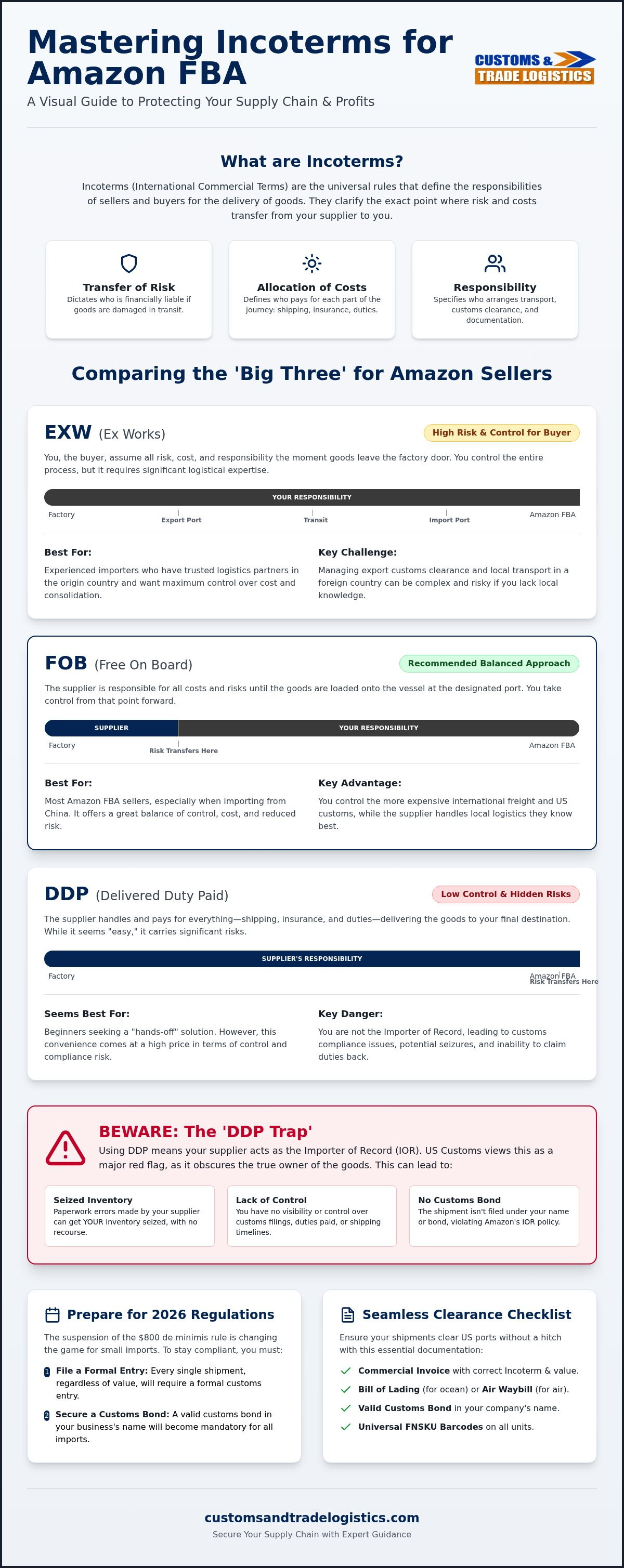
While there are 11 official terms in the ICC handbook, the vast majority of incoterms for Amazon FBA sellers boil down to three primary choices: EXW, FOB, and DDP. Each term acts as a toggle switch, shifting the boundary of responsibility between you and your manufacturer. Choosing the right one is a balancing act between the level of control you want and the amount of administrative work you're willing to handle. To help you decide, consider these primary differences:
- EXW (Ex Works): You pay for everything and assume all risk from the moment the goods leave the factory door.
- FOB (Free On Board): The supplier pays for local transport and export fees; you take over once the goods are loaded onto the vessel or plane.
- DDP (Delivered Duty Paid): The supplier covers all costs, including international freight and import duties, delivering the goods directly to Amazon.
Every quote you receive must include a "Named Place" immediately following the code, such as "FOB Shenzhen" or "EXW Yiwu". This location is the exact point where the risk of loss or damage transfers to you. If your quote just says "FOB" without a location, it's legally incomplete. This ambiguity can lead to heated disputes if your cargo is damaged at the port before it's even loaded. We always recommend getting this detail in writing to ensure your "safe pair of hands" extends across the entire journey.
FOB: The Balanced Approach for China Imports
For many of our clients, FOB is the "Goldilocks" term when importing from China. The supplier takes responsibility for getting the goods to the port and, crucially, clearing them through Chinese export customs. This removes the headache of local transport and foreign export laws from your plate. Once the goods are on the vessel, you take over. This allows you to use your own freight forwarder to coordinate with US ports, ensuring a smoother transition through customs. If you're feeling overwhelmed by these choices, our team can help you evaluate your current supplier quotes to find the most cost-effective path.
EXW: When You Want Total Logistics Control
EXW is the choice for sellers who want total oversight of their supply chain. You manage the journey from the factory door all the way to the FBA warehouse. While this can lead to the lowest manufacturing price, it requires a robust FBA freight forwarding service to handle the local trucking and export filings in the country of origin. Don't forget to account for these hidden local transport costs; they can quickly inflate your landed cost if you aren't careful. We often suggest this for seasoned sellers who have established high-volume shipping lanes and want to squeeze every cent of efficiency out of their logistics. Choosing the right incoterms for Amazon FBA sellers often comes down to this level of granular control.
The 'DDP Trap': Why Easy Shipping Can Be Risky for FBA Sellers
Delivered Duty Paid (DDP) often feels like the "easy button" for logistics. Your supplier handles everything, and your goods simply show up at the Amazon warehouse. However, this simplicity is often an illusion that masks significant legal and financial risks. When using DDP incoterms for Amazon FBA sellers, you essentially hand over your compliance to a third party who may not have your best interests in mind. This lack of oversight can lead to your inventory being seized or your importer status being revoked by US Customs and Border Protection (CBP).
The core issue is the Importer of Record (IOR) status. Amazon is very clear: they'll never act as your IOR. They won't pay duties, taxes, or handling fees. If a DDP shipment arrives at an FBA center with any outstanding charges, Amazon will simply refuse it. Beyond that, CBP is tightening the screws on importer data. Starting September 18, 2026, CBP will begin voiding IOR numbers with inaccurate or incomplete data. If your supplier uses a "shell" address or a registered agent as the IOR, your entire business could be sidelined overnight.
Another major risk involves customs valuation. Suppliers frequently under-declare the value of goods on the commercial invoice to lower the duty burden. While this might save a few dollars upfront, the legal responsibility falls entirely on you. If CBP discovers the discrepancy, you face massive fines and a permanent "red flag" on your account. Because DDP often keeps you in the dark, you rarely receive the Entry Summary (CBP Form 7501). Without this document, you have no proof of what was actually declared or paid, leaving you defenseless in an audit.
Amazon's Strict Stance on DDP and Duties
Amazon’s policy is absolute: shipments arriving with unpaid duties are rejected. With the indefinite suspension of the $800 de minimis duty-free exemption as of June 24, 2026, every single shipment now requires a formal entry. This makes the DDP arrangement even more fragile. You need a US-based partner to oversee the final delivery leg and ensure that every penny of duty is accounted for before the truck reaches the Amazon gate. A "truly" DDP shipment must be perfectly executed, or it becomes a costly nightmare of storage fees and redirected freight.
Taking Back Control: Moving from DDP to FOB
Transitioning from DDP to FOB (Free On Board) is the most effective way to protect your brand. By choosing FOB, you gain the right to select your own customs broker. This transition provides you with transparent custom brokerage service fees and total visibility into your filings. You'll receive your Form 7501 for every shipment, creating a clean paper trail for your records. Compliance is the only true way to save money long-term in global trade.
Practical Guidance: Navigating Customs and FBA Compliance in 2026
Once you've moved past the risks of the "DDP Trap," you need to master the actual mechanics of entry. In 2026, the margin for error at the US border is zero. Every shipment, regardless of the chosen incoterms for Amazon FBA sellers, requires three pillars of documentation: the Bill of Lading, the Packing List, and the Commercial Invoice. These documents must tell a consistent story. If the piece count on your packing list doesn't match your commercial invoice, US Customs and Border Protection (CBP) will likely flag your cargo for an intensive exam, adding weeks of delays and thousands in storage fees.
Since the $800 de minimis exemption was indefinitely suspended in June 2026, every import now requires a formal entry. This shift makes a Customs Bond mandatory for all FBA sellers. This bond isn't insurance for your goods; it's a financial guarantee to the US government that all duties and taxes will be paid. You should also regularly audit your supplier's shipping terms. If your business has scaled from small air-freight parcels to full ocean containers, the terms that worked last year might be draining your profits today. We often find that sellers save significantly by switching to FOB once their volume justifies a dedicated freight partner.
The Importer of Record (IOR) Responsibilities
As the Importer of Record, you have a legal duty to exercise "Reasonable Care." This means you're responsible for providing accurate product descriptions and the correct Harmonized Tariff Schedule (HTS) codes. CBP doesn't accept "I didn't know" as an excuse for misclassification. Using professional customs clearance services in the US is your best defense against these violations. A seasoned consultant acts as a mentor, ensuring your paperwork is bulletproof before it ever reaches a customs officer's desk. This proactive oversight protects your IOR number from being voided under the strict data enforcement rules that began in September 2026.
Coordinating with Amazon’s Appointment System
Your chosen Incoterm directly impacts the "last mile" of your journey. Amazon's fulfillment centers operate on a strict appointment system. If you choose a term that leaves you with no control over the carrier, you'll struggle to meet these rigid delivery windows. For sellers who aren't shipping full containers to a single location, our Delivery and Redistribution Services become essential. We can receive your goods at the port, handle the breakdown, and ensure each pallet meets Amazon's specific prep requirements. This level of coordination reduces the risk of port congestion and ensures your inventory is live on the site as quickly as possible. To ensure your next shipment arrives without a hitch, contact our team for a personalized logistics review.
Partnering with Customs and Trade Logistics for FBA Success
How do you turn a complex global shipment into a predictable business expense? For many, the answer lies in having a mentor who has seen every possible port delay and regulatory shift. At Customs and Trade Logistics, our 35+ years of industry experience acts as a stabilizer for your Amazon business. While large, impersonal brokers might treat your shipment as just another entry in a database, our family-owned consultancy offers the dedicated oversight you need. We act as a "safe pair of hands" that manages the administrative burden, allowing you to focus on what you do best: growing your brand and serving your customers.
We provide end-to-end management that bridges the gap between your foreign supplier and final US delivery. This isn't just about moving boxes; it's about protective care. We handle the coordination with your manufacturers, the complexities of International Freight Logistics, and the granular details of US Customs entry. By simplifying these logistical hurdles, we replace your anxiety with a sense of security and partnership.
Expertise in China-to-US Import Consulting
Navigating the 2026 landscape requires more than just knowing definitions; it requires strategic negotiation. Our specialized Import From China Consulting helps you choose the most advantageous incoterms for Amazon FBA sellers before you even sign a purchase order. With Section 301 tariffs reaching up to 100% on certain goods, getting your classification and valuation right from the start is vital. We coordinate directly with your foreign suppliers to ensure documentation is prepared perfectly, preventing the errors that lead to costly exams. Since Amazon no longer offers prep and labeling services as of January 1, 2026, our oversight ensures your goods arrive at the fulfillment center exactly as required.
Your National Partner for All US Ports
Whether your cargo arrives on the West Coast, the East Coast, or any port in between, we provide a seamless clearance experience. We are your national partner, offering expertise in all US Customs ports to ensure your inventory never sits idle. Our team helps you navigate the strict enforcement of importer data that began on September 18, 2026, ensuring your IOR status remains active and compliant. This comprehensive coverage gives you the peace of mind that comes from having a dedicated advocate in the global marketplace. Ready to scale your Amazon business? Contact Customs and Trade Logistics for expert import help today.
Take Control of Your International Sourcing Journey
Mastering the right incoterms for Amazon FBA sellers is the first step toward building a resilient, profitable brand. You now have the tools to choose terms like FOB that offer better control over your landed costs and customs compliance. You also understand how to avoid the "DDP Trap," ensuring your business isn't sidelined by inaccurate importer data or sudden FBA warehouse rejections. In this stricter regulatory environment, having a clear paper trail isn't just a best practice; it's a requirement for long-term survival.
Don't let the administrative weight of global trade slow your momentum. With 35+ years of family-owned expertise and specialized China-to-US import consultants, we're here to act as your dedicated mentor and advocate. We provide comprehensive national coverage for all US Customs ports, ensuring your cargo clears smoothly no matter where it enters the country. Our team manages the complex details so you can focus on what matters most: growing your business.
Secure your Amazon supply chain with expert customs brokerage and gain the professional assurance you need to scale. Your success in the global marketplace is well within reach, and we're ready to help you navigate every step of the journey with confidence.
Frequently Asked Questions
Which Incoterm is best for a first-time Amazon FBA seller?
FOB is usually the "Goldilocks" choice for first-time sellers. It requires the supplier to handle export formalities in their country while you maintain control over the US side. This prevents you from being overwhelmed by foreign transport laws while ensuring you have a clear paper trail for US Customs. Using these incoterms for Amazon FBA sellers allows you to build a reliable relationship with a US broker from your very first shipment.
Can I use DDP for Amazon FBA shipments?
You can use DDP, but it carries significant risk. Amazon will never act as the Importer of Record and will refuse any shipment that arrives with unpaid duties or taxes. Since the $800 duty-free exemption was suspended in June 2026, every shipment requires formal entry. If your supplier fails to handle this correctly, your inventory will be rejected at the FBA center, leading to expensive storage and redirection fees.
What is the difference between FOB and FCA for e-commerce?
The primary difference lies in the mode of transport and the point of delivery. FOB is specifically for sea and inland waterway transport, where risk transfers when goods are loaded onto the vessel. FCA is more flexible and applies to all transport modes, including air freight. For most e-commerce sellers using air express, FCA is technically more accurate, though many suppliers still use FOB as a catch-all term for any port delivery.
Who is responsible for paying US Customs duties under FOB terms?
Under FOB terms, the Amazon seller is responsible for all costs once the goods are loaded onto the vessel. This includes international freight, insurance, and all US Customs duties and taxes. As the Importer of Record, you'll work with a broker to ensure these payments are made accurately. This gives you total visibility into your landed costs and protects you from the hidden fees often found in "hands-off" shipping arrangements.
What happens if my supplier uses the wrong Incoterm on the paperwork?
Incorrect paperwork is a leading cause of port delays and customs exams. If the Incoterm on your Commercial Invoice doesn't match your actual agreement, US Customs may flag the shipment for a valuation audit. This can result in fines and a permanent "red flag" on your importer number. we recommend auditing your supplier's documents before the ship leaves the port to ensure everything aligns with your actual purchase agreement and legal responsibilities.
Do I need a customs broker if I am shipping DDP?
While the supplier technically handles clearance under DDP, having your own broker is a vital safety net. Many suppliers under-declare values to save money, which leaves you legally liable for the fraud. Because every shipment now requires a formal entry regardless of value, a broker ensures that your Importer of Record data is accurate. This prevents your IOR number from being voided under the strict CBP enforcement rules that began in September 2026.
How do Incoterms affect my Amazon insurance requirements?
Incoterms define the exact moment your financial risk begins. If you're using EXW, you're responsible for the goods from the factory door, meaning you need insurance for the entire journey. Under FOB, your risk starts at the port of origin. Understanding these incoterms for Amazon FBA sellers ensures you aren't paying for redundant coverage or, worse, leaving your inventory completely unprotected during the most dangerous legs of the trip from the factory to the warehouse.
Can Customs and Trade Logistics help me if my goods are already at the port?
Yes, we can step in to facilitate clearance even if your cargo has already arrived. Our Customs Clearance Services cover every port in the United States, allowing us to act as a "safe pair of hands" for shipments facing delays. We'll review your documentation, correct any errors, and coordinate with the terminal to get your goods moving toward the FBA warehouse as quickly as possible, replacing your anxiety with total resolution and peace of mind.


