

Shipping separate LCL cargo from different vendors is the fastest way to bleed profit through duplicate destination charges, surprise warehouse fees, and misaligned delivery schedules. If you feel like you're constantly playing referee between independent factories while dreading documentation nightmares at the border, you aren't alone. Most growing businesses struggle with the operational friction of uncoordinated freight. Successfully consolidating shipments from multiple Chinese suppliers into a single ocean container transforms this chaotic administrative burden into a streamlined, cost-effective freight operation.
You shouldn't have to spend your workdays worrying about conflicting paperwork, mismatched tariff classifications, or the risk of expensive examination holds at the port. In this guide, you'll learn how to transition smoothly from costly partial loads to secure full containers, harmonize commercial invoices across various manufacturers, and coordinate compliant customs entries. Here is your practical roadmap for synchronizing production timelines overseas, controlling landed costs, and clearing your goods effortlessly through domestic arrival ports nationwide.
Key Takeaways
- Eliminate redundant destination charges, terminal handling fees, and separate documentation costs by combining smaller purchase orders into a unified full container load.
- Protect your supply chain against costly delays by standardizing purchase terms and synchronizing factory ready dates across all your overseas vendors.
- Follow a structured origin coordination process, from selecting a strategically placed container freight station to issuing clear booking marks for seamless container packing.
- Ensure smooth customs clearance by coordinating unified Importer Security Filings and harmonized paperwork when consolidating shipments from multiple Chinese suppliers.
- Discover the key operational capabilities to look for in a seasoned freight partner who provides personal oversight from the factory floor to final domestic redistribution.
The Strategic Economics of Consolidating Shipments from Multiple Chinese Suppliers
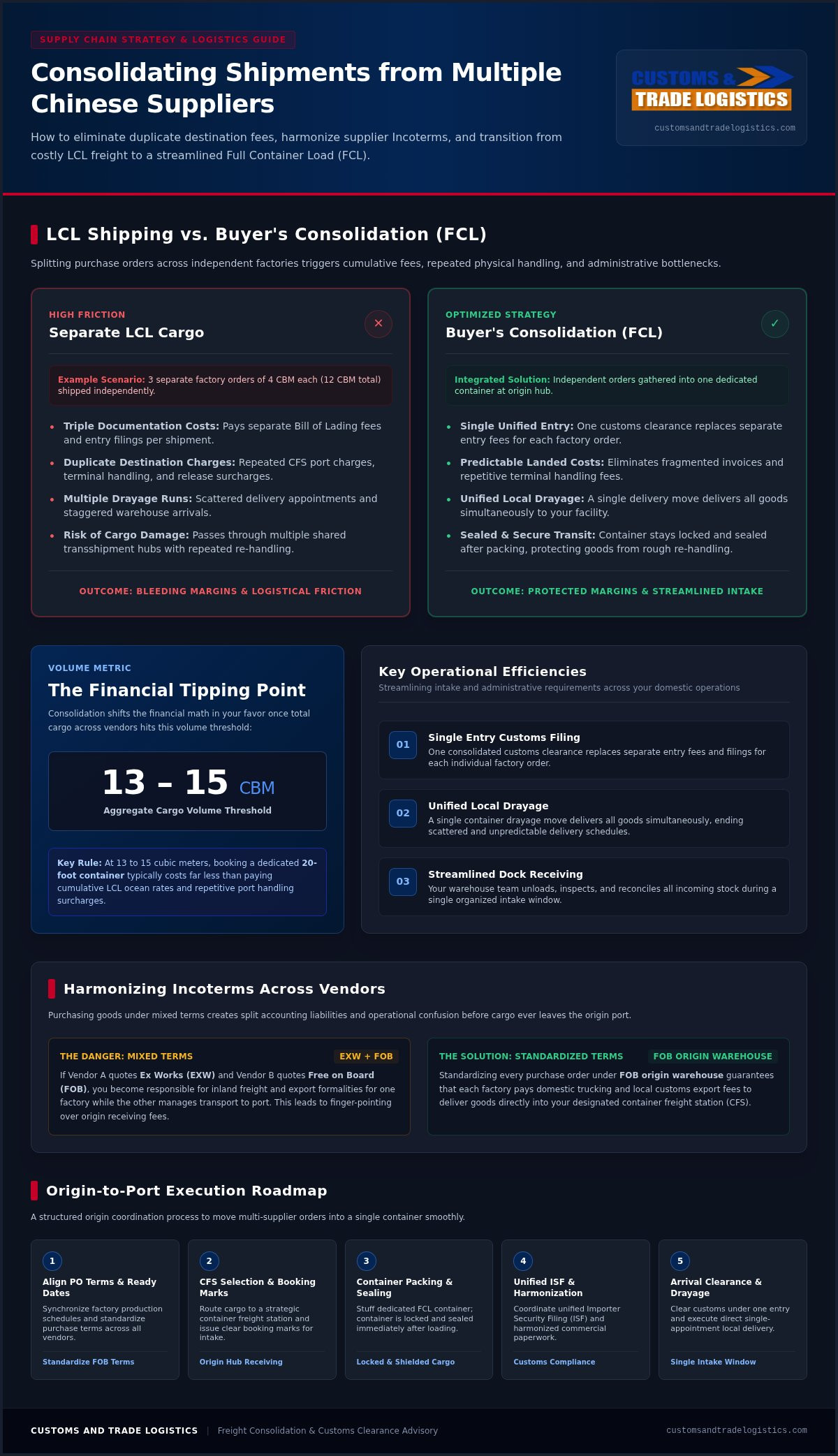
Splitting purchase orders across several factories often leads to an unexpected financial drain. When you import multiple small consignments as Less than Container Load (LCL) freight, baseline expenses quickly spiral out of control. Each individual shipment triggers its own bill of lading fees, container freight station (CFS) destination charges, local trucking runs, and entry filings. Systematically consolidating shipments from multiple Chinese suppliers into a dedicated Full Container Load (FCL) replaces fragmented invoices with predictable landed costs.
LCL Shipping vs. Buyer’s Consolidation (FCL)
Consider an importer receiving three separate supplier orders of four cubic meters each. Moving twelve cubic meters across three separate LCL runs means paying triple the baseline origin handling, documentation fees, and destination release surcharges. In contrast, buyer's consolidation gathers those independent orders into a single, dedicated container managed under your exclusive ownership.
Partnering with a reliable freight forwarder allows you to bring diverse factory outputs into a secure origin hub before ocean departure. Beyond reducing administrative overhead, dedicated container loading cuts physical handling. While standard LCL freight passes through multiple transshipment hubs and shared deconsolidation warehouses, a buyer's consolidated container remains locked and sealed after packing, shielding your inventory from transit damage and rough re-handling.
Financial and Operational Efficiencies of Single-Container Freight
Consolidation shifts the financial math in your favor once your aggregate cargo reaches approximately 13 to 15 cubic meters. At this threshold, booking a dedicated 20-foot container typically costs far less than paying cumulative LCL ocean rates and repetitive port handling surcharges across separate vendors.
The operational advantages deliver equal value for growing brands:
- Single entry filing: One customs clearance replaces separate entry fees for each factory order.
- Unified drayage: One local container drayage move delivers all your goods at once, eliminating scattered delivery appointments.
- Streamlined dock receiving: Your warehouse team unloads, inspects, and reconciles all incoming stock during a single organized intake window.
When consolidating shipments from multiple Chinese suppliers, bringing order to fragmented vendor production protects your margins. Importers looking to strengthen their broader supply chain framework can review our guide on import from China logistics to evaluate additional cost-saving shipping strategies.
Harmonizing Incoterms and Vendor Production Schedules Before Booking
Managing multiple manufacturing partners gets complicated quickly when each vendor operates under different sales terms. Purchasing goods under mixed terms creates logistical confusion and split accounting liabilities before your cargo ever reaches the dock. When consolidating shipments from multiple Chinese suppliers, establishing standardized purchasing rules across every contract is essential for maintaining control over origin timelines and costs.
Aligning Purchase Terms: FOB vs. EXW for Consolidation
Discrepant trade terms often derail consolidated cargo. If Vendor A quotes Ex Works (EXW) while Vendor B quotes Free on Board (FOB), you become responsible for inland freight and export formalities for one factory while the other handles transport to the port. Standardizing every purchase order under FOB origin warehouse guarantees that each factory pays domestic trucking and local customs export fees to deliver goods directly to your designated container freight station.
Familiarizing your procurement team with official Incoterms® rules eliminates finger-pointing over who pays origin warehouse receiving charges. If you need help restructuring your supplier agreements, leaning on dedicated import from China consulting ensures your vendor contracts share identical delivery terms from day one.
Managing Discrepant Factory Readiness Dates
Even under harmonized trade terms, production rarely finishes on identical schedules. A two-week manufacturing delay at one factory can leave another vendor's goods sitting idle, risking port congestion or storage penalties. You can protect your timeline by implementing three foundational scheduling practices:
- Synchronized Cargo Ready Dates (CRDs): Contractually mandate that all participating suppliers complete production within a tight three- to five-day target window.
- Origin free-time utilization: Coordinate with your consolidation facility to leverage temporary staging windows so early shipments can wait safely for remaining cargo without racking up daily fees.
- Firm cut-off milestones: Establish a strict container loading deadline. If a supplier misses the cutoff by more than 48 hours, roll their cargo to the subsequent ocean booking rather than penalizing on-time vendors.
Successfully consolidating shipments from multiple Chinese suppliers demands strict operational discipline. Aligning expectations before issuing purchase orders keeps your supply chain moving steadily toward departure without unnecessary friction.
Guide to Consolidating Chinese Shipments: Origin to Port
Transforming separate factory shipments into a single ocean container requires strict origin coordination. Rather than treating consolidation as simple storage, successful importers view it as proactive supply chain management. When consolidating shipments from multiple Chinese suppliers, moving through five distinct operational stages ensures cargo integrity and timely vessel dispatch.
- Designate an origin facility: Choose a container freight station (CFS) near your primary departure port to serve as the single collection node.
- Issue vendor routing guides: Distribute standardized delivery instructions, warehouse booking marks, and strict delivery dates to each factory.
- Reconcile incoming cargo: Tally, weigh, and inspect every incoming pallet against purchase order manifests upon arrival.
- Execute container stuffing: Stage cargo systematically, balancing weight distribution and securing freight to prevent shifting during transit.
- Seal and dray to terminal: Affix high-security container bolt seals, generate the Master Bill of Lading, and transfer the load to the ocean terminal.
Selecting the Strategic Consolidation Hub
Location dictates both your drayage costs and operational velocity. If your manufacturers operate primarily in Zhejiang and Jiangsu, routing cargo through Ningbo or Shanghai minimizes domestic trucking. Conversely, Pearl River Delta sourcing calls for a hub in Shenzhen or Guangzhou. Your chosen origin warehouse must provide dependable piece counts, carton labeling, and palletization while maintaining constant contact with your international freight logistics team.
Receiving, Inspection, and Container Stuffing Execution
Catching supplier errors at an overseas origin facility saves weeks of domestic troubleshooting. Once goods arrive at the CFS, warehouse staff should perform initial exterior inspections to flag crushed cartons, incorrect shipping marks, or unbanded pallets. Resolving discrepancies in China prevents documentation disputes that could later stall entry processing with U.S. Customs and Border Protection upon arrival.
Container stuffing demands careful engineering rather than quick stacking. Heavier machinery and dense crates must sit directly on the container floor over the axles, with lighter boxed merchandise positioned above. Once packed, technicians verify individual carton weights and volume metrics to calculate the container's exact Verified Gross Mass (VGM) required for terminal acceptance.
Systematically consolidating shipments from multiple Chinese suppliers transforms separate, risky orders into a unified, secure container move, setting the foundation for seamless customs clearance.
Mastering Customs Clearance, Documentation, and Compliance for Multi-Vendor Freight
Loading diverse product lines into a single shipping container solves the physical side of freight, but customs clearance demands equal precision. When consolidating shipments from multiple Chinese suppliers, a single paperwork error from one factory can freeze the entire container at the arrival terminal. Protecting your cargo requires coordinated document management and strict regulatory compliance long before the vessel docks.
ISF 10+2 and Master Bill of Lading Requirements
Compliance begins well before ocean transit starts. U.S. Customs mandates that an Importer Security Filing (ISF 10+2) must be submitted at least 24 hours prior to container loading at the Chinese port. For consolidated containers, your filing must list every individual manufacturer identity, seller name, container stuffing location, and consolidator address across all participating vendors.
Paperwork alignment is essential during this stage. The ocean carrier issues one Master Bill of Lading (MBL) covering the physical container, while your forwarder provides individual House Bills of Lading (HBL) for each factory order. Matching these bills against corresponding commercial invoices and packing lists guarantees seamless tracking under your consolidated ownership.
Single Customs Entry vs. Multiple Entry Filings
Importers often wonder whether they must file separate customs entries for each manufacturer. In most consolidated setups, your customs broker can combine multiple supplier invoices into a single formal customs entry (CBP Form 7501). Doing this offers distinct advantages:
- Lower brokerage overhead: You pay for one unified entry filing rather than individual broker fees for each factory.
- Capped merchandise fees: A single entry caps your Merchandise Processing Fee (MPF) liability instead of triggering minimum fees on small, separate entries.
- Unified duty settlement: Customs duties, Harbor Maintenance Fees, and applicable Section 301 tariffs are consolidated into one clear statement.
To examine standard filing procedures and documentation workflows in detail, explore our guide to customs clearance services.
Classifications, Partner Government Agencies, and Inspections
Harmonized Tariff Schedule (HTS) codes determine your duty rates, including Section 301 tariffs on Chinese imports. When consolidating shipments from multiple Chinese suppliers, each product line requires its own HTS line item. You must also account for Partner Government Agencies (PGAs) like the FDA or EPA, which regulate specific goods such as cosmetics, electronics, or wooden articles.
Keep in mind that U.S. Customs inspects containers as whole units. If one factory provides vague product descriptions or lacks mandatory PGA documentation, the entire container will be sent to an inspection station. If you want experienced oversight across all arrival ports, partner with our customs clearance team to ensure every document is fully vetted before your freight leaves China.
Selecting an Experienced Freight Brokerage Partner for Seamless Execution
Managing multi-vendor logistics across different time zones requires more than digital quoting algorithms. Automated platforms cannot speak directly with a factory manager in Ningbo, resolve packing discrepancies, or clarify classification nuances with customs officials. Successfully consolidating shipments from multiple Chinese suppliers depends on partnering with a team that combines established origin infrastructure, licensed customs expertise, and attentive personal communication.
Key Criteria When Evaluating Consolidation Partners
Few logistics providers possess the hands-on capabilities needed to coordinate multi-supplier freight effectively. Many modern platforms offer quick digital rates, yet they lack licensed brokerage personnel or reliable overseas facilities. When evaluating potential partners, focus on three non-negotiable standards:
- Dual freight and brokerage capabilities: Choose a firm that handles both international ocean carriage and formal US customs brokerage in-house, avoiding communication breakdowns between separate entities.
- Proven origin hub networks: Verify that your partner operates established container freight stations near key industrial export ports like Shenzhen, Ningbo, and Shanghai.
- Direct human oversight: Work with dedicated specialists who answer your calls and solve problems directly, rather than routing time-sensitive issues through automated chatbots or online support queues.
How Customs and Trade Logistics Protects Your Freight
At Customs and Trade Logistics, we bring over 35 years of family-owned experience to every container we manage. We act as your trusted advocate overseas and at home, replacing operational confusion with steady, reliable guidance. Our team oversees every detail, managing the journey from the Chinese factory floor through ocean transit, customs clearance, and final delivery and redistribution services.
Because we provide nationwide coverage across all US ports of entry, your cargo clears smoothly whether your container docks on the West Coast, East Coast, or Gulf. If you are ready to eliminate fragmented freight fees by consolidating shipments from multiple Chinese suppliers, discover how our hands-on international freight logistics and consulting services can bring total clarity to your global supply chain.
Take Control of Your Multi-Vendor Sourcing Operations
Moving away from fragmented LCL orders gives your business decisive command over landed costs and inventory timelines. Synchronizing vendor readiness dates, enforcing uniform purchase terms, and filing unified entry documents removes the friction from international shipping. What once felt like an administrative maze becomes a streamlined operation that protects your bottom line.
Successfully consolidating shipments from multiple Chinese suppliers requires a trusted guide who treats your cargo with personal care. Backed by over 35 years of family-owned import logistics and customs brokerage experience, our team provides specialized multi-factory management alongside nationwide clearance capabilities across every US Customs port of entry. We coordinate the entire journey, managing movement from overseas loading docks all the way through domestic redistribution. Partner with Customs and Trade Logistics for seamless consolidation and customs clearance to build a dependable, cost-effective supply chain today.
Frequently Asked Questions
Can I consolidate goods from different Chinese cities into one shipping container?
Yes, you can combine goods originating from different Chinese cities into a single container by designating a central export hub. Domestic trucking routes regularly move cargo between industrial centers like Hangzhou, Ningbo, and Yiwu to a central container freight station. While cross-provincial inland transit adds trucking costs, the savings gained from ocean container consolidation and single-entry customs clearance easily balance those transport expenses.
What is the main difference between buyer consolidation and carrier consolidation?
Buyer consolidation involves exclusively packing your purchase orders into a dedicated container, giving you complete control over routing and cargo handling. Carrier consolidation, commonly known as standard LCL, combines your goods with cargo owned by unrelated third parties in a shared container. When consolidating shipments from multiple Chinese suppliers under your own booking, you avoid third-party delays, multiple deconsolidation touchpoints, and unexpected shared-container terminal surcharges.
What happens if one supplier is late delivering goods to the consolidation warehouse?
If a supplier misses the agreed delivery window, you must decide whether to hold the container or roll that order to the next sailing. A brief delay of 24 to 48 hours can often be absorbed within origin warehouse free-time allowances. For longer factory delays, your logistics coordinator will typically dispatch the on-time cargo to protect your inventory flow and ship the lagging order separately.
Do I have to file separate US Customs entries for every supplier in the container?
No, you do not have to file individual entries for each factory order arriving in the same container. A licensed customs broker can consolidate multiple commercial invoices under one formal customs entry (CBP Form 7501). Combining your vendor orders onto a single entry caps your Merchandise Processing Fee and significantly reduces overall brokerage processing fees across domestic arrival ports nationwide.
How does an Importer Security Filing work when consolidating multiple Chinese vendors?
An Importer Security Filing (ISF 10+2) requires submitting detailed supply chain data to U.S. Customs at least 24 hours before your container is laden aboard the vessel. In a consolidated shipment, your broker submits a single ISF that lists the specific manufacturer IDs, seller names, container stuffing facilities, and consolidator details for every participating vendor. Accurate origin coordination ensures all ten data elements match perfectly.
Is buyer consolidation cost-effective for small businesses and Amazon sellers?
Yes, buyer consolidation is often the most economical choice for growing e-commerce brands once aggregate orders reach 13 to 15 cubic meters. Consolidating shipments from multiple Chinese suppliers eliminates duplicate LCL port fees and simplifies delivery replenishment to fulfillment centers. Moving from scattered partial loads to a unified container protects healthy profit margins and keeps inventory restocking predictable.
Can products subject to Section 301 tariffs be consolidated with non-tariff items?
Yes, you can pack goods subject to Section 301 tariffs together with exempt or lower-tariff items inside the same container. Your customs broker simply itemizes each product line under its corresponding Harmonized Tariff Schedule (HTS) classification on the customs declaration. Duties and supplemental tariffs are calculated individually per line item, allowing compliant mixed-cargo clearance without penalty or customs delay.


