

Can you clear commercial cargo through U.S. Customs yourself, or are you legally required to hire an intermediary? When weighing DIY customs clearance vs using a broker, many businesses assume self-filing is a straightforward way to trim operational overhead. The reality is often counterintuitive: attempting to cut out a filing partner frequently opens the door to unexpected terminal storage charges and costly inspection delays.
It makes complete sense why you want direct control over your supply chain. Between deciphering intricate HTSUS classification codes, coordinating with Partner Government Agencies, and registering with the Automated Commercial Environment (ACE), managing federal entry documentation can quickly become overwhelming. You need your freight cleared smoothly, without the threat of port holds eating into your margins.
This guide helps you discover the real trade-offs between self-filing customs clearance and hiring a licensed broker to protect your imports. We will walk through official U.S. entry requirements, evaluate upfront filing effort against penalty liabilities, and give you a clear decision framework to keep your cargo moving steadily across nationwide ports.
Key Takeaways
- Importers have the legal right to act as their own filer, but navigating federal entry systems requires dedicated administrative time and strict technical precision.
- When evaluating DIY customs clearance vs using a broker, short-term filing savings must be measured against the financial risks of cargo holds and port storage fees.
- Simple documentation mistakes and missed Partner Government Agency mandates often trigger extensive physical examinations and compounding shipment delays.
- A structured decision matrix helps you assess shipment value, entry complexity, and operational bandwidth before choosing your filing method.
- Working with an experienced customs broker provides nationwide protection, managing entry compliance smoothly while coordinating domestic freight redistribution.
Understanding DIY Customs Clearance: What Does Self-Filing Entail?
Under federal trade statutes, your business has every legal right to act as its own filer. When evaluating DIY customs clearance vs using a broker, the immediate appeal is direct autonomy over your supply chain. Stepping into this role means you interact directly with U.S. Customs and Border Protection (CBP) without an operational safety net. You become solely responsible for assigning correct Harmonized Tariff Schedule (HTSUS) codes, determining precise transaction valuation, and meeting entry filing deadlines. Grasping these baseline obligations is essential before weighing whether in-house filing makes sense or if investing in dedicated customs clearance services in the US provides the security your cargo requires.
The Legal Role of the Importer of Record
As the designated Importer of Record, federal law holds your company to the strict standard of "reasonable care." This statutory doctrine means that honest mistakes or unfamiliarity with regulations won't excuse valuation errors or misclassified goods. While a licensed customs broker regularly guides businesses through these intricacies, the legal liability for compliance always remains with the importer. You must also maintain complete, audit-ready trade records for five years from the date of entry, ready for CBP review at any time.
Technical Barriers: The ACE Portal and CBP Documentation
The largest practical barrier self-filers encounter is interacting with the Automated Commercial Environment (ACE). Accessing ACE isn't like checking out on an e-commerce site. Importers must apply for an ACE Secure Data Portal account, undergo corporate vetting, and often configure specialized Electronic Data Interchange (EDI) software just to transmit formal entry data smoothly.
Every commercial entry demands meticulous documentation before transmission:
- Commercial Invoices: Detailing complete product descriptions, Incoterms, transaction value, and country of origin.
- Packing Lists: Confirming precise piece counts, net and gross weights, and package markings.
- Bills of Lading: Documenting the chain of custody and arrival manifest details.
This information must align perfectly on CBP Form 7501 (Entry Summary). A minor typo in your tariff classification or currency conversion can instantly trigger electronic rejections, stalling your freight before it leaves the port terminal.
DIY Customs Clearance vs Using a Broker: Side-by-Side Comparison
Evaluating DIY customs clearance vs using a broker requires looking well beyond an immediate entry invoice. While handling entries internally eliminates third-party filing costs, it shifts the entire operational and compliance burden onto your own staff. For expanding commercial enterprises, understanding how these two approaches diverge across financial, speed, and audit management dimensions is vital.
Direct Financial Investment vs Hidden Overhead
Self-filing appears cost-effective on paper, but administrative overhead accumulates rapidly. Every hour your team spends tracking bills of lading, verifying partner agency rules, and preparing entry forms is time taken away from sales, procurement, and customer fulfillment. In-house filers also encounter ongoing electronic software expenses and secure connection fees just to submit data directly to federal systems.
As detailed in our guide on understanding custom brokerage service fees, paying for professional entry filing provides predictable budgeting. When CBP initiates a cargo review or post-summary audit, self-filers bear the full cost of internal research, legal consultation, and document retrieval. A dedicated broker already maintains the compliant infrastructure required to handle these regulatory inquiries without disrupting your daily business operations.
Speed of Cargo Release and Logistics Coordination
Logistical momentum makes or breaks commercial profitability. Customs brokers are licensed, regulated and empowered by U.S. Customs and Border Protection to lodge remote entries up to five days prior to ocean vessel arrival. This pre-arrival filing ensures release holds are resolved before your container hits the pier, allowing drayage trucks to retrieve containers immediately.
Self-filers often struggle with pre-arrival filing windows, sometimes leaving paperwork until cargo arrives physically at port. Consider the cascading consequences of these delays:
- Terminal Delays: Entry documentation hiccups delay cargo release, pushing shipments into costly storage windows.
- Downstream Distribution Bottlenecks: Idle containers stall regional freight transfers and inventory replenishment schedules.
- Broken Customer Commitments: Missed retail delivery windows and production pauses damage hard-won client trust.
Deciding on DIY customs clearance vs using a broker ultimately centers on operational resilience. If your business values reliable container flow without internal compliance stress, working with an established nationwide partner like Customs and Trade Logistics gives you the security and cargo velocity your supply chain needs.
Hidden Risks and Costly Pitfalls of Self-Clearance
Saving a modest filing fee sounds tempting until a minor clerical oversight triggers cascading financial penalties. When analyzing DIY customs clearance vs using a broker, many businesses underestimate the unforgiving nature of federal trade enforcement. A single transposed digit on a declaration can freeze an entire ocean container, generating punitive charges that wipe out product margins. Establishing proper compliance upfront is critical, particularly when managing import logistics for startups where cash flow cannot absorb sudden operational shocks.
HTSUS Misclassification and Valuation Penalties
Tariff classification requires far more than matching a product description to an online lookup tool. As outlined in CBP's Guide for Commercial Importers, selecting an incorrect code can result in substantial duty underpayments. Under 19 U.S.C. 1592, customs authorities can levy severe civil penalties for clerical negligence or gross errors. These fines easily exceed the original value of the goods, especially if you fail to account for design assists, production royalties, or packing costs in your dutiable value calculations.
Missed ISF Deadlines and Port Storage Charges
Ocean shipments require an Importer Security Filing, commonly known as "10+2," transmitted at least 24 hours before cargo loads onto a vessel at the foreign port. Missing this deadline brings an automatic liquidated damages assessment of $5,000 per violation from CBP.
Even worse, an unfiled or rejected ISF results in immediate cargo holds upon arrival. Ocean marine terminals don't offer leniency:
- Demurrage Charges: Terminal storage fees quickly escalate to between $150 and $350 per container each day once standard free time expires.
- Detention Expenses: Ocean carriers bill daily equipment fees while shipping containers remain trapped off-site under hold.
- CBP Physical Exams: Mandatory customs inspections routinely add between $300 and $1,000 or more in drayage and exam station fees.
Partner Government Agency (PGA) Interventions
Customs and Border Protection enforces entry rules on behalf of nearly 50 partner agencies, including the FDA, EPA, USDA, and CPSC. For instance, mandatory electronic compliance filing for regulated consumer goods adds rigorous data validation requirements to every entry. If your self-filed entry lacks exact registration numbers, intended use codes, or safety certificates, agency officers will reject entry. In worst-case scenarios, non-compliant goods face mandatory re-exportation or CBP-supervised destruction at the importer's direct expense.
The operational reality of DIY customs clearance vs using a broker is straightforward. Self-clearing leaves your balance sheet fully exposed to technical liabilities that an experienced customs partner routinely avoids.
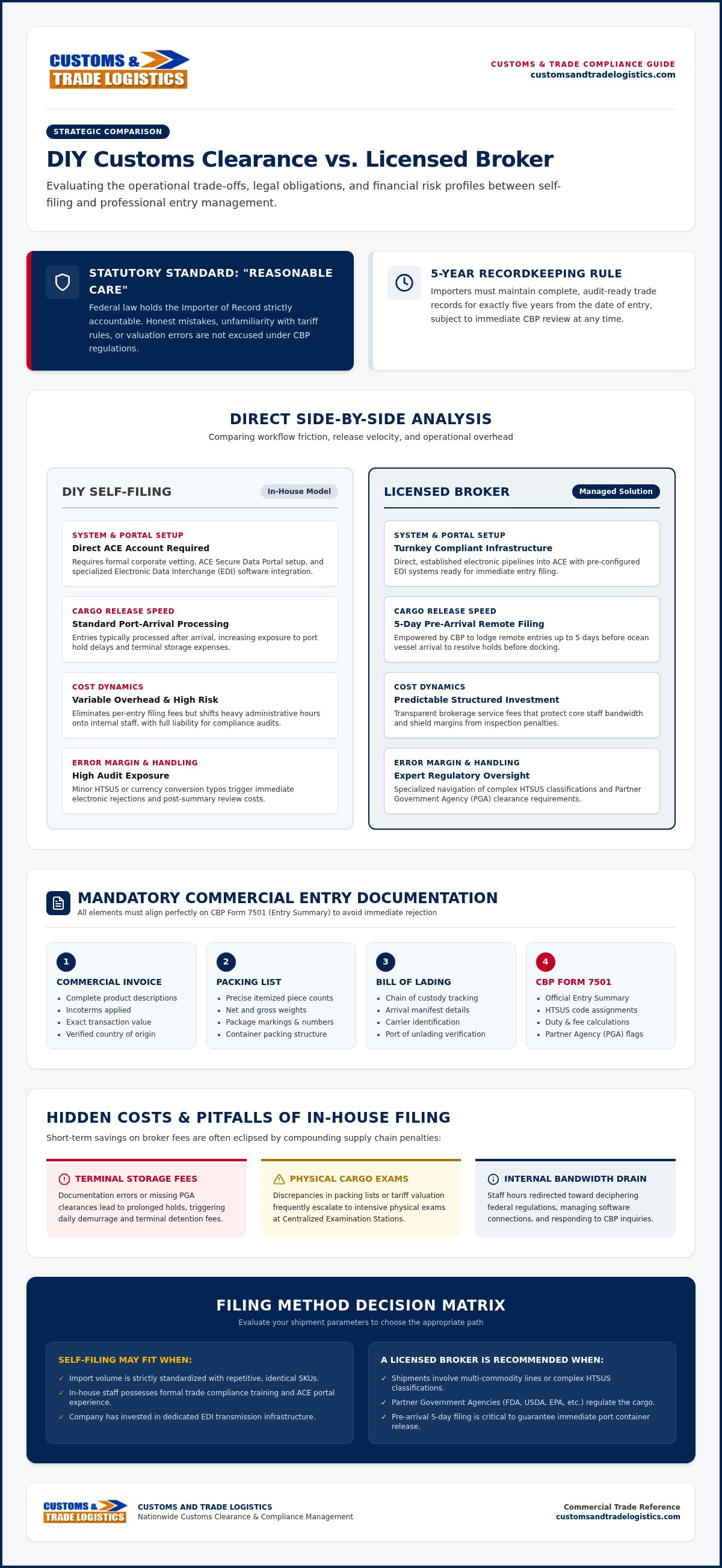
Decision Matrix: Self-File vs. Partner with a Broker
Choosing the right path depends on your shipment volume, commodity characteristics, and internal operational capacity. While select scenarios allow for safe independent filing, commercial freight demands dedicated oversight. Evaluating DIY customs clearance vs using a broker comes down to assessing cargo value, partner agency involvement, and your team's bandwidth.
When DIY Clearance Might Be Practical
Handling customs clearance internally is generally manageable when transactions are small, infrequent, and administratively simple. Consider self-filing or carrier-assisted clearance in situations like these:
- Informal Entries: Shipments valued under the $2,500 commercial threshold that do not require formal customs surety bonds.
- Standard Courier Consignments: Small parcels transported through integrated express air carriers who clear packages under consolidated manifests.
- Unregulated Goods: General consumer merchandise that carries no Partner Government Agency restrictions, quotas, or anti-dumping and countervailing duties.
When a Licensed Customs Broker Is Vital
Once your business graduates to full container loads or recurring commercial inventory, the balance shifts dramatically. High-stakes ocean container shipping requires continuous customs bonds and precise electronic coordination across nationwide ports. In these environments, any filing discrepancy creates immediate supply chain friction.
Partnering with a customs broker becomes essential if your operations involve:
- Time-Sensitive Inventory Cycles: Businesses operating on tight production or distribution schedules cannot risk entry delays at marine terminals.
- Marketplace Distribution Requirements: E-commerce businesses needing reliable Amazon seller import help must meet rigid fulfillment center delivery appointments to avoid carrier refusal.
- Complex Commodity Regulations: Products subject to technical safety certifications, agricultural inspections, or multi-component tariff classifications.
When you weigh DIY customs clearance vs using a broker for mission-critical freight, protecting your cash flow and delivery timeline takes priority. To secure dependable cargo clearance across every port of entry, connect with our nationwide customs team at Customs and Trade Logistics and keep your freight moving forward seamlessly.
How a Customs Broker Streamlines Your Import Operations
Working with an established customs partner turns what is often a stressful bottleneck into a predictable operational advantage. When reviewing DIY customs clearance vs using a broker, the greatest difference lies in having a seasoned advocate protect your commercial interests at the terminal gate. Instead of wrestling with obscure regulatory language or worrying about surprise port holds, you gain the freedom to focus entirely on core business growth.
Proactive Compliance and Tariff Management
Trade regulations shift constantly, making ongoing compliance a moving target. Licensed customs professionals monitor evolving trade remedies, partner agency adjustments, and tariff updates to ensure your entries remain fully compliant. Rather than guessing which classification applies, you benefit from meticulous documentation reviews that prevent tariff misdeclarations before transmission.
This diligence shields your balance sheet against retrospective audits. A seasoned broker helps you verify valuation adjustments, manage assists, and assemble audit-proof paper trails that satisfy federal scrutiny across every national port of entry.
Seamless Cargo Coordination and Redistribution
Customs release represents only one link in your broader supply chain. True supply chain efficiency happens when clearance integrates directly with international freight logistics and onward domestic transport. Having a single team manage this journey eliminates the communication gaps that leave shipping containers stranded on pier aprons.
This complete operational oversight proves especially vital when coordinating high-volume import from China logistics. Sourcing overseas goods involves juggling ocean carrier sailings, foreign factory handoffs, complex tariff rules, and strict domestic arrival windows. With over 35 years of family-owned industry experience, Customs and Trade Logistics provides dedicated entry filing, hands-on import consulting, and delivery and redistribution services nationwide.
When comparing DIY customs clearance vs using a broker, the peace of mind that comes with total freight coordination is undeniable. Your cargo clears smoothly, moves off the terminal without unnecessary delay, and arrives at its final destination safely under the watchful eye of a reliable logistics ally.
Secure Your Cargo and Streamline Your Import Growth
Deciding between DIY customs clearance vs using a broker isn't just about trimming an upfront entry fee. It's about protecting your bottom line from unexpected terminal storage fees, sudden inspection holds, and strict regulatory penalties. While self-filing may suit low-risk informal entries, commercial container freight requires precision and proactive compliance management.
With over 35 years of family-owned industry experience, Customs and Trade Logistics acts as your trusted partner across all U.S. ports of entry. We lift the compliance burden with seamless nationwide customs clearance, specialized import consulting, and dependable domestic delivery and redistribution services. You don't have to face complex federal trade regulations alone. Connect with Customs and Trade Logistics today to safeguard your shipments and keep your imports moving forward without interruption.
Frequently Asked Questions
Can I legally clear my own commercial imports through U.S. Customs without a license?
Yes. Federal regulations permit the Importer of Record to self-file entry documents for their own goods without a broker license. However, you cannot file on behalf of third parties for compensation. When weighing DIY customs clearance vs using a broker, keep in mind that being legally allowed to self-file doesn't waive your obligation to follow complex entry rules and exercise reasonable care under customs law.
What is the primary difference between formal and informal customs entries?
The distinction primarily centers on shipment value and commercial intent. Informal entries generally cover commercial shipments valued under $2,500 or personal items, requiring simpler documentation and no customs surety bond. Formal entries apply to commercial goods exceeding $2,500 or products subject to strict partner agency oversight. They demand detailed entry summaries, mandatory surety bonds, and comprehensive compliance filings.
Do I need a customs bond if I choose to clear goods myself?
Yes, if your shipment requires a formal entry. Self-filing does not exempt you from customs bond regulations. You must secure either a single entry bond for an individual consignment or a continuous bond for recurring shipments through an authorized surety company. U.S. Customs requires this financial guarantee to ensure duties, taxes, and potential compliance fees are paid in full.
What happens if my self-filed customs paperwork contains classification errors?
Classification errors can trigger cargo holds, shipment examinations, and mandatory reassessments of unpaid duties. If U.S. Customs discovers negligence, they can levy financial penalties under federal statute 19 U.S.C. 1592. These fines often equal or exceed the total value of your shipment. Recurring inaccuracies can also flag your business for increased audits across future port entries.
How much time does it typically take to learn and execute self-filing?
Most importers spend dozens of hours mastering trade regulations, tariff schedules, and electronic portal setup. Gaining approval for the Automated Commercial Environment (ACE) portal and configuring filing software can take weeks. For growing businesses, calculating DIY customs clearance vs using a broker reveals that internal labor spent decoding documentation frequently outweighs the cost of professional representation.
Can a customs broker help if my DIY shipment is already stuck at the port?
Yes, licensed customs brokers routinely step in to resolve stuck shipments. If your self-filed entry gets flagged for missing documents, Partner Government Agency holds, or tariff errors, an experienced broker can intervene. They coordinate directly with port officers, amend filings, and secure quick release before daily demurrage and port storage fees escalate into major financial losses.
Why do ocean freight shipments carry higher self-clearing risks than air express?
Ocean container freight involves strict pre-arrival filing mandates like the Importer Security Filing, which carries an automatic $5,000 fine for late submission. Marine terminals also have rigid storage policies with steep daily demurrage charges once free time expires. Express air consignments, by contrast, often clear on consolidated courier manifests with faster transit and lower administrative exposure.


