

What if a customs entry that looks complete still puts your shipment at risk of delay? The risks of self-filing customs entry go beyond filling out forms. A classification or valuation decision can affect the supporting documents you need, the duties assessed, and whether an agency requirement has been met.
It’s understandable to consider filing entries in-house. When shipments seem straightforward, managing the process yourself may look like a way to save effort. But your business still needs a reliable way to check each entry, keep records, and respond when information is missing or something doesn’t go as planned.
This article explains the practical and compliance risks of self-filing, what an internal process needs to cover, and how to weigh those demands against customs broker support. You’ll also see how entry decisions connect to the wider shipment journey, from paperwork and clearance to delivery coordination. With more than 35 years of experience supporting importers, Customs and Trade Logistics understands why a clear, capable process matters. The right approach depends on shipment complexity, internal expertise, and available staff time.
Key Takeaways
- Understand what self-filing involves and why filing eligibility and procedures should be checked against current CBP requirements.
- See how the risks of self-filing customs entry can extend beyond a form, and why errors may call for clarification or added coordination.
- Compare self-filing with broker support by looking at control, staff workload, expertise, and who coordinates each step.
- Use a pre-shipment review to check product details, transaction documents, classification rationale, and supporting records.
- Choose an approach based on shipment complexity, repeatability, internal expertise, and the time your team can consistently dedicate.
Risks of self-filing customs entry: what the decision really involves
Self-filing can look like a paperwork task: gather documents, enter details, submit the filing. In practice, it also involves decisions about what the goods are, how they should be classified, how their value is reported, where they originate, and whether they meet applicable requirements. These details need to agree with the commercial records and supporting documents.
Self-filing means the importer prepares and submits a customs entry without hiring a broker for that filing; filing assistance does not transfer responsibility for the accuracy of the information supplied. A filing system accepts data, but it doesn’t decide whether the product description, classification rationale, value, or origin information is well supported.
What does self-filing a customs entry mean?
The importer gathers the required entry data and supporting documents, then submits them using the process that applies to the shipment. Exact requirements and whether self-filing is available depend on the entry and current CBP procedures, so check official guidance before relying on an internal process. Filing an entry yourself also doesn’t mean managing every part of the international shipment. Freight coordination and delivery arrangements are separate responsibilities.
Some tasks are administrative, such as collecting an invoice and matching shipment details. Others require judgment. A product made from several materials, for example, may need careful review of its characteristics before you select a classification. An inaccurate value or origin detail can also conflict with transaction records. These are connected entry decisions, not just fields to complete.
A customs broker brings trade and customs knowledge to the filing process. Whether you file independently or use a broker, base the information on reliable product and transaction details. Professional support can help manage complexity, but it can’t replace the importer’s role in supplying accurate information.
Who may be considering filing without a broker?
Small businesses, occasional importers, and companies building in-house import operations may all weigh self-filing. A low shipment frequency doesn’t automatically make the work simple, just as frequent shipments don’t automatically mean a company needs outside support. The decision depends on what each shipment involves and whether the business can maintain a careful, repeatable process.
Before deciding, assess three things: the complexity of the goods and entry requirements, your staff’s practical expertise, and the time available for preparation and review. Can someone explain the classification rationale and connect the submitted details to the source documents? Is a knowledgeable second reviewer available when an entry is unfamiliar? If those checks are difficult to sustain, the risks of self-filing customs entry may outweigh the apparent convenience.
Where self-filed customs entries can go wrong
An entry can contain all the requested fields and still be difficult to support if its details don’t match the shipment records. An invoice description may be too broad to explain the selected classification, or the entered quantity may differ from the packing information. These mismatches can prompt questions, require corrections, or call for extra coordination. They don’t happen with every self-filed entry, but they are practical risks to account for.
Check classification, customs value, and country of origin together because each describes a different aspect of the same goods and must align with the supporting records. A weak record trail makes it harder to explain how information was determined if a question arises later. Keep source documents and the reasoning behind key decisions organized and easy to retrieve.
Classification, customs value, and country of origin
Tariff classification identifies goods within the applicable customs schedule and can affect how they’re treated under current requirements. Value and origin are separate entry details, each of which should be supported by relevant transaction and product records. For example, a change in product composition may call for revisiting the classification rationale, while purchase documents should support the value reported.
Potential duty, tariff, or trade-program effects depend on the goods and the rules in force. Don’t rely on an old entry or an informal product description as proof that the same treatment applies today. Check current authoritative guidance for the specific product and transaction before filing.
Documentation, admissibility, and missed requirements
Before submission, compare the entry against the commercial invoice, packing information, and product details. Differences in description, quantity, or other shipment data may need clarification. Product-specific requirements may also apply through relevant government agencies. Confirm what applies to the goods with the responsible authority rather than assuming a standard set of documents covers every shipment.
Good records make review and follow-up more manageable. Keep the documents used to prepare the entry, along with notes explaining classification, value, and origin decisions. If a question comes up, a clear link between the declared information and its source gives your team a reliable starting point for responding.
CBP’s page on the requirements to become a licensed customs broker describes the qualifications for that professional role. It isn’t a checklist for importers who file their own entries, but it helps clarify that broker expertise is a distinct area of practice. If entry review and shipment coordination are stretching your team, consider whether customs clearance support would fit your process.
Self-filing vs. using a customs broker: compare the real workload
The choice isn’t simply between doing paperwork yourself and handing it off. Compare the full process: preparing entry information, checking it against records, resolving questions, and coordinating the filing with the shipment. The US customs clearance services guide offers broader context on how clearance fits into importing.
| Consideration | Self-filing | Using a customs broker |
|---|---|---|
| Control | Your team manages the filing directly and owns its internal workflow. | A broker prepares or handles the filing based on information your business provides. |
| Internal workload | Staff gather records, enter details, review decisions, and manage follow-up. | Your team still needs to provide accurate shipment information and respond to questions, while the broker can take on filing work. |
| Expertise needs | Staff need the knowledge and time to assess product details and applicable requirements. | Broker experience can help with entry preparation and questions that call for customs knowledge. |
| Coordination | Your team coordinates filing tasks with the parties managing freight and delivery. | A broker can support customs clearance coordination, while responsibilities for other shipment stages should be clearly assigned. |
Neither approach automatically reduces the total work or makes an entry error-proof. Consider staff time, review effort, training, and the capacity to handle unfamiliar situations, not just who submits the information. Broker support also doesn’t remove the importer’s responsibility to provide accurate, complete details. The risks of self-filing customs entry may be harder to manage when the people preparing an entry lack time or a dependable review process.
When can self-filing be manageable?
Self-filing may be worth assessing when shipments are repeatable, procedures are documented, and staff have relevant experience. Build in a second-person review and a clear escalation route for unfamiliar goods, changed requirements, or inconsistent records. These conditions can help an internal process stay organized, but they don’t prove every shipment is straightforward. Review the process when products or circumstances change.
When does broker support add practical value?
Support may be useful when products are complex, requirements shift, internal capacity is limited, or entry decisions need to be coordinated with other shipment stages. An experienced customs professional can prepare or review entry information and help your team manage the customs clearance portion of the shipment. If your workload or entry complexity is difficult to manage internally, you can discuss customs clearance support as one option.
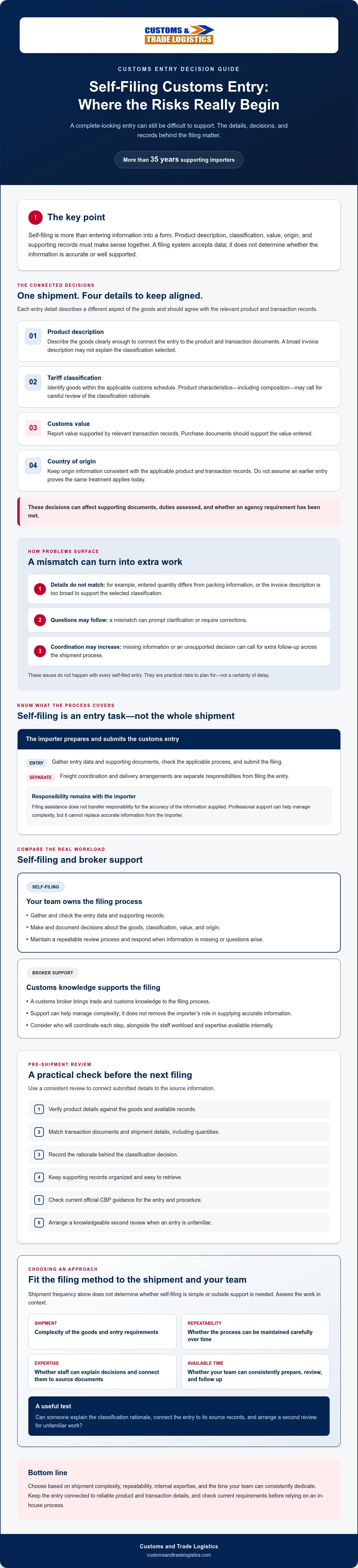
How to assess your self-filing risk before the next shipment
A repeatable pre-shipment review helps your team catch gaps before submitting an entry. Assign each check to someone with the knowledge to complete it, and make clear who can pause the filing when details don’t line up. For startups building an import process, this import logistics guide for startups offers broader planning context.
A pre-filing review for each shipment
Use a consistent sequence, even for familiar shipments. Familiarity can make it easier to overlook a changed product detail or a discrepancy between documents.
- Match the shipment details. Have the preparer compare product descriptions and quantities with the invoice, packing information, and other transaction documents. Resolve differences rather than guessing which record is correct.
- Review key entry decisions. Assign a knowledgeable reviewer to check the classification rationale, declared value, and country of origin against the available records. Note who completed the review and what information supported each decision.
- Check applicable requirements. Before submission, confirm current CBP procedures and whether a partner government agency has requirements for the particular goods. Consult the relevant authority when the answer isn’t clear, since requirements can depend on the product and shipment.
- File the supporting record set. Keep the documents and decision notes together in an organized, accessible location. Follow current official recordkeeping guidance for what to retain and for how long.
This process makes ownership visible: the person preparing the information gathers and reconciles it, while a reviewer checks the supporting rationale. A designated lead can confirm that required reviews are complete before the entry moves forward.
Signals to pause and get expert input
Don’t treat an unanswered question as a routine data-entry issue. Pause for review if the goods are unfamiliar, their composition or intended use is unclear, supplier documents conflict, or your team can’t confirm which requirements apply. Regulated products and changing trade measures call for current, authoritative guidance, not assumptions based on a prior shipment.
Keep a simple escalation route: identify the question, gather the relevant product and transaction records, then refer it to a qualified customs professional or the appropriate government authority. This can help your team address uncertainty before it turns into rework. Small businesses can also consult this practical overview of customs paperwork guidance.
If your team needs help assessing entry complexity or coordinating customs clearance with the wider shipment, discuss customs clearance support. A consistent review process can help clarify the risks of self-filing customs entry and when additional expertise may make sense.
Choose a filing approach that fits your business and shipment
There isn’t one filing method that suits every importer. Self-filing may fit a business with experienced staff, repeatable shipments, clear procedures, and enough time to review each entry. Broker support may be practical when goods are complex, requirements are unfamiliar, or internal capacity is stretched. The risks of self-filing customs entry depend on how well your team can manage decisions and follow-up, not simply how often you import.
Use these questions to test whether your current process is sustainable:
- Can your team explain and document its decisions? Staff should be able to connect the information entered for each shipment to product details and transaction records.
- Can someone monitor requirements and resolve questions? Consider who checks for applicable changes and what happens when information is incomplete or unclear before filing.
- Can entry work be coordinated with the shipment? Confirm that the people handling entry preparation can communicate with those managing freight and final delivery needs.
If your team can answer these questions confidently and maintain the process consistently, self-filing may be worth evaluating for appropriate shipments. If answers depend on one person’s memory, or there’s little time for review, consider where outside expertise could fill the gap. Either way, confirm current filing procedures and responsibilities for the specific entry.
What to expect when exploring broker support
An initial discussion should clarify what you import, how shipment patterns vary, which documents are available, and where your team needs help. Bring examples of product information and transaction records, along with questions about how entry preparation connects to freight coordination and delivery. A practical conversation should also establish who supplies information, who reviews it, and who handles follow-up if a question arises.
Customs and Trade Logistics is a family-owned customs brokerage and logistics consulting firm with more than 35 years of industry experience. That experience provides useful context, not a promise of a particular clearance result or compliance outcome. Before proceeding, confirm the service scope and entry responsibilities for the engagement, including the information your business must provide and the shipment stages covered.
Self-filing and professional support are options to assess, not universally right or wrong answers. Match the approach to your team’s expertise, shipment complexity, repeatability, and available staff time, then revisit the decision as those factors change. If you’d like to talk through your import process and customs clearance needs, contact Customs and Trade Logistics.
Make your next entry decision with confidence
The risks of self-filing customs entry depend on more than how often you import. They’re shaped by the complexity of your goods, your team’s customs knowledge, the quality of your records, and the time available to review each filing. A repeatable process with clear checks may support self-filing for some shipments. When requirements are unfamiliar or internal capacity is limited, broker support can be a practical alternative.
Before your next shipment, confirm who will verify product and transaction details, review classification, value, and origin, and coordinate entry work with freight and delivery needs. Then decide whether your team has the expertise and capacity to manage those steps consistently. Neither filing approach is right for every business, and responsibilities should be clear whichever path you choose.
Customs and Trade Logistics is a family-owned and operated firm with more than 35 years of industry experience and customs clearance support across US Customs ports. If you’d like to discuss how your filing approach fits your shipments, talk with Customs and Trade Logistics about your import process. With a clear plan and the right support, you can move forward with greater confidence.
Frequently Asked Questions
What are the risks of self-filing a customs entry?
The risks of self-filing customs entry include inaccurate data, incorrect classification or valuation, unsupported origin details, and incomplete documents. If information doesn’t match across the entry, invoice, and shipment records, your team may need to clarify or correct it. That can add coordination work and may contribute to delays, but neither is inevitable. The practical impact depends on the shipment, the information filed, and the requirements that apply.
Can an importer file a customs entry without a broker?
Possibly, but filing options depend on the importer, the type of entry, and current U.S. Customs and Border Protection (CBP) requirements. Don’t assume every importer or shipment can use the same process. Before planning an internal filing, check current CBP guidance for your specific situation, including any applicable eligibility and procedural requirements. If the rules or your filing status aren’t clear, seek qualified guidance before submitting.
Is the importer still responsible when a customs broker files the entry?
Broker assistance doesn’t automatically remove the importer’s responsibility to provide accurate, complete information. The importer and broker may have different duties under applicable rules and their specific working arrangement, so don’t assume hiring a broker transfers every obligation. Review the agreement to understand who supplies, prepares, checks, and submits information. Verify current CBP guidance on importer responsibilities, and raise questions about the arrangement before the shipment is filed.
What information should I check before self-filing a customs entry?
Check that the product description and details support the classification, and that the declared value and country of origin match reliable records. Compare invoice quantities and shipment details with the entry information, and confirm you have the supporting documents required for the goods. Some products may also involve partner government agency requirements. Assign a knowledgeable person to review the information, document the reasoning, and verify current CBP and agency guidance before submission.
Can mistakes on a customs entry delay a shipment?
Yes, errors or missing information may lead to questions, a request for clarification, corrections, or delays while details are reviewed. The effect varies with the shipment, the nature of the issue, and the requirements that apply, so a delay isn’t an inevitable result of self-filing. Reduce avoidable rework by comparing the entry with the invoice, packing information, product details, and supporting records before submitting.
When should a small business use a customs broker instead of self-filing?
Consider broker support if the goods are unfamiliar or complex, your team lacks entry experience, requirements are changing, or staff don’t have time for careful review and follow-up. Support can also be useful when customs clearance must be coordinated with freight and final delivery. Shipment frequency alone isn’t decisive. Compare the expertise, repeatability, and staff capacity your internal process requires with the help a broker could provide.
Does hiring a customs broker guarantee that an entry will be accepted?
No. A broker can provide customs expertise and help prepare or review entry information, but no service can guarantee an entry outcome. Processing depends on the accuracy and completeness of the information, the requirements that apply to the goods, and any review by the relevant authorities. Share reliable product and transaction records, clarify who is responsible for each step, and ask your broker how questions or missing information will be handled.


