

Did you know that choosing the "cheapest" shipping rate on paper could actually be the most expensive mistake your small business makes this year? As you scale your imports, the decision between LCL vs FCL shipping from China becomes about much more than just the size of your boxes. We understand the anxiety that comes with unpredictable freight invoices and the fear of your products sitting in a shared container for weeks. It's a heavy burden to carry, but you don't have to navigate these complex logistics alone.
This guide is designed to help you master these differences so you can lower your cost per unit and speed up your transit times. We'll look at the 2026 break-even points and explain how the new Section 122 global surcharge impacts your choice. We also provide a clear roadmap for smoother US Customs clearance following the elimination of the de minimis threshold. By the end, you'll have the confidence to choose the shipping mode that acts as a stabilizing force for your business's growth and gives you total peace of mind.
Key Takeaways
- Learn the core differences between LCL vs FCL shipping from China to choose the right foundation for your supply chain.
- Explore how FCL provides faster transit times and better security, while LCL helps you manage cash flow with smaller, more frequent shipments.
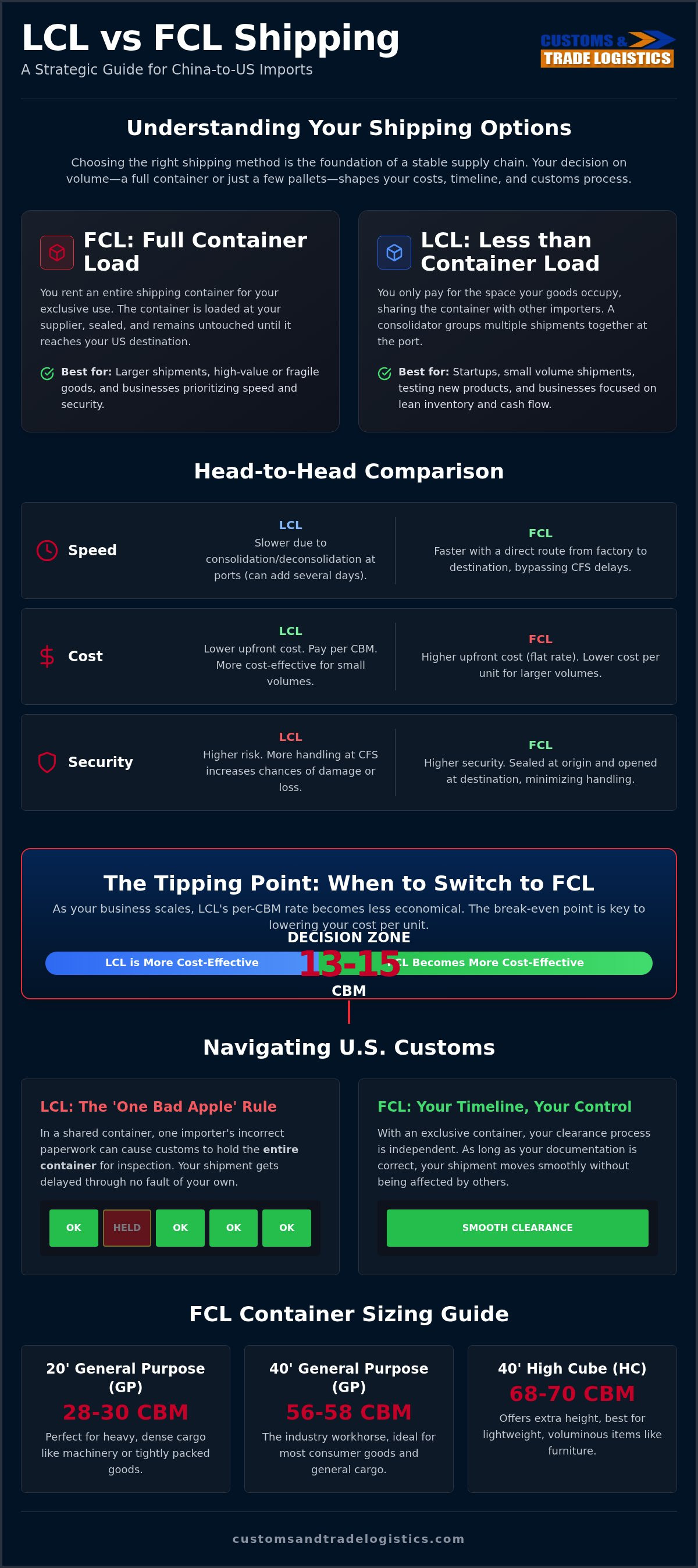
- Identify the 13-15 CBM tipping point where switching to a full container helps you lower your cost per unit as you grow.
- Discover how to navigate the 'One Bad Apple' rule to prevent other importers' mistakes from causing your own customs delays.
- Master the process of calculating your total landed cost to ensure your import strategy remains profitable in 2026.
What are FCL and LCL? Understanding Your China Shipping Options
Choosing your shipping method is like choosing the foundation for a house. If you get it wrong, every other part of the structure feels unstable. When you start planning your import from China logistics, the first question is always about volume. Are you moving enough product to fill a whole box, or just a few pallets? This decision shapes your costs, your timeline, and how US Customs views your cargo. It's the primary fork in the road for every small business owner.
FCL, or Full Container Load, means you've rented the entire space inside one of the standardized shipping containers used in global trade. You don't necessarily have to fill it to the brim, but you're paying for the exclusive right to that space. LCL, or Less than Container Load, is a community approach. You only pay for the volume your goods occupy, sharing the rest of the container with other businesses. A third-party "consolidator" manages this puzzle at the port, grouping various small shipments into a single container to maximize efficiency. Understanding the mechanics of LCL vs FCL shipping from China helps you avoid paying for empty space or getting caught in unnecessary delays.
How FCL Works: The Dedicated Route
When you choose FCL, the container usually travels directly to your supplier's factory. They load it, and a heavy-duty bolt seal is applied. That seal remains intact until the container reaches your warehouse or redistribution center in the US. This "one-touch" approach is why LCL vs FCL shipping from China discussions often favor FCL for fragile or high-value goods. You'll typically choose between three standard sizes:
- 20' General Purpose (GP): Holds about 28 to 30 cubic meters (CBM). It's perfect for heavy, dense cargo like machinery.
- 40' General Purpose (GP): Holds about 56 to 58 CBM. This is the workhorse for most consumer goods.
- 40' High Cube (HC): Offers extra height, holding about 68 to 70 CBM. It's the best choice for lightweight, voluminous items.
How LCL Works: The Shared Journey
LCL is a bit more involved. Your goods go to a Container Freight Station (CFS) near the Chinese port. Here, workers combine your pallets with others. Because you're sharing space, you're billed based on the cubic meter (CBM) rather than a flat container rate. This flexibility makes it the gold standard for import logistics for startups. It allows you to test new products or keep inventory lean without the massive upfront cost of a full container. While it requires more handling at both ends, it's a vital tool for businesses that need to keep cash flow fluid while growing their presence in the US market.
The Pros and Cons of FCL and LCL Shipping from China
Deciding between FCL and LCL isn't just about the volume of your goods. It's a strategic choice that affects your speed to market and your bottom line. While both methods move your products across the ocean, they offer very different experiences once they hit the water. FCL provides a sense of total control, while LCL offers the nimbleness a growing business needs to stay competitive without overextending its budget. Choosing the right path helps you replace logistical anxiety with a clear plan for growth.
Speed and Reliability: FCL's Competitive Edge
Why do seasoned importers often prefer a full container? It usually comes down to speed and security. Since your container is loaded at the factory and stays sealed until it reaches your door, there are far fewer touchpoints. You don't have to wait for a consolidator to find enough cargo to fill the box, which can save you several days at the port of origin. Once it arrives in the US, FCL containers move directly from the port to your final destination, bypassing the time-consuming redistribution phase.
There's also a significant benefit regarding regulatory oversight. FCL shipments often face fewer delays because they aren't tied to other shippers' cargo. According to U.S. Customs and Border Protection (CBP), every ocean shipment requires specific security filings. In an LCL container, if one business hasn't filed their paperwork correctly, the entire container can be held for inspection. With FCL, your timeline is in your own hands. If you're feeling overwhelmed by these requirements, partnering with a team for international freight logistics can provide the oversight you need to keep shipments moving smoothly.
Cost and Flexibility: The LCL Advantage
If you aren't moving enough product to fill at least 13 CBM, LCL is your financial lifeline. It eliminates the "empty space tax" you'd pay if you booked a half-full FCL container. This method is the best friend of the bootstrap entrepreneur because it keeps upfront capital requirements low. You only pay for what you use, allowing you to reinvest that saved cash into marketing or new product development. Scheduling is also quite simple. Major hubs like Shenzhen and Ningbo have frequent LCL departures, so you aren't stuck waiting weeks for a specific vessel.
However, you must account for the de-consolidation phase. At the US port, workers must unpack the container and sort the goods for different importers. This extra handling increases the risk of minor damage compared to a sealed FCL unit. It's a trade-off that requires careful packing and a "safe pair of hands" to manage the hand-offs. When you weigh LCL vs FCL shipping from China, remember that LCL offers the flexibility to scale your inventory as demand grows, provided you plan for the slightly longer transit times. As your volume increases, you'll eventually reach a point where the cost per unit makes a full container the more logical choice.
Choosing Between FCL and LCL: A Decision Framework for 2026
Deciding on the right shipping method isn't just about looking at a single freight quote. It's about understanding the "tipping point" where the math shifts in your favor. For most small businesses, the 13-15 CBM rule is the golden standard. If your shipment is smaller than 13 cubic meters (CBM), LCL is usually the most economical path. However, once you cross that 15 CBM threshold, the flat rate of a 20ft container often becomes cheaper than paying for shared space. Even if you don't fill that container to the ceiling, the security and speed of a dedicated unit often outweigh the minor savings of a shared one.
To make a truly informed choice, you must calculate your total landed cost. This includes your freight rate, insurance, and custom brokerage service fees. In 2026, these costs are more than just line items; they're the variables that determine your product's final margin. Beyond the math, consider your cargo's nature. High-value electronics or fragile goods often default to FCL regardless of volume. The peace of mind that comes with a factory-sealed container is a powerful stabilizer for your supply chain, protecting you from the risks of multiple hand-offs in a shared environment.
The Volume Calculation: CBM vs. Weight
Calculating your volume is the first step in mastering LCL vs FCL shipping from China. You can find your CBM by multiplying the length, width, and height of your pallets in meters. It's a simple formula, but precision matters. To help you visualize it, 15 CBM is roughly equivalent to 10 or 12 standard pallets. If your items are small but very heavy, be aware that some carriers might apply a weight-based surcharge. We've seen many startups surprised by these fees when shipping dense materials like stone or metal components. Always check both your volume and your weight before committing to a shipping mode.
Special Considerations for Amazon FBA Sellers
If you're selling on Amazon, your logistics requirements are even stricter. FCL shipments can often be delivered directly to an FBA warehouse, provided you follow their specific "floor loading" or palletization rules. This bypasses extra handling and gets your stock live faster. On the other hand, LCL shipments almost always require a 3PL partner to de-consolidate, label, and prep the goods to meet Amazon's rigorous intake standards. Managing these extra steps requires a "safe pair of hands" to avoid costly rejection at the warehouse gate. For more detailed support, you can consult our Amazon seller import help guide to ensure your FBA journey remains profitable and stress-free.
How LCL vs FCL Impacts Your US Customs Clearance Process
While the physical journey across the Pacific is the same, the way your goods interact with U.S. Customs and Border Protection (CBP) changes significantly based on your shipping mode. When you analyze LCL vs FCL shipping from China, you must account for the "shared risk" inherent in consolidated loads. In an FCL environment, your company is the only entity CBP scrutinizes within that specific container. In LCL, you're effectively tied to the compliance habits of every other business sharing that space. This is where the 'One Bad Apple' rule comes into play. If another importer in your container mismanages their paperwork or attempts to ship restricted items, the entire container may be flagged for inspection, delaying your cargo regardless of your own perfect compliance.
The administrative burden also shifts. LCL shipments require managing both a House Bill of Lading, issued by the freight forwarder, and a Master Bill of Lading. Furthermore, the timing for your Importer Security Filing (ISF) is critical. For FCL, the timeline is often predictable. For LCL, you must coordinate closely with the consolidator to ensure your ISF is filed at least 24 hours before the vessel is loaded in China. Given that the $800 de minimis threshold for Chinese goods was eliminated on May 2, 2025, every commercial shipment now requires a formal entry. This makes professional customs clearance services us an essential part of your strategy to avoid costly penalties.
Customs Exams and Shared Risk
If CBP decides to perform a VACIS (X-ray) or a physical exam on a shared container, the costs are typically pro-rated among all shippers based on the volume they occupy. While this shared cost might seem fair, the real expense is the time lost. A physical exam can add a week or more to your transit time. FCL simplifies this chain of custody because the container remains sealed from the factory to the port. If an exam is required, you're only paying for your own goods, and the process is generally more straightforward. If you want to minimize these risks, our team provides expert Customs Clearance Services to act as your dedicated advocate at every US port.
Filing Accuracy for Small Businesses
Small businesses often struggle with complex HTS code classifications. In an LCL environment, a single classification error can trigger a broader audit of the container. We focus on ensuring your documentation is bulletproof before the vessel leaves Shanghai or Ningbo. By acting as a stabilizing force in your supply chain, a mentor-style broker helps you navigate these administrative hurdles, replacing the anxiety of a potential customs hold with the security of a well-planned entry. We ensure your House Bill of Lading matches the Master Bill perfectly, keeping your business in good standing with CBP and ensuring you don't overpay on duties.
Scaling Your Imports: Why a Logistics Partner Makes the Difference
Transitioning from LCL to FCL is a significant milestone for any growing brand. It's the moment your logistics shift from reactive to proactive. As your order volumes stabilize, moving to a full container helps you reclaim time spent managing multiple smaller shipments. This evolution isn't just about saving money on freight; it's about reducing the complexity of your operations. When you move into the FCL space, you gain more control over your inventory flow and reduce the administrative burden on your team. However, making this jump requires a strategic plan to ensure your warehouse is ready for the increased volume and your cash flow can support the larger upfront investment.
While many startups begin their journey using digital-only automated platforms, these tools often fall short when global trade tensions rise or port congestion peaks. There's no substitute for a "safe pair of hands" that understands the nuances of LCL vs FCL shipping from China. With 35+ years of industry experience, our family-owned firm acts as a stabilizing force, providing the oversight that an algorithm simply can't offer. We don't just track a box; we manage the movement, the compliance, and the human relationships that keep your supply chain moving. This dedicated care extends beyond the ocean voyage to include your "last mile" coordination through our Delivery and Redistribution Services, ensuring your goods reach their final destination without a hitch.
Personalized Consulting for Small Businesses
Why risk a costly rookie mistake when you can have a veteran in your corner? A one-on-one consultation can reveal hidden efficiencies in your HTS classifications or suggest a better port of entry to avoid seasonal bottlenecks. In the 2026 trade landscape, having a dedicated advocate is a necessity. Our Import From China Consulting is designed to demystify the process for those who feel overwhelmed by the scale of international operations. We take pride in being a local partner with national coverage, offering the reliability and personal investment that only a family-run consultancy can provide.
Ready to Move Your Next Shipment?
The choice between LCL and FCL ultimately depends on your current volume, your budget, and your tolerance for customs risk. LCL offers the flexibility to keep your business lean, while FCL provides the speed and security needed to dominate your niche. Do you know which method is best for your next purchase order? We're here to help you conduct a thorough logistics audit to find the most cost-effective path forward. Let us handle the complex paperwork and regulatory hurdles so you can focus on what you do best: growing your business. Reach out to us for a professional Customs Clearance Services consultation today, and let's build a supply chain that works for you.
Secure Your Supply Chain for 2026 and Beyond
Navigating the nuances of LCL vs FCL shipping from China is more than a logistical hurdle; it's a strategic opportunity to strengthen your business. By understanding the 15 CBM tipping point and the "shared risk" of consolidated loads, you can protect your margins and your reputation. As trade regulations continue to evolve, having a veteran advocate ensures your goods clear customs without unnecessary delays or hidden fees. You've worked hard to build your brand, and your shipping strategy should reflect that same dedication.
Whether you're a startup sending your first pallets or an established brand scaling to full containers, you don't have to carry the administrative burden alone. With 35+ years of customs expertise and specialized support for Amazon FBA sellers, we provide national service across all US ports to keep your operations steady. Let our family-owned team guide your next China import and experience the relief of having a safe pair of hands on your side. Your growth is our priority, and we're ready to help you move forward with confidence.
Frequently Asked Questions
Is LCL or FCL better for first-time importers from China?
LCL is usually the best choice for first-time importers because it keeps your initial investment low. It lets you start small and scale up as your sales grow without the pressure of filling a massive 20ft container right away. This approach acts as a stabilizing force for your cash flow while you're still learning how to navigate the complexities of international logistics and customs requirements.
What is the minimum volume required for an LCL shipment?
While there isn't a legal minimum, most logistics providers bill for at least 1 cubic meter (CBM). Even if your total volume is only 0.5 CBM, you'll likely pay the 1 CBM price. If your shipment is significantly smaller than this, you might find that air freight is a more cost-effective and faster alternative for your very first small-batch import from a new supplier.
How much longer does LCL shipping take compared to FCL?
You should expect LCL shipments to take an additional 3 to 15 days compared to FCL. This delay happens because your goods must be consolidated at a warehouse in China before loading and then separated again at a US facility after arrival. These extra steps are necessary for shared containers but do add a predictable amount of time to your overall transit schedule that you must plan for.
Can I ship hazardous materials in an LCL container?
Shipping hazardous materials in an LCL container is possible but often restricted. Many consolidators won't accept "hazmat" items like certain batteries or chemicals because they don't want to risk the safety of other importers' cargo in the same box. If you need to move these goods, you'll often find that booking a dedicated FCL container is a safer and more reliable way to manage the strict safety requirements.
What are the hidden costs of LCL shipping at the US port?
Common hidden costs for LCL include de-consolidation fees, terminal handling charges at the US port, and potential warehouse storage fees. Unlike FCL, where costs are more straightforward, LCL involves more handling, which leads to more line items on your final invoice. We always recommend requesting a full breakdown of arrival charges early so you aren't surprised by these administrative expenses once your goods arrive.
Does FCL guarantee that my goods won't be inspected by US Customs?
No shipping method provides a total guarantee against inspection. While FCL shipments are statistically less likely to face certain types of exams than shared containers, US Customs still performs random and targeted checks on all types of cargo. The best way to reduce your risk is to ensure your paperwork is 100% accurate and filed well in advance of the vessel's arrival at the US port.
How do I calculate CBM for my China import?
To calculate your CBM, simply multiply the length, width, and height of your pallets in meters. This number is the foundation of your LCL vs FCL shipping from China decision. If your measurements are off by even a few centimeters, it can change your billing tier or lead to unexpected surcharges. Always measure your final, packaged dimensions rather than the individual product boxes for the most accurate results.
What happens if my LCL container is delayed by another shipper's paperwork?
If another shipper in your container has paperwork issues, the entire container can be held by customs for inspection. This "one bad apple" rule is the biggest risk of shared shipping. While you can't control other businesses, you can protect yourself by ensuring your own filings are perfect. This minimizes the chance that your specific goods will be the cause of a delay and keeps your business in good standing.


