

A single clerical error on your import entry can trigger a $5,000 penalty before your goods even leave the terminal. For many small business owners, the international supply chain feels like a minefield of hidden costs and complex HTS codes that seem to change every season. It's completely normal to feel anxious when your capital is tied up in a container sitting at a port, waiting for a green light from U.S. Customs and Border Protection. You want your products on shelves, not stuck in a warehouse facing demurrage charges that can reach $350 per day.
Understanding exactly what does a customs broker do for an importer is the first step toward reclaiming your peace of mind. We believe a broker should be more than just a document filer; they should be a seasoned mentor and a "safe pair of hands" for your global operations. In this 2026 guide, you'll discover how the right partner manages everything from the new $34.58 Merchandise Processing Fee minimums to complex regulatory compliance. We will walk through the specific duties of a brokerage, how they protect you from federal liability, and the essential questions you must ask to vet a partner who will truly advocate for your growth.
Key Takeaways
- Understand how a licensed broker acts as your legal liaison with CBP to ensure every shipment meets strict federal safety and tax standards.
- Learn exactly what does a customs broker do for an importer on a daily basis, from navigating complex HTS classifications to managing precise entry filings.
- Discover why "doing it yourself" can lead to $5,000 penalties and how professional oversight prevents costly x-ray exams and shipment seizures.
- Master a 5-step framework to vet your logistics partner, ensuring they have the specific commodity expertise and active licensing your business requires.
- See why a family-oriented brokerage provides a stabilizing "mentor advantage" that automated platforms simply can't match.
What is a Customs Broker and Why Are They Essential for Importers?
Think of a customs broker as your business’s legal representative at the nation’s borders. At its core, a customs broker is a highly specialized professional, licensed and empowered by U.S. Customs and Border Protection (CBP) to act on behalf of importers. They don't just fill out forms; they manage the entire legal entry process to ensure your goods actually make it to your warehouse without unnecessary friction. Without a licensed guide, an international shipment is just a metal box full of potential liabilities.
When you ask, what does a customs broker do for an importer, the answer involves acting as a strategic shield. Their primary mandate is to ensure every shipment meets strict federal requirements, safety standards, and tax obligations. By verifying every detail of your shipment before it hits the water, they prevent the audits and seizures that can bankrupt a small business. They are your primary defense against a regulatory system that is increasingly complex in 2026. A proactive broker also acts as a consultant, helping you navigate long-term supply chain health by identifying cost-saving measures like continuous bonds, which typically cost between $400 and $1,200 per year.
The Difference Between a Customs Broker and a Freight Forwarder
It's easy to confuse these two roles, but they serve very different purposes in your supply chain. Freight forwarders are the architects of physical movement. They coordinate the ships, trucks, and planes that get your cargo from point A to point B. They focus on the logistics of transit. In contrast, a customs broker focuses on the legal admissibility and financial obligations of the goods. They ensure that fees, such as the 2026 Merchandise Processing Fee minimum of $34.58, are calculated and paid correctly. Most successful importers choose a partner that handles both logistics and brokerage to create a seamless, end-to-end experience.
The Concept of 'Reasonable Care' in US Imports
U.S. law requires importers to exercise "reasonable care" in their filings. This means the burden of accuracy for HTS classification and valuation rests entirely on you, the importer of record. If you choose to file your own paperwork and make a mistake, saying "I didn't know" is not a valid defense. Hiring a professional broker is the most effective way to fulfill this legal obligation. If you are still wondering what does a customs broker do for an importer that software can't, it's this: they provide the expert oversight needed to avoid the $5,000 penalties associated with late ISF filings or incorrect data. They turn a high-risk administrative burden into a predictable, manageable process that protects your bottom line.
Core Services: What Does a Customs Broker Do for an Importer Daily?
When people ask, what does a customs broker do for an importer on a day-to-day basis, they're often surprised by the sheer volume of technical oversight involved. Every single shipment requires a mountain of data that must be perfectly aligned before it ever touches a U.S. port. As a professional licensed, regulated and empowered by U.S. Customs and Border Protection, your broker handles the heavy lifting of Harmonized Tariff Schedule (HTS) classification. This isn't just picking a category; it's a precise legal determination that dictates your duty rate. One wrong digit can mean the difference between a 0% duty and a 25% trade remedy tariff.
Beyond classification, your broker manages the Entry Summary Filing. This is a complex data set that CBP uses to track everything from the country of origin to the manufacturer's ID. They also act as your financial liaison, calculating and facilitating payments to the U.S. Treasury for duties, taxes, and the Harbor Maintenance Fee (HMF). If your goods fall under the jurisdiction of Partner Government Agencies (PGAs) like the FDA, EPA, or FCC, your broker ensures those specific safety and compliance requirements are met simultaneously. They provide the oversight needed to ensure you aren't overpaying or under-reporting.
Managing Import Documentation and Paperwork
Accuracy is everything. Your broker reviews and prepares the Commercial Invoice, Packing List, and Bill of Lading to ensure they tell a consistent story about your cargo. They also prioritize the Importer Security Filing (ISF). Because CBP strictly enforces the "No ISF, No Entry" rule, filing this at least 24 hours before your vessel departs is non-negotiable. Missing this deadline triggers an automatic $5,000 penalty. Professional import paperwork assistance ensures your files are always audit-ready and compliant with 2026 standards.
Specialized Support for Amazon FBA and E-commerce
For those selling online, the logistics don't stop at the port. Amazon FBA has notoriously strict delivery requirements that can lead to rejected shipments if not handled correctly. A specialized broker simplifies import logistics for startups by managing the redistribution services needed to get inventory from the terminal to fulfillment centers. They act as a bridge, ensuring your inventory flow remains steady even during peak seasons. If you're feeling overwhelmed by these moving parts, talking to an expert in Customs Clearance Services can provide the clarity you need to scale safely.
The High Cost of DIY: Risks a Professional Broker Eliminates
Trying to handle your own customs entries might seem like a way to save a few hundred dollars, but it often ends up costing thousands in avoidable fees. When you look at what does a customs broker do for an importer, their most valuable service is risk mitigation. A single digit error in an HTS code doesn't just delay a shipment; it can trigger a retrospective audit of every entry you've made over the last five years. These classification errors often result in significant back-taxes and penalties that far exceed the cost of professional service.
Beyond clerical mistakes, incomplete or vague data sets are the primary reason for customs holds. If CBP flags your cargo for a physical or x-ray examination, you are responsible for the bill. These exams typically cost between $300 and $1,000 or more per container. While your goods sit in a secure facility awaiting inspection, the demurrage clock is ticking. At $150 to $350 per day, a one-week delay can easily wipe out your profit margin for the entire quarter. A broker acts as your advocate, ensuring your data is clean so your cargo moves smoothly through the 314-day liquidation period, which is the window CBP has to review and finalize your entry.
Common Pitfalls in China to US Imports
Importing from certain regions carries unique regulatory weight. For instance, navigating Section 301 tariffs or anti-dumping duties requires a deep understanding of current trade policy. This is why specialized import from China logistics consulting is so vital. Brokers also help verify manufacturer declarations to ensure your supply chain remains compliant with forced labor regulations, protecting your brand from the reputational and legal nightmare of a shipment seizure.
The Hidden Impact of Customs Delays on Cash Flow
A 10-day delay at the port doesn't just mean late deliveries; it means capital is trapped in a container instead of working for your business. When considering what does a customs broker do for an importer, think of them as a liquidity protector. They use their expertise to assist importers in meeting federal requirements and ensure your continuous bond is correctly filed. This allows your goods to be released immediately while duties are finalized. The ROI of professional customs clearance services us is found in the hundreds of hours and thousands of dollars saved in avoided penalties and port storage fees.
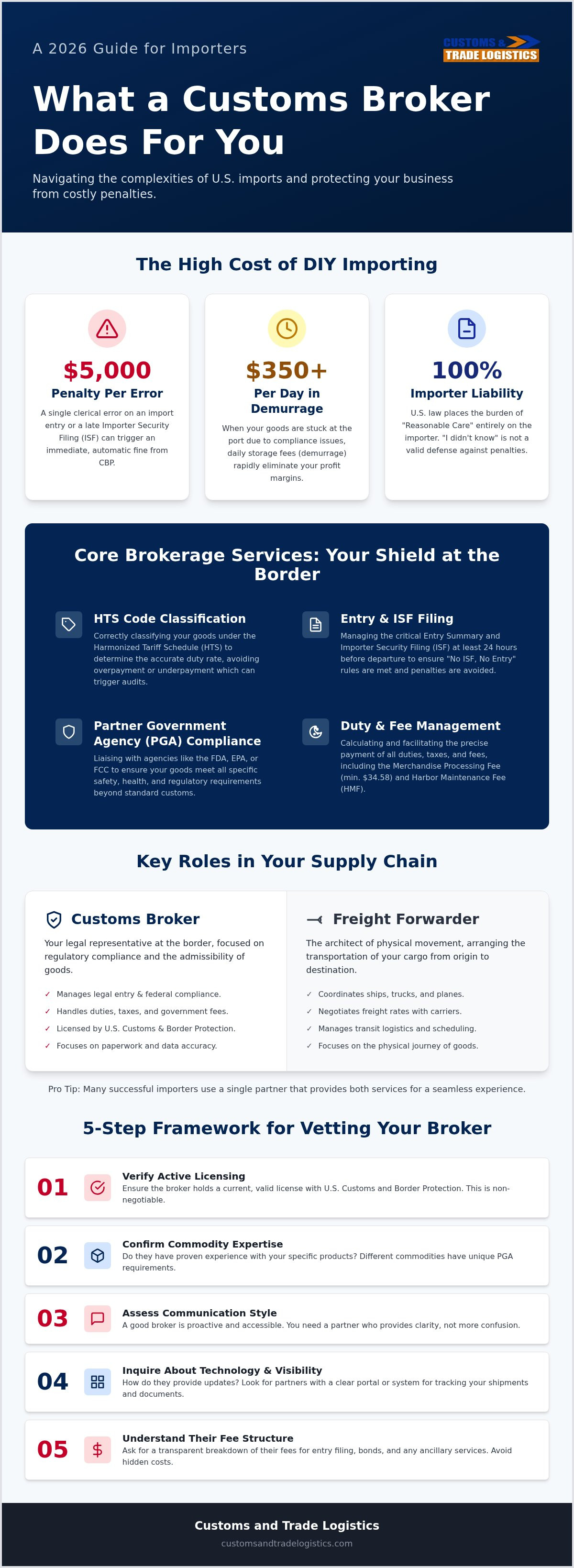
How to Vet a Customs Broker: A 5-Step Evaluation Framework
Choosing a logistics partner is one of the most significant decisions you'll make for your supply chain. It's not just about finding someone to file paperwork; it's about finding a "safe pair of hands" to protect your business from federal liability. When evaluating what does a customs broker do for an importer, you need a framework that looks beyond the price tag. Start by verifying their licensing and CBP standing. A broker should be in good standing with U.S. Customs and Border Protection, with an active permit for the ports you use. This ensures they have the legal authority to act on your behalf.
Next, assess their industry-specific expertise. Does the broker understand the nuances of your specific commodity? For example, textiles and electronics have vastly different regulatory requirements and HTS classifications. You also need to evaluate their communication style. Will you have a dedicated mentor who understands your business history, or will you be stuck in a generic support ticket queue? Finally, review their port coverage and fee transparency. A reliable partner provides a clear breakdown of custom brokerage service fees, ensuring there are no hidden costs that surprise you after your goods have cleared.
Questions to Ask During Your Initial Consultation
A consultation is your chance to see if a broker is truly an advocate for your growth. Don't be afraid to ask direct questions about their internal processes. A seasoned veteran will have no trouble providing clear, declarative answers. Consider asking these three critical questions:
- "How do you handle HTS classification disputes with CBP if they challenge our filing?"
- "What is your specific process for managing Partner Government Agency (PGA) filings, such as FDA or FCC requirements?"
- "Can you provide references from other small businesses or Amazon sellers who currently use your services?"
Warning Signs of an Unreliable Broker
Price isn't everything. In fact, unusually low fees are often a red flag. They often suggest an automated, "hands-off" filing approach where no human actually reviews your data for errors before submission. Other warning signs include a lack of a physical office or a vague track record. In an industry where experience is the ultimate stabilizer, a partner should have a verifiable history, ideally spanning 35+ years. If they give you vague answers regarding current trade wars or upcoming tariff updates, they aren't the strategic shield your business needs. If you want a partner who prioritizes personal oversight at every U.S. port, reach out to our team for expert Customs Clearance Services.
Why a Family-Owned Brokerage is the Strategic Choice for 2026
In an era dominated by automated portals and faceless support tickets, the human element remains your greatest asset. When you evaluate what does a customs broker do for an importer, the most critical factor isn't just their software; it's their level of personal investment in your success. A family-owned brokerage offers a "mentor advantage" that transforms a transactional service into a protective partnership. You aren't just another account number in a database. Instead, you have a dedicated advocate who treats your cargo with the same care as their own business.
Consistency of service is the cornerstone of this approach. With 35+ years of institutional knowledge, a family-run firm provides a stabilizing force that large corporations often lack. While big firms struggle with high staff turnover, a seasoned team maintains the long-term relationships and deep expertise required to handle complex U.S. imports. This continuity ensures that the person managing your HTS classification today will be the same expert who understands your business history next year. This is the "safe pair of hands" that small and medium-sized businesses need to thrive in a volatile global market.
Agility is another vital benefit. Small, expert teams pivot faster during port strikes, geopolitical shifts, or sudden regulatory changes. When 2026 brings new challenges to international trade, you need a partner who can adjust your strategy in real-time. This personal accountability means that if a shipment is flagged at a port, your broker is already on the phone with CBP, working to resolve the issue before it impacts your bottom line.
Demystifying Global Trade for the Modern Importer
Our mission is to replace administrative anxiety with professional assurance. A dedicated broker acts as your primary advocate during CBP inquiries, providing clear roadmaps through the maze of federal requirements. Whether you are an Amazon seller managing your first container or a seasoned importer scaling to a national operation, we help you build a foundation for growth. We demystify the process, ensuring you understand every fee and compliance step along the way. We move beyond simple filings to provide a stabilizing force for your entire operation.
Your Next Steps in International Logistics
Ready to secure your supply chain? Your journey toward predictable landed costs and total compliance starts with a few simple steps. We recommend you take action today to protect your inventory flow. Consider these priorities:
- Gather your current shipping documents for a professional compliance review to spot hidden risks before they become fines.
- Schedule a consultation to identify potential duty-saving opportunities through better HTS classification or tariff engineering.
- Partner with a team that values personal connection as much as technical accuracy.
By choosing a partner that understands what does a customs broker do for an importer at a strategic level, you gain the peace of mind to focus on what you do best: growing your business. Let our family protect yours as you expand into the global marketplace.
Future-Proof Your Global Operations
International trade in 2026 demands more than just a passing knowledge of logistics; it requires a strategic partner who understands that compliance is your business's strongest shield. By now, it's clear that what does a customs broker do for an importer goes far beyond simply filling out digital forms. They protect your capital from $5,000 ISF penalties, navigate complex HTS updates, and ensure your goods move through all U.S. ports without the sting of unexpected demurrage fees. This level of oversight is what keeps a supply chain resilient during market shifts.
Choosing a partner with 35+ years of family-owned expertise means you get a mentor who is personally invested in your growth. Whether you need specialized Amazon FBA support or national coverage to reach new markets, we provide the stabilizing force your supply chain deserves. Don't leave your seasonal inventory to chance or automated platforms that lack personal oversight. Secure your supply chain with a veteran customs broker today. We are ready to help you turn international logistics from a source of anxiety into a predictable, competitive advantage for your business.
Frequently Asked Questions
Is a customs broker required by law for all imports?
No, U.S. law doesn't strictly require you to hire a broker, but it does mandate that the Importer of Record exercises "reasonable care" in every filing. This means you are legally responsible for the accuracy of your HTS codes, valuations, and duty payments. Most businesses find that the risk of a $5,000 penalty for a minor clerical error makes professional assistance a practical necessity for staying compliant with CBP regulations.
How much does a customs broker typically charge per entry?
Service fees for customs entries vary based on the complexity of the shipment and whether other government agencies, like the FDA, are involved. While industry rates fluctuate, importers should expect to pay for the professional oversight and legal filing of their entry documents. When asking what does a customs broker do for an importer in terms of financial value, remember that their fee covers the mitigation of much larger costs like port storage or federal fines.
Can a customs broker help me reduce the duties I owe?
Yes, a knowledgeable broker can often identify legitimate ways to lower your overall import costs through tariff engineering. This involves reviewing the specific components or materials of your product to ensure it is classified under the most favorable HTS code. They might also suggest using duty drawback programs or Foreign Trade Zones if your business model qualifies, which can save your company thousands in annual taxes.
What is the difference between a customs broker and a freight forwarder?
A customs broker manages the legal admissibility of goods while a freight forwarder manages the physical transportation. Think of the forwarder as the architect of the journey and the broker as your legal counsel at the border. While they perform different tasks, many modern importers prefer a partner who can handle both logistics and brokerage to ensure there is no communication gap between the ship's arrival and the customs filing.
How long does the customs clearance process take with a broker?
The actual clearance process often takes between 24 and 48 hours once your documents are submitted to CBP. However, the work actually begins much earlier. For ocean shipments, your broker must file the Importer Security Filing at least 24 hours before the vessel departs the foreign port. Having your paperwork ready and audit compliant is the best way to ensure your cargo moves through the terminal without a single day of delay.
Do I need a different broker for each port my goods enter?
No, you don't need multiple brokers because a firm with a national permit can clear goods at any U.S. port of entry. This is a significant advantage for businesses that ship into different regions, such as Los Angeles, Savannah, or New York. Working with a single partner provides a consistent point of contact and ensures that your HTS classifications remain uniform across every shipment you bring into the country.
What happens if my customs broker makes a mistake on my filing?
You remain legally liable for all information submitted to CBP, even if your broker makes the error. This is why vetting your partner for a long track record of accuracy is so vital. If an error occurs, a proactive broker will file a Post Summary Correction to fix the mistake before it triggers an audit. This accountability is a core part of what does a customs broker do for an importer to protect their long term legal standing.
Can a customs broker assist with Amazon FBA specific requirements?
Yes, specialized brokers provide essential support for the unique requirements of Amazon fulfillment centers. This includes ensuring your cargo is properly palletized and labeled to meet Amazon's strict delivery appointments. They also manage redistribution services, which involve moving your goods from the port to a secondary facility before they are sent to various FBA warehouses, helping you maintain a steady flow of inventory without rejections.


