

Since the permanent suspension of the $800 de minimis exemption in June 2026, the small shipment loophole has officially closed. Every commercial package now faces the full weight of U.S. Customs, making the process of choosing a customs broker for Amazon FBA more critical than it's ever been. You're likely feeling the pressure of rising fulfillment fees and the constant anxiety that a single compliance error could lead to your inventory being rejected at the warehouse door or stuck at a port racking up daily demurrage charges.
We understand that managing international logistics feels like a heavy burden when you're trying to grow a business. You deserve predictable import costs and a seamless transition from the factory to the fulfillment center. That's why we've put together a comprehensive vetting checklist to help you find a reliable partner who acts as a true advocate for your brand. We'll walk you through the ten essential questions you must ask to ensure your inventory stays in a safe pair of hands, allowing you to avoid hidden brokerage fees and focus on your next product launch with total peace of mind.
Key Takeaways
- Understand why a specialized broker is essential for bridging the gap between US Customs compliance and Amazon’s rigid warehouse delivery standards.
- Learn how to verify a partner's licensing and port expertise when choosing a customs broker for Amazon FBA to ensure your inventory is never stranded.
- Identify the specific questions that reveal if a broker can manage end-to-end logistics, including Amazon’s strict labeling and palletization rules.
- Gain a clear framework for uncovering hidden fees and preparing for unexpected costs like port exams to protect your business margins.
- Discover why a "safe pair of hands" partnership with a seasoned mentor provides more long-term value than a simple transactional service.
Why Your Amazon FBA Shipment Needs a Specialized Customs Broker
When you start selling on Amazon, it's easy to think of a customs broker as just another administrative hurdle. In reality, they act as your legal representative to the U.S. government and your primary logistics coordinator. What is a Customs Broker? At its core, this professional ensures your goods meet federal regulations while facilitating the physical movement of your inventory. However, standard commercial imports are a different beast than FBA shipments. Amazon isn't just a destination; it's a strict gatekeeper with rules that can change overnight. If your broker doesn't understand these specific nuances, you aren't just risking a delay; you're risking a total rejection at the fulfillment center. This is why choosing a customs broker for Amazon FBA requires a specialized eye. Vetting your partner isn't just a chore; it's the best insurance policy you have against a supply chain collapse.
The High Stakes of FBA Customs Compliance
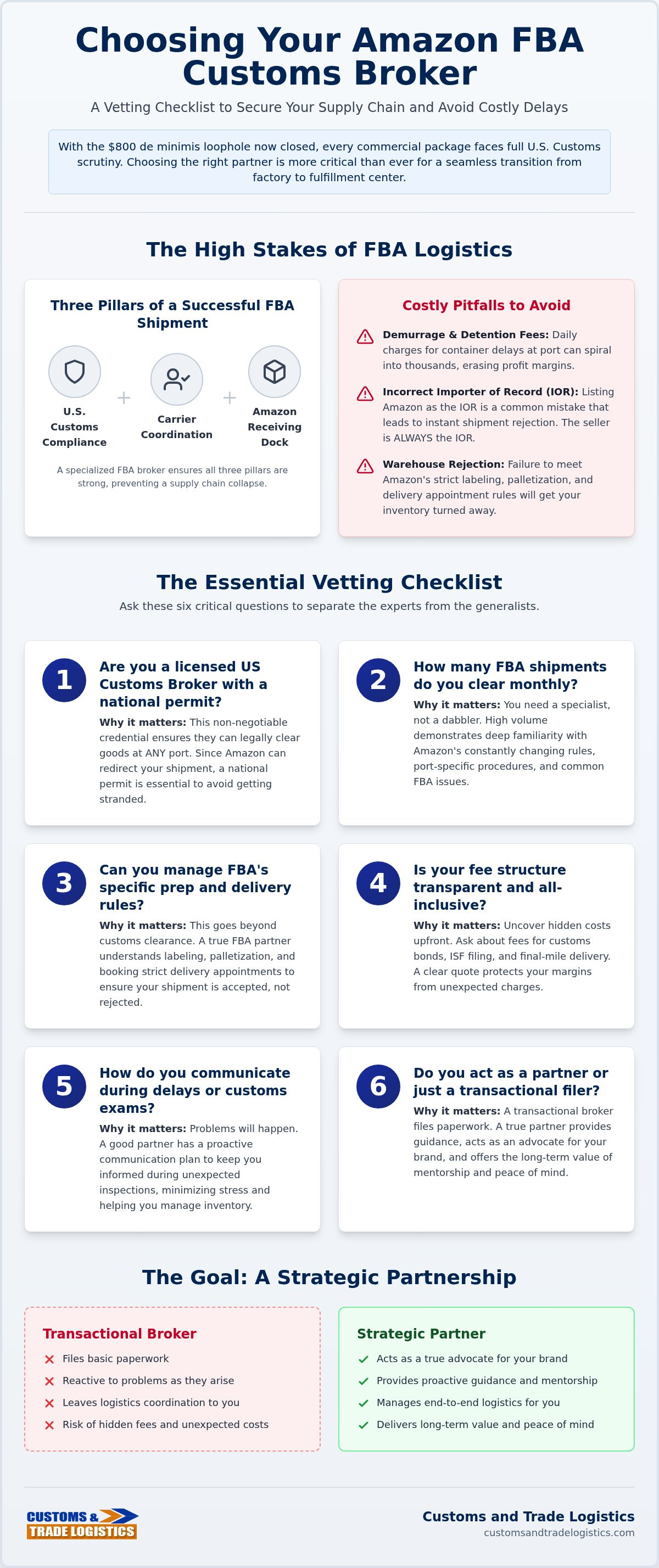
Success in the FBA world rests on three pillars: US Customs, your carrier, and the Amazon receiving dock. If any of these pillars crumble, the financial fallout is immediate. For instance, if a paperwork error holds your container at the port, you'll face "demurrage" fees, which are charged by the terminal for the container staying too long. You might also face "detention" fees, charged by the shipping line for the late return of their equipment. These costs can quickly spiral into thousands of dollars, eating your entire profit margin before the goods even reach a customer. For those just starting out, focusing on import logistics for startups helps build a foundation where these risks are managed proactively rather than reactively. A specialized broker knows how to keep your cargo moving so you never have to explain a stockout to your customers.
FBA vs. Traditional Retail Logistics
Traditional retailers usually act as the "consignee" and have their own staff to handle the unloading. With Amazon, the seller is the Importer of Record (IOR), while Amazon is merely the "Ultimate Consignee." This distinction confuses many new importers and even some general brokers. If the paperwork incorrectly lists Amazon as the IOR, they will refuse the shipment instantly. When choosing a customs broker for Amazon FBA, you need someone who recognizes that Amazon is never the IOR and who understands Delivered Duty Paid (DDP) terms to ensure all taxes are settled before the goods arrive at the warehouse door. To get started, you must sign a Power of Attorney (POA), which is a legal document that grants a licensed customs broker the authority to conduct U.S. Customs business on your behalf. This vetting process begins with asking the right questions about their core credentials and specific FBA experience.
The Expertise Checklist: Questions to Verify Licensing and FBA Experience
When you start narrowing down your options, don't be afraid to dig into the technical details. Choosing a customs broker for Amazon FBA is a long-term commitment to your brand's security. You need to know if a potential partner has the legal standing and the practical experience to protect your business from federal scrutiny. Start by asking these four foundational questions to separate the seasoned veterans from the generalists.
Verifying Regulatory Credentials
Question 1: Are you a licensed US Customs Broker with experience in all US ports? This is your non-negotiable baseline. You can handle Verifying a Customs Broker's Credentials by checking the official CBP website to ensure their license is active and in good standing. A broker with "national permit" status is essential for Amazon sellers. Because Amazon can change your designated fulfillment center at a moment's notice, your broker must be able to clear cargo at any port of entry, whether it's Los Angeles, Savannah, or New York. With 35+ years of experience, a family-owned firm provides the stability you need to navigate the complex 2026 regulatory environment without your inventory getting stranded.
Question 2: How many Amazon FBA shipments do you clear per month? You aren't looking for a broker who clears one or two FBA shipments as a side project. You want a partner who manages them daily. High volume indicates they're familiar with the latest port-specific quirks and Amazon's evolving delivery requirements. This consistent exposure means they can often spot potential issues before your goods even leave the origin port.
Product-Specific Knowledge
Question 3: Can you assist with HTS (Harmonized Tariff Schedule) classification for my specific products? Incorrect HTS codes are the leading cause of customs audits and heavy fines. You should ask if the broker has specific experience in your niche, whether you sell complex electronics or simple textiles. U.S. Customs and Border Protection expects every importer to meet the "reasonable care" standard, which means you must take proactive steps to ensure your product classifications are 100% accurate. If you're feeling overwhelmed by the paperwork, a quick consultation with a customs clearance expert can help clarify your obligations.
Question 4: Do you offer import from China logistics consulting? Since the majority of FBA inventory originates in China, your broker should understand the entire journey from the factory floor to the US port. A broker who provides consulting on China-to-US routes can help you navigate Section 301 tariffs and find the most cost-effective shipping lanes. This end-to-end oversight is what transforms a simple service provider into a "safe pair of hands" for your growing business.
Logistics Coordination: Ask These Questions About FBA Delivery Requirements
Once your goods clear customs, the journey is far from over. In fact, the "final mile" is often where the most expensive errors occur. When you are choosing a customs broker for Amazon FBA, you need a partner who understands that the clearance is just one step in a complex chain. If your broker doesn't have a handle on how Amazon receives inventory, your cleared goods could still end up sitting in a warehouse or being rejected at the fulfillment center door.
Question 5: Do you manage the end-to-end shipping chain or just the clearance? Some brokers only file the entry and leave you to find your own trucker. This creates a dangerous gap in oversight. A full-service partner manages the entire flow, ensuring that the person moving your goods understands the urgency of FBA deadlines. This "safe pair of hands" approach prevents your inventory from getting lost in the hand-off between the port and the final destination.
Question 6: How do you handle Amazon’s strict labeling and palletization requirements? Amazon has very specific rules for how boxes must be labeled and pallets must be built. For example, they require heat-treated, ISPM-15 compliant pallets. If your broker isn't verifying these details before the truck leaves the port, you risk your entire shipment being sent back at your expense. Does your team double-check these requirements at the redistribution point?
Question 7: Are you familiar with scheduling appointments through Amazon’s Carrier Central? Amazon doesn't allow random trucks to show up at their gates. Every delivery must be scheduled through their proprietary system. A broker who isn't fluent in Carrier Central will struggle to get your goods into the warehouse on time, leading to stockouts and lost sales.
Question 8: Do you provide FBA freight forwarding services that include redistribution? Often, Amazon requires your shipment to be split and sent to different regions. A partner who can manage this redistribution ensures your stock is positioned correctly across the country without you having to hire multiple different companies.
Managing the "Final Mile" to Amazon
The difference between a broker and a full-service logistics partner is often measured in the stress you feel during the final mile. Door-to-door oversight is much safer for high-volume sellers because it eliminates the need for you to act as the middleman between different service providers. Common mistakes like missing a delivery window or using non-compliant labels can be caught and corrected before they become expensive rejections if one partner is watching the whole process.
China-to-US Specialization
If you are sourcing from China, ask if they handle LCL (Less than Container Load) consolidation. This is vital for growing brands that don't yet need a full 40-foot container. Managing communication across 12 hour time zones is a specific skill that a family-owned firm with 35+ years of experience has mastered. Choosing a customs broker for Amazon FBA who acts as a bridge between your Chinese factory and the U.S. market ensures that simple documentation misunderstandings don't turn into week-long port delays.
Transparency and Fees: Questions to Avoid Hidden Import Costs
Choosing a customs broker for Amazon FBA requires looking far beyond the initial quote. Many sellers get lured in by a low entry fee only to be blindsided by "ancillary" charges that weren't mentioned upfront. These hidden costs can quickly turn a profitable product launch into a financial headache. To maintain your margins, you need a partner who provides total visibility into the financial side of the import process.
Question 9: Can you provide a transparent breakdown of all custom brokerage service fees? You should expect a line-item estimate that covers every predictable cost. This isn't just about the broker's service fee; it includes government-mandated charges like the Merchandise Processing Fee (MPF), which is set at 0.3464% of your goods' value in 2026. For ocean freight, you'll also see the Harbor Maintenance Fee (HMF) at 0.125%. If a broker gives you a vague "all-in" price, ask them to show their work. Transparency at this stage prevents disputes later.
Understanding the Quote
Look for specific line items in your quote: the entry fee, ISF filing, MPF, HMF, and even small courier fees. Digital freight forwarders often use automated systems that miss the granular details of a complex FBA shipment, leading to surprise invoices weeks after delivery. In contrast, a family-owned firm with 35+ years of experience provides more predictable pricing through personal oversight. We believe that a "safe pair of hands" means no financial surprises. Let our team provide a transparent customs clearance quote that helps you budget with confidence.
Handling Customs Exams and Audits
Question 10: How do you handle unexpected costs like exams or storage fees? Unexpected events like a CBP X-ray or a physical exam can add $300 to $1,000 or more to your costs. Ask your broker about their process when a shipment is flagged. A proactive broker will work to minimize storage fees by coordinating quickly with the exam site and the trucker. They should also help you secure a continuous customs bond, which typically costs between $400 and $1,200 annually in 2026. This is much more cost-effective for regular importers than buying single-entry bonds for every shipment.
Protecting your business means being realistic about compliance. As a seasoned mentor in this industry, our advice is simple: if a price seems too good to be true, the compliance probably is too. Choosing a customs broker for Amazon FBA who values honesty over low-balling ensures your brand stays on the right side of the law while keeping your import costs predictable.
Making the Final Decision: Why Partnership Trumps a Transactional Broker
Finalizing your decision requires a look at the big picture. We've covered the technical essentials: verifying licenses, assessing FBA-specific volume, mastering HTS classifications, and ensuring fee transparency. However, the most significant factor in choosing a customs broker for Amazon FBA is the level of partnership they offer. A transactional broker treats your shipment as a mere file number in a database. A true partner treats your inventory as the lifeblood of your brand. This distinction becomes clear the moment a shipment faces a delay or a compliance hurdle.
The Family-Owned Advantage
Personal accountability is the cornerstone of a successful logistics strategy. When your inventory is stuck at a port, you don't want to navigate a maze of chatbots or wait days for a response to a support ticket. You need a veteran who has spent 35+ years building direct relationships with port authorities and carriers across the country. This deep-rooted expertise allows us to act as a "safe pair of hands," resolving issues through personal connection and professional persistence. Our family-owned approach ensures that your business receives the dedicated oversight it deserves, bridging the gap between your overseas factory and the Amazon warehouse.
Your 2026 FBA Growth Roadmap
Logistics is not a "set it and forget it" part of your business. Your needs will evolve as you scale from small LCL (Less than Container Load) shipments to full containers (FCL). To maintain your growth, you must stay updated with customs clearance services us to adapt to shifting trade laws and new federal regulations. Reviewing your logistics strategy annually helps you identify cost-saving opportunities and ensures your brand reputation remains spotless with both U.S. Customs and Amazon’s receiving docks.
The final step in choosing a customs broker for Amazon FBA is to schedule a direct consultation. Use this conversation to test their responsiveness and industry literacy. Do they explain complex regulations in plain English? Do they show a genuine interest in your specific product niche? If the answer is yes, you've found more than just a service provider; you've found a mentor. A great broker is an investment in your brand’s stability and long-term success. We invite you to experience the relief of having a dedicated advocate manage your imports, allowing you to focus on what you do best: growing your Amazon business.
Securing Your Amazon Supply Chain for 2026 and Beyond
You've now seen how the right questions can transform your logistics from a source of stress into a competitive advantage. By verifying licensing, demanding total fee transparency, and ensuring your partner understands Amazon's strict delivery rules, you're doing more than just filing paperwork. You're building a resilient business. When choosing a customs broker for Amazon FBA, remember that technical compliance is just the baseline; the real value lies in a partner who anticipates port delays and warehouse rejections before they ever happen.
At Customs and Trade Logistics, we bring 35+ years of US Customs expertise and specialized China-to-US import support to every shipment. As a family-owned and operated firm, we take pride in being the "safe pair of hands" your brand deserves. Don't let compliance anxiety or hidden fees hold back your growth. Get a Professional FBA Customs Consultation from Customs and Trade Logistics today to secure your inventory and streamline your path to the fulfillment center. You've worked hard to build your brand; we're here to make sure it reaches your customers without a hitch.
Frequently Asked Questions
Do I really need a customs broker for Amazon FBA if my supplier offers DDP shipping?
Yes, you still need a dedicated advocate because you remain the legal Importer of Record. While DDP means the supplier pays the duties, you are ultimately responsible for the accuracy of the HTS classifications and compliance. If a supplier's broker makes a mistake to save on costs, U.S. Customs will hold you accountable for any fines or legal issues.
Can a customs broker help me if Amazon rejects my shipment at the warehouse?
A specialized broker can act as a logistics coordinator to resolve warehouse rejections. Rejections often stem from improper labeling or non-compliant pallets. A broker with redistribution capabilities can intercept the rejected shipment, fix the compliance issues at a local facility, and reschedule the delivery. This prevents the costly alternative of shipping the inventory back to the factory.
What is the difference between a freight forwarder and a customs broker for FBA?
A freight forwarder organizes the physical movement of cargo, while a customs broker manages the legal documentation and duty payments required for entry. Many Amazon sellers prefer a partner that provides both services. This end-to-end oversight ensures that the logistics team and the compliance team are in constant communication, reducing the risk of port delays.
How much do customs brokerage fees typically cost for an Amazon seller in 2026?
Industry averages for a formal customs entry in 2026 typically range between $150 and $400. This fee covers the filing of the entry but does not include government duties or taxes. You should also budget for the Merchandise Processing Fee, which is 0.3464% of the cargo value, and the annual cost of a continuous customs bond.
Does Amazon act as the Importer of Record (IOR) for my shipments?
No, Amazon will never act as the Importer of Record for any shipment. They are strictly the "Ultimate Consignee." If you list Amazon as the IOR on your customs paperwork, your shipment will be rejected immediately. You must ensure your broker lists your business as the legal party responsible for the entry to avoid terminal delays.
What happens if my customs broker makes a mistake on my FBA entry?
You are legally liable for any errors submitted to U.S. Customs, even if the broker made the mistake. Errors can lead to cargo exams, increased scrutiny on future shipments, and significant financial penalties. This risk is exactly why choosing a customs broker for Amazon FBA with decades of experience is a critical investment in your brand's long-term security.
How do I choose between a traditional customs broker and a digital freight platform?
Choose a traditional broker if you want a seasoned mentor who provides personalized oversight. Digital platforms often rely on automated systems that can miss subtle compliance risks or fail to provide support when a shipment is flagged for an exam. A family-owned firm offers a level of accountability and industry literacy that algorithms simply cannot match.
Can one customs broker handle all my FBA shipments across different US ports?
Yes, as long as the broker holds a national permit from U.S. Customs and Border Protection. This capability is essential when choosing a customs broker for Amazon FBA because Amazon often splits shipments between multiple regions. A broker with national coverage can clear your goods in any port, ensuring a consistent and predictable import process for your entire inventory.


