
Imagine checking your tracking status only to find your critical shipment is held at the port, and your current logistics provider hasn't returned your calls in three days. For many entrepreneurs, international freight logistics for small business feels like a game where the rules change constantly and the big players always get to cut the line. You're often left paying premium rates for small loads while worrying that a single paperwork error could trigger a $5,000 ISF penalty. It's frustrating to feel like a low priority just because you aren't moving thousands of containers a month.
We understand that your business deserves the same level of protection and precision as a global corporation. This guide will show you how to navigate the complexities of 2026 trade regulations, from the new 10% to 40% tariff brackets to the latest customs payment rules. You'll learn how to secure a logistics partner that acts as a mentor, ensuring your imports move seamlessly from the factory floor to your customer's door. We'll break down total landed costs and provide a clear roadmap for staying fully compliant with US Customs, giving you the confidence to grow your brand on a global scale.
Key Takeaways
- Understand why small businesses often feel overlooked by major carriers and how to bridge that gap by partnering with a dedicated logistics mentor.
- Compare the pros and cons of digital-only platforms versus traditional customs brokers to determine which model offers the personal oversight your team needs.
- Master the essentials of international freight logistics for small business to ensure your shipments are fully compliant with US Customs and free from costly paperwork errors.
- Learn how to calculate total landed costs, including the latest 2026 tariff updates, so you can protect your profit margins from hidden regulatory fees.
- Discover how 35+ years of industry experience can transform your import process from a source of anxiety into a seamless, end-to-end operation.
The Small Business Gap in International Freight Logistics
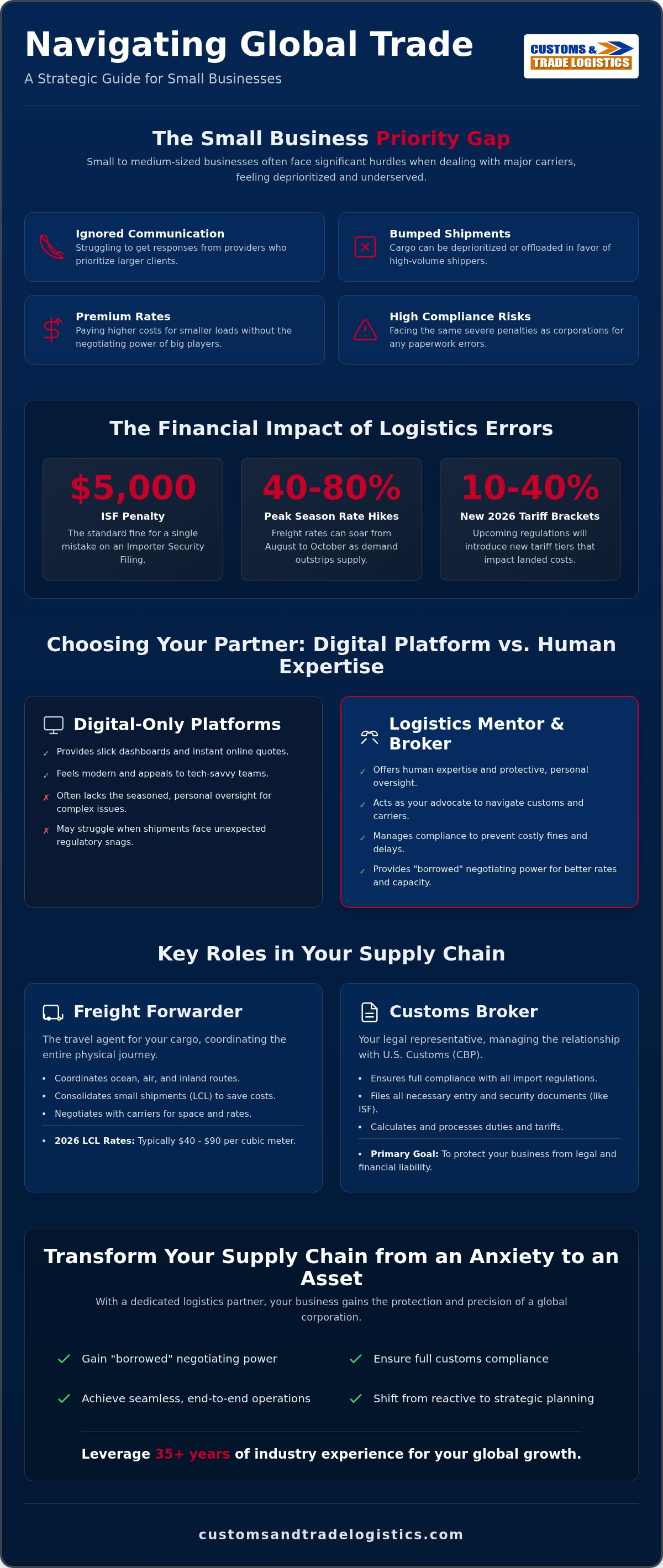
Many small business owners feel like they are shouting into a void when dealing with global shipping lines. If you aren't moving five hundred containers a month, you might find your emails ignored or your cargo bumped for a larger client's shipment. This priority gap is a real hurdle in international freight logistics for small business. It's not just about the shipping rates; it's about the lack of a protective partner who watches your back when things go sideways at the port.
You don't have to accept this "small player" status as a permanent disadvantage. By working with a seasoned logistics partner, you effectively borrow their established negotiating power. They represent hundreds of businesses like yours, which gives them the leverage to secure space and attention that you couldn't get on your own. When you master international freight logistics for small business, you stop reacting to crises and start planning for expansion. This shifts your operation from a survival mindset to a strategic growth mindset where your supply chain becomes a reliable asset rather than a source of constant anxiety.
Competing for Capacity in a Global Market
Large-scale importers often dominate the primary shipping lanes and equipment availability, especially during the peak season from August to October. During these months, ocean freight rates can jump by 40% to 80% as demand outstrips supply. If you're trying to manage this alone, you might find that essential equipment like containers or chassis simply isn't available for smaller loads. To understand the broader role of these intermediaries, you can look into What is a Freight Forwarder? to see how they consolidate shipments to keep your goods moving. Securing space requires foresight and a partner who knows how to navigate carrier alliances and blank sailings without leaving your cargo stranded on the dock.
The Reality of Customs Compliance Risks
U.S. Customs and Border Protection (CBP) doesn't offer a beginner's discount on penalties. They hold a startup to the same rigorous standards as a global corporation. A simple mistake on an Importer Security Filing (ISF) can result in a $5,000 fine per violation, which is often enough to wipe out the profit margin on an entire shipment for a growing brand. Customs compliance is the ongoing process of ensuring every legal requirement, duty payment, and documentation standard is met to protect your business from financial and legal liability. DIY logistics often leads to these expensive delays because the administrative burden is too heavy for a small team to carry without expert oversight. Having a mentor to manage these details turns a high-risk gamble into a secure, predictable journey.
Logistics Partners: Digital Platforms vs. Traditional Customs Brokers
Do you know the difference between the partner who moves your boxes and the one who talks to the government? Many entrepreneurs use the terms interchangeably, but understanding the distinct roles is the first step toward mastering international freight logistics for small business. The industry has seen a massive rise in digital-only forwarders that offer slick dashboards and instant quotes. While these tools feel modern, they often lack the seasoned oversight required when a shipment hits a regulatory snag. Choosing the right partner means finding a balance between technological speed and the protective care of a human expert.
The Role of the Freight Forwarder
Think of a freight forwarder as a travel agent for your cargo. They don't usually own the ships or planes, but they coordinate the entire physical journey across ocean, air, and inland routes. For small teams, forwarders are essential because they bundle smaller shipments into shared containers. This process, known as Less than Container Load (LCL), allows you to access ocean freight rates that typically range between $40 and $90 per cubic meter in 2026. This "negotiating power" helps you compete with larger firms without needing to fill an entire 40-foot container. If you are also looking to expand your reach outward, the SBA Exporting Guide provides excellent foundational advice on the broader trade landscape.
The Role of the Customs Broker
While a forwarder moves the goods, a customs broker manages the legal relationship with U.S. Customs and Border Protection. They carry the heavy responsibility of filing entries and ensuring your products are classified under the correct Harmonized System (HS) codes. A single classification error can lead to you overpaying duties or, worse, facing a seizure of goods. Because regulations are constantly shifting, it's helpful to review custom brokerage service fees to understand how to budget for this professional oversight. A broker acts as your advocate, ensuring every document is precise and every duty is paid correctly.
Algorithms are excellent for processing data, but they can't provide the "safe pair of hands" a small business needs during a complex audit. Digital platforms might give you a fast price, but they often struggle with the nuanced consulting required for specialized imports. The hybrid sweet spot is a partner who uses modern efficiency to keep things moving while providing a veteran mentor to guide you through the hurdles. If you feel overwhelmed by the technical density of global trade, consider reaching out for expert logistics consulting to stabilize your supply chain. You deserve a partner who treats your small shipment as a high priority, not just another line of code in an automated system.
How to Find a Reliable Customs Broker for Your Small Business
Finding a partner for international freight logistics for small business is one of the most critical decisions you'll make. It's more than just a transaction; it's a long-term alliance that determines whether your goods clear the port or get stuck in a bureaucratic loop. Before you start your search, take a moment to define your specific needs. Do you need help navigating the complexities of Amazon FBA? Are you importing a specialized product category that requires specific Harmonized System (HS) knowledge? Identifying these requirements early ensures you find a broker who understands your unique business model.
You can find licensed customs brokers through the official U.S. Customs and Border Protection (CBP) port lists. However, a license is only the baseline. You need a partner who views your success as their own. A seasoned mentor will look at your documentation before it's sent, catching errors that could lead to inspections or fines. This proactive care is what separates a truly reliable broker from a high-volume firm where your small shipment might get lost in the shuffle.
Step-by-Step Vetting Framework
The vetting process should be methodical and thorough. First, you must verify that any potential partner is a licensed customs broker. Reviewing the CBP Tips for Importers and Exporters is a great way to familiarize yourself with the standards you should expect. Beyond the license, look for a broker with a track record in your specific product niche. A broker who specializes in textiles might not be the best fit if you are importing electronics. Finally, evaluate their communication style. Do they take the time to explain the "why" behind a regulation, or do they simply send an invoice and wait for you to figure out the rest?
Crucial Questions to Ask Every Potential Partner
When you sit down for an initial consultation, come prepared with questions that test their expertise and commitment to small-scale operations. Ask specifically how they handle Importer Security Filing (ISF) for small ocean shipments. Since ISF late filing penalties are a flat $5,000, you need to know their process for ensuring 24-hour pre-loading compliance. Another vital topic is their experience with imports from China, as this trade lane involves unique hurdles and tariff structures. If you're just starting out, you might find our guide on import logistics for startups helpful for preparing these initial conversations.
Watch out for red flags that suggest your business won't be a priority. If a broker is slow to respond or provides vague answers about their experience with small freight loads, they likely aren't the "safe pair of hands" you need. A reliable partner should be transparent about their capabilities and proactive in identifying potential risks before your goods even leave the factory. You aren't just looking for someone to file paperwork. You're looking for a dedicated advocate who can navigate the ever-changing landscape of international freight logistics for small business with confidence and care.
Calculating Landed Cost: The Financial Key to Logistics
How do you ensure your price point stays competitive when global shipping rates fluctuate? Understanding the financial landscape of international freight logistics for small business is the difference between a profitable quarter and a surprise deficit. Many entrepreneurs focus only on the factory price and the initial shipping quote, but these figures are just the beginning of the journey. The true measure of your investment is the landed cost, and failing to account for every regulatory fee can leave you with "sticker shock" once your goods arrive at the port.
Landed cost is the total price of a product once it has arrived at the buyer's doorstep, encompassing the original price of the goods, all transportation fees, customs duties, taxes, insurance, and any handling charges incurred during the journey.
Breaking Down the Components of Landed Cost
Hidden fees can constitute 20-40% of the total landed cost of a shipment, making it essential to look beyond the basic freight rate. When you're budgeting for 2026 imports, you must account for several specific U.S. Customs charges. For instance, the Merchandise Processing Fee (MPF) is currently 0.3464% of the cargo value, with a minimum of $31.67 and a maximum of $614.35. If you are importing via ocean freight, you also need to factor in the Harbor Maintenance Fee (HMF) at 0.125% of the value. These small percentages add up quickly, especially when combined with terminal handling fees and insurance costs that protect your capital while it's in transit.
The Strategic Advantage of Proper Classification
Your Harmonized System (HS) code is the most powerful lever you have for controlling your bottom line. These codes dictate your duty rate and ensure you are legally compliant with U.S. trade laws. As of August 1, 2026, new tariff actions have pushed rates between 10% and 40% for many goods, making precise classification more critical than ever. A seasoned broker acts as a mentor here, identifying duty-saving opportunities through Free Trade Agreements or more accurate sub-classifications that an automated system might miss. Misclassification doesn't just lead to fines; it often results in missed savings that could have been reinvested into your business growth.
Don't let unexpected regulatory fees erode your margins. You can find more detailed breakdowns of these requirements in our guide on customs clearance services. If you want to move forward with total financial clarity, you can request a landed cost analysis from our team. We'll help you demystify the numbers and ensure your international freight logistics for small business is built on a foundation of predictable, manageable costs.
The Customs and Trade Logistics Advantage: Your Growth Partner
Why settle for being a low priority when you can have a seasoned mentor in your corner? At Customs and Trade Logistics, we've spent over 35 years turning the anxiety of global trade into a steady path for growth. We don't believe your business should be penalized just because your shipments are smaller than those of a global corporation. Instead, we specialize in providing international freight logistics for small business that combines high-level expertise with the personal touch of a family-owned consultancy. You deserve a partner who treats your cargo with the same care you put into your products.
Our team understands the unique hurdles of China-to-US trade. With the broad tariff actions effective August 1, 2026, pushing rates between 10% and 40% for many goods, you need more than just a software platform. You need a partner who can provide Import From China Consulting to ensure your supply chain remains viable. We manage the entire journey, from the moment your goods leave the foreign factory until they reach their final delivery point. This end-to-end oversight ensures that no detail is overlooked and no deadline is missed. Mastering international freight logistics for small business is about building this kind of resilience into your daily operations.
A Safe Pair of Hands for Modern Importers
We act as a knowledgeable bridge between your local operations and the global marketplace. Demystifying U.S. Customs regulations is at the heart of what we do. By clearing customs at all US ports, we provide the flexibility your business needs to scale without geographic limits. Our personalized oversight prevents the costly administrative delays that often plague DIY importers. We don't just file your paperwork; we act as a protective force that lifts the heavy burden of compliance from your shoulders, allowing you to focus on what you do best.
Ready to Secure Your Supply Chain?
Whether you're a startup or an established e-commerce brand, our services are designed to protect your margins. We specialize in Amazon FBA and small business imports, ensuring your inventory is compliant and ready for redistribution. You deserve a logistics partner who values personal connection as much as technical accuracy. Let's move beyond the survival mindset and build a supply chain that supports your long-term goals. Let Customs and Trade Logistics manage your international freight today.
Securing Your Global Supply Chain for the Future
Mastering international freight logistics for small business is about more than just finding the cheapest shipping rate. It's about building a foundation of compliance and cost clarity that allows you to scale without fear. By now, you should have a clear understanding of how to distinguish between automated digital platforms and the nuanced oversight of a traditional broker. You also know that calculating total landed costs is the only way to protect your margins from the evolving tariff landscape of 2026.
You don't have to navigate these regulatory hurdles alone. With over 35 years of industry-leading experience, Customs and Trade Logistics provides the personalized, family-owned service that high-volume firms often overlook. We clear customs at all US ports, acting as a dedicated advocate for your brand at every stage of the journey. Partner with a veteran customs broker to secure your small business logistics.
Your business growth shouldn't be stalled by administrative errors or port delays. With a seasoned mentor by your side, you can trade with total confidence and reach new markets with ease.
Frequently Asked Questions
What is the difference between a freight forwarder and a customs broker?
A freight forwarder acts as a travel agent for your cargo, coordinating its physical movement across ocean, air, and land. In contrast, a customs broker is a licensed professional who manages the legal relationship with U.S. Customs and Border Protection. While the forwarder ensures your boxes move from point A to point B, the broker ensures those boxes legally enter the country by filing the correct entries and paying duties.
How much does a customs broker typically charge a small business?
In 2026, standard industry fees for a basic customs entry usually range between $150 and $250. If your shipment is more complex or requires filings with other government agencies, these costs can exceed $400. These professional fees are separate from the actual duties and taxes you owe the government, but they provide the expert oversight needed to avoid much larger penalties.
Can a small business handle its own international freight logistics?
While it is legally possible to manage your own imports, the technical requirements make it a high-risk strategy for most entrepreneurs. Managing international freight logistics for small business involves a steep learning curve regarding HS codes, ISF deadlines, and bond requirements. Most small teams find that the time spent on administrative paperwork is better invested in growing their brand while a mentor handles the logistical details.
What is an ISF filing and why is it critical for small importers?
The Importer Security Filing, also known as "10+2," is a mandatory electronic document for all ocean freight entering the United States. It must be filed at least 24 hours before your goods are loaded onto the vessel in the foreign port. This is critical because U.S. Customs issues a flat $5,000 penalty for late or inaccurate filings, which can easily wipe out the profit margin for a small shipment.
How do I know if my product needs a special import permit?
You can determine permit requirements by checking your product's Harmonized System (HS) code against the regulations of Partner Government Agencies. Agencies like the FDA, USDA, or EPA often require additional documentation for electronics, food, or chemicals. A seasoned broker can review your product details before you place an order to identify these specific "flags" and ensure you have the right permits in place.
What are the most common customs mistakes small businesses make?
The most frequent errors include misclassifying goods to save on duties and under-valuing shipments on the commercial invoice. Both mistakes are red flags for U.S. Customs and often lead to intensive inspections or heavy fines. Missing the 24-hour ISF deadline is another common pitfall that results in avoidable financial loss for new importers who aren't familiar with the strict timeline.
How long does it take for a shipment to clear customs in the US?
Most shipments clear customs within 24 to 48 hours of arrival if the paperwork is perfect and no physical inspection is required. However, if your goods are selected for an exam or if there are errors in your documentation, the process can be delayed by several days or even weeks. Having a proactive broker helps ensure that all entries are filed well before the ship docks to minimize these wait times.
Why is importing from China more complex for small businesses in 2026?
Importing from China has become more challenging due to broad tariff actions effective August 1, 2026, which have introduced rates between 10% and 40% on many categories. These shifting trade relations mean that international freight logistics for small business now requires much more strategic planning. You must stay updated on the latest regulatory changes to ensure your landed costs remain manageable and your supply chain stays resilient.


