

Did you know that as of 2026, even the smallest commercial shipments from China now require formal customs entry due to the suspension of the de minimis exemption? It's a daunting shift for many US businesses that used to rely on duty-free limits. You're likely feeling the pressure of new 12.5% Section 301 tariffs and the anxiety that a single typo on an ISF filing could lead to a $5,000 penalty. We understand that deciphering what documents are needed to import from China feels less like running a business and more like a high-stakes obstacle course.
You shouldn't have to stay up at night worrying about industry jargon or supplier errors. We've spent over 35 years acting as a safe pair of hands for importers just like you, and we want to help you regain your confidence. This article promises to clear the fog by providing a comprehensive, printable checklist designed to prevent costly port storage fees and ensure your cargo clears customs smoothly. We will walk you through everything from the mandatory CPSC eFiling requirements to the essential commercial invoices, giving you a methodical roadmap for your 2026 logistics strategy.
Key Takeaways
- Understand your legal liability as the Importer of Record and why the "24-hour rule" makes filing timing just as critical as the paperwork itself.
- Identify exactly what documents are needed to import from China for a standard entry, including why granular detail on your packing list is vital for passing CBP inspections.
- Learn to navigate specialized requirements for regulated goods, such as FDA Prior Notice for cosmetics or EPA forms for engines, to avoid unexpected holds.
- Discover how your choice of Incoterms shifts your documentation responsibilities and how to handle situations where a supplier lacks a China Export License.
- See how a proactive document review by a seasoned broker can catch errors before your shipment leaves the factory, protecting you from costly port storage fees.
Understanding the High Stakes of US Customs Documentation
Starting an import business means wearing many hats, but "Importer of Record" (IOR) is perhaps the heaviest one you'll ever put on. As the IOR, you're the party legally responsible for ensuring your goods comply with all US laws, regulations, and duty requirements. This isn't a task you can simply hand off to a factory in Shenzhen and forget about. If the paperwork is wrong, US Customs and Border Protection (CBP) holds you accountable, not your supplier. Whether it's a minor clerical error or a missing certificate, the legal liability rests squarely on your shoulders.
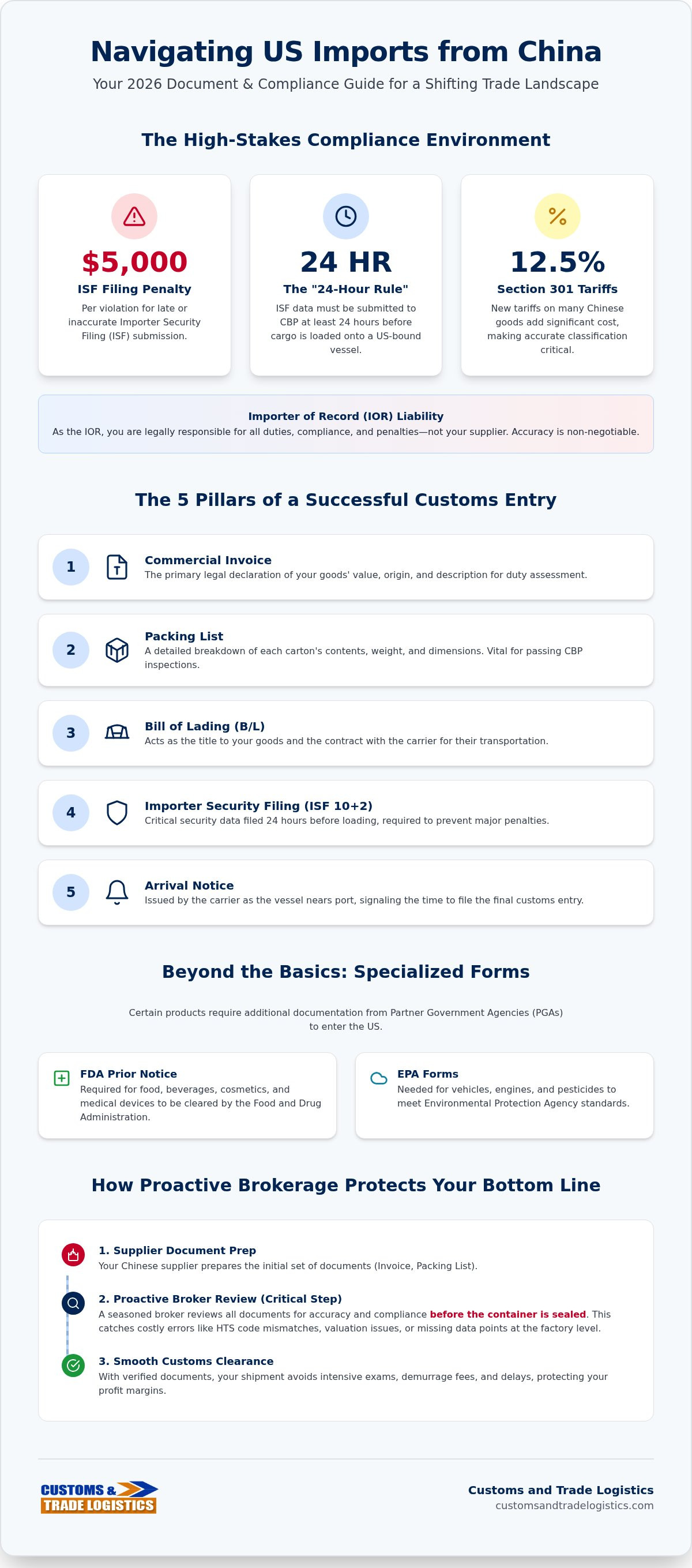
Timing is just as critical as the accuracy of the data itself. The "24-hour rule" for Importer Security Filing (ISF) requires you to submit specific data elements to CBP at least 24 hours before your cargo is even loaded onto a vessel destined for the US. Missing this window isn't just a small hiccup. It can trigger an automatic $5,000 penalty per violation. Understanding the broader customs clearance process helps you see why these strict windows exist. It's a security and data-matching exercise that begins long before the ship ever reaches American waters.
Knowing exactly what documents are needed to import from China is the first step in protecting your business from these high stakes. When documents don't match or filings are late, your cargo doesn't just sit still. It incurs costs. Common consequences include intensive physical exams, mounting port storage fees known as demurrage, and significant fines that can jeopardize your company's standing with CBP. Professional brokerage acts as a stabilizer here, replacing that sense of "what if" with the security of expert oversight.
The Role of the Customs Broker in 2026
While digital tools are everywhere, software alone can't replace the expert verification required in today's trade environment. A computer might not catch a subtle description error that incorrectly triggers the 12.5% Section 301 tariff. We act as your "safe pair of hands," verifying every line item against current 2026 regulations. We bridge the gap between your Chinese supplier's paperwork and the strict requirements of CBP, managing the entire international shipping chain to ensure nothing is overlooked.
The Financial Impact of "Simple" Paperwork Mistakes
A single typo can lead to an intensive customs exam. This doesn't just mean a delay; it means you're responsible for the cost of the exam and the daily storage fees at the port. These expenses can quickly spiral, potentially costing thousands of dollars and erasing your profit margins. Most holds are preventable at the factory level. By confirming what documents are needed to import from China before the container is sealed, you protect your bottom line and ensure a smooth journey for your goods.
The Essential Document Checklist: 5 Pillars of a Successful Entry
Navigating the sea of paperwork requires more than just a folder; it requires a strategy. When you're trying to determine what documents are needed to import from China, you must look at your paperwork as a data-matching exercise. If the weight on your packing list doesn't match the weight on your bill of lading, CBP may flag your container for an exam. These five pillars form the foundation of every successful entry into the United States.
- Commercial Invoice: This is your primary legal declaration of value, origin, and item description.
- Packing List: A granular breakdown of what's inside every carton, essential for physical inspections.
- Bill of Lading (B/L): This document serves as the title to your goods and the contract for their transportation.
- ISF (Importer Security Filing): The "10+2" rule that must be filed before the ship leaves China.
- Arrival Notice: The document issued by the carrier once the goods are nearing the US port, triggering the final customs entry.
The Basic Importing and Exporting requirements established by US Customs demand that these documents work in perfect harmony. Since the de minimis exemption was suspended in 2025, even small shipments now require this full suite of formal documentation. Our import from China consulting team often finds that "simple" errors, like a mismatched HTS code, are the most common cause of multi-day delays at the port.
Auditing the Commercial Invoice
Your commercial invoice is much more than a bill of sale. In 2026, with the additional 12.5% Section 301 tariffs in effect, your Harmonized Tariff Schedule (HTS) codes must be beyond reproach. You need to verify that the "Country of Origin" is clearly marked for every single line item. If the currency or value on the invoice doesn't match your sales contract perfectly, you risk a valuation flag that could lead to an audit of your entire business history. Accuracy here is your best defense against unexpected costs.
Mastering the ISF 10+2 Filing
The Importer Security Filing is non-negotiable for ocean cargo. You need ten data elements from your supplier at least 48 hours before the cargo is loaded onto the vessel to ensure you hit the 24-hour filing deadline. Don't wait until the last minute. A late filing is an automatic $5,000 penalty. We recommend coordinating with your freight forwarder early to ensure a seamless submission. This proactive approach acts as a shield, protecting your profit margins from avoidable fines and ensuring your shipment stays on schedule.
Beyond the Basics: Specialized Forms for Regulated Commodities
While the standard checklist covers most bases, certain goods require specialized oversight from Partner Government Agencies (PGAs). When you ask what documents are needed to import from China, the answer often shifts based on the specific category of your product. For example, if you're importing consumer goods like toys or electronics regulated by the CPSC, you must now comply with the mandatory eFiling mandate that took effect on July 8, 2026. This requires you to electronically file a Certificate of Compliance at the time of entry through the Automated Commercial Environment (ACE).
For those in the health, beauty, or food industries, the FDA Prior Notice is your most critical hurdle. Without this digital "heads up" to the Food and Drug Administration, your goods won't even be allowed to leave the port. Similarly, if your shipment includes engines, vehicles, or certain chemicals, you'll need to submit EPA and DOT forms to prove environmental and safety compliance. Don't forget the Lacey Act if you're importing wood furniture or plant-based products. You'll need to declare the genus, species, and country of harvest to satisfy environmental protection laws. These China-specific import requirements ensure that your goods aren't just legal, but safe for American consumers.
Finally, be aware of Anti-Dumping and Countervailing Duties (AD/CVD). China is frequently subject to these additional duties designed to offset unfair pricing or foreign government subsidies. You may need specific certificates or non-reimbursement declarations to prove your goods aren't subject to these massive extra costs, which can sometimes exceed 100% of the product's value. Identifying these requirements before you ship is the only way to protect your profit margins.
Amazon FBA Specific Requirements
If you're an Amazon seller, your documentation needs to be even more precise to avoid "dark" inventory. CBP doesn't care about your FBA shipment ID, but Amazon certainly does. To ensure a smooth transition from the port to the warehouse, your customs entry paperwork must align perfectly with your Amazon shipping plan. Misaligned labels or missing IDs can lead to weeks of delays at the fulfillment center. You can explore our specialized FBA freight forwarding services to see how we sync these two very different worlds for you.
Intellectual Property and Brand Authorization
Protecting your brand is a two-way street. CBP is on high alert for counterfeit goods, especially coming from China. If you're importing branded products, you must have trademark authorization letters on file. Without these, customs may seize your goods under the suspicion of IP infringement, even if they're authentic. We help you manage these risks during the import from China logistics process, acting as your advocate to prove that your supply chain is legitimate and authorized.
Managing the "China Side": Supplier Responsibilities and Export Licenses
Your shipment's journey begins long before it hits the water, and the quality of your factory's paperwork determines whether that journey is smooth or stressful. While you are responsible for the US side, your supplier must handle the Chinese export formalities. A common pitfall for new businesses is assuming every factory has a China Export License. In reality, many smaller manufacturers don't. If they lack this license, they must use an authorized export agent to clear the goods through Chinese Customs. This adds another layer of paperwork and another party to the transaction, making it even more important to verify what documents are needed to import from China at the very start of your negotiation.
Another critical document is the Certificate of Origin. Even with the flat 12.5% Section 301 tariff currently in effect for 2026, a formal Certificate of Origin is vital for accurate record-keeping and potential future duty preference programs. Beyond the legal forms, your communication strategy with the factory is paramount. Don't accept blurry smartphone photos of documents. You need legible, high-resolution PDF scans of every form to ensure that US Customs can read the fine print. If you're feeling overwhelmed by these factory-level details, our import from China consulting team can step in to audit your supplier's documents before the cargo ever leaves the warehouse.
Choosing the Right Incoterm for Document Control
Which Incoterm you choose directly impacts your level of document oversight. For most US businesses, FOB (Free on Board) is the safest choice because the supplier is responsible for all China-side export documentation and costs until the goods are on the ship. While "Door-to-Door" DDP (Delivered Duty Paid) shipping sounds convenient, it's often a trap for the unwary. Under DDP, the supplier controls the documentation, which can lead to valuation errors that you, as the Importer of Record, are still legally liable for. Your choice of Incoterm will also influence your overall custom brokerage service fees, as more complex document chains require more intensive review.
The Supplier Verification Step
Before the ship sails, you must confirm that the supplier's name on the commercial invoice matches the name on the China Export License exactly. Any discrepancy here can cause a major bottleneck at the Chinese port. You should also ensure that the "Notify Party" on the Bill of Lading is your US customs broker, which allows us to receive automated updates from the carrier. The Bill of Lading must be endorsed correctly to ensure the legal transfer of the title to the goods occurs without delay. By verifying these details early, you act as a protective bridge between your factory and the global marketplace.
How Professional Brokerage Protects Your Bottom Line
Understanding what documents are needed to import from China is a vital first step, but the real magic happens in the execution. In the complex trade environment of 2026, where regulations shift and tariffs fluctuate, simply having the right forms isn't enough. You need the expertise to interpret them. With over 35 years of industry experience, we've seen how port-specific nuances can change the game. A document accepted in Long Beach might face additional scrutiny in Savannah. We use our deep-rooted knowledge to navigate these local variations, acting as a stabilizing force for your business.
Our proactive document review is where we truly save you money. Instead of waiting for your container to arrive at a US port to find a mistake, we catch errors while your goods are still at the factory. This oversight prevents the "Customs Holds" that lead to thousands of dollars in demurrage fees. While digital-only platforms offer speed through automation, they often lack the human intuition needed to resolve a complex port dispute. As a family-owned and operated consultancy, we provide a personal connection that software simply can't replicate. We're your dedicated advocate, ensuring your growth isn't stunted by administrative burdens.
Setting Your Foundation as a New Importer
If you're just starting out, your first formal step is signing a Customs Power of Attorney (POA). This legal document allows us to act on your behalf, filing the necessary entries and managing your what documents are needed to import from China checklist. You'll also need to decide between a Single Entry Bond and a Continuous Bond. If you plan to import more than three times a year, a Continuous Bond is almost always the more cost-effective choice. For those just beginning their journey, we offer specialized import logistics for startups to help you build a compliant foundation from day one.
Next Steps: Moving From Factory to Final Delivery
Our partnership doesn't end when your goods clear customs. We provide a seamless transition from the port to your warehouse through our delivery and redistribution services. We coordinate the final leg of your shipment, ensuring your inventory reaches its destination without further delay. This end-to-end management offers the peace of mind that comes from leaving your logistics in a "safe pair of hands." You've worked hard to source your products; don't let paperwork stand in the way of your success. Contact us today for a personalized logistics consultation and let us handle the complexities of global trade for you.
Securing Your 2026 Import Strategy
The landscape of international trade is more complex than ever. You now know that being the Importer of Record is a significant legal commitment that requires absolute precision from the moment your goods leave the factory. By mastering what documents are needed to import from China, you've taken the first step toward protecting your profit margins and ensuring your cargo doesn't get sidelined by preventable customs holds. Success in 2026 depends on your ability to harmonize supplier data with strict US Customs requirements.
Remember that timing is just as vital as accuracy. Whether you're coordinating ISF filings before loading or ensuring your Amazon FBA labels match your entry forms, every detail counts. You don't have to carry this administrative weight alone. With over 35 years of customs expertise and a family-owned approach that covers every US port, we're ready to be your specialists in China-to-US logistics. We'll act as your dedicated mentor, helping you navigate the granular details of global trade with confidence.
Your business deserves a partner that treats your shipment with the same care you do. Get a Professional Document Review and Shipping Quote today to secure your supply chain and turn these logistical challenges into a smooth, predictable path for growth.
Frequently Asked Questions
Do I need a different set of documents for air freight vs. sea freight from China?
Yes, the primary transport document changes depending on your shipping method. Air freight utilizes an Air Waybill (AWB), while sea freight requires a Bill of Lading (B/L). Additionally, sea freight shipments must have an Importer Security Filing (ISF) submitted to customs at least 24 hours before loading, a requirement that does not currently apply to air cargo.
Can my Chinese supplier file the ISF for me?
While your supplier provides the necessary data elements, they typically cannot file the ISF directly into the US Customs system. You or your licensed US customs broker must handle the actual submission. It's vital to remember that as the Importer of Record, you are legally liable for the $5,000 penalty if the filing is late or inaccurate.
What happens if a document has a typo or a weight mismatch?
Typographical errors or weight mismatches between your packing list and Bill of Lading often trigger a customs hold or an intensive physical exam. CBP uses automated data-matching to flag these discrepancies as potential risks. If your paperwork doesn't align, your shipment will sit at the port, quickly accruing costly storage and demurrage fees while you resolve the error.
Is a Commercial Invoice the same as a Proforma Invoice?
No, these documents serve very different roles in the shipping process. A Proforma Invoice is a preliminary document used for quoting or opening a letter of credit. A Commercial Invoice is the final, legal declaration of value used by customs to calculate duties and taxes. CBP will not accept a Proforma Invoice for a formal customs entry.
How long should I keep my import documents after the shipment arrives?
You are legally required to maintain all import records for five years from the date of entry. This mandate from US Customs and Border Protection ensures that all data is available for a post-entry audit. Your files should include the commercial invoice, packing list, Bill of Lading, and any specialized certificates or permits used for that specific shipment.
Do I need an import license to bring goods from China into the US?
Generally, the US does not require a "general" import license to start bringing goods into the country. However, you may need specific permits or licenses for regulated commodities like food, chemicals, or medical devices. These are overseen by Partner Government Agencies such as the FDA or EPA rather than a single overarching import license.
What is a "Certificate of Origin" and is it always required?
A Certificate of Origin (COO) is a document that officially declares the country where your goods were manufactured. While not mandatory for every shipment, it's often required to verify the application of the 12.5% Section 301 tariff. It's also essential if you're attempting to claim duty preferences or prove your goods didn't originate from a prohibited region.
How does the HTS code affect which documents I need?
Your HTS code is the master key that determines both your duty rate and any additional forms required by other government agencies. For instance, an HTS code for electronics might trigger a mandatory CPSC eFiling. Identifying what documents are needed to import from China always starts with an accurate HTS classification to ensure you don't miss these specialized requirements.


