

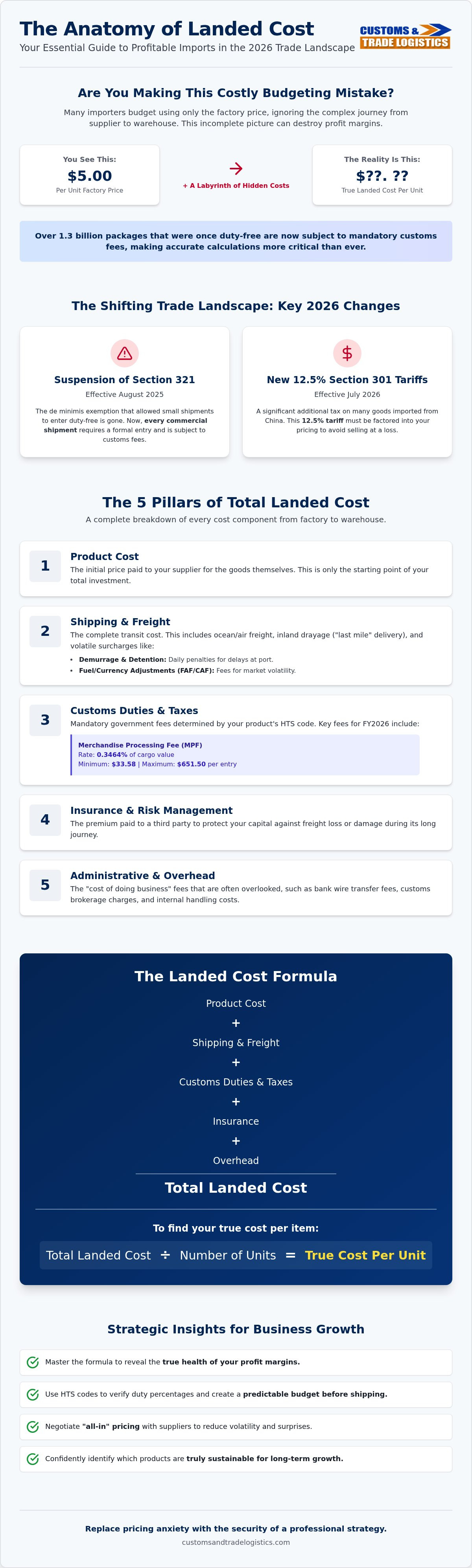
Did you know that over 1.3 billion packages that once entered the U.S. duty-free are now subject to mandatory customs fees and tariffs? Since the suspension of the Section 321 de minimis exemption, every commercial shipment requires a formal entry, making it more critical than ever to understand how to calculate landed cost for imports. We know how stressful it is to open a freight invoice and see your margins disappearing into unforeseen duties or the new 12.5% Section 301 tariffs that took effect this July.
You deserve a predictable budget and the confidence that your per-unit pricing is actually accurate. We're here to help you master the math behind your profit margins with a clear, step-by-step breakdown of the 2026 trade landscape. This guide will walk you through the updated MPF minimums, the latest Harbor Maintenance Fees, and the exact formula you need to keep your international trade operations compliant and profitable. It's time to replace that pricing anxiety with the security of a professional strategy.
Key Takeaways
- Understand why relying on the factory price is a deceptive budgeting mistake and how total landed cost reveals the true health of your profit margins.
- Master the essential mathematical formula for how to calculate landed cost for imports by properly allocating freight, duties, and insurance across your inventory.
- Identify the five critical pillars of cost, including often-overlooked "last mile" delivery expenses and overhead that impact your final per-unit pricing.
- Learn how to use HTS codes and commercial documents to verify duty percentages, ensuring you have a predictable budget before your shipment even leaves the port.
- Gain the strategic insight needed to negotiate "all-in" pricing with suppliers and identify which products are truly sustainable for your long-term growth.
What is Landed Cost and Why Does it Determine Your Success?
Many new importers find a product in China, see a unit price of $5.00, and assume they can sell it for $15.00 to make a healthy profit. This is the "Factory Price" trap. It's a dangerous way to budget because it ignores the massive logistical journey that follows. Learning how to calculate landed cost for imports is the difference between a thriving business and a surprise bankruptcy. Simply put, the Landed Cost is the "all-in" price of global procurement, covering every cent spent from the moment a product leaves the factory to the second it sits on your warehouse shelf.
If you miss even one small detail, like the Merchandise Processing Fee or a sudden fuel surcharge, your profit margins can evaporate. This is why many Amazon sellers struggle. They price their products based on incomplete data and end up selling at a loss after platform fees and shipping are deducted. Beyond just profit, accurate calculations affect your tax liabilities and your ability to secure business loans. Lenders and tax authorities want to see that you understand your true cost of goods sold, not just a rough estimate.
The Difference Between FOB and Landed Cost
FOB (Free on Board) means the supplier's responsibility ends at the port of origin. It's a common term, but it's only the starting point. You must shift your mindset from "buying a product" to "managing a supply chain." The invoice price is just the first chapter of a much longer story. New importers often mistake this starting price for the total cost, forgetting that they're now responsible for ocean freight, insurance, and the final truck delivery to their door. Mastering how to calculate landed cost for imports ensures you're not just doing math; you're protecting your family's investment.
Why 2026 Trade Realities Require Precision
The trade landscape has shifted dramatically. With the suspension of the Section 321 de minimis exemption as of August 2025, those small "duty-free" shipments are a thing of the past. Every package now carries a cost and requires a formal or informal entry. Combine this with the new 12.5% Section 301 tariffs on Chinese goods that took effect in July 2026, and you'll see why precision isn't optional. Modern freight markets are volatile, and fuel surcharges can change weekly. We've seen many entrepreneurs start with high hopes, only to be blindsided by a customs bill they didn't expect. Our goal is to make sure that doesn't happen to you by providing a clear, predictable roadmap for every shipment.
The 5 Pillars of Total Landed Cost: A Detailed Breakdown
Understanding how to calculate landed cost for imports requires looking far beyond the price tag on your products. While the unit price is the most visible number on your commercial invoice, four other pillars often hold the most surprises for businesses. Think of these pillars as the structural support for your profit margins. If one is weak or missing, your entire budget could collapse. To build a reliable financial model, you must account for these five specific areas:
- Product Cost: The raw price paid to your supplier for the goods themselves.
- Shipping and Freight: The cost of ocean or air transit, plus the "last mile" delivery to your door.
- Customs Duties and Taxes: Fees determined by the Harmonized Tariff Schedule (HTS) and local trade laws.
- Insurance and Risk Management: The premium paid to protect your capital if a container is lost or damaged.
- Administrative and Overhead: Bank wire fees, customs brokerage charges, and internal handling costs.
Freight and Logistics: Beyond the Ocean Voyage
Do you know what happens after your container arrives at the port? Many importers forget to budget for inland drayage, which is the short-haul move from the pier to your warehouse. You also need to watch for the "silent killers" of import budgets: demurrage and detention fees. These daily penalties accrue if your cargo sits at the port too long or if you don't return the empty container on time. Additionally, your freight quote might include a Fuel Adjustment Factor (FAF) or a Currency Adjustment Factor (CAF) to account for market volatility. These small percentages add up quickly, turning a "cheap" shipment into an expensive lesson.
Customs and Compliance Costs
Customs fees are no longer a rounding error. For fiscal year 2026, the Merchandise Processing Fee (MPF) rate is 0.3464%, with a minimum of $33.58 and a maximum cap of $651.50 per formal entry. If you're importing by sea, you must also pay the Harbor Maintenance Fee (HMF), which is a steady 0.125% of the cargo value. The biggest shift in 2026 is the 12.5% Section 301 tariff on goods originating from China. This makes expert import from China logistics essential for staying profitable. If these complex calculations feel heavy, our Customs Clearance Services can act as a safe pair of hands to manage the details for you. Precise data is the only way to truly master how to calculate landed cost for imports without risking your bottom line.
The Landed Cost Formula: Navigating the Math
At its core, the math behind your business doesn't have to be intimidating. The standard formula for how to calculate landed cost for imports is a simple addition of five key variables, divided by your total inventory. It looks like this: (Product Cost + Shipping + Customs + Insurance + Overhead) / Total Units. While the addition is easy, the real challenge lies in how you allocate those shared costs across different items in a single shipment. If you're bringing in a container with three different products, you can't just split the freight bill evenly and expect an accurate result.
Most successful importers use one of three allocation methods: weight, volume, or value. While weight and volume (CBM) are great for shipping charges, value-based allocation is often the most precise for mixed shipments. Since customs duties are usually a percentage of the product's value, allocating your brokerage and insurance fees based on that same value keeps your per-unit pricing aligned with your actual expenses. Don't forget to use mid-market currency exchange rates when doing your math. A small fluctuation in the dollar can shift your costs by 2% or 3% before the goods even arrive, so budgeting with a slight buffer is a smart way to protect your margins.
Calculating Duty with HTS Codes
Accuracy starts with your classification. Every product has a specific ten-digit number that dictates its duty rate. HTS codes are the 'DNA' of your landed cost. If you select the wrong code, even by one digit, you could face a 1% or 2% error that leads to thousands of dollars in overpayment or, worse, heavy penalties from U.S. Customs. You should use official lookup tools or consult with a professional to verify your specific commodity's current rate. When you know how to calculate landed cost for imports with the correct HTS data, you move from guessing to knowing exactly what your check to the government will look like.
Allocating Shared Logistics Costs
How do you divide a $5,000 container fee across 1,000 units of varying sizes? If half the container is filled with large, light pillows and the other half with small, heavy hand weights, a simple per-unit split will fail you. The Cubic Meter (CBM) method is the industry standard here. You calculate the volume each SKU occupies and assign the shipping cost proportionally. This is especially vital for e-commerce sellers who rely on FBA freight forwarding services to keep their inventory moving. By mastering this allocation, you ensure that every SKU carries its fair share of the burden, preventing your smaller items from subsidizing the shipping costs of your bulkier products.
Step-by-Step: How to Calculate Landed Cost for Your Next Shipment
Are you ready to put the pencil to the paper? Knowing how to calculate landed cost for imports is about more than just having a calculator; it's about having the right paperwork in front of you before you start. To begin, gather your Commercial Invoice, Packing List, and the latest Freight Quote. These documents provide the foundation for your math. You'll need the total value of the goods, the total number of units, and the physical dimensions or weight of the cargo to ensure your allocation is precise.
Once your documents are ready, follow these steps to build your budget:
- Verify HTS and Duty: Use your 10-digit HTS code to find the duty percentage. Multiply this by the value on your Commercial Invoice.
- Apply 2026 Customs Fees: Calculate the Merchandise Processing Fee (MPF) at 0.3464%. Remember that for 2026, the minimum fee is $33.58 and the maximum is $651.50. If you're shipping by sea, add the Harbor Maintenance Fee (HMF) at 0.125% of the cargo value.
- Sum Logistics Costs: Add up every line item from your freight quote. This includes ocean or air freight, terminal handling charges, and the final trucking fee to your warehouse.
- Final Unit Calculation: Add your product cost, duties, fees, and logistics together. Divide this grand total by the number of sellable units to find your true cost per item.
A Practical Example: Importing Electronics from China
Imagine you're importing 500 units of a new electronic gadget from Shenzhen. Your initial factory quote might be $20 per unit, but the "leakage" often happens in the details. After adding the 12.5% Section 301 tariff, the MPF, and the $1,500 freight and drayage bill, your $20 item might actually cost $26.50 to land. New importers often forget to account for terminal handling or storage fees at the port. Seeing the difference between your initial estimate and the final liquidated entry cost is a vital reality check for your business growth.
Validating Your Data with a Professional
An estimated landed cost is a great starting point, but it's rarely the final word. U.S. Customs doesn't finalize your bill the moment the goods arrive; they "liquidate" the entry months later. A professional audit can identify opportunities for duty drawbacks or exemptions that you might have missed. If you're just starting out, learning the ropes of import logistics for startups can save you thousands through early strategic planning. If you want to ensure your math is bulletproof before you hit "order," our International Freight Logistics team can provide the expert oversight you need to move forward with confidence.
Beyond the Spreadsheet: Using Landed Cost to Scale Your Business
Once you've mastered how to calculate landed cost for imports, you hold a powerful strategic tool in your hands. This data is no longer just a column in a spreadsheet; it's the foundation for every major decision you make as a business owner. When you know the exact "all-in" price of your goods, you move from being a passenger in the global market to being the pilot of your own growth. You can stop guessing about your margins and start making surgical cuts to expenses that are holding you back.
Use your findings to practice SKU rationalization. This means looking at every product you sell and asking if it's actually pulling its weight. If a bulky item has a low retail price but high shipping costs, its true landed cost might reveal a razor-thin profit that isn't worth the warehouse space. You can also use these numbers to compare countries of origin. For example, while China currently carries a 12.5% Section 301 tariff, you might find that sourcing from India, with its 10% rate, offers a more sustainable path for specific product lines. Finally, always build a "landed cost buffer" into your retail pricing. A 5% or 10% cushion protects you from the sudden currency shifts or fuel surcharges we discussed earlier.
Negotiating Better Terms with Logistics Partners
Your cost data allows you to benchmark freight forwarder performance with total clarity. Are you paying more for drayage than the industry average? Is there an opportunity to consolidate smaller shipments into a full container to lower the per-unit burden? Having these answers ready makes you a more informed negotiator. We've found that small businesses thrive when they move away from transactional relationships and toward long-term partnerships. A family-owned consultancy acts as a dedicated advocate, helping you spot these consolidation opportunities that a larger, automated firm might overlook.
Future-Proofing Your Import Strategy
The trade environment will continue to shift. The "One Big Beautiful Bill Act," signed on July 4, 2025, has already set a permanent end date for the de minimis exemption on July 1, 2027. By understanding how to calculate landed cost for imports now, you're preparing your business for a future where every single package requires meticulous documentation. Investing in compliance today is the best way to avoid the heavy "hidden cost" of a Customs audit tomorrow. Precision in your math leads to peace of mind in your operations. When you control your costs, you control your future. Stay diligent, stay accurate, and watch your business scale with confidence.
Secure Your Profit Margins with Precision
Mastering how to calculate landed cost for imports is more than a mathematical exercise; it's the foundation of a resilient global business. We've explored the five pillars of cost, the critical 2026 formula, and how to use your data to scale strategically through SKU rationalization. By moving beyond the factory price and accounting for every duty, fee, and drayage charge, you replace uncertainty with a predictable budget that protects your bottom line. Precision today is what ensures your profitability tomorrow.
Don't let complex freight invoices or shifting trade policies overwhelm your operations. With 35+ years of industry expertise and national port coverage, we act as a safe pair of hands for your logistics journey. Whether you need specialized Amazon seller support or expert guidance through every U.S. port, we're here to demystify the process and help your business thrive. It's time to trade with total confidence. Request a Professional Customs Consultation with Customs and Trade Logistics today. Your growth is our priority, and we're ready to help you navigate the complexities of international trade with ease.
Frequently Asked Questions
What is the simplest formula for landed cost?
The simplest formula is the sum of your unit price, freight charges, customs duties, insurance premiums, and local handling fees. While the math is straightforward, the accuracy of how to calculate landed cost for imports depends on ensuring no small charge, like a bank wire fee, is left out. This total is then divided by the number of units in your shipment to find your true per-item cost.
Does landed cost include marketing and selling expenses?
No, landed cost does not include marketing, advertising, or the final delivery to your customer. It represents the "all-in" price of getting the product to your warehouse shelf or fulfillment center. Once the goods are in your possession, subsequent costs like platform fees or social media ads fall under operating expenses rather than the landed cost of the inventory itself.
How do I find the HTS code for my imported product?
You can find your HTS code by using the U.S. International Trade Commission's online lookup tool or by asking your supplier for a suggested code. However, because classification is a legal declaration with financial consequences, it's best to have a professional verify it. A wrong code can lead to overpaying duties or facing penalties from U.S. Customs during an audit.
Is insurance mandatory for calculating landed cost?
Transit insurance isn't legally required by U.S. Customs, but it's a vital component of a realistic budget. Without it, a single lost or damaged container could wipe out your business capital. We always recommend including the premium in your calculations to ensure your per-unit pricing reflects the true risk and protection of your investment during its global journey.
What are the Merchandise Processing Fee (MPF) rates for 2026?
For fiscal year 2026, the Merchandise Processing Fee (MPF) remains 0.3464% of your cargo value. For formal entries, the minimum fee has increased to $33.58 and the maximum cap is now $651.50. These specific figures are essential for anyone learning how to calculate landed cost for imports accurately under the current trade regulations that took effect in late 2025.
How often should I recalculate my landed costs?
You should recalculate your costs at least once a quarter or whenever a major variable like a tariff rate or freight surcharge shifts. Given the volatility of modern shipping and the new 12.5% Section 301 tariffs on Chinese goods, a "set it and forget it" approach is risky. Frequent reviews help you adjust your retail prices before your profit margins start to erode.
Can a customs broker help me lower my landed cost?
Yes, a customs broker can often lower your costs by identifying more favorable HTS classifications or uncovering duty drawback opportunities. They act as a knowledgeable bridge between your business and the government, ensuring you don't pay more in duties than the law requires. Their expertise helps you avoid the "hidden costs" of compliance errors and shipment delays.
What happens if my actual landed cost is higher than my estimate?
If your actual cost exceeds your estimate, your profit margins will shrink, and you may even lose money on that specific batch of inventory. This often happens due to unforeseen port fees, like demurrage, or currency fluctuations. When this occurs, you should review your retail pricing model and look for logistics efficiencies, such as shipment consolidation, to bring future costs back in line.


