

What if the only thing standing between your shipment and a successful delivery is a single legal document you didn't realize was mandatory? It's a common frustration for many importers to see their cargo stalled at the port while storage fees pile up and technical jargon creates more questions than answers. You're likely wondering, what is a customs bond and do I need one? It's a fair question, especially when you're trying to manage the logistics of a growing business without getting buried in paperwork.
We understand that the world of international trade can feel overwhelming, but securing your shipment doesn't have to be a source of anxiety. This guide provides the clarity you need to navigate the $2,500 commercial entry threshold and avoid the risk of seized goods. We'll show you exactly how to choose between single and continuous bonds so you can protect your bottom line. By the end of this article, you'll have a clear roadmap for a smooth clearance process and the confidence to handle your next import with ease.
Key Takeaways
- Learn the difference between a customs bond and insurance to ensure your duties and taxes are always covered.
- Understand exactly what is a customs bond and do I need one by reviewing the $2,500 value threshold and Partner Government Agency requirements.
- Discover how to choose between a Single Entry Bond for occasional shipments and a Continuous Bond for more frequent importing needs.
- Protect your business from costly port delays and shipment seizures by maintaining a valid bond for every entry.
- Find out how a licensed customs broker can simplify the process and secure your bond with just a few pieces of basic business information.
Understanding the Basics: What Exactly Is a Customs Bond?
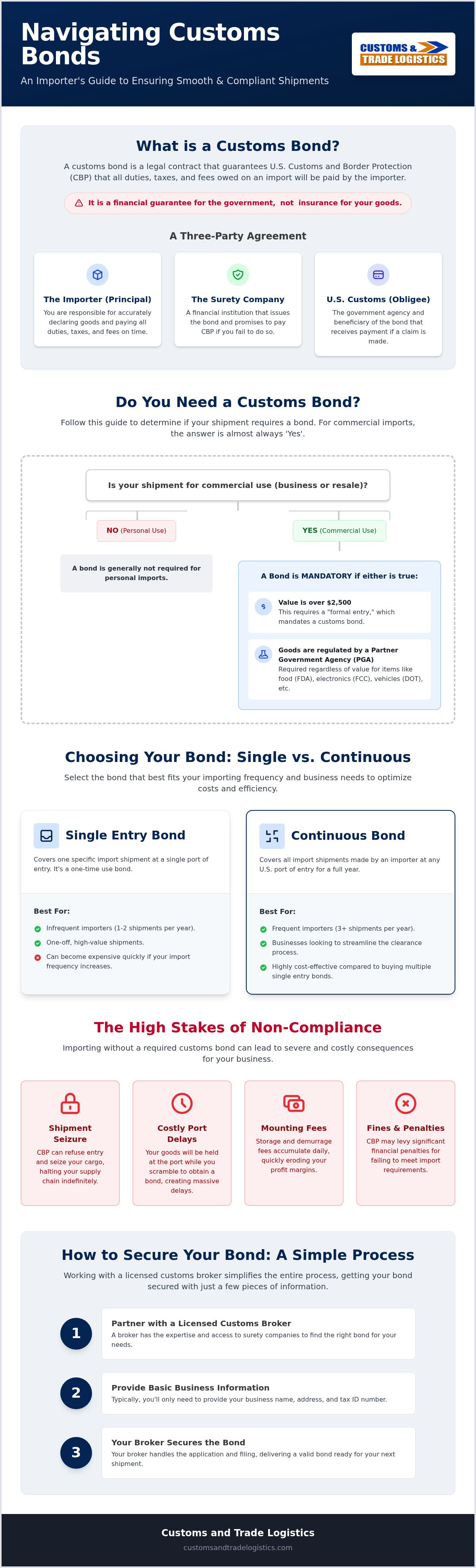
If you're asking yourself what is a customs bond and do I need one, you're already taking a proactive step toward protecting your business from unnecessary hurdles. At its core, a customs bond is a legal agreement that serves as a financial guarantee between three parties: the importer, a surety company, and U.S. Customs and Border Protection (CBP). It's a common mistake to assume this is insurance for your cargo. It isn't. While insurance protects you if your goods are damaged or stolen, a bond protects the U.S. government if you fail to pay your legal debts. Essentially, a customs bond is a safety net for the U.S. government to ensure total trade compliance.
The Three-Party Contract Explained
This agreement functions as a three-party contract where each group has a specific role. You, the importer, are known as the Principal. Your primary responsibility is to follow all federal regulations, report your cargo accurately, and pay duties on time. The Surety is the company that acts as your financial backer. This is a specialized surety bond where the issuer promises to pay CBP if you don't meet your financial obligations. Finally, the Obligee is U.S. Customs and Border Protection. They're the beneficiary who receives the payment if a claim is made. This structure ensures that you remain accountable while giving the government a reliable way to collect revenue without delay.
Why CBP Requires This Financial Guarantee
The scale of American trade is enormous. In 2025, total U.S. imports reached over $4.3 trillion. With such high volumes, CBP can't manually verify every single payment before letting cargo leave the port. A bond allows the government to "release" your goods into the country immediately, even before the final duty calculation is complete. This keeps your supply chain moving and prevents massive bottlenecks at the border. Without this financial backing, the port would become a graveyard for shipments waiting for manual accounting. These bonds also cover more than just standard taxes; they act as security for potential fines, penalties, or liquidated damages. Understanding what is a customs bond and do I need one helps you see that this isn't just red tape. It's a tool that facilitates the fast, secure movement of goods into the country while proving your reliability as a business partner to the federal government.
Determining Your Requirement: Do You Actually Need a Customs Bond?
Are you bringing in a single gift for a friend or inventory for your online store? This distinction is the first step in answering what is a customs bond and do I need one. Personal imports for your own use generally don't require this document. However, if you're importing for resale or business use, you fall into the commercial category where the rules become much stricter. For many small businesses and Amazon FBA sellers, the answer is almost always yes. Understanding the specific triggers for this requirement can save you from having a shipment stuck at the port without warning.
The $2,500 Commercial Threshold
The primary rule used by U.S. Customs is based on value. Any commercial shipment valued at over $2,500 requires what's known as a "formal entry." This process mandates a customs bond to ensure all duties and taxes are paid correctly. You might have heard of the "de minimis" rule, which allows shipments under $800 to enter duty-free and without a bond. While this is helpful for tiny parcels, growing businesses quickly outgrow this limit. Even if your shipment is borderline, such as $2,300, it's often safer to secure a bond. If a customs officer revalues your goods at over $2,500 upon arrival, your shipment will be halted immediately. If you're unsure where your shipment falls, speaking with an expert about securing the right documentation can prevent these costly surprises.
Regulated Goods and Partner Government Agencies (PGAs)
Value isn't the only factor. Many items require a bond regardless of how much they cost. This happens when your goods are regulated by Partner Government Agencies (PGAs). As U.S. Customs and Border Protection (CBP) explains, these agencies have their own set of rules to protect public health and safety. If your shipment contains any of the following, you'll likely need a bond even for low-value items:
- Food and Cosmetics: Regulated by the Food and Drug Administration (FDA).
- Electronics: Regulated by the Federal Communications Commission (FCC).
- Vehicles or Parts: Regulated by the Department of Transportation (DOT).
- Chemicals or Pesticides: Regulated by the Environmental Protection Agency (EPA).
High-scrutiny items like food or electronics are flagged because they must meet specific safety standards. Additionally, if your goods are subject to quotas or anti-dumping duties, a bond is mandatory to guarantee those extra fees are covered. Navigating these agency requirements can be complex, so it's helpful to review customs clearance services us to see how professional oversight ensures your regulated goods meet every legal standard without delay.
Comparing Your Options: Single Entry vs. Continuous Bonds
Once you've determined that your shipment meets the requirements for a formal entry, the next step is choosing the right financial tool. It's a common question for newcomers: what is a customs bond and do I need one, and if so, which type saves me the most money? The answer depends entirely on your frequency and long-term goals. While both types fulfill the legal requirement, they function very differently in terms of cost and administrative workload.
When to Choose a Single Transaction Bond (STB)
If you're only planning to import goods once a year, a Single Transaction Bond (STB) might seem like the easiest path. It's designed for businesses that are "testing the waters" with a trial shipment. However, calculating the specific amount isn't always straightforward. Usually, the bond must cover at least the total value of the goods plus any applicable duties and taxes. If you're importing by sea, there's an additional hurdle. You'll likely need a separate ISF bond to cover the Importer Security Filing requirement. These individual costs and separate filings can add up quickly, making the "cheaper" option more expensive and time-consuming than you initially expected.
The Long-Term Benefits of a Continuous Customs Bond
Are you planning to scale your business or import more than three times a year? If so, a Continuous Bond is almost always the smarter choice. Unlike the single-use version, this bond is a flat-rate guarantee that stays valid for 12 months. It covers all your shipments across every U.S. port during that year. One of the biggest relief points for our clients is that a Continuous Bond automatically includes your ISF filing requirements. This eliminates the need for extra paperwork or separate bond fees for every ocean freight arrival. For those looking into import logistics for startups, establishing this foundation early is a strategic move that prevents administrative bottlenecks as you grow.
CBP requires the bond amount to be sufficient to cover your total import activity. For a Continuous Bond, the standard minimum coverage is $50,000. This amount is typically calculated at 10% of the total duties and taxes you've paid over the last 12 months. As your business expands, CBP may issue an "insufficiency notice" if your imports surge and your bond no longer covers that 10% threshold. This is why having a mentor to oversee your bond status is vital. We help you monitor these limits so you don't face a sudden stop at the port because your coverage didn't keep pace with your success.
The Stakes of Non-Compliance: What Happens Without a Valid Bond?
Imagine your container has finally arrived after weeks at sea. Your customers are waiting, and your inventory is low. Suddenly, you get a notification that your goods are on hold at the terminal. If you didn't proactively answer the question, what is a customs bond and do I need one, you're now facing the most stressful scenario in international trade. Trying to secure a bond while your cargo sits on a busy pier is like trying to buy car insurance after you've already had a collision. It's difficult, expensive, and every minute counts. The pressure is immense because the clock is already ticking on terminal storage limits.
Immediate Port Delays and Storage Fees
When a shipment arrives without a valid bond, it simply cannot clear customs. This triggers a financial snowball effect that can be hard to stop. First, you'll encounter demurrage, which are daily storage fees charged by the port terminal for taking up space. These costs vary by port but often range from $150 to $500 per day per container. These fees usually increase the longer the cargo stays. If the delay continues, you might also face detention fees for holding onto the shipping line's equipment. A "waiting and seeing" approach is the most expensive strategy you can take. The administrative nightmare of correcting a bond-less entry involves coordinating with brokers, sureties, and port officials, all while your profit margins disappear into terminal storage bills.
Legal Seizures and Long-Term Importer Standing
The legal risks go far beyond storage bills. CBP has the legal authority to deny entry or seize cargo that doesn't meet mandatory bonding requirements. If your shipment is seized, the process to recover it is long, costly, and often unsuccessful. Perhaps even more damaging is the impact on your standing as an Importer of Record. CBP keeps a history of your compliance. One major mistake can lead to your business being "red flagged" for years. This means your future shipments are significantly more likely to be pulled for intensive, expensive physical exams. These exams can cost thousands of dollars and add weeks to your transit times.
Partnering with a reliable import logistics partner ensures that every regulatory box is checked long before your cargo hits the water. Don't wait for a port-side emergency to realize your business is at risk. Connect with our team now to secure your compliance and protect your long-term growth.
How to Secure Your Customs Bond and Streamline Your Imports
Securing the right bond doesn't have to be a complicated ordeal that pulls you away from running your business. While the legal requirements are strict, the actual application process is remarkably straightforward when you work with the right partner. Most importers don't go directly to a surety company. Instead, they obtain their bonds through their licensed customs broker. This approach is much more efficient because your broker already has the necessary shipment data to ensure your bond is filed correctly and stays compliant with U.S. Customs and Border Protection. You won't need to fill out dozens of forms; usually, all that's required is a Power of Attorney (POA) and some basic business information to get started.
The Advantage of Using a Licensed Customs Broker
Bundling your bond with your broader custom brokerage service fees is a strategic move that saves both time and money. A seasoned broker does more than just file paperwork. They calculate the precise bond amount you need based on your projected duties and taxes. This prevents you from overpaying for excess coverage you don't need or, conversely, facing an insufficiency notice because your bond is too small. At Customs and Trade Logistics, we bring over 35 years of industry experience to the table, specifically specializing in the complexities of China-to-US imports. We act as your advocate, ensuring that every detail is managed so you don't have to worry about technical errors at the port.
Next Steps for Your Next Shipment
Ready to move forward? Preparing for your next import is simple if you follow a methodical path. First, gather your commercial invoice and packing list. These documents provide the valuation and commodity details needed to determine your bond requirements. Next, consider your growth plans for the year. If you're asking, what is a customs bond and do I need one for multiple shipments, a continuous bond is likely your best path forward. If you're still unsure, we're here to help you weigh the options based on your specific business model.
You don't have to navigate the global marketplace alone. Think of us as a safe pair of hands that manages the administrative burden while you focus on scaling your brand. Whether you're a first-time Amazon seller or an established business, we're dedicated to your success. Reach out to us today for a personalized consultation and ensure your next shipment moves through customs without a hitch.
Secure Your Supply Chain with Confidence
Navigating international trade doesn't have to be a solo journey filled with technical hurdles. We've explored how the $2,500 commercial threshold and Partner Government Agencies dictate your bonding requirements. You now know that selecting the right bond type is a strategic financial decision that protects your business from escalating storage fees and legal seizures. Understanding what is a customs bond and do I need one gives you the power to prevent port-side delays before they ever begin.
With over 35 years of customs brokerage experience, we understand the unique challenges of moving goods from China to all U.S. ports. Whether you're a new Amazon FBA seller or an established importer, we provide the dedicated oversight you need to stay compliant. Let our family-owned team handle your customs bond and logistics today so you can focus on what you do best. Your cargo is in safe hands, and we're ready to help your business reach its full potential in the global marketplace.
Frequently Asked Questions
How much does a customs bond actually cost?
The cost of a bond depends on whether you choose a single entry or a continuous option. Continuous bonds are typically calculated at 10% of the duties, taxes, and fees you paid over the previous 12 months, with a minimum bond amount of $50,000. Your broker can provide a specific quote based on your unique import volume and the projected value of your goods.
Does a customs bond expire?
Continuous bonds remain in effect for one year and typically renew automatically until they are canceled by either the importer or the surety company. Single transaction bonds are only valid for one specific entry and expire once that shipment is cleared. It's a good practice to review your bond sufficiency annually to ensure your coverage still meets the 10% duty threshold required by CBP.
Can I import from China without a customs bond?
You generally cannot import commercial goods from China without a bond if the value exceeds $2,500. Many first-time sellers wonder what is a customs bond and do I need one when sourcing from overseas. If your goods are subject to anti-dumping duties or regulated by agencies like the FDA, you'll need a bond regardless of the shipment's total value.
Is a customs bond the same as shipping insurance?
No, these are two very different financial tools. A customs bond is a guarantee to the U.S. government that you'll pay your duties and taxes. Shipping insurance protects your business if your goods are lost or damaged during transit. You should carry both to ensure your financial interests and your legal obligations are fully protected throughout the journey.
What is an ISF bond and is it different from a customs bond?
An ISF bond specifically covers the Importer Security Filing required for ocean freight shipments. If you have a continuous customs bond, it already includes ISF coverage. However, if you're using a single entry bond, you'll likely need to purchase a separate ISF bond for every shipment arriving by sea, which can quickly increase your total logistics costs.
How long does it take to get a continuous customs bond?
You can typically secure a continuous customs bond in one to five business days. The process moves quickly once you've provided your broker with a signed Power of Attorney and your basic business details. This short waiting period is why we recommend securing your bond well before your cargo leaves the port of origin to avoid last-minute stress.
Do I need a bond for air freight shipments?
Yes, air freight shipments are subject to the same bonding rules as ocean or land entries. Many importers ask what is a customs bond and do I need one for air shipments; the answer is yes if the value is over $2,500. The mode of transportation doesn't change the legal requirement to guarantee your duty payments to the government.
What happens if my surety company goes out of business?
If your surety company goes out of business, CBP will notify you that your bond is no longer sufficient. You'll need to secure a new bond from a different, approved surety company immediately to keep your import operations running smoothly. Working with an experienced broker ensures you're partnered with reliable, stable sureties that protect your long-term standing with customs.


