

If you're importing more than three times this year, are you accidentally paying a "convenience tax" to U.S. Customs? It's a common trap for growing businesses. Many importers stick with a single entry bond because it feels less intimidating upfront, yet they often end up blindsided by separate ISF bond fees and processing delays that stall their supply chain. You want your goods to move smoothly across the border, not get stuck in a web of avoidable paperwork.
We understand that the choice between a single entry bond vs continuous customs bond can feel like a high-stakes guessing game. That's why we've simplified the decision-making process for you. In this guide, you'll learn the critical differences between these two options to help you save money and maintain total compliance in 2026. We'll provide a clear mathematical rule of thumb to determine exactly when a continuous bond becomes the smarter investment for your bottom line. By the end, you'll have a streamlined path to securing your bond through a partner you can trust, so you can focus on your business while we handle the heavy lifting at the port.
Key Takeaways
- Understand why U.S. Customs requires a bond as a financial guarantee and how this three-party agreement protects your business from shipment seizures.
- Discover how a Single Entry Bond works for occasional importers and why the calculation is usually based on the total value of your goods plus duties.
- Learn why a $50,000 continuous bond is the standard choice for growing brands looking to cover all entries across every U.S. port for a full year.
- Master the "Rule of Three" to settle the debate of a single entry bond vs continuous customs bond and identify the exact moment it's cheaper to switch.
- See how working with an experienced customs broker removes the administrative burden of filing, ensuring your paperwork is perfect before your cargo arrives.
Understanding the Basics: What is a US Customs Bond?
Have you ever wondered why the government requires a financial guarantee before your goods even leave the port? A U.S. Customs bond is not insurance for your business; instead, it's a legal contract that ensures the U.S. Government gets paid. Think of it as a performance guarantee. It's a three-party agreement between you (the Importer or Principal), the Surety Company (the insurance firm providing the bond), and U.S. Customs and Border Protection (CBP).
The bond ensures that all duties, taxes, and fees associated with your commercial imports are paid in full. It also guarantees that you'll follow all trade regulations. If your commercial shipment is valued at over $2,500, federal law requires you to have a bond on file. This is true even if the goods are duty-free. When you're deciding between a single entry bond vs continuous customs bond, you're essentially choosing the most efficient way to satisfy this legal mandate.
The Role of the Surety Company
The surety company acts as your financial guarantor. CBP doesn't just accept any company; they require sureties to be "rated" and listed on the Department of the Treasury’s Circular 570. If an importer fails to pay a fine or a duty bill, the surety company steps in to pay the government. However, this doesn't let the importer off the hook. The surety will eventually seek reimbursement from you. Because we've spent 35+ years in this industry, we know that having a reliable surety is the backbone of a stress-free import process.
Why Your Business Needs a Bond in 2026
Why is this so critical right now? In 2026, tariff volatility and strict enforcement mean the financial stakes are higher than ever. A bond allows for the "immediate release" of your goods. This means CBP can let your cargo move to your warehouse while they finalize the exact duty amount later. Without a bond, your goods stay at the port, racking up expensive storage fees.
Beyond simple duty payments, bonds are vital for compliance with Importer Security Filing (ISF) for ocean freight. If your cargo needs to wait before formal entry, it might be stored in a bonded warehouse, but even then, a bond remains the central pillar of your compliance strategy. It keeps your supply chain moving and keeps you on the right side of the law. Choosing the right type of bond is the first step toward scaling your business without unnecessary administrative friction.
The Single Entry Bond: Ideal for Occasional Shipments
Are you planning to import just once or twice a year to test the waters? For many small businesses and Amazon sellers, the Single Entry Bond (SEB) serves as the "starter" option. It's designed for one-time transactions, covering a single shipment into a specific U.S. port. This makes it a low-commitment choice when you're vetting a new manufacturer or bringing in a seasonal product line. However, understanding the trade-offs in the single entry bond vs continuous customs bond debate is essential before your cargo leaves the origin port.
The amount of an SEB is typically calculated as the total value of your goods plus any applicable duties, taxes, and fees. For most entries, this ensures the government is fully protected for that specific transaction. While the percentage-based cost might look small on paper, most surety companies apply a minimum fee. This can make low-value shipments surprisingly expensive on a per-unit basis because you're paying that base fee every time you ship.
Costs and Limitations of Single Entry Bonds
While the upfront cost of a single bond is lower than an annual one, the administrative burden adds up quickly. You must apply for and secure a new bond for every single shipment you bring into the country. This repetitive process creates more room for clerical errors and can lead to longer clearance times at the port. If your paperwork isn't filed perfectly each time, your goods sit idle, and you could face unexpected storage fees. If you're feeling overwhelmed by these requirements, our customs clearance services can help simplify the process for you.
The ISF Complication for Ocean Imports
If you're importing via ocean freight, the Single Entry Bond comes with a significant complication often overlooked by newcomers. CBP requires an Importer Security Filing (ISF) for all maritime cargo. While a continuous bond covers this automatically, an SEB does not. An ISF bond is a separate financial guarantee required specifically for ocean freight filings to ensure data accuracy.
This means ocean importers using SEBs must secure a "Double Bond": one for the ISF filing and another for the actual entry. The standalone ISF bond must be for a minimum of $10,000. Managing two separate bonds for a single shipment increases your costs and doubles the potential for filing delays. For businesses looking to scale, these hidden layers of the single entry bond vs continuous customs bond choice often point toward a more permanent solution.
The Continuous Customs Bond: Efficiency for Growing Brands
If your business plan involves more than a handful of shipments, the continuous customs bond is usually the point where logistics starts feeling like a professional operation rather than a series of hurdles. Unlike a single entry bond, which is tied to a specific transaction at a specific port, a continuous bond acts as a blanket financial guarantee. It covers every entry you make across all U.S. ports for a full 12-month period. For Amazon FBA sellers and expanding brands, this isn't just about compliance; it's about building a predictable, scalable supply chain.
One of the biggest relief points for our clients is the automatic inclusion of the Importer Security Filing (ISF) bond. As we discussed earlier, ocean imports require this filing, and managing it separately for every shipment is a common source of anxiety. A continuous bond satisfies both the entry and ISF requirements simultaneously. This eliminates the "double bond" headache and ensures your cargo doesn't get flagged for missing filings before it even leaves the port of origin.
Key Advantages of the Continuous Bond
The primary benefit here is speed. Continuous bonds allow for "paperless" processing through the Automated Commercial Environment (ACE). Because your bond is already on file with CBP, the system can validate your entries instantly. This often leads to faster release times compared to the manual verification steps required for single entries. It's truly a "set it and forget it" solution. Once the bond is active, you don't have to worry about securing new paperwork for every container, allowing you to focus on selling your products rather than managing administrative minutiae.
Calculating the $50,000 Bond Requirement
You might wonder why the "face value" of these bonds is so high. CBP sets the minimum continuous bond at $50,000. This doesn't mean you pay $50,000; it's simply the amount the surety company guarantees to the government. For about 95% of the small businesses we mentor, this minimum is more than enough to cover their annual operations.
How does CBP decide if you need more? They use a 10% rule. Your bond amount must be at least 10% of the total duties, taxes, and fees you paid in the previous 12 months. If you're a new importer, the $50,000 minimum is the standard starting point. If your business grows rapidly and your duty exposure exceeds this limit mid-year, CBP may issue a "bond insufficiency" letter. In those cases, we work with you to increase the bond to the next $10,000 increment, ensuring your shipments never stop moving. Understanding this math is a vital part of the single entry bond vs continuous customs bond comparison.
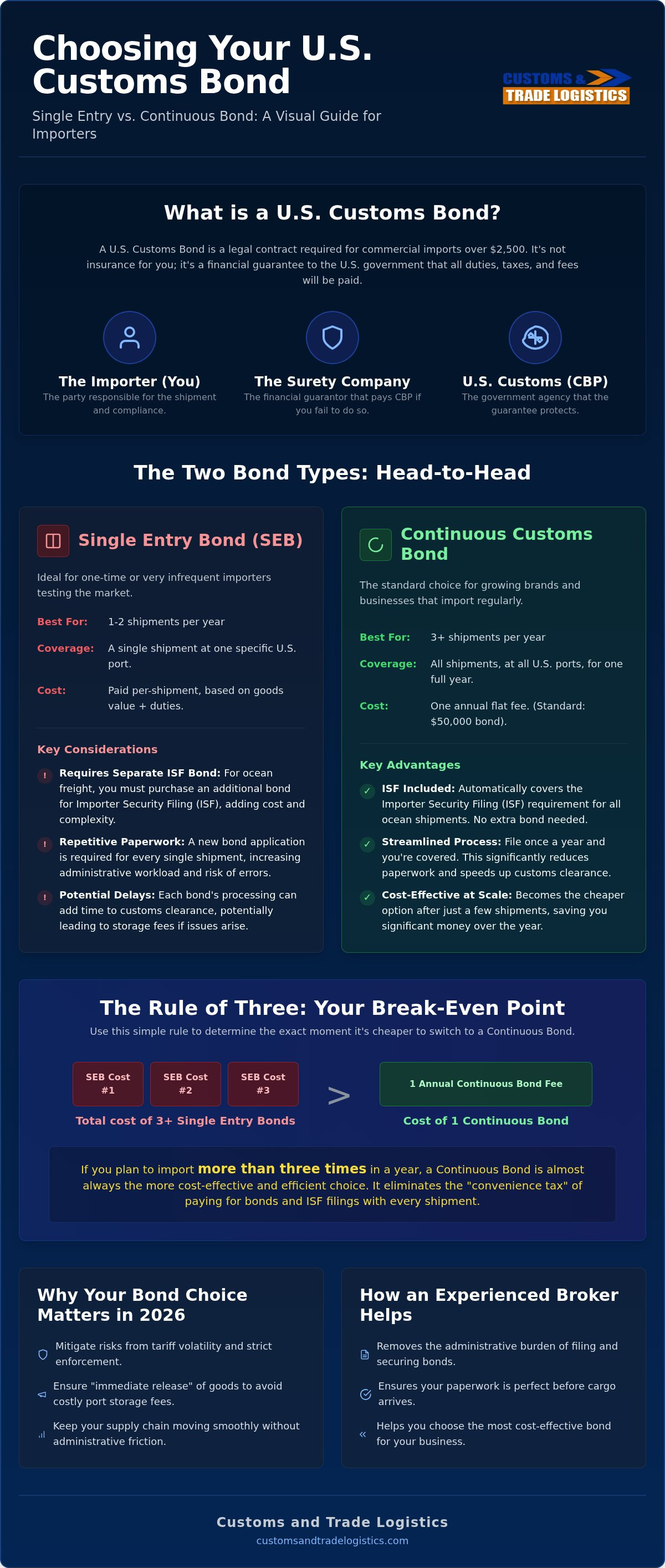
Single Entry vs Continuous Bond: Which is Right for You?
How do you decide which path is best for your specific business model? The most common benchmark in the industry is the "Rule of Three." If you anticipate importing goods three or more times within a 12-month period, the math almost always favors a continuous bond. While a single entry bond might look like a bargain for a one-off shipment, the costs multiply quickly when you factor in the repetitive service fees charged by brokers to file each individual bond. We've seen many growing brands lose hundreds of dollars a year simply because they stayed with the "starter" option for too long.
Why is three the magic number? It's the point where the administrative friction starts to cost you more than the bond itself. Every manual filing is an opportunity for a delay or a clerical error. A continuous bond removes that friction entirely. Your shipping method also dictates the urgency of this choice. Air freight moves fast, and you don't want a shipment sitting in a warehouse because your single bond hasn't been processed yet. Ocean freight carries the heavy burden of ISF requirements. When you weigh the single entry bond vs continuous customs bond, remember that the latter covers both modes of transport seamlessly, giving you the freedom to switch between air and sea as your inventory needs change.
The Financial Break-Even Analysis
Let's look at the numbers. Every time you use a single entry bond, you're paying for the bond premium plus a service fee for the manual labor of filing it. If you're importing via ocean freight, you're also paying for a separate ISF bond and its associated filing fee. By the time you reach your fourth shipment, the total spent on these individual transactions usually exceeds the cost of one annual continuous bond premium. For those just beginning their journey, our guide on import logistics for startups explains how to scale these costs effectively as your volume grows.
Strategic Considerations for Scale
Beyond the immediate savings, a continuous bond offers strategic advantages that help you grow. It's a prerequisite for Remote Location Filing (RLF). This allows your broker to clear cargo at any U.S. port regardless of where they're physically located. This flexibility is vital if you're diversifying your entry points to avoid port congestion. Additionally, maintaining a continuous bond builds a consistent "Importer of Record" history with CBP, which can lead to fewer inspections over time. If you want a partner to manage these complexities for you, our customs clearance services us provide the oversight you need to stay compliant while you focus on expansion.
Ready to stop overpaying for individual filings? Contact us today to secure your continuous bond and streamline your 2026 imports.
Securing Your Bond: How a Customs Broker Simplifies the Process
Once you've settled the debate between a single entry bond vs continuous customs bond, the next step is the actual filing. While the paperwork might look like a wall of jargon, a seasoned broker turns this into a simple, predictable process. You don't have to tackle the government's Automated Commercial Environment (ACE) on your own. We take that burden off your plate so you can stay focused on your customers and your growth. Our role is to act as the bridge between your business and the complex requirements of U.S. Customs.
To get started, you'll need to provide a few essential pieces of information. This includes your business Tax ID (EIN), a verified physical business address, and a clear description of the commodities you plan to import. Because Customs and Trade Logistics is a family-owned firm with over 35 years of experience, we don't just process forms. We look for the small details that automated digital platforms often miss. This personalized oversight is what prevents costly errors and ensures your bond amount remains sufficient for the evolving trade landscape of 2026.
The Application and Approval Timeline
How long should you wait before applying? Ideally, you should have your bond secured before your goods ever leave the factory. A continuous bond typically takes a few business days to become fully active within the ACE system. We've seen many importers face rejections for simple mistakes, such as using a P.O. Box instead of a physical address or submitting an incorrect EIN. By starting the process early, you ensure that your "safe pair of hands" has everything verified and ready before your cargo ever hits the water or the air.
The Advantage of Personalized Logistics Mentorship
Securing a bond is just one piece of the puzzle. For SMBs and Amazon sellers, the real value lies in end-to-end management that looks at the big picture. We act as your mentor, guiding you through international freight logistics and consulting on imports from China to ensure every step is optimized for speed and cost. This holistic approach prevents the "hidden" costs of delays and compliance gaps that can derail a growing brand.
For a better understanding of how to plan your overall import budget, take a look at our guide on custom brokerage service fees. Choosing the right partner means you aren't just getting a bond; you're getting a dedicated advocate who is invested in your success. With the right bond and a veteran team behind you, you can move your goods across the globe with total peace of mind.
Take Control of Your 2026 Import Strategy
Choosing between a single entry bond vs continuous customs bond is one of the first major financial decisions you'll make for your business. As we've explored, the right choice depends on your frequency and long-term goals. If you're importing more than three times a year, a continuous bond isn't just a convenience; it's a strategic move that saves money and slashes your administrative burden. By consolidating your entry and ISF requirements, you ensure your cargo moves through the ACE system without the friction of repetitive filings.
At Customs and Trade Logistics, we bring 35+ years of industry experience to every client we serve. As a family-owned and operated firm, we take pride in being a "safe pair of hands" for Amazon sellers and growing SMBs. We handle the complex compliance details so you can focus on expanding your brand. Ready to streamline your logistics? Get a Professional Quote for Your Customs Bond Today and let us guide your business toward a successful and secure 2026. Your global trade journey is just beginning, and we're here to help you navigate it with confidence.
Frequently Asked Questions
How much does a continuous customs bond cost in 2026?
The annual premium for a continuous bond depends on your total duty exposure and the specific requirements of the surety company. While the face value of the bond is typically at least $50,000, you only pay a small annual fee to keep it active. This fee covers all your entries for a full year, making it a predictable expense for your budget. We recommend getting a personalized quote to see how this fits into your 2026 import planning.
Can I switch from a single entry bond to a continuous bond later?
You can transition to a continuous bond at any point as your business scales. Many importers start with a single entry bond to test a new supplier and then switch once they commit to a regular shipping schedule. Once your new continuous bond is filed and accepted in the ACE system, it will cover all your future shipments across any U.S. port. This transition is a common milestone for growing brands that want to reduce their paperwork.
Does a continuous bond cover my ISF (Importer Security Filing) requirements?
A continuous bond automatically includes the necessary coverage for ISF filings on ocean shipments. This is one of the most significant advantages in the single entry bond vs continuous customs bond comparison. By using a continuous bond, you avoid the need to purchase a separate $10,000 ISF bond for every maritime container you bring into the country. It simplifies your logistics and ensures you remain compliant with ocean freight regulations without extra steps.
What happens if my annual duties exceed the $50,000 bond limit?
If your annual duties, taxes, and fees grow to the point where 10% of that total exceeds $50,000, CBP will require you to increase your bond amount. You'll receive a bond insufficiency letter, and you'll have a specific window to upgrade to a higher bond limit, such as $60,000 or $70,000. We monitor these limits for our clients to ensure their cargo never gets stuck at the port due to an insufficient bond on file.
How long does a continuous customs bond stay valid?
A continuous customs bond stays valid until it is officially terminated by you, the surety company, or CBP. Unlike a single entry bond that expires after one transaction, a continuous bond is renewed annually through your premium payment. As long as you maintain that annual payment and your bond amount remains sufficient for your duty levels, the bond stays active in the government system. It provides ongoing peace of mind for your entire supply chain.
Do I need a customs bond if I only import by air?
You are legally required to have a customs bond for air imports if your commercial shipment is valued at more than $2,500. While air freight doesn't require the ISF filing used for ocean cargo, the basic entry bond requirement still applies. Having a bond on file allows for the immediate release of your goods upon arrival. This prevents your air cargo from sitting in a warehouse and racking up daily storage fees while you wait for paperwork.
Can a customs broker file a bond for me if I am an Amazon FBA seller?
Customs brokers specialize in securing bonds for Amazon FBA sellers to ensure their shipments clear the border without delay. We act as your mentor, helping you set up your Importer of Record status and choosing the right bond for your volume. Whether you're importing small parcels or full containers from China, we handle the filing details. This "safe pair of hands" approach is vital for sellers who want to focus on sales rather than customs regulations.
What is the difference between a customs bond and cargo insurance?
A customs bond is a financial guarantee that protects the U.S. Government's revenue, while cargo insurance protects your business from financial loss if goods are damaged. The bond ensures that duties and taxes are paid if you fail to meet your obligations. Cargo insurance, on the other hand, covers the value of your merchandise during transit. Both are necessary for a secure import strategy, but the bond is a legal requirement for entry while insurance is a business safeguard.


