

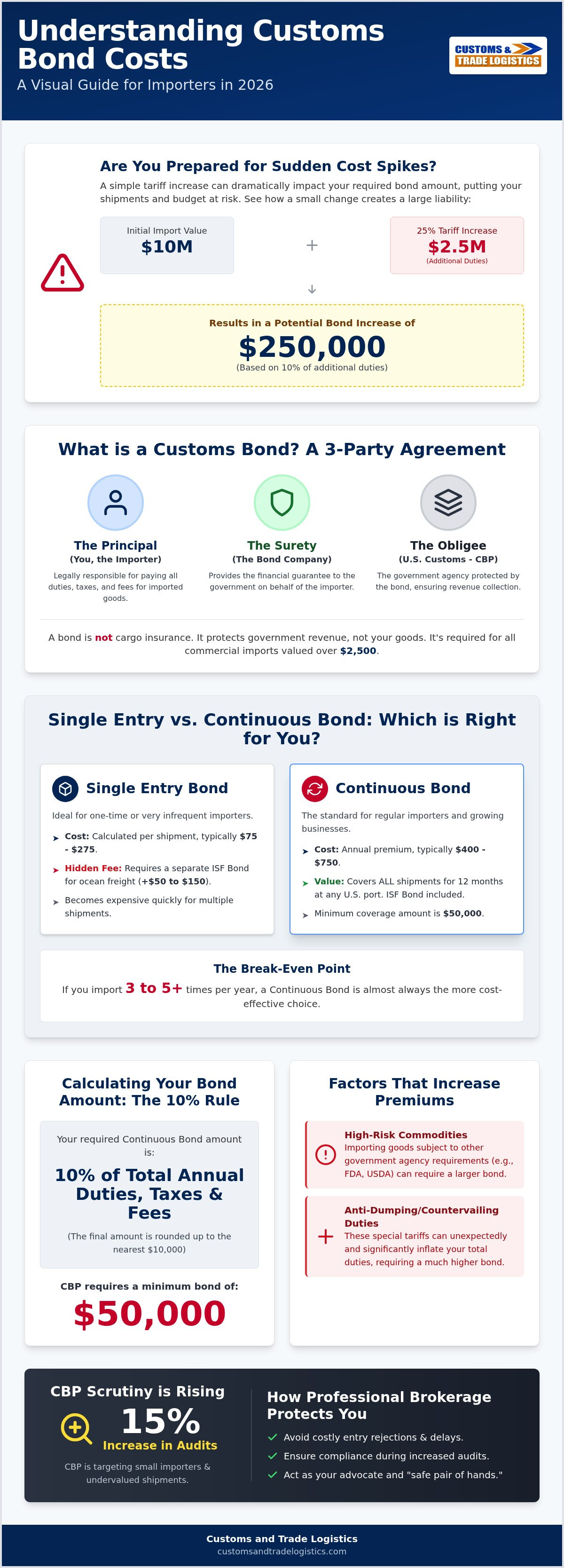
If you imported $10 million worth of goods last year, did you know that a simple 25% tariff increase could suddenly spike your required bond amount by $250,000? International trade is already a complex puzzle, and trying to figure out how much does a customs bond cost in 2026 shouldn't feel like a guessing game that puts your shipments at risk. Most importers just want to move their goods efficiently without the constant fear of hidden fees or a sudden CBP audit holding up cargo at the port.
We understand that the administrative burden of customs compliance feels heavy, especially when you're trying to scale your operations. You deserve a partner who demystifies these costs and replaces anxiety with a sense of security. We've spent over 35 years acting as a dedicated advocate for businesses like yours, ensuring that your bond is a strategic tool rather than just another line-item expense.
This guide provides the transparent answers you need to budget with confidence. You'll discover the exact calculation formulas for both single and continuous bonds, learn which option saves you the most money over 12 months, and see how to stay ahead of the 15% increase in CBP audits projected for this year.
Key Takeaways
- Understand the exact variables that determine how much does a customs bond cost in 2026, including the standard $50,000 minimum threshold for continuous coverage.
- Identify the break-even point to decide whether a single-entry bond or a continuous bond offers the best value for your annual shipping volume.
- Master the "10% Rule" calculation to accurately project your required bond limits based on your estimated annual duties, taxes, and fees.
- Learn how specific high-risk commodities and Anti-Dumping duties can unexpectedly inflate your bond premiums and how to mitigate those risks.
- Discover how professional brokerage oversight helps you avoid costly entry rejections and ensures compliance during increased CBP audit periods.
What is a Customs Bond and Why is it Required in 2026?
A customs bond acts as a legal bridge between your business and the U.S. government. It's a promise that ensures U.S. Customs and Border Protection (CBP) will receive all required duties, taxes, and fees, even if the importer fails to pay. Think of it as a safety net that keeps trade moving smoothly across borders. While you might be focused on how much does a customs bond cost in 2026, it's equally important to know why CBP demands one in the first place.
This agreement functions as a specific type of Surety Bond involving three distinct parties. First, there's the Principal (that's you, the importer). Second is the Surety company that issues the bond and provides the financial backing. Finally, there's the Obligee, which is CBP. In 2026, understanding this relationship is more critical than ever. CBP has projected a 15% increase in audits this year, specifically targeting small importers and undervalued shipments. If you're wondering how much does a customs bond cost in 2026, the answer starts with understanding the scale of your obligation to the government.
CBP requires a customs bond for all commercial entries valued over $2,500. Even if your goods are duty-free, you still need a bond to guarantee compliance with federal regulations. This ensures that every shipment entering the U.S. marketplace meets the necessary legal standards.
The Protective Role of a Customs Bond
Many new importers confuse a customs bond with cargo insurance, but they serve very different masters. Cargo insurance protects your investment if your goods are damaged or lost at sea. A customs bond, however, protects the government's revenue. Without a valid bond, CBP can seize your shipment at the port, leading to storage fees that can quickly spiral out of control. Your customs broker typically manages this process for you, acting as a "safe pair of hands" to ensure your bond is filed correctly before your ship even docks.
Who Must Carry a Bond?
If you're an Amazon FBA seller or an e-commerce entrepreneur, you're likely the "Importer of Record." This status means you're legally responsible for the goods entering the country. While "informal entries" valued under $2,500 don't always require a formal bond, most growing businesses quickly surpass this limit. Staying compliant isn't just about following rules; it's about protecting your ability to sell. As scrutiny on e-commerce imports rises in 2026, having your own bond ensures you aren't reliant on a third party's compliance record.
Comparing Costs: Single Entry vs. Continuous Customs Bonds
Deciding between a single entry or a continuous bond is one of the first major financial hurdles you'll face as an importer. It's helpful to view this choice through the lens of your 12-month business plan. If you're wondering how much does a customs bond cost in 2026, the answer depends largely on your shipping frequency and the total value of your merchandise. To stay compliant with U.S. Customs and Border Protection bond requirements, you must choose a bond type that matches your operational scale.
For many, the break-even point is the magic number. Industry data shows that if you plan to import more than three to five times per year, a continuous bond is almost always the more cost-effective route. This is because a continuous bond covers all your entries at every U.S. port for a full year, whereas single entry bonds require a new payment for every single shipment. If you're feeling overwhelmed by these calculations, our team provides personalized Customs Clearance Services to help you find the most economical path forward.
Single Entry Bond Pricing Breakdown
Single Entry Bonds (SEB) are tailored for one-off shipments or very infrequent importers. The cost is generally calculated as a percentage of the shipment value, often around $4 to $7 per $1,000 of the bond's face value. Most importers find that a typical SEB costs between $75 and $275. However, there's a hidden catch for ocean freight. If you don't have a continuous bond, you must also purchase a separate Importer Security Filing (ISF) bond, which typically adds another $50 to $150 to your total per shipment. This "double bonding" is why SEBs can quickly become a financial drain for growing startups.
Continuous Bond: The Cost-Effective Choice for Growth
The continuous bond is the gold standard for Amazon FBA sellers and high-volume businesses. The annual premium for a minimum $50,000 continuous bond usually ranges between $400 and $750. While this upfront cost is higher than a single SEB, it includes your ISF filing and covers an unlimited number of entries for 12 months. This bond type provides total management of your compliance needs across all ports, acting as a "safe pair of hands" for your logistics budget. It replaces the anxiety of per-shipment fees with a predictable, once-a-year expense that supports your long-term growth.
How the Customs Bond Amount is Calculated in 2026
Calculating your bond limit isn't a matter of guesswork. It follows a strict formula set by the government. When you're trying to determine how much does a customs bond cost in 2026, you first have to identify your "bond amount," which is different from the premium you pay to a surety. For continuous bonds, the standard formula is the "10% Rule." This means your bond must cover at least 10% of the total duties, taxes, and fees you paid to U.S. Customs and Border Protection over the previous 12 months. If you're a new importer, you'll use an estimate of what you expect to pay in the coming year.
The minimum amount for a continuous bond is $50,000. CBP uses specific rounding rules to ensure your coverage is sufficient. For bond amounts up to $100,000, they round up to the nearest $10,000. For anything above that, they round to the nearest $100,000. For example, if your 10% calculation comes out to $52,000, your required bond amount will actually be $60,000. This precision prevents administrative delays and ensures your business remains a "safe pair of hands" in the eyes of federal regulators.
Recent tariff updates in early 2026 have made these calculations even more sensitive. If a new 25% tariff is applied to $10 million of annual imports, that adds $2.5 million in duties. Suddenly, your required bond amount jumps by $250,000. If your business scales faster than expected and your bond doesn't cover 10% of your actual duties, CBP may issue a "Bond Sufficiency" notice. If you don't increase your bond within 30 days, they can stop your entries entirely, causing massive delays at the port.
Determining Your Bond Limit
To avoid mid-year surprises, you should work closely with a broker to forecast your import volume. We look at your historical data and upcoming growth plans to ensure your bond isn't just compliant today, but also six months from now. This proactive oversight is the best way to manage how much does a customs bond cost in 2026 because it avoids the rush fees and shipment rejections associated with an insufficient bond.
ISF Bonding for Ocean Freight
If you're importing by sea, you must also consider the Importer Security Filing (ISF). For those without a continuous bond, each ocean shipment requires a separate ISF bond. This is where costs can spiral. CBP is strict about ISF compliance, and the penalty for a late or inaccurate filing is a staggering $5,000 per violation. Because a continuous bond automatically covers your ISF requirements, it acts as a stabilizing force for your budget, protecting you from these heavy administrative penalties.
Factors That Can Increase Your Bond Premium
While the minimum annual premium for a continuous bond often starts between $400 and $600, your final bill depends on the specific risks associated with your business. It's common for new importers to ask how much does a customs bond cost in 2026 only to find that their specific products trigger higher rates. Surety companies don't just look at your shipment volume; they evaluate the likelihood that CBP will demand a payment they have to cover. In early 2026, some surety companies reported individual bond premium increases of upwards of 200% for businesses deemed high-risk.
The type of goods you bring into the country is the biggest variable. Commodities like textiles, electronics, and food products often require higher scrutiny due to complex regulations and higher duty rates. If your products fall into these categories, the surety may view your account with more caution. Having a mentor-like partner to help you identify these risks early can prevent your budget from being blindsided by unexpected costs. If you are unsure how your specific products will affect your bottom line, our Customs Clearance Services can provide the clarity you need before you apply.
Navigating High-Duty Imports
Nothing impacts your bond cost more than Anti-Dumping and Countervailing Duties (AD/CVD). These are extra duties imposed on foreign goods that are priced below fair market value or benefit from foreign government subsidies. Because these duties can be 100% or even 200% of the cargo value, they drastically increase your total duty exposure. Since your bond must cover 10% of those total duties, an AD/CVD commodity can multiply your required bond amount by 10x or more. Consulting with a broker to identify your HTS codes before bonding is the only way to avoid a massive, mid-year sufficiency notice from CBP.
Surety Underwriting in 2026
In the current trade environment, surety companies have become more selective about who they back. They look at your financial health, credit history, and most importantly, your compliance record. A clean history with no late duty payments or ISF violations signals that you are a reliable partner. We act as a "safe pair of hands" during this process, presenting your business case to the surety to highlight your commitment to compliance. This professional representation often helps first-time importers secure better rates, even when how much does a customs bond cost in 2026 is trending higher across the industry. By showing that you have expert oversight, you reduce the perceived risk and stabilize your long-term premium costs.
Reducing Costs Through Professional Customs Brokerage
Attempting a "DIY" approach to bonding might seem like a simple way to shave a few dollars off your overhead, but it often leads to expensive rejections or paying for significantly more coverage than you actually need. When you're calculating how much does a customs bond cost in 2026, you have to factor in the hidden cost of errors. A single mistake in your estimated duties or a mismatched HTS code can trigger a bond sufficiency notice from CBP that halts your supply chain entirely. At Customs and Trade Logistics, we've spent over 35 years helping importers avoid these administrative traps. We don't just facilitate a transaction; we act as a mentor to ensure your financial strategy is built on solid ground.
By integrating your bond management into your broader custom brokerage service fees, you gain a transparent, line-item budget for the entire year. This holistic approach replaces the anxiety of unexpected invoices with the relief of predictable costs. It allows you to focus on growing your business while we handle the granular procedural details that keep you compliant with federal regulations. Our role is to be the stabilizing force that lifts this heavy burden from your shoulders, allowing you to move goods with confidence.
The Broker Advantage: Beyond the Bond
Accurate HTS classification is the bedrock of a cost-effective bond. If your goods are classified incorrectly, you might be overpaying on duties, which directly inflates your required bond limit and your annual premium. For businesses managing the complexities of import from China logistics, this oversight is particularly common and costly. We provide the protective care needed to navigate these high-volume lanes, offering personalized consulting that is especially vital for startups that need to preserve capital while staying in CBP's good graces. Our family-owned approach means we treat your shipments with the same diligence we would our own, acting as a knowledgeable bridge to the global marketplace.
Next Steps for Your 2026 Import Strategy
How can you ensure your business remains a "safe pair of hands" for the rest of the year? We recommend conducting a mid-year bond audit. If your sales are exceeding your initial projections, your bond might be nearing its limit sooner than you think. By preparing your documentation now, you ensure that any necessary increase is fast and hassle-free, avoiding the rush fees associated with emergency filings. We are here to guide you through every step of this progression, from the first application to the final delivery at your warehouse. To get started with a clear picture of how much does a customs bond cost in 2026 for your specific volume, contact Customs and Trade Logistics for a personalized bond quote today.
Master Your 2026 Import Strategy with Confidence
Success in international trade requires more than just moving goods; it's about building a foundation of compliance that supports your growth. Understanding how much does a customs bond cost in 2026 is the first step toward a predictable logistics budget. Whether you choose a single entry bond for occasional shipments or a continuous bond for your expanding Amazon FBA business, the 10% calculation rule remains your most important guide for maintaining bond sufficiency throughout the year.
You don't have to navigate these complex regulations alone. With over 35 years of industry expertise, our family-owned team acts as a dedicated advocate for your business. We specialize in helping SMBs and Amazon sellers demystify logistics fees, ensuring your shipments move across all U.S. ports without the threat of CBP delays or audits. Let us provide the stabilizing force your supply chain needs to thrive in a volatile market.
Are you ready to take the next step? Secure Your 2026 Customs Bond with Expert Guidance and experience the peace of mind that comes with professional oversight. Your business has a bright future, and we're here to help you reach it safely.
Frequently Asked Questions
How much does a continuous customs bond cost annually in 2026?
A minimum $50,000 continuous bond typically costs between $400 and $750 in annual premiums. This rate varies based on your business risk profile and the surety company's underwriting standards. For importers with higher duty obligations requiring a $500,000 bond, the annual cost usually ranges from $2,500 to $4,000. It's the most predictable way to manage how much does a customs bond cost in 2026 for frequent shippers.
Can I import goods into the US without a customs bond?
You can only import commercial goods without a bond if the shipment is valued at $2,500 or less, which is classified as an informal entry. For any shipment exceeding this value, U.S. Customs and Border Protection requires a bond to guarantee that all duties and taxes are paid. Even if your goods are duty-free, a bond is still mandatory for formal entries to ensure compliance with federal regulations.
How long does it take to get a customs bond approved?
Most continuous customs bonds are approved and filed with CBP within one to two business days. Single entry bonds are often processed even faster, sometimes within a few hours, when you work with an experienced customs broker. If your business involves high-risk commodities or complex Anti-Dumping duties, the surety company may require additional time to review your financial history and compliance record before issuing the bond.
What is the difference between a customs bond and a surety bond?
A customs bond is a specific type of surety bond designed exclusively for the international trade industry. While a surety bond is a general term for any three-party contract that guarantees an obligation, a customs bond specifically ensures that an importer fulfills their financial duties to CBP. In this relationship, you are the principal, the government is the obligee, and the insurance provider is the surety.
Do Amazon FBA sellers need a continuous bond for every shipment?
Amazon FBA sellers don't need a new bond for every shipment if they have a continuous bond on file. One continuous bond covers every entry you make at any U.S. port for a full 12-month period. This is the most cost-effective choice for sellers who import more than three times a year, as it also covers the mandatory Importer Security Filing (ISF) requirements for ocean freight shipments.
What happens if my bond amount is too low for my import volume?
If your import volume grows and your bond no longer covers 10% of your annual duties, CBP will issue a "Bond Sufficiency" notice. You'll have 30 days to increase your bond limit to the required level or risk having your shipments held at the port. This is why many growing businesses ask how much does a customs bond cost in 2026 as part of their mid-year financial planning and scaling strategy.
Does a customs bond cover the cost of the goods if they are lost?
No, a customs bond does not protect your investment or cover the cost of lost, stolen, or damaged merchandise. Its only purpose is to guarantee that the U.S. government receives its required duties, taxes, and fees. To protect your financial interest in the physical goods themselves, you'll need to purchase separate cargo insurance. We recommend carrying both to ensure total protection for your business operations.
Can I cancel my customs bond if I stop importing?
You can cancel your customs bond at any time by providing written notice to your surety company and CBP. However, most surety companies don't provide pro-rated refunds for the annual premium you've already paid. It's usually best to let the bond remain active until its natural expiration date. If you decide to resume importing after a cancellation, you'll need to go through the full application process for a new bond.


