

Did you know that missing a single filing deadline by just one hour can trigger a $5,000 penalty before your cargo even touches the water? It's a stomach-turning realization for any importer. You've worked hard to secure your margins, only to have a late Importer Security Filing (ISF) put your entire shipment at risk. We understand the stress that comes with the 24-hour rule, especially when you're coordinating with a customs broker to keep things moving. It feels like one small administrative slip could derail your entire season.
The good news is that a late filing doesn't have to be a financial catastrophe. While U.S. Customs and Border Protection is strict, there's a clear path to resolution if you act quickly. This guide will walk you through the 2026 mitigation process, showing you how first-time offenders can often reduce liquidated damages to a fraction of the original amount. We'll cover the actionable steps to file late, how to avoid costly cargo holds at the port, and the best ways to protect your supply chain from repeat violations.
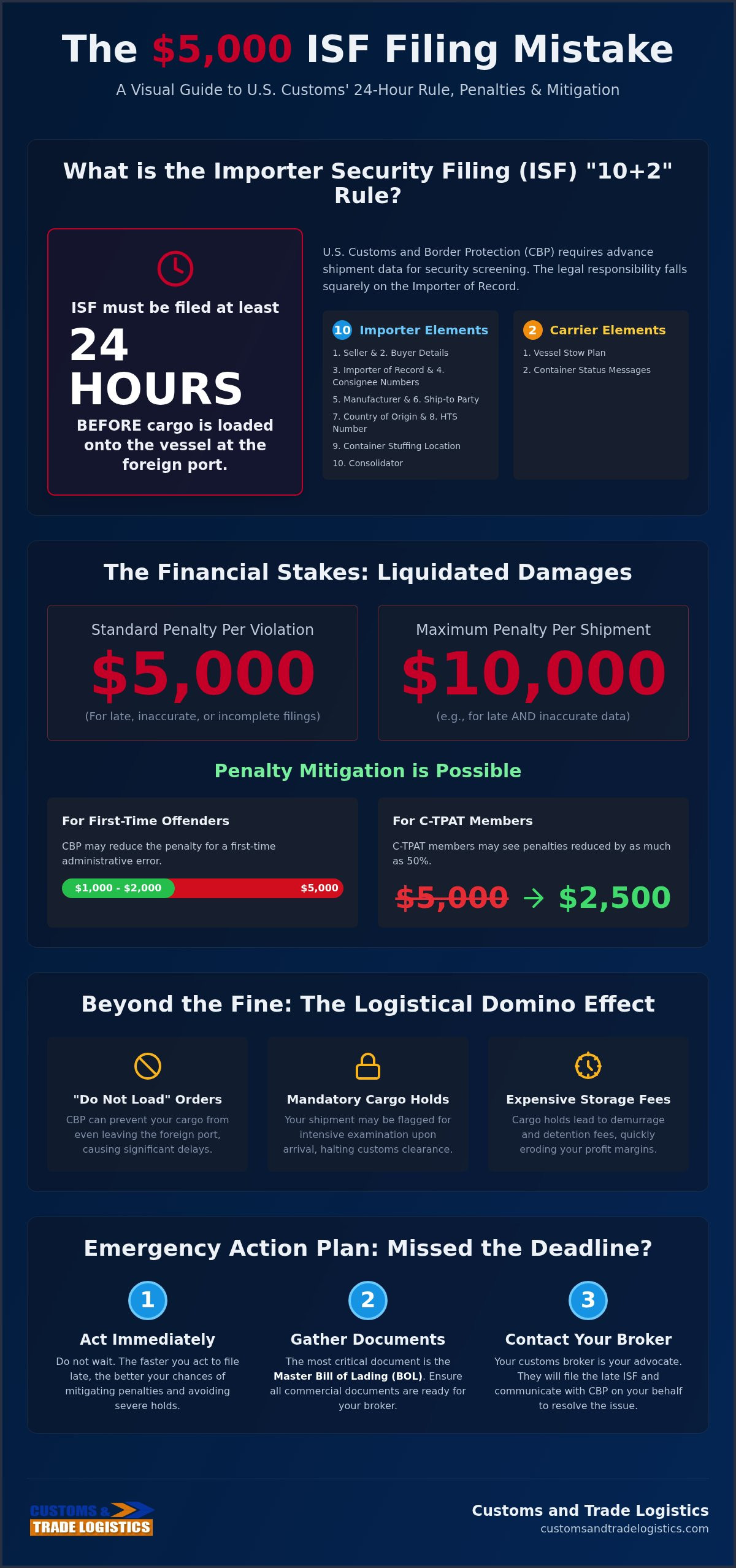
- Understand the 2026 penalty landscape, where late filings start at $5,000 and can reach a $10,000 maximum for a single shipment.
- Learn how a customs broker acts as your advocate to proactively correct filing errors and mitigate liquidated damages.
- Identify the logistical risks beyond the fine, such as "Do Not Load" orders and mandatory cargo holds that lead to expensive storage fees.
- Follow an immediate action plan to gather critical documents like your Master Bill of Lading to resolve delays and clear your cargo quickly.
- Discover how expert oversight and automated systems can flag compliance gaps before the critical 24-hour window closes.
Table of Contents
What is ISF and Why is the 24-Hour Deadline Critical?
If you're importing goods into the United States via ocean freight, you've likely heard the term "10+2" whispered with a bit of dread. This is the Importer Security Filing (10+2), a mandatory requirement for all maritime shipments. While it might feel like just another administrative hurdle, this filing is the backbone of modern maritime security. U.S. Customs and Border Protection (CBP) uses this data to screen for high-risk shipments long before they reach our shores. Working with a dedicated customs broker Port of Baltimore can act as your safety net, catching these details before they become expensive mistakes.
The most critical part of this regulation isn't just what you file, but when you file it. You must submit the ISF at least 24 hours before the cargo is loaded onto the vessel at the foreign port. It's a common mistake to think the clock starts 24 hours before arrival in the U.S., but waiting that long is a guaranteed way to trigger a $5,000 fine. CBP wants this information early so they can issue a "Do Not Load" order if they spot a security concern. It's also vital to remember that the legal responsibility for this filing falls squarely on the Importer of Record. Even if your supplier promised to help, you're the one CBP will hold accountable if the data is missing or late.
The 10+2 Rule: Data Elements You Need to Provide
The name "10+2" comes from the specific data points required. As the importer, you're responsible for ten elements, while the carrier handles two. To file successfully, you'll need to provide:
- Seller and Buyer details: Full names and addresses.
- Importer of Record and Consignee numbers: Usually your IRS or Social Security number.
- Manufacturer and Ship-to party: Where the goods were made and where they're going.
- Country of Origin and HTS number: The specific tariff classification for your goods.
- Container stuffing location and Consolidator: Who packed the goods and where.
The "2" elements provided by the carrier are the vessel stow plan and container status messages. The "glue" that binds everything together is the Master Bill of Lading (BOL) number. If your ISF doesn't match the BOL exactly, CBP can't link the data, which often leads to a "No Match" status and potential penalties.
Common Pitfalls Leading to Late ISF Filings
Even diligent importers can run into trouble. During peak seasons in China, communication with suppliers often slows down, leading to delays in receiving manufacturer details. Another major issue is the misunderstanding of Incoterms. If you're buying goods under Ex Works (EXW) terms, you're responsible for the filing, yet many importers mistakenly assume their supplier has it covered. Finally, last-minute vessel changes are common. If a ship departs earlier than expected and your administrative team hasn't kept pace, you could miss that 24-hour window before you even realize the ship has sailed.
The Financial Penalty: $5,000 Fines and Liquidated Damages
When the 24-hour window closes and your filing is still missing, the financial clock starts ticking. CBP's standard penalty for a late, inaccurate, or incomplete filing is $5,000 per violation. It doesn't stop there. If your entry is both late and contains incorrect data, you could face up to $10,000 in penalties for a single shipment. These charges are officially categorized as "liquidated damages." This means they aren't just simple tickets; they are formal claims made against your Customs Bond. Under the updated 2026 enforcement guidelines, local Port Directors now have the direct authority to initiate these claims. This shift means that a customs broker Port of Baltimore must be even more vigilant, as enforcement is happening faster and at a more granular, local level than in previous years.
For more detailed guidance on the official Importer Security Filing and Additional Carrier Requirements, you can review the latest documentation from U.S. Customs and Border Protection. Understanding these rules is the first step toward protecting your profit margins from unexpected hits.
Will CBP Always Issue the Maximum Fine?
It's natural to feel a sense of panic when you realize a mistake has been made. Does CBP always demand the full $5,000? Not necessarily. While they've moved away from the old "three strikes" leniency policy, they still exercise some discretion. For a first-time administrative error, you might be eligible for mitigation, which can reduce the fine to a more manageable range, often between $1,000 and $2,000. Additionally, importers who are members of the C-TPAT program may see their penalties reduced by as much as 50%. However, CBP looks closely at your overall compliance history. A first-time importer might receive a bit more grace than an established business with a history of non-compliance. Proactive disclosure is key. If you catch the error before CBP flags it, your chances of a successful mitigation petition improve significantly.
The Role of Your Customs Bond in Late Filings
Your Customs Bond acts as a financial guarantee to the government that all duties and penalties will be paid. When CBP issues a claim for liquidated damages, they're essentially calling on that bond. If you use a continuous bond, the process is generally smoother than with a single entry bond, but the stakes remain high. If your surety company is forced to pay a fine on your behalf, they'll aggressively seek reimbursement from you. This can also lead to higher premiums or even the cancellation of your bond, which effectively halts your ability to import. Understanding how these costs fit into your overall budget is vital. You can learn more about how custom brokerage service fees and bond requirements interact to protect your bottom line. If you're feeling overwhelmed by these regulations, partnering with a knowledgeable advocate can help you stay compliant and avoid these heavy financial hits.
Beyond the Fine: The Logistical Domino Effect
While a $5,000 penalty is a significant blow to any small business's bottom line, it's often just the beginning of the trouble. The real damage usually comes from the logistical domino effect that follows a late filing. When you miss that 24-hour window, U.S. Customs and Border Protection (CBP) systems flag your shipment as high-risk. This often triggers a "Do Not Load" (DNL) order at the origin port. If your container is already on the water, it's virtually guaranteed to be met with a mandatory cargo hold the moment it arrives. Working with an experienced customs broker Port of Baltimore is vital during these moments, as they can help coordinate with the terminal to manage the fallout.
Once a hold is placed on your cargo, the secondary costs start to pile up fast. You'll likely face demurrage fees, which are daily charges for your container sitting at the port terminal past its "free time." On top of that, detention fees may apply for keeping the carrier's equipment longer than allowed. These daily storage and equipment costs can easily exceed the original fine if the hold lasts more than a few days. It's a stressful cycle that turns a simple administrative delay into a full-blown supply chain crisis.
Customs Exams and Non-Intrusive Inspections (NII)
Why does a late filing cause so much scrutiny? CBP's automated risk-assessment algorithm views missing data as a potential security threat. This makes late filers statistically more likely to be flagged for intensive exams. Many shipments are sent for a Non-Intrusive Inspection (NII), which uses giant X-ray machines to scan the container. If the X-ray results are unclear, CBP may order a full physical "tail-gate" exam, where officers manually inspect the goods. These secondary inspections can add weeks to your total transit time and cost thousands of dollars in exam site fees.
Specific Risks for Amazon FBA and E-commerce Sellers
For e-commerce businesses, the stakes are even higher. An ISF delay that causes your inventory to arrive late can lead to out-of-stock status on Amazon, which quickly destroys your hard-earned search rankings. Many sellers mistakenly believe that "door-to-door" shipping terms mean their freight forwarder handles everything. In reality, the legal responsibility for the ISF remains with the Importer of Record. You can find more targeted advice in our guide on Amazon seller import help to better understand these FBA-specific logistics hurdles. Don't let a paperwork error be the reason your store loses its momentum.
Emergency Steps: What to Do if You Missed the ISF Deadline
If you've just realized your cargo is already on the water and the ISF hasn't been filed, the first thing to do is take a deep breath. While the threat of a $5,000 fine is real, your next move determines whether that penalty sticks or gets mitigated. CBP tends to look more favorably on importers who proactively correct their mistakes before the vessel arrives in the U.S. Waiting for a "Do Not Load" order or a port hold to trigger only makes the situation harder to resolve. Your priority now is to get the data into the system as quickly as possible to show a good faith effort to comply.
To start this recovery process, you'll need three key documents immediately: your commercial invoice, the packing list, and most importantly, the Master Bill of Lading (BOL) number. Without a correct BOL number, your filing won't match the carrier's data, which only adds more layers of confusion for federal authorities. Once you have these in hand, contacting a customs broker Port of Baltimore should be your next step. They act as your advocate, managing the complex communications with the Port Director to explain the lapse and begin the mitigation process.
Step 1: Immediate Late Filing and Correction
It's a common myth that if you've missed the 24-hour deadline, you should just wait and see what happens. In reality, filing "Late" is significantly better than "Never" in the eyes of federal authorities. When your broker submits the entry, they'll correctly mark it as a late submission. This transparency prevents further automated red flags and demonstrates that you're taking your compliance responsibilities seriously. An immediate filing stops the "non-compliance" clock and provides the necessary foundation for any future mitigation requests.
Step 2: Petitioning for Penalty Mitigation
Once the late ISF is in the system, the focus shifts to minimizing the financial hit. A licensed broker will file a formal petition to reduce or cancel the liquidated damages claim. CBP often considers "reasonable causes" for a delay, such as a documented technical failure or a sudden, unannounced change in the vessel's sailing schedule by the carrier. The timeline for a response can vary, but it's common for CBP to take several weeks to review a petition. During this time, your broker can track the status and keep you updated, providing the peace of mind you need to keep your business running. If you're facing a deadline crisis right now, our team can provide the expert brokerage support needed to handle your late filing and protect your supply chain.
How a Customs Broker Protects You from ISF Errors
How do you transition from a state of constant anxiety about deadlines to a smooth, predictable supply chain? The answer lies in the partnership you build with your customs broker Port of Baltimore. A broker does much more than just submit paperwork. They act as your primary advocate, scrutinizing every line of your data for accuracy before it ever reaches CBP's systems. This oversight is vital because even a small typo in a manufacturer's address or a Bill of Lading number can trigger the same red flags as a late filing.
Modern logistics moves fast, and manual tracking is no longer enough to stay compliant. Our automated brokerage systems are designed to flag missing ISF data long before that critical 24-hour window closes. When you combine this technology with over 35 years of industry experience, you get a "safe pair of hands" that understands the specific nuances of every major U.S. port. Whether you're dealing with unique terminal requirements in Baltimore or clearing goods on the West Coast, having a seasoned mentor ensures you're prepared for every variable. For a broader look at how these partnerships streamline your entire operation, explore our comprehensive guide on customs clearance services us.
Proactive Compliance vs. Reactive Damage Control
The best way to handle a late filing is to never have one in the first place. We help our clients move from reactive damage control to proactive compliance by establishing Standard Operating Procedures (SOPs) directly with their suppliers in China. By automating the flow of data from the factory floor to the brokerage office, we eliminate the communication breakdowns that cause most delays. This level of oversight is especially important for startups and small businesses. You shouldn't have to learn the hard way that "door-to-door" shipping terms don't exempt you from federal regulations. Having a mentor in the logistics space allows you to focus on growing your brand while we manage the heavy administrative burden of international trade.
Partner with Customs and Trade Logistics
While many large digital forwarders rely on call centers and faceless algorithms, Customs and Trade Logistics remains a family-owned consultancy. We believe in personal connection and dedicated advocacy. We don't just tell you that your filing is late; we roll up our sleeves to handle the mitigation petitions and communicate directly with Port Directors at any U.S. port of entry. Our goal is to replace your confusion with clarity and your stress with security. Are you ready to protect your profit margins and ensure your cargo moves without interruption? Contact us today for a consultation on your ISF filing and customs needs and see the difference that 35 years of expertise can make for your business.
Securing Your Supply Chain Against ISF Risks
A late ISF filing is undeniably stressful, but it doesn't have to be the end of your shipment's profitability. By understanding the 2026 penalty landscape and acting immediately to file late, you can often mitigate the $5,000 fine and avoid the worst of the logistical domino effect. Remember that the real cost often lies in the storage fees and exam delays that follow a CBP hold. Partnering with a dedicated customs broker Port of Baltimore ensures you have a seasoned advocate to handle the complex paperwork and petition process on your behalf.
At Customs and Trade Logistics, we bring 35+ years of industry expertise to every shipment. As a family-owned business, we provide personalized service and nationwide coverage across all U.S. ports of entry. We're here to act as your "safe pair of hands," demystifying the jargon and protecting your growth from administrative hurdles. Don't let a single deadline derail your operations when expert support is just a click away.
Get Expert Help with Your Late ISF Filing Now
You've built a great business; don't let a single filing deadline hold you back from global success. We're ready to help you clear your cargo and keep your supply chain moving forward with confidence.
Frequently Asked Questions
Is there a 'three strikes' rule for late ISF filing in 2026?
No, the "three strikes" leniency policy is no longer in effect as of 2026. CBP now enforces the 24-hour rule strictly starting from the very first violation. While first-time offenders might still receive penalty mitigation, you shouldn't count on a free pass. Every late filing is recorded in your importer history, which directly impacts your risk profile for all future shipments.
Can my freight forwarder file the ISF for me, or do I need a broker?
Yes, a freight forwarder can file, but a licensed broker provides a higher level of protective care. A customs broker Port of Baltimore acts as a compliance mentor, ensuring your data elements match your Bill of Lading perfectly. If a mistake happens, a broker is also legally authorized to file mitigation petitions on your behalf, a service many forwarders don't provide.
What happens if I file the ISF late but before the ship arrives in the US?
You'll still face a $5,000 penalty, but filing before arrival is a critical step for mitigation. CBP views proactive corrections as a sign of good faith. While it won't stop the initial liquidated damages claim, it can prevent a mandatory cargo hold or an intensive exam once the ship docks. This action saves you thousands in potential terminal storage fees.
How much does it typically cost to file an ISF through a customs broker?
CBP doesn't charge a government filing fee for the ISF, so any cost you see is a service fee from your provider. These fees cover the professional oversight, data transmission, and compliance checks required to keep your shipment safe. It's best to view this as an investment in your supply chain's stability rather than just an administrative expense for your business.
Will a one-time late ISF filing affect my ability to import in the future?
One mistake won't revoke your importing privileges, but it does increase your risk score in CBP's automated systems. This means you're statistically more likely to face intensive examinations for subsequent shipments. Consistently working with an expert partner helps you rebuild your compliance standing over time and eventually lowers that risk profile back to a normal, safe level.
What is the technical difference between an ISF-10 and an ISF-5 filing?
The difference lies entirely in the cargo's final destination. An ISF-10 is required for all goods intended for the U.S. market. An ISF-5 is a shorter filing used for cargo that is just passing through U.S. ports, such as Foreign Remaining On Board (FROB) shipments. Both versions require filing at least 24 hours before the vessel is loaded at the origin.
Can CBP seize my cargo entirely for a late ISF filing?
While total seizure is rare for a simple late filing, CBP has the authority to deny entry or order the cargo exported. Usually, the consequence is a "Do Not Load" order at the origin or a prolonged hold at the destination. These delays often create storage costs so high that they eventually exceed the total value of the goods themselves.
How do I verify if my ISF has been filed and accepted by Customs?
Your broker will receive an "Accepted" status message from the system and provide you with a unique ISF Transaction Number. This number is your official proof of compliance. You can also ask your customs broker Port of Baltimore to provide a copy of the transmission log to verify that the filing was submitted before the vessel departed the foreign port.


