

Imagine opening your mail to find a $5,000 penalty notice from U.S. Customs for a shipment that cleared the port weeks ago. It's a gut-punch that many importers are facing as CBP ramps up enforcement in 2026. You probably feel like these "10+2" technical requirements are a minefield designed to catch you off guard. It's frustrating when a simple clerical error threatens your profit margins and holds up your inventory. Understanding the path toward ISF filing penalty mitigation is no longer just a "nice to have" skill; it's a critical survival tactic for your business.
We're here to help you navigate this complex process, showing you exactly how to petition for liquidated damage reductions and protect your bottom line. You'll learn how the June 2026 Executive Order changed the rules for first-time offenders and why demonstrating "reasonable care" is your best defense. We'll walk through the specific steps to address your current fine while building a compliance strategy that keeps your cargo moving without the fear of unanticipated costs. Let's take the weight of this administrative burden off your shoulders and find a clear path forward together.
Key Takeaways
- Learn how to identify the technical "10+2" errors, such as missing the 24-hour filing deadline, that trigger $5,000 liquidated damage claims.
- Discover how to navigate the 2026 enforcement landscape where automated data-matching makes filing accuracy more vital than ever.
- Follow a clear, step-by-step process for ISF filing penalty mitigation to successfully petition U.S. Customs for a reduced fine.
- Understand the specific evidence you'll need to gather to prove clerical errors or "reasonable care" when responding to a Notice of Action.
- Shift your business from reactive firefighting to long-term compliance by centralizing your logistics and brokerage oversight across all ports.
Understanding ISF Filing and the $5,000 Penalty Trap
If you're importing goods via ocean freight, you've likely heard of the Importer Security Filing (ISF). While it's often dismissed as just another piece of paperwork, this regulation is the foundation of U.S. Customs and Border Protection (CBP) security efforts. For many small business owners, it only becomes a focus when a penalty notice arrives in the mail. At that point, the situation feels urgent because the financial stakes are remarkably high.
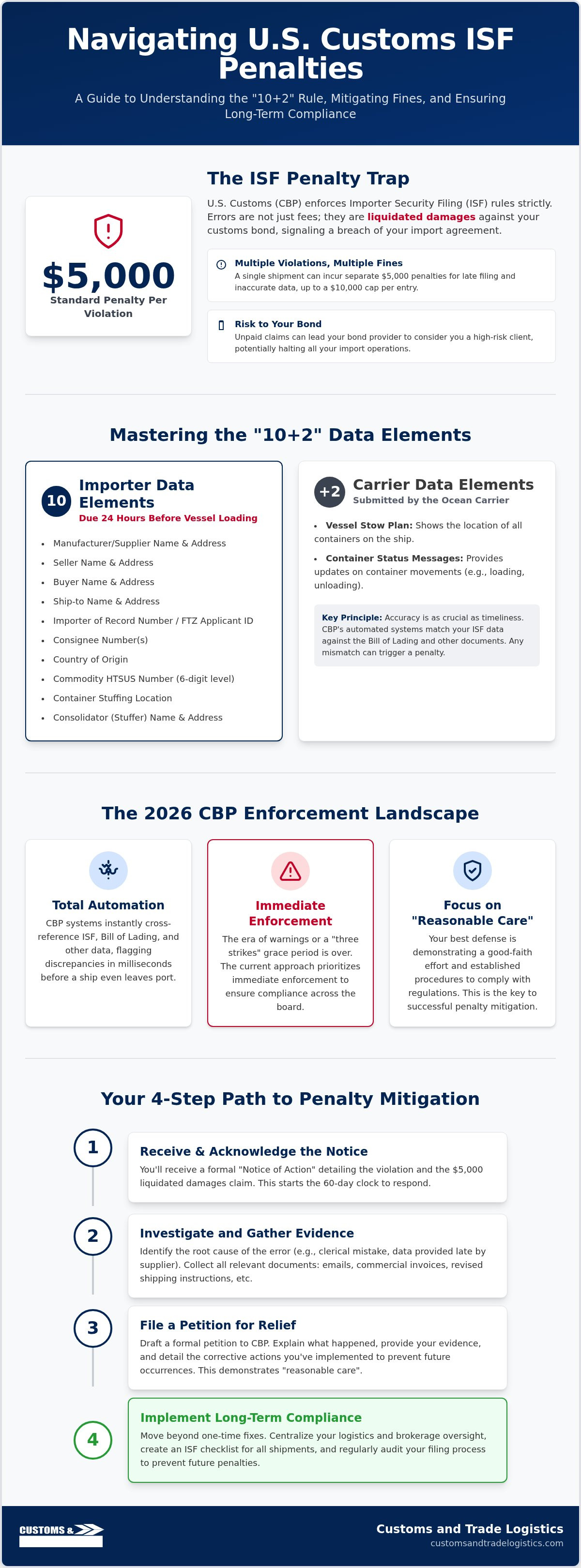
CBP doesn't view these errors as simple administrative fees. Instead, they classify ISF penalties as "liquidated damages" against your customs bond. This distinction matters. It means the government is essentially making a claim that you've breached the terms of your legal agreement to follow import laws. The standard price for this breach is a flat $5,000 per violation. It's a heavy price for a clerical slip, but it's the baseline the agency uses to ensure compliance across all ports.
What surprises many importers is how quickly these costs stack up. You can be fined $5,000 for a late filing and another $5,000 for inaccurate data on that same shipment. With a $10,000 cap per entry, a single mistake can wipe out the profit from an entire container. This is why understanding the path toward ISF filing penalty mitigation becomes a top priority the moment that Notice of Action arrives. You aren't just fighting a fine; you're protecting your business's standing with federal authorities.
The '10+2' Data Elements You Must Get Right
To avoid the trap, you need to master the "10+2" components. The "10" represents data elements you, the importer, must provide at least 24 hours before the cargo is loaded onto the vessel. This includes details like the manufacturer's name, the HTS numbers, and the consignee number. The "+2" refers to carrier-specific data: the vessel stow plan and the container status message. Accuracy is just as critical as timing. A typo in a Bill of Lading number or an incorrect seller address is often treated with the same severity as a missing filing. CBP expects the data to match the physical reality of the cargo perfectly.
Why CBP Enforces ISF So Strictly in 2026
Why is the pressure so high in 2026? CBP's oversight has moved into a fully automated era. Their systems now use sophisticated data-matching to flag discrepancies before the ship even leaves the port of origin. In previous years, you might have received a warning or a "three strikes" grace period. Today, the agency has shifted toward immediate enforcement to protect national security and streamline risk assessment. They've made it clear that importing is a privilege. They expect every Importer of Record to exercise "reasonable care" and will use these penalties to ensure that only compliant, transparent shipments enter the United States.
The 2026 CBP Enforcement Landscape: Why Mitigation is Critical
The enforcement environment in 2026 has shifted dramatically toward total automation. CBP’s systems now cross-reference data in milliseconds. This means that if your ISF doesn't match your Bill of Lading, a flag is raised before your goods even leave the water. While this sounds intimidating, it actually provides a structured framework for ISF filing penalty mitigation. CBP isn't looking to punish businesses for honest mistakes; they're looking for proof of "reasonable care." If you can demonstrate that you have established procedures and made a good-faith effort to comply, you have a strong chance at a reduction.
The primary tool in your arsenal is the "petition for relief." This is your formal opportunity to explain why the error occurred and what you've done to prevent it from happening again. Think of it as a conversation with a mentor who wants to see you succeed but needs to ensure you’re following the rules. Relying on a specialized Guide to Mitigating ISF Penalties can help you understand the legal nuances of these petitions, but the core objective remains the same: proving you are a reliable partner in the global supply chain.
Liquidated Damages vs. Fines: What's the Difference?
It's a common misconception that an ISF penalty is a simple fine. In reality, these are liquidated damages. This means CBP is making a claim against your customs bond for a breach of contract. Because your bond provider is financially responsible for these claims if you fail to pay, they become a vital player in your defense. If you ignore a notice, your bond provider may see you as a high-risk client. In the worst-case scenario, CBP can render your bond "insufficient." This effectively halts all your imports until the issue is resolved. Working with an experienced customs clearance service ensures that these bond-related complications are handled with professional oversight.
The Ripple Effect of ISF Violations
The financial impact often goes far beyond the initial penalty amount. When an ISF is flagged, your cargo is often marked for an intensive exam. These exams can cost thousands of dollars in drayage and storage fees while your goods sit in a warehouse. Beyond the immediate costs, CBP maintains an "importer score." Frequent violations lead to increased scrutiny on every future shipment, slowing down your supply chain velocity. For Amazon FBA sellers, these delays are catastrophic, leading to missed restock limits and lost sales rankings during peak seasons. Mitigation isn't just about saving money; it's about maintaining the health of your entire operation.
Identifying the Root Cause: Why Your ISF Was Flagged
Before you can successfully petition for ISF filing penalty mitigation, you must understand exactly where the process broke down. CBP doesn't just issue penalties at random. Each flag is the result of a specific data mismatch or a timing failure. By pinpointing the root cause, you can demonstrate to the agency that you've identified the weakness in your supply chain and taken steps to fix it. This proactive approach is exactly what customs officers look for when deciding whether to grant a reduction.
- The 24-Hour Rule: This remains the most frequent stumbling block. Your ISF must be filed at least 24 hours before the cargo is loaded onto the vessel at the foreign port. If your filing goes in 23 hours before loading, it's technically late. The system triggers an automatic alert the moment the carrier's manifest is uploaded.
- Inaccurate HTS Classifications: Using an incorrect Harmonized Tariff Schedule code isn't just a duty issue. It makes your security filing inaccurate. In 2026, automated audits are much better at spotting codes that don't match the described goods or the manufacturer's profile.
The Bill of Lading Mismatch: A Silent Killer
The Bill of Lading (B/L) number is the "hook" that connects your ISF to the carrier's manifest. If there's even a single-digit typo in this number, CBP's system won't recognize that a filing exists for your shipment. You'll likely receive a penalty for "no filing" even though you did the work. It's vital to verify the "lowest level" B/L number. For most small businesses, this is the House Bill of Lading provided by your freight forwarder, not the Master Bill of Lading used by the ocean carrier. Always double-check this number against your shipping documents before hitting submit. A mismatched B/L is one of the hardest errors to correct after the ship has sailed.
Supplier Communication Gaps
Many importers fall into the trap of assuming their factory handles everything. While your supplier is an expert at manufacturing, they may not fully grasp the technicalities of U.S. "10+2" regulations. Relying on a factory to manage your compliance without oversight is a high-risk strategy. You need a clear confirmation workflow with your logistics partners to ensure every data element is submitted on time. If you're managing complex shipments, reviewing a comprehensive guide for China logistics can help you bridge the gap between your overseas production and U.S. customs requirements. Establishing this oversight proves that you're exercising the "reasonable care" required for successful ISF filing penalty mitigation. It shows you aren't just reacting to fines, but building a professionalized operation.
Step-by-Step Guide to ISF Penalty Mitigation and Petitions
Receiving a Notice of Action can feel like a crisis, but it is actually the starting point for a structured resolution. Once you have identified why the flag occurred, you must act quickly to engage with the Fines, Penalties, and Forfeitures (FP&F) office. The process for ISF filing penalty mitigation is methodical. If you follow the steps correctly, you can often significantly reduce the financial impact on your business.
- Step 1: Review the Notice: Carefully examine the "Penalty Notice" for specific violation codes. These codes tell you if the fine is for a late filing, an inaccurate filing, or a total failure to file.
- Step 2: Gather Your Evidence: Collect documentation that supports your case. This includes proof of the original filing, correspondence with your supplier, and any internal logs that show you attempted to comply.
- Step 3: Draft the Petition for Relief: This is a formal letter addressed to the local FP&F office at the port of entry. You must clearly state the facts, identify the mitigating factors, and request a reduction of the liquidated damages.
- Step 4: Respect the 60-Day Window: You generally have 60 days from the date of the notice to file your petition. Missing this deadline often results in a total loss of mitigation eligibility, making the full $5,000 fine mandatory.
- Step 5: Follow Up and Pay: Once a decision is reached, CBP will send a "Mitigation Decision." Pay the reduced amount promptly to show good faith and close the case.
What Counts as a Mitigating Factor?
CBP officers have the discretion to lower your fine if they see evidence of a "culture of compliance." If you have a high volume of successful imports and this is a rare mistake, highlight that ratio. Did you discover the error yourself and file a corrective ISF before CBP caught it? This "self-correction" is a powerful argument for relief. Reasonable care is the standard CBP uses to judge importers, meaning you must prove you took every logical step to ensure your data was accurate and timely.
The Role of Your Customs Broker in Mitigation
Attempting to handle a federal petition alone can be overwhelming for small business owners. A veteran broker acts as a safe pair of hands, using their relationship with FP&F officers to present your case effectively. With 35+ years of industry expertise, we understand the specific language and evidence that officers look for when granting relief. Professional representation doesn't just save you time; it often leads to much higher mitigation percentages because we know how to demonstrate your commitment to the rules. If you are facing a penalty now, our customs clearance services can help you navigate the petition process and protect your cargo's future movements.
Long-Term Compliance: Moving Beyond Penalty Recovery
Successfully navigating ISF filing penalty mitigation is a vital skill, but the ultimate goal for any growing business is to never receive a Notice of Action in the first place. Transitioning from reactive firefighting to proactive compliance transforms your logistics from a source of anxiety into a stable competitive advantage. When you centralize your oversight through professional customs clearance services us, you gain a partner who monitors the 24-hour filing clock so you don't have to. These services effectively pay for themselves by eliminating the $5,000 traps that catch unassisted importers.
How do you turn a one-time mitigation success into a permanent shield for your profit margins? It starts by utilizing technology and expert oversight to automate the technical requirements of the "10+2" rule. By the time your cargo is ready for loading, the data should already be verified and submitted. This shift allows you to focus on scaling your business while we handle the granular procedural details at every U.S. port.
Standard Operating Procedures (SOPs) for Importers
Building a culture of compliance requires clear, repeatable steps. You should establish a checklist for every new purchase order that triggers an ISF alert for your team. Training your staff on the specific 10 importer-provided data elements ensures that no one is guessing when it's time to file. Additionally, remember that federal law requires you to keep all import records for five years. This is a non-negotiable requirement that protects you during future audits. If you can produce accurate records on demand, you prove to CBP that you're a professional operator who takes their responsibilities seriously.
Partnering for Peace of Mind
At Customs and Trade Logistics, we act as a knowledgeable bridge between your small-scale operations and the global marketplace. We specialize in demystifying the process for Amazon sellers and startups who may feel overwhelmed by the scale of international trade. Our family-owned mentorship approach means you get personalized attention to your specific cargo, appearing as a safe pair of hands in a complex industry. We value personal connection as much as technical compliance, ensuring you always have a dedicated advocate in your corner. If you're planning your next shipment, reviewing our guide on Understanding Custom Brokerage Service Fees can help you budget effectively for a future free of penalties. Let's move forward with a sense of total resolution and the peace of mind that comes from expert oversight.
Protect Your Business and Secure Your Supply Chain
Navigating the complexities of customs enforcement doesn't have to be a source of constant anxiety. By mastering the 24-hour rule and understanding how to identify root causes like Bill of Lading mismatches, you've already taken the first step toward professionalizing your operations. The path to successful ISF filing penalty mitigation relies on your ability to demonstrate a culture of compliance and "reasonable care" to CBP officers. Whether you're a startup or a seasoned Amazon FBA seller, having a veteran advocate in your corner ensures that one clerical error doesn't derail your entire growth strategy.
With 35+ years of customs brokerage experience, we provide specialized support for SMB importers across all U.S. ports. We act as your "safe pair of hands," handling technical petitions and logistics hurdles so you can focus on scaling your brand. Don't let a penalty notice sit on your desk and risk your customs bond sufficiency. Stop the Stress: Let Our Experts Handle Your ISF Mitigation Today. We're here to help you turn these challenges into a stable, secure future for your business.
Frequently Asked Questions
Can an ISF penalty be completely cancelled?
Complete cancellation only occurs if you can prove the penalty was issued in error. For example, if you have proof that the filing was submitted on time but a CBP system glitch caused a mismatch, the fine may be voided. In most other cases, the goal is ISF filing penalty mitigation, which reduces the fine to a more manageable amount rather than eliminating it entirely.
What is the time limit for filing an ISF mitigation petition?
You have exactly 60 days from the date printed on your Penalty Notice to file a formal petition for relief. This is a strict federal deadline. If you miss this window, you lose your right to request a reduction, and the full $5,000 amount becomes immediately due. It's best to start gathering your evidence the moment you receive the notice to ensure you have time for a thorough submission.
How much does it typically cost to mitigate a $5,000 ISF fine?
Under the June 3, 2026, Executive Order, mitigation standards have become much stricter. While first-time violations were previously reduced to as low as $1,000, new guidelines now establish a minimum penalty floor of 50% for many cases. This means you should prepare to pay at least $2,500 even with a successful petition. Repeat offenders face even tougher rules and may not be eligible for any reduction at all.
What happens if I ignore an ISF penalty notice from CBP?
Ignoring a notice is a dangerous move that leads to a "bond sufficiency" crisis. If the fine remains unpaid, CBP will eventually collect the money directly from your customs bond provider. Once this happens, your bond is usually rendered insufficient, which effectively stops you from importing any goods into the United States until a new, often more expensive, bond is secured.
Does a 'Late ISF' always result in a fine?
In the current 2026 enforcement climate, a late filing almost always triggers a penalty. CBP has moved away from the "informed compliance" period where warnings were common. Because the system is now highly automated, filings that occur less than 24 hours before vessel loading are flagged instantly. You should treat every late filing as a potential $5,000 liability and take immediate steps to document why the delay occurred.
Will my customs bond be affected by an ISF penalty?
Yes, your bond is directly tied to your ISF compliance. Because these penalties are classified as liquidated damages, they represent a claim against your bond. Frequent penalties make you a high-risk client for surety companies. This can lead to significantly higher bond premiums or even a total cancellation of your coverage, which would halt your entire import operation.
How do I know if my ISF was filed correctly?
You should always receive a confirmation message from your broker or filing software that includes an "Accepted" status and a unique transaction number. However, acceptance doesn't always mean accuracy. You must verify that the Bill of Lading number on your ISF matches the carrier's manifest exactly. If these numbers don't match, CBP's system will treat the shipment as if no ISF was filed at all.
Can I handle the mitigation process myself or do I need a broker?
You can technically file a petition yourself, but it's often a stressful and technical process for non-experts. A veteran broker understands the specific "mitigating factors" that Fines, Penalties, and Forfeitures officers look for in a successful petition. Having a professional advocate helps you present a "culture of compliance" that can make the difference between a full $5,000 fine and a significantly reduced amount.


