

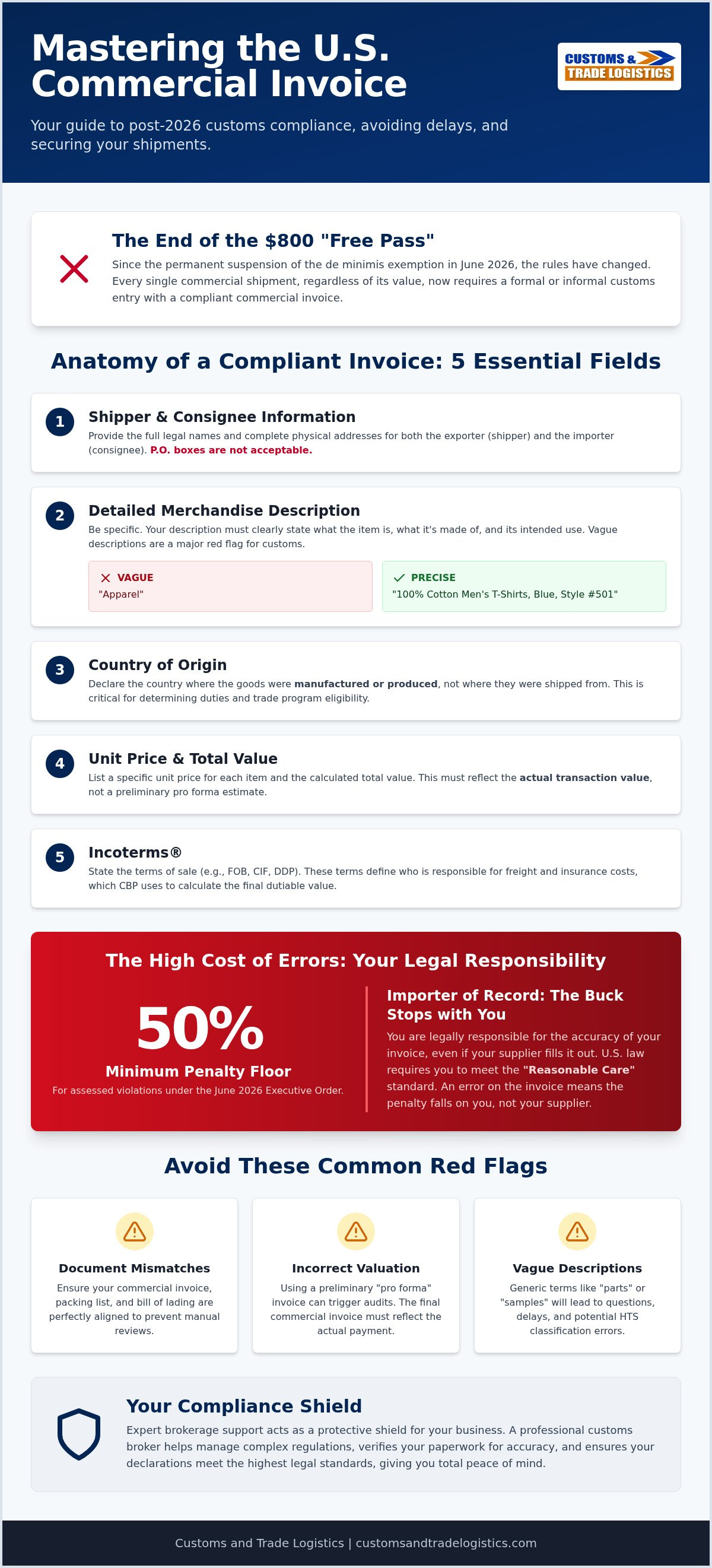
The days of the $800 "free pass" are officially over, and for many importers, that simple fact has turned a routine shipment into a compliance nightmare. Since the permanent suspension of the de minimis exemption in June 2026, every single commercial shipment now requires a formal or informal entry regardless of value. It's completely natural to feel a bit of anxiety when you're staring at a blank form, wondering if a small error will lead to a costly audit or a flagged container. Learning how to fill out a commercial invoice for US customs correctly isn't just about administrative paperwork anymore; it's your primary defense against delays and the strict new penalty floors established this year.
We know that navigating the 2026 HTS Revision 12 and shifting MPF rates can feel overwhelming. You want to focus on your business growth, not spend your nights worried about whether your goods description is specific enough for CBP. This guide provides the professional assurance you need by walking you through a clear checklist of required fields and accurate classification steps. We'll cover the latest regulatory changes and the exact level of detail required to keep your shipments moving. You'll finish this article with a reliable roadmap and the confidence that your paperwork is fully compliant.
Key Takeaways
- Understand why the commercial invoice is the foundation of your import strategy and how it serves as a binding legal declaration for US Customs.
- Get a field-by-field breakdown of how to fill out a commercial invoice for US customs to ensure your paperwork is complete and compliant every time.
- Learn the art of describing your goods with precision to avoid the "red flags" that lead to manual inspections and HTS classification errors.
- Identify the most common documentation inconsistencies that trigger costly storage fees and learn how to align your invoice with your packing list perfectly.
- Discover how expert brokerage support acts as a protective shield, helping you manage complex regulations with total peace of mind.
What is a Commercial Invoice and Why is it Critical for US Customs?
Think of the commercial invoice as the passport for your products. It's the most critical document in your shipping folder, acting as the primary record that U.S. Customs and Border Protection (CBP) uses to determine duty rates and verify trade compliance. This document isn't just a request for payment between you and your supplier; it's a formal legal declaration of the goods' value, country of origin, and detailed contents. Understanding how to fill out a commercial invoice for US customs correctly is the difference between a shipment that clears in hours and one that sits in a warehouse for weeks.
It's vital to distinguish between a pro forma invoice and a final commercial invoice. While a pro forma invoice acts as a preliminary quote or a placeholder for a sale, CBP requires the final Commercial Invoice for customs entry. This final version must reflect the actual transaction value. If the numbers don't match your payment records, you risk triggering a "Red Flag" status, which leads to increased scrutiny on every future shipment you bring into the country.
The Legal Role of the Importer of Record
Did you know that you're legally responsible for the accuracy of your invoice even if your supplier fills it out? As the Importer of Record, you must meet the "Reasonable Care" standard required by US law. This means you can't simply blame a manufacturer for a typo or a vague description. If the invoice is wrong, the penalties fall on your shoulders. These consequences became even more severe following the June 2026 Executive Order, which established a minimum penalty floor of 50% for assessed violations. Partnering with professional customs clearance services us provides a much-needed safety net, ensuring your declarations meet these high legal standards before they reach a customs officer's desk.
When is a Commercial Invoice Required?
The rules for 2026 are clearer than ever: every commercial shipment requires an invoice. Since the permanent suspension of the $800 de minimis exemption, even low-value shipments must undergo a formal or informal entry process. While shipments valued under $2,500 generally qualify for informal entry, they still require a professional invoice to prove their value. Whether you're moving goods via air freight for speed or ocean freight to save on costs, the invoice requirements remain consistent. For ocean shipments, remember that your invoice data also helps calculate the Harbor Maintenance Fee (HMF), which currently stands at 0.125% of the cargo value. Having your paperwork ready and accurate from day one prevents the administrative headaches that often plague first-time importers.
Step-by-Step: Essential Fields for US Customs Compliance
While the commercial invoice might look like a standard business receipt, for a customs officer, it's a data-rich document used to assess risk and duty. Missing just one detail can result in your shipment being pulled aside for a physical exam. When you're learning how to fill out a commercial invoice for US customs, accuracy in these core fields is your first line of defense against unexpected costs. Every line item must be transparent, leaving no room for interpretation by port authorities.
Your invoice must clearly state the full legal names and physical addresses of both the Shipper (Exporter) and the Consignee (Importer). P.O. boxes are never acceptable. Beyond contact details, ensure you include these specific elements:
- Detailed Merchandise Description: You must describe exactly what the item is, what it's made of, and its intended use.
- Country of Origin: This is the country where the goods were manufactured, not just where they were shipped from. This is vital for determining if special trade programs or retaliatory tariffs apply.
- Unit Price and Total Value: Every item needs a specific unit price and a calculated total value.
- Incoterms: Terms like FOB, CIF, or DDP must be listed. These define who pays for the freight and insurance, which is essential because CBP uses this information to calculate the final dutiable value.
According to the International Trade Administration on commercial invoices, providing a complete and clear document is the best way to avoid clearance delays. If you're feeling unsure about these technical requirements, our customs clearance services can help you verify every field before you ship.
Identifying the Manufacturer and MID Code
CBP wants to know exactly where your goods were made. This is where the Manufacturer Identification (MID) code comes into play. It's a unique identifier derived from the name and address of the actual factory. You cannot simply list a trading company or a middleman; the invoice must provide the specific factory address. Formatting the MID code correctly is a technical task, as it combines country codes and specific character strings from the manufacturer's name. An incorrect MID code is a common reason for entry rejection.
Currency and Valuation Rules
All values on your commercial invoice must eventually be converted to US Dollars (USD) for customs entry filing. If your transaction happened in another currency, clearly state that currency on the invoice so your broker can apply the correct exchange rate. What about samples or "no charge" items? CBP doesn't recognize a "zero value" for customs purposes. You must declare the fair market value of these items, even if you didn't pay for them. If your total price includes shipping or insurance, itemize these costs separately. This prevents you from paying duties on the transportation costs, which can save you a significant amount of money over time.
Mastering the "Description of Goods" and HTS Classifications
Precision is your best friend when it comes to the cargo description on your invoice. When you provide a crystal-clear description, you're essentially handing the customs officer a roadmap that proves your shipment is exactly what you say it is. Vague language is one of the fastest ways to get your container flagged for a manual inspection. For example, listing an item simply as "Plastic Parts" tells the officer nothing about the material, the manufacturing process, or the intended use. Instead, using a compliant description like "Injection Molded PVC Pipe Fittings for Irrigation" provides the specific details needed to verify the duty rate immediately.
The description you write is the primary evidence used to support your Harmonized Tariff Schedule (HTS) code. If your written description and the HTS code don't align, it creates a discrepancy that invites scrutiny. Learning how to fill out a commercial invoice for US customs means understanding that you must describe the product's composition, its primary function, and often its dimensions or weight. This level of detail doesn't just speed up the process; it actively prevents the physical exams that can cost you thousands of dollars in storage and handling fees.
- List the material: Is it 100% cotton, stainless steel, or high-density polyethylene?
- State the function: What is the item actually used for?
- Include components: For complex items, list the main parts that make up the finished product.
How to Assign an HTS Code
The HTS is a 10-digit hierarchical structure used to classify every imported good. While the first six digits are standardized globally, the final four are specific to the United States. Including the correct HTS code directly on your commercial invoice helps your broker file the entry much faster. However, you must be careful. Some importers try to use "General" codes or "Other" categories to find lower duty rates. This is a high-risk strategy. With CBP auditing 17% more shipments in 2026, misclassification is easily caught and can lead to negligence penalties that reach up to 20% of the item's value.
Case Study: Common China Import Descriptions
Accuracy is especially vital for high-volume categories. If you're importing electronics, don't just write "Electronics." Use "Lithium-ion battery powered portable speakers." For textiles, specify the weave and gender, such as "Men's 100% knitted polyester running shorts." If you're shipping multi-part kits or bundles, it's best practice to itemize the components so the officer can see the full value breakdown. Our import from China logistics experts frequently review these descriptions to ensure they meet current 2026 standards before the goods ever leave the factory floor.
Common Mistakes That Trigger Customs Exams and Delays
It's a heart-sinking moment for any importer: your shipment arrives at the port, but instead of clearing, it's flagged for an intensive exam. These inspections don't just cost time; they often come with thousands of dollars in storage and handling fees. Most of these delays are entirely preventable if you know the common pitfalls. One of the most frequent triggers is a simple lack of consistency between your Commercial Invoice, Packing List, and Bill of Lading. If your invoice lists 1,000 units but your packing list shows 1,010, CBP interprets this as a lack of control over your supply chain, which invites a much closer look.
Accuracy isn't just about the numbers on the page; it's also about the physical reality of your cargo. Even if you've mastered how to fill out a commercial invoice for US customs, your shipment can still be held if the Country of Origin markings on the products don't match your paperwork. CBP officers are trained to spot discrepancies where an invoice claims one origin while the physical packaging suggests another. This is often seen as an attempt to evade specific tariffs, leading to immediate seizures and investigations. To avoid these headaches, double-check that your invoice and physical markings are perfectly aligned before the goods leave the factory.
- Vague Descriptions: Using "catch-all" terms like "Gift" or "Merchandise" is a guaranteed way to get flagged.
- Document Discrepancies: Ensure weights, counts, and values are identical across all shipping documents.
- Missing Contact Info: Forget a phone number or a specific factory address, and your shipment could sit in limbo.
The Danger of Under-Invoicing
CBP uses sophisticated industry benchmarks to detect undervalued goods. If you're importing high-demand items at a price that seems "too good to be true," officers will likely demand proof of payment. In 2026, the stakes are higher than ever; civil penalties for false claims can reach $28,619 per occurrence, plus three times the duties evaded. Valuation fraud is a serious offense that can lead to your business being permanently blacklisted from importing. Remember, even "gifts" or "samples" must have a fair market value listed on the invoice; "zero value" is not an option in the eyes of US Customs.
Amazon FBA Specific Paperwork Challenges
Selling on Amazon adds another layer of complexity to your documentation. A critical mistake many new sellers make is listing Amazon as the Importer of Record (IOR). Amazon will never act as the IOR for your shipments, and doing so will result in your goods being rejected at the port. You must list yourself or your business as the IOR, while Amazon is typically listed as the "Ultimate Consignee." Navigating these distinctions is much easier with professional FBA freight forwarding services that specialize in e-commerce compliance. If you're feeling overwhelmed by these requirements, our team provides the "safe pair of hands" you need through our dedicated customs clearance services.
Expert Assistance: How a Customs Broker Streamlines Your Paperwork
Do you really want to gamble your business growth on a single piece of paper? While you can learn the mechanics of how to fill out a commercial invoice for US customs, the reality is that the regulatory environment in 2026 is less forgiving than ever. A licensed customs broker acts as your professional "second set of eyes," reviewing every line item to ensure it stands up to CBP scrutiny. At Customs and Trade Logistics, we've spent over 35 years acting as a safe pair of hands for importers, catching the subtle errors in HTS codes or MID formatting that automated systems often miss.
We understand that every dollar counts when you're scaling an operation. It's helpful to view custom brokerage service fees not as an added expense, but as a strategic investment in your supply chain's stability. When you consider that a single misclassification can now trigger a minimum penalty floor of 50% of the assessed value, a broker's oversight pays for itself by preventing these catastrophic costs. Before you hit "send" on your next shipment, run through this final checklist:
- Review: Does the invoice match the packing list and bill of lading exactly?
- Verify: Are you using the 2026 HTS Revision 12 codes for every item?
- Sign: Is the invoice signed and dated by the shipper?
- Retain: Have you made a plan to store these records for the required 5-year period?
Transitioning from Startup to Pro Importer
As your business grows, your documentation needs will naturally become more complex. What worked for a small air freight parcel won't suffice for full container loads arriving by sea. The import logistics for startups often involves a steep learning curve, especially when transitioning to continuous bonds and recurring entries. This is where a family-owned partner makes a difference. Unlike digital-only freight forwarders that rely on chatbots, we provide personal communication and mentorship. We're here to help you navigate the nuances of global trade as a dedicated advocate for your success.
Ready to Clear Customs Without the Stress?
Mastering your documentation is the key to a predictable, profitable import business. You've seen how a precise description of goods and accurate valuation can protect you from the increased enforcement and audits of 2026. Don't let paperwork anxiety hold your business back from the global marketplace. We're ready to help you streamline your process and ensure every commercial invoice you submit is fully compliant. Contact Customs and Trade Logistics for expert paperwork assistance and gain the peace of mind that comes with professional brokerage support.
Secure Your Shipments with Compliance
Navigating the complexities of global trade doesn't have to be a source of stress for your business. By prioritizing precise goods descriptions and ensuring total consistency across your shipping documents, you've already taken the most important steps toward avoiding the strict penalties of 2026. Mastering how to fill out a commercial invoice for US customs is a vital skill for any importer, but you don't have to manage the burden of compliance alone. Whether you're dealing with intricate HTS classifications or the unique requirements of Amazon FBA, having a seasoned mentor by your side makes all the difference.
At Customs and Trade Logistics, we bring over 35 years of family-owned expertise to every shipment we handle. We provide specialized support for Amazon FBA sellers and comprehensive China-to-US logistics management, acting as a protective bridge for your growing operations. Why risk costly delays when you can have a "safe pair of hands" overseeing your documentation? Let our experts handle your US Customs documentation today and enjoy the relief that comes with professional partnership. Your growth is our priority, and we're ready to help your business thrive in the global marketplace.
Frequently Asked Questions
Does a commercial invoice need to be signed?
Yes, the exporter or shipper must sign the commercial invoice to certify that the information provided is true and correct. This signature serves as a legal declaration that the values and descriptions match the actual transaction. While digital signatures are widely accepted in 2026, the absence of a signature can lead to immediate rejection by customs officers. It's a simple step that ensures your document is treated as a formal, binding record.
Can I use a Pro Forma invoice for US Customs clearance?
No, you cannot use a pro forma invoice for the final customs entry process. A pro forma invoice is essentially a quote or a preliminary agreement, but CBP requires a final commercial invoice that reflects the actual price paid or payable. Using a pro forma for clearance is a common mistake that triggers delays. Customs officers need the final document to accurately assess duties and verify that the transaction is complete.
What happens if I put the wrong HTS code on my commercial invoice?
Using an incorrect HTS code can lead to shipment seizures, intensive exams, and heavy fines. Under the June 2026 penalty revisions, even simple negligence can result in a minimum penalty floor of 50% of the assessed violation. If you're unsure about how to fill out a commercial invoice for US customs with the right codes, it's best to consult a broker. An error here isn't just a typo; it's a misdeclaration of your legal tax liability.
What is the difference between a commercial invoice and a packing list?
The commercial invoice is a financial document used for duty assessment, while the packing list is a logistical tool used to verify physical contents. Your invoice details the transaction value, currency, and payment terms. In contrast, the packing list describes the weight, dimensions, and specific box counts for the shipment. Both must align perfectly. If the invoice says you're shipping 500 units but the packing list says 505, customs will likely flag the shipment for an exam.
How do I list "free samples" on a commercial invoice for US Customs?
You must declare a fair market value for every item, even if the supplier provided it for free. US Customs doesn't recognize a "zero value" for commercial imports. You should list the actual value of the goods and include a statement like "Samples of no commercial value; value for customs purposes only." Knowing how to fill out a commercial invoice for US customs for samples prevents the officer from having to estimate a value themselves, which is often much higher than your actual cost.
Do I need to include the shipping costs on the commercial invoice?
Yes, it's highly beneficial to itemize shipping and insurance costs separately on your invoice. US Customs generally calculates duties based on the "transaction value" of the goods alone, excluding international freight and insurance. If you provide a lump sum, you might end up paying duties on the transportation costs as well. Clearly separating these fees ensures you only pay what's legally required and can significantly reduce your overall import expenses.
What language must the commercial invoice be in for US imports?
The commercial invoice must be written in English to be accepted by U.S. Customs and Border Protection. If your supplier provides an invoice in another language, you're required to provide a full and accurate English translation. Providing the document in English from the start is the most efficient way to prevent administrative delays at the port. This allows the customs officer to quickly verify the contents and HTS classifications without needing additional clarification.
How many copies of the commercial invoice do I need for a shipment?
While most entries are filed electronically through the ACE system in 2026, you should still provide one original and at least two copies with the shipment. One copy typically stays with the freight, while the others are used by the carrier and the customs broker. Having physical copies attached to the exterior of the pallet or container is a "safe pair of hands" approach. It ensures that if there's a technical glitch, the port authorities can still process your goods manually.


