

What if that "cheaper" unit price from your supplier is actually the most expensive mistake your business makes this year? Many importers choose Ex Works because the initial quote looks low, but they soon find themselves buried under unsuspected local charges in China and confusing liability shifts. Understanding EXW vs FOB what is the difference isn't just a matter of terminology; it's the difference between a predictable supply chain and a logistical nightmare.
We understand how overwhelming it feels to manage international freight while worrying about hidden fees that can eat your margins. It's stressful when you lack transparency in your freight costs or feel uncertain about where your legal liability begins. This guide will help you master the critical differences between EXW and FOB to lower your costs, reduce risk, and protect your bottom line. We'll explore the total cost of ownership for each term, the impact of new 2026 customs regulations, and how to choose the right strategy for your next purchase order.
Key Takeaways
- Understand the fundamental shift in responsibility between the "pick it up yourself" EXW model and the "port handoff" FOB model.
- Identify EXW vs FOB what is the difference in terms of total landed cost so you can avoid hidden fees and accurately budget for your 2026 imports.
- Pinpoint the exact "Transfer of Risk" moment to ensure your cargo is protected and your liability is clear at every stage of the journey.
- Learn how to choose the right Incoterm based on your experience level and your specific need for control over the shipping route.
- Streamline your US Customs clearance by identifying which documents your broker needs to meet the latest regulatory requirements.
Understanding Incoterms: The Basics of EXW and FOB
Have you ever looked at a proforma invoice and wondered why the price changes so drastically between two different quotes? These three-letter codes are part of the Incoterms framework, which acts as the universal language for global trade. For your 2026 business strategy, understanding these terms is vital because they dictate who pays for what and who is responsible if something goes wrong. Think of them as a legal handshake between you and your supplier that prevents expensive misunderstandings at the border.
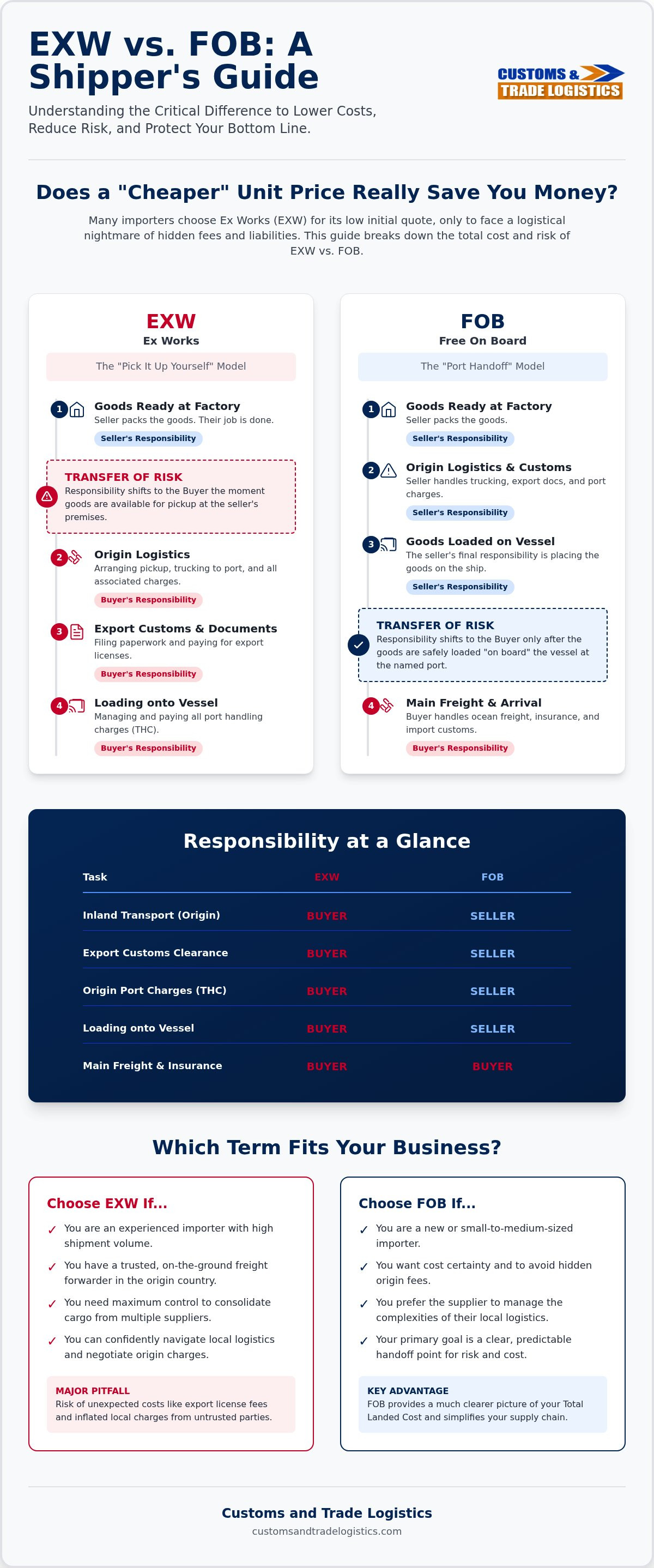
When we talk about EXW, or "Ex Works," we're looking at the "pick it up yourself" model. The supplier’s only job is to have the goods ready and packed at their factory or warehouse. From that point on, every single step, from trucking the goods to the port in China to loading them onto a vessel, is your responsibility. It's a high-effort approach that requires you to have a firm grip on local logistics in a foreign country. If you don't have a boots-on-the-ground partner, this can quickly become a administrative burden.
On the flip side, FOB stands for "Free on Board." This is the "deliver it to the ship" model. Under these terms, your supplier is responsible for getting the goods through local customs and safely onto the ship at a named port. Once the cargo is on the vessel, the risk transfers to you. When analyzing EXW vs FOB what is the difference, you're looking at where the supplier's job ends and your logistical journey begins. This distinction is the foundation of your entire shipping budget.
Why EXW and FOB are the Most Common for SMEs
Most small businesses default to these two terms because they offer the clearest boundaries for international shipping. In every agreement, you'll see a "named place" following the term, such as "FOB Shanghai" or "EXW Shenzhen." This specific location is the line in the sand where the supplier's duties end and yours begin. Without this clarity, you might find yourself paying for local storage or transport you never budgeted for; these costs can quickly eat into your margins before the goods even leave the country.
Common Misconceptions About Shipping Terms
A common trap for new importers is choosing EXW because the unit price is lower. Importers often misunderstand EXW vs FOB what is the difference by focusing purely on the factory price rather than the total landed cost. You often end up paying more in the long run because you're responsible for export documentation and local Chinese port fees that you can't easily negotiate from overseas. You also need to remember that these terms don't actually define when you own the goods; they only define who handles the movement and the risk during the journey.
Incoterms are a standardized language for global risk management that ensures both buyers and sellers understand their specific duties during transport.
Buyer vs. Seller Responsibilities: A Granular Breakdown
When you're trying to figure out EXW vs FOB what is the difference, you're really asking: where do I start being legally and financially liable for these goods? The "Transfer of Risk" is the exact moment when the responsibility for loss or damage shifts from the supplier to you. According to the official government guidance on Incoterms, this point varies significantly between these two terms, and getting it wrong can leave your cargo uninsured during the most vulnerable parts of its journey.
Beyond the risk of damage, you must consider the "hidden" origin costs that aren't always visible on a proforma invoice. These include inland transportation from the factory to the port, export customs clearance, and terminal handling charges (THC). Under FOB, your supplier absorbs these costs. Under EXW, these are all on your tab. If you're feeling unsure about which path protects your business best, our Import From China Consulting can help you audit your supplier's shipping quotes before you sign the purchase order.
The EXW Workflow: The Buyer Takes the Lead
In an EXW arrangement, you are the pilot of the entire logistical journey. This requires you to have a highly reliable freight forwarder on the ground at the origin. Why? Because you're responsible for the "last mile" in reverse, picking up the goods at the factory door. A common pitfall in China is the export license fee. Many smaller factories don't actually hold their own export licenses. If you buy EXW, you might be hit with a surprise fee to "borrow" a license so the goods can legally leave the country. It's a logistical burden that many SMEs find difficult to manage without a dedicated team on the ground.
The FOB Workflow: Supplier-Managed Origin Logistics
FOB is generally the "safer" bet for those new to international trade. The seller is obligated to get the goods "past the ship's rail," meaning they handle everything until the container is safely loaded onto the vessel. This is ideal because the supplier is better positioned to handle local trucking, Chinese customs paperwork, and port fees in their own language and currency. One thing to watch out for is the term "FOB Factory." Technically, this isn't a valid Incoterm. If a supplier uses this phrase, they usually mean EXW, but they're trying to make it sound more official. Always insist on "FOB [Named Port]" to ensure the handoff happens exactly where you expect it to.
From a customs brokerage perspective, your choice dictates the flow of information. Under FOB, the supplier provides the necessary export data to the carrier, which helps ensure your Commercial Invoice and Packing List align with the actual shipment. This consistency is vital for a smooth US Customs entry and helps you avoid the "red tape" delays that can happen when origin documentation is incomplete.
EXW vs. FOB: The Critical Comparison for Small Businesses
Choosing between these terms is more than a technicality; it's about defining your circle of control. While the official Incoterms® 2020 rules provide the legal framework, your daily operations depend on how you manage the gap between a factory's door and your warehouse. When small business owners ask EXW vs FOB what is the difference, they are often searching for the best way to balance their budget with their peace of mind. Your choice directly impacts your US customs entry services, as the level of control you have over the cargo dictates how easily your broker can access the necessary data for a clean filing.
| Feature | Ex Works (EXW) | Free on Board (FOB) |
|---|---|---|
| Unit Price | Lowest (Factory price only) | Higher (Includes origin logistics) |
| Control | Maximum (You choose every carrier) | Shared (Supplier handles origin) |
| Risk Transfer | At the factory door | When loaded onto the vessel |
| Complexity | High (Requires origin partners) | Low (Supplier manages the start) |
Risk Management: Where Things Go Wrong
Liability is often invisible until a crisis occurs. Under EXW, if a forklift driver at the factory accidentally pierces your pallet, the argument over who pays becomes your headache because the risk transferred the moment the goods were ready. Under FOB, the supplier remains responsible until the container is safely on the ship. This is particularly important when facing port strikes or unexpected congestion. Under FOB, the supplier generally handles the logistics of getting goods to the port; however, you should still secure marine insurance for the ocean leg to protect your investment from unpredictable maritime disasters.
Total Landed Cost Analysis
The true cost of an Incoterm includes both the invoice price and the logistical overhead required to move the goods. When you are calculating custom brokerage service fees into your margin, remember that hidden fees like brokerage and demurrage can constitute 20% to 40% of your total landed cost. While an FOB quote from a supplier might include a small markup for their trouble, it often saves you from the $125 to $350 entry fees and local trucking surprises that come with managing EXW yourself. We often see SMEs save money by choosing FOB because it eliminates the need for them to negotiate local Chinese rates they don't fully understand.
Strategic Selection: Which Term Fits Your Business Model?
How do you decide which logistical path is right for your specific operation? For many businesses, the answer to EXW vs FOB what is the difference depends on where they are in their growth journey. If you're just starting out, you likely want a "clean" handoff. Choosing FOB allows you to focus on your sales while the supplier manages the complexities of Chinese export customs and inland trucking. It's a protective approach that keeps you from getting bogged down in origin-side administrative hurdles.
As you scale, you might consider moving toward EXW. This term is best suited for experienced importers who have established deep relationships with local logistics partners in China. Why would you take on the extra work? It gives you total oversight of the movement and cost of your goods from the moment they leave the factory floor. However, you must account for the "China Factor." Regional relationships often allow suppliers to secure better local rates for trucking and port fees than a foreign business could negotiate on its own. If you need a second pair of eyes on your next purchase order, our Import From China Consulting provides the mentorship you need to scale safely.
Special Considerations for Amazon FBA Sellers
Amazon sellers face unique pressures, specifically the need to meet strict delivery windows at FBA warehouses. Your choice of shipping terms directly impacts your FBA freight forwarding services. While some sellers are tempted by "delivered" terms like DDP, these often result in a lack of transparency. FOB is frequently the "sweet spot" for FBA because it ensures the supplier handles the origin while giving you control over the international carrier. This control is vital when you need to reroute cargo or speed up a shipment to avoid an out-of-stock disaster.
Decision Matrix for 2026 Importers
Before you sign your next purchase order, take a moment to evaluate your current setup. Startups often find that import logistics for startups are most manageable when using FOB. To help you finalize your decision on EXW vs FOB what is the difference for your specific PO, ask yourself these five questions:
- Does my supplier have a valid export license for China?
- Do I have a freight forwarder who can pick up goods from the factory door?
- Am I consolidating goods from multiple different suppliers into one container?
- How much time can I realistically spend managing origin-side disputes?
- Is the supplier's FOB markup significantly higher than the cost of me hiring my own local truck?
If you're consolidating from three different factories, EXW might actually be more efficient, as your forwarder can collect all three shipments and bring them to a single warehouse. If you're working with one large, reliable factory, FOB is almost always the path of least resistance. The goal is to create a steady, rhythmic flow of goods that doesn't require you to micromanage every mile.
Navigating Shipping Terms with a Customs Brokerage Partner
Your choice of Incoterm acts as a roadmap for the documentation your broker needs to clear your goods through the border. When we evaluate EXW vs FOB what is the difference from a regulatory perspective, we focus on the accuracy and flow of data. Under FOB, the supplier is responsible for the export side, which usually results in a more organized Commercial Invoice and Packing List. These documents are the heart of your US Customs compliance. If you choose EXW, you're responsible for gathering this data yourself, which can lead to gaps if your supplier isn't familiar with US requirements.
Having a "safe pair of hands" is essential for bridging the gap between a foreign factory and your US doorstep. We leverage our 35+ years of experience to audit your shipping terms before the cargo even leaves the origin. This proactive approach prevents the "red tape" delays that often catch new importers off guard. We don't just file paperwork; we act as a stabilizing force that protects your business from heavy administrative burdens and the anxiety of potential penalties.
Streamlining Your China-to-US Imports
Success in import from China logistics requires more than just booking a boat and a truck. It requires specialized oversight to navigate the June 2026 customs enforcement changes and the new 50% penalty floor for violations. Customs and Trade Logistics simplifies the transition from an FOB handoff to a final warehouse delivery. Our family-owned approach means we provide the mentorship SMEs need to scale without fear of customs violations or hidden port fees.
Next Steps: Auditing Your Current Agreements
Is your current shipping term actually serving your business? If you find yourself constantly surprised by local charges in China or documentation errors, it's time to request a change. Clear communication in your contracts is the best way to avoid disputes before they happen. When you truly understand EXW vs FOB what is the difference for your specific supply chain, you can negotiate with your supplier from a position of strength.
Don't let confusing logistics hold back your growth. If you're ready to secure your supply chain and ensure every shipment arrives without a hitch, contact us for a logistics consultation. We'll help you audit your current agreements and optimize your 2026 shipping strategy for maximum efficiency and total peace of mind.
Securing Your Supply Chain for 2026
Choosing the right Incoterm is the first step in protecting your profit margins and ensuring total regulatory compliance. While EXW offers maximum oversight for established brands with local partners, FOB provides a much safer, streamlined handoff for businesses looking to avoid origin-side headaches in China. Mastering EXW vs FOB what is the difference allows you to move away from logistical guesswork and toward a strategic plan that actually scales with your long-term growth.
At Customs and Trade Logistics, we act as your dedicated "safe pair of hands" in a complex global marketplace. As a family-owned consultancy with 35+ years of brokerage expertise, we specialize in the unique nuances of China-to-US small business imports. Our team provides full management of US Customs entry across all ports, ensuring your cargo clears without the stress of unexpected penalties or red-tape delays. You don't have to navigate these waters alone. Get a Professional Logistics Consultation Today and let us help you build a more resilient, profitable business for 2026 and beyond.
Frequently Asked Questions
Is EXW always cheaper than FOB for the buyer?
No, EXW is rarely cheaper once you calculate the total landed cost of your shipment. While the unit price on your initial invoice looks lower, you're responsible for paying for trucking in China, export licenses, and port handling fees. These origin costs often exceed the small markup a supplier adds for an FOB quote, making FOB the more cost-effective choice for most SMEs.
Who pays for the freight from the port to my warehouse under FOB?
You are responsible for all costs once the goods are loaded onto the vessel at the origin port. This includes the international ocean or air freight, US customs bonds, import duties, and the final trucking from the US port to your warehouse. The seller's financial obligation ends the moment the container clears the ship's rail at the starting port.
Does FOB mean the seller pays for the export customs clearance?
Yes, the seller is legally required to handle all export formalities in their home country under FOB terms. This includes filing the necessary export declarations with local customs and paying any associated duties or taxes. This is a major benefit for US importers, as it removes the burden of navigating foreign government regulations and local paperwork from your shoulders.
Can I use FOB for air freight shipments in 2026?
Strictly speaking, the Incoterms 2020 framework reserves FOB for sea and inland waterway transport only. For air freight, the technically correct term is FCA (Free Carrier). However, many suppliers still use "FOB" colloquially for air shipments to indicate they'll deliver the goods to the airport and handle export clearance. It's best to clarify the specific handoff point with your supplier to avoid confusion.
What happens if the goods are damaged during ocean transit under EXW?
You are financially responsible for any damage during transit because the risk transferred to you at the factory door. This is why securing your own marine insurance is non-negotiable when buying on Ex Works terms. If you don't have a policy, you'll have to absorb the loss yourself, as the supplier fulfilled their legal duty by making the goods available at their warehouse.
How do I know if my supplier is overcharging me for FOB local costs?
You can verify this by requesting both an EXW and an FOB quote to see the price difference. If the gap is significantly higher than the typical local handling fees for a standard container, they might be padding their profit margin. Understanding EXW vs FOB what is the difference in these specific line items helps you negotiate with your supplier from a position of knowledge.
Do I need a different customs broker if I switch from EXW to FOB?
No, you don't need a different broker because your customs partner handles the US side of the entry regardless of the origin terms. However, switching to FOB often makes the process smoother for your broker. Since the supplier handles the export side, they typically provide more standardized documentation, which reduces the risk of data errors during your US Customs filing.
What is the most common mistake beginners make when choosing between EXW and FOB?
The most common mistake is choosing EXW simply because it offers the lowest initial unit price. Beginners often underestimate the complexity and hidden costs of managing logistics in a foreign country without a local presence. When you look at EXW vs FOB what is the difference, the "hidden" trucking and export fees of EXW often turn a perceived bargain into a logistical nightmare.


