

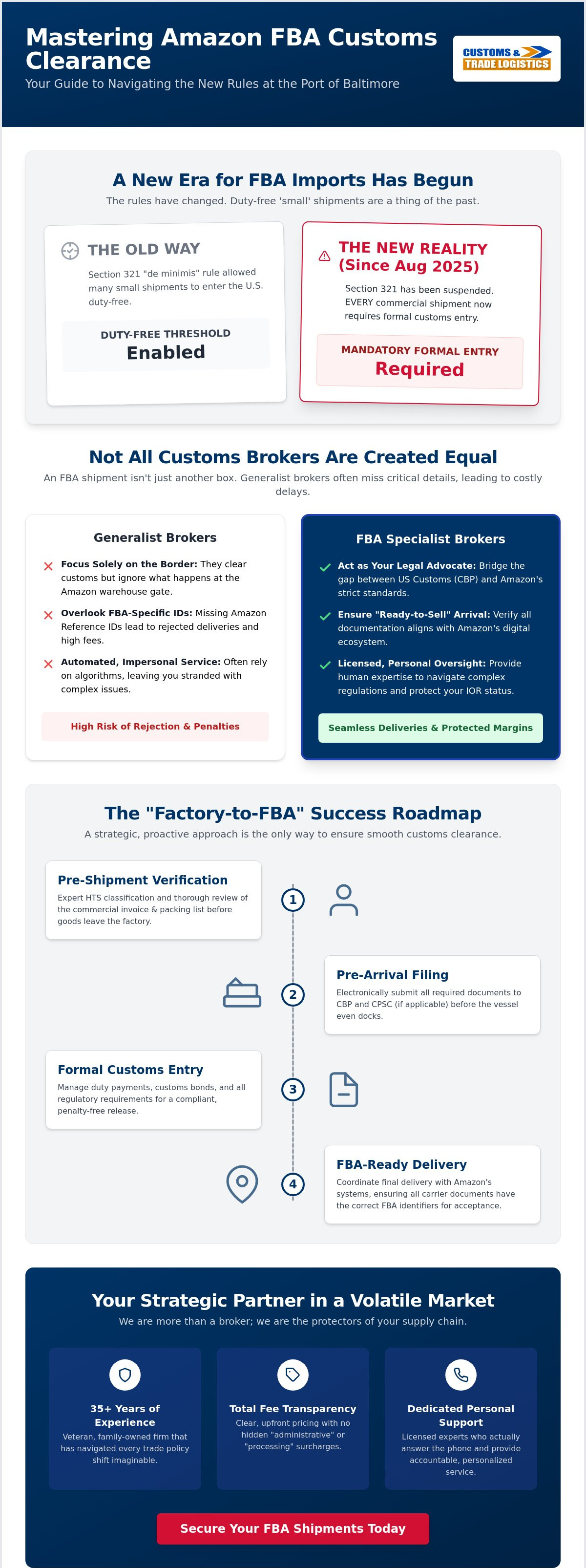
The era of duty-free "small" shipments is officially over, and the margin for error at the Port of Baltimore has never been thinner. Since the suspension of the Section 321 de minimis rule in August 2025, every commercial shipment now requires formal entry and duty payment. You've likely felt the pressure as Amazon FBA customs clearance Baltimore becomes more technical and less forgiving. It's natural to feel anxious when Amazon no longer provides prep services and the CPSC requires strict electronic filing for regulated goods. You want to focus on scaling your brand, but how can you stay compliant when the rules change every few months?
We understand that the logistics of 2026 can feel like a mountain of red tape. This guide will help you master these international complexities and find a customs broker who acts as a true protector of your business. We'll walk through the essential steps to achieve a seamless "factory-to-FBA" experience, lower your risk of compliance penalties, and ensure you have a dedicated partner who actually answers the phone when you need them most.
Key Takeaways
- Understand why a licensed customs broker acts as your essential legal advocate to bridge the gap between US Customs regulations and Amazon’s strict delivery standards.
- Learn how to secure your inventory with Amazon FBA customs clearance Baltimore by prioritizing pre-arrival filings and expert HTS classification.
- Navigate the 2026 shift from duty-free thresholds to mandatory formal entries and understand the new fee structures for automated releases.
- Master the factory-to-FBA roadmap to ensure your shipments meet Amazon’s requirements without the safety net of their discontinued prep services.
- Find out why partnering with a veteran, family-owned firm provides the personalized support and 35+ years of expertise needed to protect your brand from costly border delays.
Navigating the Complexities of Amazon FBA Customs Clearance
Do you know who stands between your inventory and a total border shutdown? A professional customs broker serves as your legal advocate with US Customs and Border Protection (CBP). They don't just file paperwork; they protect your Importer of Record (IOR) status, which is the foundation of your ability to sell in the United States. When you're managing Amazon FBA customs clearance Baltimore, this role becomes even more specialized. Federal law dictates how goods enter the country, but Amazon’s Terms of Service dictate how they enter the warehouse. We treat this responsibility as a "safe pair of hands" for your business, ensuring that every regulatory box is checked while keeping your inventory moving toward the customer.
Why do standard customs entries often fail? Most generalist brokers focus solely on the border. They ensure the duty is paid and the HTS codes are correct, but they often ignore what happens next. Amazon requires shipments to be "ready-to-sell" the moment they arrive. This means your documentation must align perfectly with Amazon’s digital ecosystem. Without this alignment, your cargo is just another pallet taking up space and accruing unnecessary fees. You need a partner who understands the intersection of federal trade law and the rigid requirements of a fulfillment center gate.
Why Generalist Brokers Often Struggle with FBA
Generalist brokers often treat FBA shipments like any other commercial cargo. This is a dangerous oversight. Amazon requires specific identifiers, such as Amazon Reference IDs and FBA Shipment IDs, to be clearly listed on carrier documents. If these are missing or incorrect, the fulfillment center will likely turn the truck away. The broker acts as a knowledgeable bridge between the foreign factory and the Amazon fulfillment center. They ensure that the data flowing from your supplier matches exactly what Amazon expects to see in their system, preventing administrative bottlenecks before they start.
The High Cost of Rejected FBA Deliveries
What happens when a delivery is rejected? The financial fallout is immediate and painful. You'll face mounting storage fees, truck detention charges, and potential demurrage costs if the goods have to return to the port. In extreme cases, a return-to-sender scenario can wipe out your entire profit margin for the quarter. Proactive documentation is the only way to secure successful delivery appointments. By verifying every line of the commercial invoice and packing list before the ship even docks, a specialized broker prevents these gate-side disasters. It's about more than just clearing customs; it's about ensuring your inventory actually reaches the shelf to start generating revenue.
Essential Criteria for Selecting Your FBA Import Customs Broker
Selecting the right partner for Amazon FBA customs clearance Baltimore isn't just about finding someone to file a form. It's about finding a mentor who understands that one mistake can halt your entire supply chain. Start by verifying that you are working with a licensed US Customs Broker. This isn't a mere suggestion; it's a legal requirement for anyone transacting customs business on your behalf. While many digital freight forwarders offer slick interfaces, they often lack the deep-rooted accountability and personalized touch of a family-owned firm.
Longevity matters in a volatile trade environment. When a broker has 35+ years of experience, they've seen every trade war, policy shift, and port strike imaginable. This historical perspective allows them to anticipate problems before they reach the dock. You should also demand total transparency in fees. Many high-volume brokerage mills lure you in with low base rates, only to bury you in "administrative" or "processing" surcharges later. A reliable partner provides a clear breakdown of costs so you can accurately protect your margins, especially when managing the nuances of Amazon FBA customs clearance Baltimore.
Verifying Licensed Expertise and Accountability
The rise of automated platforms has created a sea of brokerage mills that prioritize volume over accuracy. These firms often rely on machines to process entries, leaving you stranded when a complex issue arises. In contrast, a licensed broker provides a level of personal oversight that algorithms can't match. You can find essential resources on the legal requirements for importers through the CBP's guide on Basic Importing and Exporting. Identifying the red flags of low-cost mills is vital for your security:
- Automated chat-only support with no direct phone line to a consultant.
- Lack of clarity regarding HTS classification methods for new products.
- Vague "all-in" pricing that doesn't account for specific commodity duties.
The Importance of Import From China Consulting
With Section 301 tariffs and shifting trade hurdles, importing from China requires more than just a shipping label. A seasoned consultant helps you navigate these specific challenges, ensuring you don't get blindsided by unexpected duties. They assist in calculating your true landed cost before you even place a factory order. This foresight is critical now that Amazon has discontinued its internal prep and labeling services, placing the full burden of compliance on the seller. For a deeper look at managing these specific routes, you can explore our guide on import from China logistics. If you are feeling overwhelmed by the paperwork, reaching out for personalized customs clearance advice can turn a complex hurdle into a streamlined process.
The Journey from Factory to FBA: A Strategic Logistics Roadmap
When you manage Amazon FBA customs clearance Baltimore, the clock starts ticking the moment your goods leave the factory floor. Success isn't just about moving boxes from point A to point B. It requires a synchronized effort where your broker, carrier, and the Amazon fulfillment center work in total harmony. A strategic roadmap ensures that your door to door import logistics are handled with care, preventing your inventory from sitting idle in a port terminal while storage fees accumulate. We believe your broker should start their work weeks before the ship ever docks, reviewing commercial invoices and verifying HTS codes to ensure a "pre-arrival" filing is possible.
The regulatory landscape shifted significantly in 2025. While many sellers previously navigated the border using Section 321 Programs for duty-free entry, the current suspension of these rules means that every shipment now requires a formal or informal entry. This change makes the "pre-arrival" phase even more critical. If your paperwork isn't filed and cleared before the vessel arrives at the Port of Baltimore, you're already behind. This proactive oversight is what separates a seamless delivery from a logistical nightmare.
Coordinating the International Freight Leg
Choosing between ocean and air freight depends entirely on your FBA inventory cycles and profit margins. Ocean freight offers cost-effectiveness for bulkier items, while air freight provides the speed necessary to prevent "out of stock" badges during peak seasons. Regardless of the mode, you must prioritize the Importer Security Filing (ISF). The ISF must be filed at least 24 hours before cargo is loaded in the origin country. Failing to meet this strict deadline results in a $5,000 "no-file" penalty that can instantly evaporate your shipment's profitability. Your broker acts as the diligent guardian of these timelines, ensuring every filing is submitted with precision.
Delivery and Redistribution for E-commerce
Once your goods clear customs, the final challenge begins: redistribution. Amazon often requires shipments to be split across multiple regions to optimize their delivery speeds. This is where import delivery and redistribution becomes a strategic advantage. By coordinating the redistribution of your cargo before it reaches the fulfillment center, you can significantly reduce Amazon’s inventory placement fees. We help you manage this by coordinating with specialized carriers through Amazon’s Carrier Central, ensuring that every delivery appointment is secured and every pallet meets the strict inbound requirements of 2026.
Comparing Entry Types: Section 321 vs. Formal Customs Entries
How do you decide which entry type is right for your business? In the past, many sellers relied on Section 321 to avoid duties, but the 2026 regulatory environment has fundamentally changed this strategy. For Amazon FBA customs clearance Baltimore, understanding the difference between informal and formal entries is no longer optional; it's a requirement for survival. Your broker's primary job is to determine the correct Harmonized Tariff Schedule (HTS) code to ensure you pay exactly what you owe and not a penny more. Misclassification can lead to heavy penalties, while precise coding keeps your landed costs predictable.
A critical component of this process is the Customs Bond. If you import into the U.S. more than four times a year, a continuous bond is almost always the more cost-effective choice. It covers all your entries for a full year, providing a "blanket" of security that speeds up the release of your cargo. Single entry bonds might seem cheaper for a one-off shipment, but the administrative burden and higher per-shipment costs quickly add up for growing brands. We help you evaluate your annual volume to ensure you aren't overspending on these mandatory security requirements.
When to Utilize Section 321 for FBA
The 2026 reality is much harsher than previous years. Following the executive order in August 2025, the Section 321 de minimis exemption was suspended for commercial shipments. While the $800 threshold technically exists, CBP has increased scrutiny on Type 86 digital filings to an all-time high. Splitting shipments to stay under this limit is now viewed as "structuring" and can lead to immediate inventory seizure. Today, Section 321 is best reserved for small sample orders or testing a single new product line, provided you have clear documentation that the goods are not for immediate commercial redistribution.
Navigating Formal Entries and Compliance
Most established Amazon sellers have now transitioned fully to formal entries. This shift provides a higher level of data accuracy and compliance, which is essential given the new CPSC eFiling requirements starting July 8, 2026. Formal entries are required for any shipment valued over $2,500 or for regulated commodities like electronics and children's toys. By embracing formal entry early, you build a reliable "import footprint" with CBP, which can actually lead to fewer inspections over time. To understand how this fits into your broader supply chain, you can read our detailed guide on FBA freight forwarding services. If you're unsure if your current bond is sufficient for these new rules, contact us for a comprehensive bond and compliance review today.
Why Customs and Trade Logistics is the Strategic Choice for Amazon Sellers
Why should you trust a family-owned firm with your global supply chain instead of a faceless digital platform? While large brokerage mills focus on volume, we focus on your growth. With over 35 years of industry-leading expertise in customs clearance services us, we've seen every shift in trade policy. We treat your business as if it were our own, providing a protective layer of oversight that automated systems simply can't replicate. When you partner with us for Amazon FBA customs clearance Baltimore, you're not just getting a service provider; you're gaining a dedicated advocate who ensures your inventory moves from the factory floor to the FBA dock without a hitch.
Our approach is rooted in proactive logistics consulting. We don't wait for a shipment to get flagged at the border to start looking for errors. Instead, we identify paperwork discrepancies and classification mistakes before your goods even leave the origin port. This meticulous care is what provides the sense of relief our clients value most. By lifting the heavy administrative burden from your shoulders, we allow you to focus on the high-level strategy of scaling your brand while we handle the granular procedural details of federal compliance.
Personalized Consulting for Growing Brands
Are you feeling overwhelmed by the scale of international operations? Our "mentor" approach is designed specifically to help small businesses scale into confident global importers. We provide a dedicated expert who takes the time to understand your specific product line and its unique regulatory requirements. This personalized connection creates a stabilizing force for your business. Our clients often tell us that the greatest benefit isn't just the successful clearance of goods, but the peace of mind that comes from knowing a "safe pair of hands" is managing their most valuable assets.
Get Started with a Reliable FBA Logistics Partner
Setting up your partnership with us is a straightforward, methodical process designed to get your inventory moving quickly. We start by establishing a Power of Attorney (POA), which legally allows us to transact customs business on your behalf. During your initial logistics consultation, we'll review your upcoming shipments and identify any potential hurdles in the 2026 regulatory landscape. You can expect a clear roadmap for your first shipment, with total transparency regarding fees and timelines. Don't let the complexities of Amazon FBA customs clearance Baltimore hold your business back. Partner with a veteran advocate who is deeply invested in your success and experience the difference that 35 years of expertise can make for your Amazon business.
Scaling Your Amazon Brand with Confidence
Scaling an e-commerce business in 2026 requires more than just a great product; it demands a resilient supply chain. You've learned that the shift toward mandatory formal entries and the complexities of FBA redistribution require a partner who looks far beyond the standard paperwork. By prioritizing licensed expertise and proactive consulting, you protect your inventory from the costly gate rejections and border delays that often plague unguided importers. It's about building a foundation that can withstand the ever-changing tides of international trade.
We're here to act as your seasoned mentor and a knowledgeable bridge to the global marketplace. With over 35 years of experience as a family-owned firm, we specialize in China-to-US import compliance and the specific nuances of Amazon FBA customs clearance Baltimore. You don't have to navigate these federal hurdles alone. It's time to replace logistical anxiety with the relief of steady, professional oversight.
Secure your FBA supply chain with Customs and Trade Logistics and take the next step in your brand's growth. We're ready to help you turn these complex regulations into a streamlined competitive advantage for your business.
Frequently Asked Questions
Do I need a customs broker for my Amazon FBA shipments?
You generally need a licensed professional to manage your Amazon FBA customs clearance Baltimore because the legal liability of the Importer of Record is significant. While you can technically file yourself, the risk of errors in HTS classification or missing the new 2026 CPSC eFiling deadlines is too high for most growing brands. A broker acts as your advocate, ensuring that every box meets federal standards before it reaches the fulfillment center.
What is the difference between a freight forwarder and a customs broker?
A freight forwarder manages the physical movement of your cargo, while a customs broker handles the legal entry of that cargo into the United States. Think of the forwarder as the driver and the broker as the legal expert who ensures you have the right to cross the border. Many sellers find relief in partnering with a firm that manages both sides, creating a seamless "factory-to-FBA" experience.
How much does an FBA import customs broker typically charge?
Brokerage fees are typically structured around the type of entry required and the complexity of your product line. You'll usually see a base entry fee, charges for additional HTS lines, and costs for mandatory security bonds. We recommend focusing on fee transparency rather than just the lowest base rate, as hidden "administrative" surcharges can quickly inflate your total landed costs and shrink your margins.
Can I use Section 321 for my Amazon FBA inventory to avoid duties?
No, you cannot use Section 321 for commercial FBA inventory under the current 2026 regulations. The de minimis rule was suspended for commercial shipments in August 2025, meaning all goods now require formal or informal entry regardless of value. Trying to split shipments to bypass these rules is now a high-risk strategy that could lead to immediate inventory seizure by CBP.
What documents do I need to provide my broker for an FBA shipment?
You must provide a Commercial Invoice, a Packing List, and a Bill of Lading for every shipment. For FBA specifically, your broker also needs your Amazon Reference ID and FBA Shipment ID to ensure the carrier can secure a delivery appointment. Providing these documents well before the vessel arrives allows for the critical pre-arrival filing that prevents Amazon FBA customs clearance Baltimore delays.
How long does the customs clearance process take for FBA goods?
The actual clearance process often takes between 24 and 72 hours, provided your broker submits a pre-arrival filing. If your paperwork is submitted after the ship docks, you're likely to face longer delays and mounting storage fees. Efficiency depends entirely on the accuracy of your documentation and how quickly your broker responds to any CBP requests for additional information.
What happens if my shipment is rejected by an Amazon fulfillment center?
If Amazon rejects your delivery, the financial consequences are immediate and painful. You'll face truck detention fees, warehouse storage costs, and the administrative headache of rescheduling via Carrier Central. This usually happens because of missing FBA labels or paperwork errors, which is why having a broker who understands Amazon's strict inbound requirements acts as a vital safety net for your brand.
Do I need a continuous customs bond for my Amazon business?
A continuous bond is the most strategic choice if you plan to import more than four times a year. It covers all your entries for a 12-month period and is much more cost-effective than buying single-entry bonds for every individual shipment. This bond also speeds up the cargo release process, which is essential for maintaining the tight inventory cycles required for a successful Amazon business.


