

Could a legitimate-looking payment link still send your customs duty to the wrong recipient? Paying customs duties online can be straightforward, but the right route depends on how your shipment is entered and who is handling payment. A duty request may arrive alongside taxes, carrier charges, or brokerage fees. These are separate costs and shouldn’t be treated as interchangeable.
If unclear instructions or unfamiliar reference numbers have made you hesitate, that’s sensible. A payment link alone doesn’t prove that a charge is valid or that the recipient is right. This guide explains how to identify the appropriate payment channel, verify a request before paying, and keep records that show what you paid.
You’ll learn how CBP payment options such as Pay.gov and ACH fit into the process, how to distinguish government duties from carrier or brokerage charges, and what to do when the instructions don’t match your shipment. We’ll also explain how customs-entry support and import coordination can ease the administrative work.
Key Takeaways
- Separate customs duties from taxes, carrier charges, and customs-broker service fees so you can see what each payment covers.
- Payment instructions vary by shipment and entry type. Identify the route that applies before paying customs duties online.
- Check that the shipment details, sender, charge explanation, and payment channel match. Treat pressure or unusual payment requests as warning signs.
- Use a consistent process: identify the shipment, verify who is collecting, review the charge, pay through verified instructions, and save your records.
- For recurring imports or complex entries, customs-entry preparation and freight coordination can help reduce the administrative load.
Online Customs Duties: Charges and Responsibility
A customs duty is a government charge assessed on imported goods under applicable U.S. customs rules. The amount can depend on factors such as the goods’ classification, value, and origin, so it isn’t interchangeable with every charge on an import invoice. For a general overview of what customs duty means, start by distinguishing duties on imported goods from the separate costs of preparing or moving a shipment.
U.S. Customs and Border Protection (CBP) guidance places responsibility for duties on the importer, even when another party helps prepare an entry or facilitate payment. A seller may collect import-related charges under the shipment’s terms, but that doesn’t mean the seller is always responsible for paying the duty to CBP. The party handling payment and the party accountable for the import are not necessarily the same.
Which charges might appear in an online payment request?
Review each line item rather than treating the full balance as “customs.” A request may include one or more of these distinct charges:
- Customs duty: A government charge assessed on imported goods under applicable tariff rules.
- Taxes or other government charges: These may apply separately, depending on the shipment and relevant requirements.
- Carrier or postal charges: A delivery company or postal operator may collect charges related to handling or processing a shipment. These are not the same as the duty itself.
- Customs-broker service fees: A broker may charge for services such as preparing or submitting customs-entry documentation. That service fee is separate from government duty.
One payment request may combine some costs, while others arrive through a different party or invoice. For example, a parcel notice could show a government-related amount alongside a carrier’s collection charge. Check what each line represents before paying, and save the request with the shipment records. A combined total doesn’t mean every dollar is duty.
Who may request payment for a U.S. import?
The payment route can depend on how the shipment is moving and how its customs entry is arranged. A carrier or postal operator may send a payment request for a parcel; a broker may coordinate entry and payment steps for a business shipment; or the importer may follow a government payment process. Don’t assume every duty is paid through one public portal, or that the party sending an invoice receives every charge.
The right payment recipient depends on the shipment, its entry arrangements, and the charge being collected. Match the request to the shipment and distinguish the importer’s responsibility from the role of the carrier, broker, or other payment facilitator. For a clearer view of how entry preparation fits into the wider process, the U.S. customs clearance guide explains key steps in import clearance. When paying customs duties online, remember that a familiar-looking invoice alone doesn’t establish who should receive the money.
How online customs duty payment routes differ by shipment
The payment route depends on how an import travels and how its customs entry is handled. A parcel notice from a carrier, a broker’s invoice for entry work, and a government payment instruction can relate to the same shipment without representing the same charge. CBP offers electronic payment options for certain customs transactions, but that doesn’t mean every importer pays through one public portal. Use the instructions tied to the shipment and entry rather than searching for a universal payment link.
| Shipment type | Who may provide instructions | What to match before paying |
|---|---|---|
| Postal or courier parcel | The postal operator or delivery carrier may notify the recipient about charges associated with a parcel. | Tracking details, shipment references, recipient, and the charge description. |
| Business freight or customs entry | The importer may work through a broker, logistics coordinator, or applicable government payment process. | Entry and shipment records, the party issuing the request, and whether the amount is duty or a service charge. |
This comparison is a practical guide, not a guarantee that every shipment follows the same sequence. Carrier practices, entry arrangements, and payment instructions can vary. A carrier or broker invoice may include charges beyond government duty, so review its line items and identify the collector before paying.
Personal parcels and carrier-issued payment requests
For a parcel, a carrier or postal operator may contact the recipient about charges connected with that delivery. Before using an online payment request, compare its tracking or reference information with the order and shipment records you already have. Check that the recipient, sender, and goods make sense. If details don’t match, pause and reach the carrier through contact information you access independently, rather than relying only on the message.
Business imports, freight, and customs entries
Commercial shipments can require entry documentation and coordination among the importer, broker, and freight parties. A broker’s invoice for preparing or submitting an entry is a service bill, not automatically the government’s duty bill. Read the description and supporting records to understand which charge is being requested and where payment should go. A customs brokerage service fee guide explains how broker charges differ from customs duties.
Match the payment instruction to the shipment record and the party responsible for collecting that specific charge. That check helps make paying customs duties online more orderly, especially when several parties handle different parts of an import. For businesses coordinating repeated shipments, customs clearance and freight support can connect entry preparation with logistics. Learn how customs clearance and import logistics support fits into broader shipment coordination.
Is an online customs duty request legitimate? Warning signs to check
A payment request can look polished and still be misleading. Before paying, verify the message against the shipment and the organization collecting the charge. Treat the notice as a reason to investigate, not proof that payment is due. Don’t rely on an email or text link alone. Instead, open the carrier’s or relevant government organization’s official website or account independently and look for shipment information there.
Details to match before paying
Compare the request with the order confirmation, shipping notice, entry paperwork, and other records you already have. Check the details together. A familiar company name or one correct reference number doesn’t authenticate every part of a message.
- Shipment reference: Compare the tracking number or entry reference with your records. Confirm that the shipment is expected and the reference belongs to it.
- Recipient and shipment description: Check the delivery details and goods described. A request naming an unfamiliar recipient, product, or shipment deserves further review.
- Sender and collector: Identify who sent the notice and who is supposed to receive payment. Check whether that carrier, broker, or government process is connected to the shipment or entry.
- Charge explanation: Look for a clear description of the amount requested. If the notice doesn’t explain whether it concerns duty, another government charge, or a service charge, don’t assume.
- Payment channel: Navigate independently to the organization’s official site or account. Check the request there rather than entering payment details through a link in the message.
Logos, professional formatting, and a working payment page can be copied or imitated. They may make a request look convincing, but they don’t prove its source or show that the charge matches your import.
Red flags that call for a pause
Some warning signs call for extra care, though no single sign proves a message is fraudulent. A legitimate shipment may have confusing details, and a suspicious-looking message still needs to be checked through an independent channel. Pause if you see:
- Urgent pressure to pay immediately or threats that don’t align with the shipment information you have.
- Tracking or entry references, recipient details, or goods that don’t match your records.
- An unfamiliar or misspelled web domain, or a link that doesn’t lead to a payment channel you reached independently.
- An unexplained charge or a demand for gift cards, cryptocurrency, or a wire transfer.
- A request for sensitive personal or financial information that seems unrelated to processing the payment.
If details don’t line up, don’t use the message’s link or reply with sensitive information. Contact the named organization through details found independently on its official website or account, and ask it to verify the request. Report suspicious messages through that organization’s current official reporting channel. Keep a copy of the notice and relevant shipment records. This deliberate check can make paying customs duties online safer without relying on guesswork.
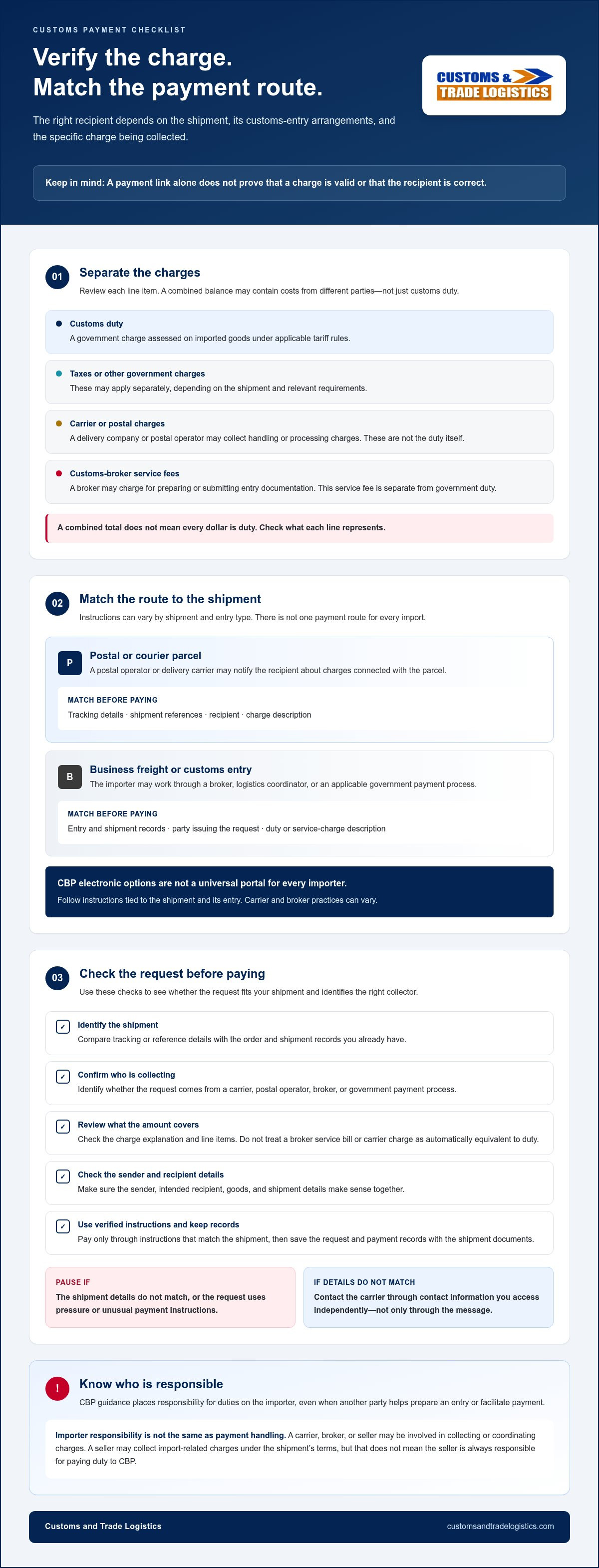
How to pay customs duties online safely: a practical checklist
A careful payment process protects your funds and import records. Before paying, connect the request to the shipment, identify what the amount covers, and confirm that the payment route comes from a source responsible for that transaction. Current CBP guidance describes online options such as Pay.gov and ACH for applicable payments, but the right method depends on the bill and payment arrangement. Follow current instructions from the verified carrier, broker, or government process rather than assuming one option fits every import.
Before submitting payment
Work through these steps in order. If a detail doesn’t match or the collector is unclear, pause and verify through an independently accessed official account or contact channel before submitting funds.
- Identify the shipment. Locate the parcel or freight shipment in your order, tracking, or entry records. Confirm that the notice refers to an import you’re expecting and that its status makes sense.
- Classify the request. Read the charge description and determine whether it refers to customs duty, another government charge, a carrier charge, or a broker’s service fee. Don’t assume a combined balance is entirely duty.
- Verify the collector. Identify who issued the request and who will receive payment. Check that the named carrier, broker, or government process is connected to the shipment or entry.
- Review the amount and references. Compare the requested amount and its explanation with the invoice or entry information available to you. Check that tracking, entry, and recipient details align.
- Pay through verified instructions. Access the relevant carrier, broker, or government account independently, then follow its current instructions. For CBP payments, verify current guidance for the applicable payment type rather than relying on an old bookmark or a link in an unexpected message.
- Save the evidence. Keep the payment confirmation and transaction reference with the original notice, invoice, entry or tracking reference, charge breakdown, and related correspondence.
For business importers, a repeatable process helps staff handle requests consistently. Keep the shipment reference and charge explanation with the payment record so someone reviewing the file later can see what was paid, to whom, and why. This makes reconciliation easier if an invoice, entry record, or payment status needs follow-up.
After paying: keep a clear import record
Save records together in a shipment folder or another organized system. Include the payment notice, invoice, entry or tracking reference, receipt, and relevant messages. Use the verified carrier or logistics channel for shipment updates, not an unsolicited link. If the payment status remains unclear, contact the responsible organization using a route you accessed independently, and provide the transaction reference and shipment details.
These checks make paying customs duties online more manageable, especially when several documents or parties are involved. For business shipments, customs clearance support can help coordinate customs-entry preparation and import logistics.
When business importers benefit from customs payment and entry support
For a business importing regularly, each payment question can connect to a larger set of moving parts: supplier paperwork, shipment details, customs-entry documents, freight coordination, and final delivery. Keeping those pieces aligned takes time, especially when records arrive from different parties or a charge breakdown doesn’t clearly show what it covers. Support with entry preparation and import coordination can make the process easier to follow while keeping the importer informed about the shipment and its charges.
This can be especially useful when a small business moves from occasional orders to recurring imports, or when staff must reconcile several shipments at once. Instead of treating each notice as a standalone task, connect the entry documents, shipment records, and payment correspondence. That context can help identify missing paperwork or unclear charge descriptions before they lead to more administrative back-and-forth.
What a customs broker can coordinate for an importer
A customs broker can help prepare and submit customs-entry documentation using the information provided for the shipment. The broker can also coordinate import steps with freight movement and delivery logistics, helping the business keep key records and responsibilities connected. This is process support, not a promise of a particular duty amount, clearance timing, or shipment release. The importer should still review the information and understand the charges associated with its entry.
That coordination is valuable when a payment question depends on understanding the entry behind it. A well-organized file can help distinguish government charges from service invoices and connect each request to the correct shipment. It also gives the business a clearer view of what has been prepared, what has been submitted, and which records to retain as part of its import documentation.
A practical next step for small-business importers
Start by organizing the documents you already have. Keep supplier invoices and product details together with shipment notices, customs-entry records, payment requests, and receipts. Use a consistent file name or folder structure tied to the shipment reference, so your team can locate relevant details without sorting through unrelated messages. When paying customs duties online, that record trail makes it easier to connect a payment confirmation to the charge and shipment it belongs to.
Customs and Trade Logistics is a family-owned customs brokerage and logistics consulting firm with more than 35 years of industry experience supporting small and medium-sized businesses. Its customs clearance and international freight coordination services help businesses manage entry preparation alongside the broader import process.
Make payment checks part of your import workflow
Turn careful payment handling into a repeatable part of your importing process. Assign responsibility for matching requests to shipment records, saving receipts, and flagging unclear charges. That habit gives your team a clearer record to use when reviewing import expenses or resolving a payment question later.
As your shipments grow, keep customs paperwork, freight movement, and delivery planning connected rather than treating each payment notice as a separate task. A coordinated process can help your business manage the administrative work around imports, while leaving duty assessments and release decisions to the applicable customs process.
If payment questions are becoming part of a larger coordination challenge, talk with Customs and Trade Logistics about customs clearance and import coordination. The family-owned firm supports business imports with customs clearance and international freight coordination across U.S. ports. Take the next step toward a clearer import process by getting in touch.
Frequently Asked Questions
Can I pay U.S. customs duties online?
Yes, U.S. customs duties can be paid electronically when the instructions for the shipment or entry provide an online route. For a parcel, start with the delivery provider’s shipment page. For a commercial import, follow the applicable broker or government payment instructions. The channel depends on how the entry and payment are arranged. When paying customs duties online, avoid using a generic payment page that isn’t connected to a verified shipment or account.
Who is responsible for paying customs duties on an imported purchase?
CBP guidance places responsibility for duty payment on the importer, even if the seller arranged shipping. Check the purchase terms, commercial invoice, and import paperwork to understand whether the seller collected import costs in advance or whether a separate request is expected. A carrier’s request may include its own handling or collection charges. Review each line item to distinguish those costs from government duty.
How can I tell if a customs duty payment link is legitimate?
Compare the request with an import you expect, including its recipient, goods, and shipment or entry reference. Then access the carrier’s or relevant government account independently instead of relying on an unsolicited link. A familiar logo or polished page isn’t enough to establish that a request is genuine. If the message demands unusual payment, creates unexplained urgency, or includes mismatched details, pause and verify it through the organization’s official contact route.
What happens if I do not pay a customs charge online?
The shipment may be handled according to the applicable carrier or customs process, but the next steps depend on the shipment and provider. Don’t assume a standard deadline, storage charge, or return outcome based only on a message. Review the verified notice and contact the responsible organization using contact information you obtained independently. Keep a copy of the notice and any response so you can follow up with the shipment details at hand.
Are customs duties and customs broker fees the same?
No. Customs duty is a government import charge, while a broker’s fee pays for professional work such as preparing or submitting entry documentation. A carrier may also charge for handling or collecting a payment. For example, an invoice could show a broker service charge separately from a duty amount. If the description is unclear, review an itemized breakdown before recording the expense or submitting payment.
Do small businesses pay customs duties differently from individual shoppers?
Duty treatment depends on the imported goods and applicable rules, not simply on whether the importer is a business or an individual. The paperwork and coordination can differ, though. A business receiving commercial freight may need to manage supplier documents, entry records, and shipment-level accounting across multiple imports. Keep each payment request tied to its entry and supporting documents so government charges aren’t mixed with broker or logistics service expenses.
What records should I keep after paying customs duties online?
Keep the payment notice, charge breakdown, receipt, transaction reference, and shipment or entry documents together. For a business import, match them to the supplier invoice and the correct shipment file, then use your normal accounting process to record the transaction. This makes it easier to reconcile a payment later or answer a question about which import it covered. Save related correspondence too, especially if the payment status needed clarification.