

What if the biggest risk in a temporary U.S. import isn’t getting the goods through the port, but failing to close the bond afterward? When you’re using a temporary importation bond (TIB), entry is only the first step. Your goods must qualify for a TIB and be exported or otherwise handled as authorized within the approved timeframe.
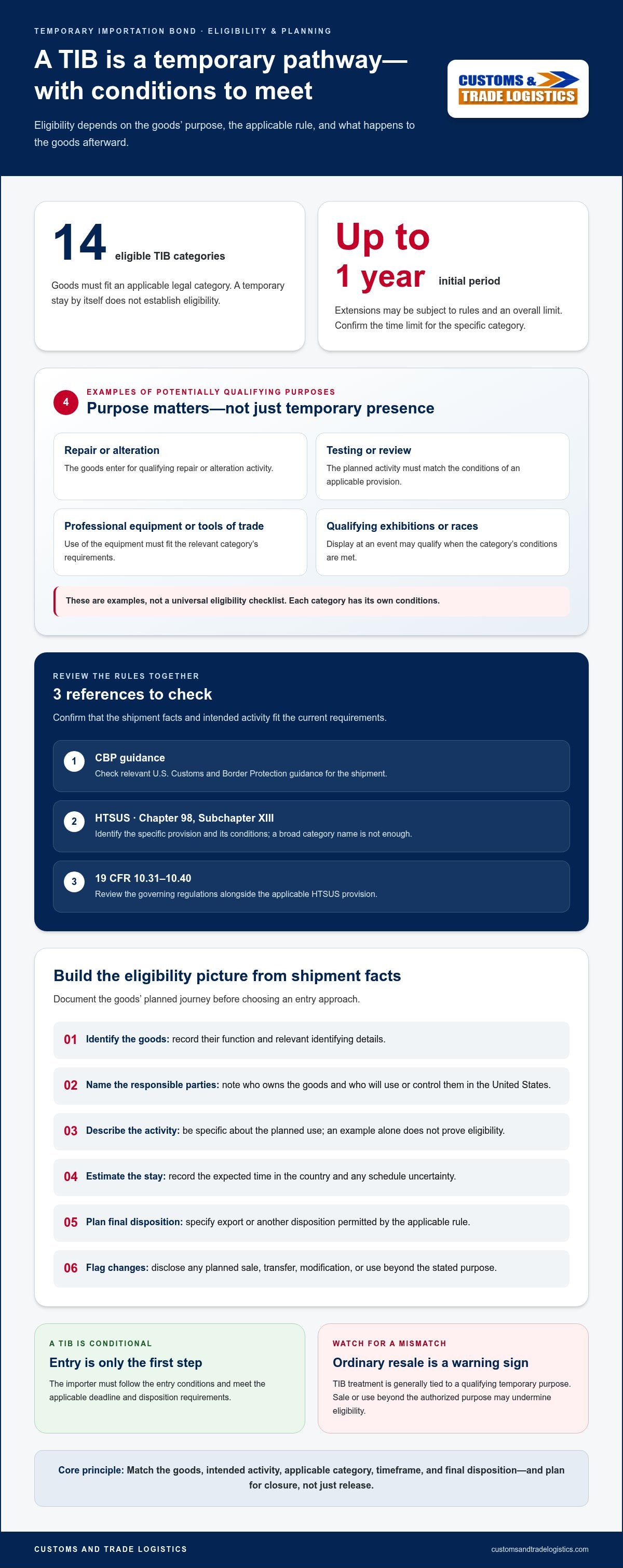
It’s understandable to focus first on whether a TIB can help you avoid paying duties upfront. But eligibility, deadlines, bond obligations, and proof of final disposition all matter. A TIB generally covers goods in one of 14 eligible categories. The initial period can be up to one year, with extensions subject to rules and an overall limit. Closure isn’t automatic, so plan the shipment’s full journey to reduce the risk of costly compliance problems.
This guide explains how to assess whether a TIB fits your shipment, prepare for entry, track key deadlines, and manage closure. You’ll also learn how customs-entry coordination and organized logistics can support the process. Customs and Trade Logistics brings more than 35 years of experience helping businesses coordinate customs paperwork and shipment milestones, from entry planning through delivery.
Key Takeaways
- Match the goods’ intended activity and final disposition to the applicable TIB category before planning the entry.
- Using a temporary importation bond (TIB) makes sense only when the shipment’s purpose and planned handling meet the applicable requirements.
- Compare a TIB with an ordinary consumption entry based on the shipment’s purpose and obligations, not an assumption about which approach costs less.
- Set clear responsibilities for entry paperwork, shipment milestones, and disposition records so the importer can manage the process through closure.
What using a Temporary Importation Bond (TIB) means for a US importer
Featured-snippet definition: A Temporary Importation Under Bond (TIB) is a customs entry option that allows eligible goods to enter the United States temporarily without payment of duties, provided the importer follows the applicable conditions and exports or otherwise disposes of the goods as authorized within the required time.
That relief is conditional, not a blanket exemption. A TIB is for goods entering for a qualifying temporary purpose, not merchandise imported for ordinary sale in the United States. If the shipment’s use or final disposition doesn’t meet the applicable requirements, the importer may owe duties and face bond-related consequences. The details depend on the goods, entry facts, and relevant customs rules.
In practice, using a temporary importation bond (TIB) means planning for the goods’ entire stay in the country, not just arranging their release at the port. The importer needs a clear account of why the goods are entering, how they’ll be used, and what will happen to them afterward. Entry paperwork and shipment plans should reflect that intended path.
What role does the bond play?
The bond provides a financial commitment supporting compliance with the terms of the entry. It assures customs that the importer will meet the conditions attached to the temporary import, including applicable deadlines and disposition requirements. Bond requirements depend on the governing rules and shipment circumstances, so there isn’t one amount or approach for every TIB. The importer remains responsible even when a broker helps coordinate the entry.
When might a temporary import be considered?
Eligibility is tied to specific legal categories, not simply to the fact that goods are “only here temporarily.” The relevant provisions appear in Chapter 98, Subchapter XIII of the Harmonized Tariff Schedule of the United States (HTSUS), with TIB regulations in 19 CFR 10.31-10.40. The intended use and entry facts matter, so confirm that the goods and activity fit an applicable provision before planning around TIB treatment.
Examples of potentially qualifying purposes under relevant provisions include:
- Repair or alteration of goods.
- Testing or review of articles.
- Use of professional equipment or tools of trade.
- Display at qualifying exhibitions or races.
These examples aren’t a universal eligibility checklist. Each category has its own conditions, and similar goods may receive different treatment depending on their purpose and handling. For broader context on entry steps and customs paperwork, see the US customs clearance guide.
Before shipment, write down the planned activity, expected duration, and intended disposition. This information helps align entry details and logistics milestones with the goods’ actual use. A customs broker can assist with entry coordination, but the importer must understand the conditions and remains accountable for meeting them.
Check TIB eligibility, intended use, and the applicable US customs rules
Start with the shipment’s facts, not the assumption that a temporary stay automatically qualifies. TIB eligibility depends on whether the goods and planned activity fit a specific legal category and whether the entry details support that treatment. Document the goods, their ownership, intended use, expected time in the United States, and planned final disposition to create a practical basis for reviewing the rules.
How to assess whether the shipment may qualify
Before choosing an entry approach, assemble the information that explains the shipment’s purpose and path. Be specific: “equipment for a demonstration” is more useful than “temporary use,” but the exact activity still needs to match an eligible provision.
- Identify the goods, including their function and relevant identifying details.
- Describe who owns them and who will use or control them in the United States.
- Explain the planned activity, such as repair, testing, or display, without assuming that an example alone establishes eligibility.
- Estimate how long the goods will remain in the country and note any schedule uncertainty.
- State what will happen when the activity ends, such as export or another disposition permitted by the applicable rule.
- Flag any planned sale, transfer, modification, or use beyond the stated purpose.
Next, compare those facts with the current Harmonized Tariff Schedule of the United States (HTSUS) provision that may apply. TIB classifications appear in Chapter 98, Subchapter XIII, but the precise heading and its conditions matter. Check the current text and relevant U.S. Customs and Border Protection (CBP) guidance rather than relying on a broad category name or an old checklist. If the facts don’t fit cleanly, treat the case as an edge case for professional review before filing.
Which rules and entry details need checking?
Use three references together: CBP guidance, the applicable HTSUS provision, and the governing regulations in 19 CFR 10.31-10.40. Confirm the requirements for the specific category, including permitted use, the applicable time limit, whether an extension may be available, and which final dispositions are allowed. Don’t assume a deadline or procedure for one category applies to another.
Ordinary resale is a key warning sign. TIB treatment is generally tied to a qualifying temporary purpose, so importing goods for sale in the United States, or using them beyond the authorized purpose, may undermine eligibility or require a different entry approach. A change in plans after arrival also needs prompt review. Don’t assume the original entry terms automatically cover a new use or disposition.
Entry details should tell a consistent story. The commercial documents, goods description, stated purpose, and shipment plan should align. For a broader view of how entry paperwork fits into customs processing, review the US customs entry guide. Customs brokerage support can help organize entry paperwork and shipment milestones around the intended activity. For import preparation, coordinate your customs entry planning before the shipment moves.
TIB versus other import approaches: choose by purpose, not assumption
A shipment’s temporary arrival doesn’t automatically make it eligible for a TIB. The right approach depends on what the goods will do in the United States, whether they’ll enter ordinary commerce, and how they’ll leave or otherwise be handled. Compare the available paths against the actual shipment plan, not just the expected length of stay. The table below is a starting point; the governing rules and entry details determine the right treatment.
| Approach | Purpose and intended use | Disposition | Compliance responsibility |
|---|---|---|---|
| Temporary Importation Under Bond (TIB) | For goods that fit an eligible temporary-import category and its conditions. | The importer must meet the applicable requirements for export or other authorized disposition. | The importer remains responsible for the entry conditions, deadlines, and required closure. |
| Ordinary consumption entry | For goods entering U.S. commerce, including merchandise intended for ordinary sale or use. | Goods are entered for domestic commerce rather than under a temporary-use commitment. | The importer must meet the requirements for the applicable consumption entry. |
| ATA Carnet | A separate document for certain temporary-admission situations, including some international itineraries. | Goods must follow the carnet’s terms and applicable temporary-admission procedures. | The holder must manage the document and comply with the requirements that apply in each relevant jurisdiction. |
When does a TIB differ from ordinary consumption entry?
A TIB is built around an eligible temporary purpose and a required disposition. A consumption entry, by contrast, is generally used when goods enter U.S. commerce rather than under temporary-use conditions. The distinction isn’t simply how long the shipment will stay. Intended use, eligibility, and what happens to the goods next all matter.
For example, goods brought in for an authorized temporary activity may warrant a TIB review, while goods imported for resale point toward ordinary entry. Neither route is universally less expensive. Duties and other obligations depend on the applicable rules and facts, so don’t choose based on an assumed cost advantage.
How does a TIB differ from an ATA Carnet?
An ATA Carnet is a distinct international customs document, not another name for a TIB. It can support temporary admission of certain goods across multiple countries, while TIB treatment is tied to U.S. customs requirements and eligible categories. A carnet may suit some shipments, but its coverage and procedures differ. It isn’t interchangeable with a TIB or automatically available for every item.
Before deciding, match the goods, planned activity, destination itinerary, and final disposition to the current rules for each instrument. If the shipment’s purpose changes, or its route includes more than one country, revisit the choice before dispatch. Using a temporary importation bond (TIB) is appropriate only when the shipment’s facts fit the applicable U.S. requirements and the importer can manage the obligations through final disposition.
How to manage a TIB from entry filing through final disposition
Using a temporary importation bond (TIB) calls for coordinated planning from the first eligibility review to the final record showing what happened to the goods. The importer of record remains accountable for meeting the entry conditions, even when a customs broker prepares or files entry information. A broker can help organize customs paperwork, while logistics coordination keeps transport plans and shipment milestones aligned with the goods’ permitted use.
- Review eligibility and purpose. Match the goods and planned activity to the applicable TIB category. Define the intended use, expected time in the United States, and anticipated disposition before selecting the entry approach.
- Prepare the entry information. Assemble an accurate product description, value, country of origin, intended-use details, and supporting shipment documents. Align the information with the broker and transport schedule before arrival. Organize customs paperwork for small businesses so entry details and shipping records tell a consistent story.
- Confirm current filing requirements. Check the applicable entry type, filing codes, forms, bond requirements, and CBP procedures for the specific category. Requirements can vary, so don’t reuse a prior shipment’s paperwork without checking that it still applies.
- Track the authorized period. Record the entry date and deadline in a shared shipment file, then assign someone to monitor reminders and changes to the use or schedule. CBP allows an initial TIB period of up to one year; extensions may be granted in one-year increments, subject to a maximum of three years from importation. An extension application using CBP Form 3173 must be filed before the current period expires, and extensions aren’t retroactive.
- Complete and document disposition. Keep evidence showing that the goods were exported or otherwise handled as authorized. Verify the current closure process for the entry. CBP’s electronic procedure calls for proof of export to be uploaded through the Document Imaging System (DIS) and a closure message to be sent through the relevant ACE module. Confirm that both required steps are complete rather than assuming the bond closes automatically.
Build a shipment file that supports closure
Keep the entry record, bond details, product and use information, deadline reminders, correspondence, and disposition evidence together. If the plan changes, record what changed and promptly review whether the existing terms still apply. A well-organized file helps the importer, broker, and logistics team work from the same timeline while keeping compliance responsibility clear.
Customs-entry coordination can help keep documentation and shipment milestones organized. Coordinate your customs entry and import logistics with Customs and Trade Logistics.
Get practical support using a Temporary Importation Bond
A well-planned temporary import starts with a clear purpose and ends with a documented disposition. Before moving forward, define what the goods will do in the United States, review whether an applicable TIB category may fit, organize entry information, and plan how to monitor the authorized period and final disposition. These steps turn a complicated process into a series of manageable decisions.
What to prepare before planning a temporary import
Gather details that explain both the goods and their journey. A focused file gives customs-entry planning an accurate starting point and makes it easier to identify questions that need attention before shipment.
- Product descriptions, identifying details, value, and country of origin.
- The goods’ owner, intended activity, and expected duration in the United States.
- The planned disposition after the activity, such as export or another authorized outcome.
- Supplier paperwork and transport details relevant to customs entry and shipment coordination.
- Unresolved questions about classification, eligibility, filing requirements, or schedule changes.
Raise uncertainties before building a shipping plan around an assumption. For instance, if the intended use could involve a sale, transfer, or activity beyond the original plan, flag that detail for review. This helps clarify which questions need an authoritative answer and what information the entry process will require.
Coordinate customs entry and shipment logistics
Entry paperwork and freight planning work best when they follow the same shipment plan. Customs brokerage support can help organize entry information and coordinate documentation with transport milestones, while logistics coordination keeps arrival and delivery arrangements aligned. The importer remains responsible for the accuracy of the information and compliance with applicable conditions. Support helps organize the process, but doesn’t guarantee TIB eligibility or a particular customs outcome.
Customs and Trade Logistics is a family-owned customs brokerage and logistics consulting firm with more than 35 years of industry experience. The firm provides practical support with customs paperwork, import logistics, and international freight coordination. Keep the shipment’s intended use, anticipated timing, and disposition information connected to the entry file so everyone involved can work from a consistent picture.
If you’re preparing an import, using a temporary importation bond (TIB) should be one part of a broader entry and logistics plan. Define the use, gather shipment facts, identify open eligibility questions, and map milestones through final disposition. Discuss your import and customs clearance needs with Customs and Trade Logistics to coordinate entry paperwork and shipment planning.
Put your next temporary shipment on a clear path
Before confirming a shipment, decide who will own the timeline from arrival through final disposition. Allow time to resolve classification questions, align transport plans with entry preparation, and revisit the plan if the goods’ use or schedule changes. Early coordination helps your team make a deliberate choice about using a temporary importation bond (TIB), rather than treating it as a last-minute paperwork decision.
When customs requirements and freight milestones intersect, a coordinated plan can make the next steps easier to manage. Customs and Trade Logistics supports customs clearance and import logistics across US ports, helping businesses organize entry paperwork and shipment coordination around their needs.
Ready to plan an upcoming import? Discuss your import and customs clearance needs. Customs and Trade Logistics can help coordinate entry paperwork and shipment planning.
Frequently Asked Questions
What is a temporary importation bond, and how does it work?
A temporary importation bond is a customs bond used for eligible goods entering the United States temporarily under specific conditions. It supports the importer’s commitment to follow the applicable rules, including requirements for the goods’ use and final disposition. Using a temporary importation bond (TIB) doesn’t automatically remove every duty obligation; the conditions depend on the applicable category and entry facts. The importer remains accountable for meeting those terms.
Who can use a TIB to import goods into the United States?
An importer may use a TIB when the goods and planned activity meet the requirements of an eligible category. Eligibility depends on what the goods are, how they’ll be used, and what will happen to them afterward, not simply on who owns them or how briefly they’ll stay. Review the current HTSUS provisions and CBP requirements for the specific shipment before choosing this entry approach.
How long can goods remain in the United States under a TIB?
The general initial TIB period can be up to one year from importation. CBP may grant extensions in one-year increments, but the total period generally cannot exceed three years from the import date. Category-specific provisions and entry conditions may affect the applicable timeframe, so verify the rule for the goods in question. Track the deadline from the entry record, not an estimated arrival or project completion date.
Can goods imported under a TIB be sold in the United States?
Generally, a TIB is intended for qualifying temporary use, not ordinary domestic sale. A planned sale may conflict with the conditions of the applicable category and could mean the goods need a different entry approach. Don’t assume that a later sale is allowed simply because the goods first entered temporarily. Check the specific HTSUS provision and CBP requirements before changing the use, ownership, or disposition plan.
What happens if goods are not exported or otherwise properly accounted for?
If the importer doesn’t meet the required disposition conditions or deadline, CBP may take action under the bond, including assessing liquidated damages. The applicable consequences depend on the entry, bond terms, and circumstances; they shouldn’t be treated as automatic or identical for every shipment. Keep evidence of export or another permitted disposition, and confirm that the required closure steps are complete rather than assuming the entry closes on its own.
Can a TIB be extended?
Extensions may be available under the applicable rules, but they aren’t automatic. For a TIB extension, an application using CBP Form 3173 must be filed with the port director before the current bond period expires. CBP doesn’t grant extensions retroactively. Confirm the current procedure and category-specific requirements, then assign someone to track the deadline and retain the filing record with the shipment documents.
Is a TIB the same as an ATA Carnet?
No. A TIB and an ATA Carnet are distinct mechanisms for certain temporary imports, with different eligibility rules, documents, and procedures. A carnet may be used for qualifying goods and itineraries involving multiple participating countries, while a TIB is governed by U.S. customs provisions. Neither option applies automatically to every temporary shipment. Compare the goods, intended activity, route, and required disposition against current rules before selecting an instrument.
What documents should an importer prepare for a TIB entry?
Prepare shipment and product details that support an accurate entry: a clear goods description, value, country of origin, supplier and transport documents, and information about intended use and expected duration. Include the planned disposition and any available records that can help establish what happens to the goods afterward. The exact documents depend on the entry and applicable category, so organize the file around current CBP requirements and the broker’s filing needs.