

What if the biggest EPA import mistake happens before a vehicle or engine ever reaches the port? The EPA requirements for vehicle and engine imports depend on what you’re bringing in and how it will be used. Start with accurate classification so you can identify the relevant compliance pathway before preparing the customs declaration.
If you’re unsure which rules apply, what paperwork to prepare, or how EPA steps fit into your shipment schedule, you’re not alone. Requirements vary by item and intended use, and incomplete or inaccurate declarations can complicate customs entry. This guide explains how to identify the relevant pathway, organize records, and coordinate compliance planning with shipping and entry steps.
You’ll find an overview of EPA forms for different vehicle and engine categories, possible exemptions, and the distinction between EPA compliance and customs clearance. You’ll also see how freight coordination and entry paperwork fit into the process without replacing EPA decisions. Customs and Trade Logistics helps importers coordinate customs paperwork, international freight, and delivery planning, bringing more than 35 years of experience in customs clearance and international freight logistics.
Key Takeaways
- Classify the vehicle or engine and identify its intended use to determine which EPA compliance pathway may apply.
- Compare certification status, condition, and category before shipment. A foreign-market configuration may need a different review from a U.S.-certified one.
- Prepare records and declarations that match the item and pathway, and verify current form instructions before completing paperwork.
- The EPA requirements for vehicle and engine imports are separate from customs-entry and freight steps, so plan for each responsibility together.
- Use a readiness sequence to organize compliance review, records, customs entry, and delivery planning before the shipment moves.
What EPA requirements apply to vehicle and engine imports?
Before arranging shipment, determine whether the item must meet U.S. emissions requirements and which declaration or supporting evidence applies. EPA import compliance involves meeting the emissions rules for the specific vehicle or engine and accurately declaring its status during import. The Clean Air Act (United States) provides the foundation for federal air-pollution controls, including requirements affecting vehicles and engines entering the country.
There isn’t one pathway for every import. The relevant requirements may depend on whether the item is a highway vehicle, motorcycle, heavy-duty engine, or nonroad engine, as well as its model year, emissions certification, condition, and intended use. A foreign-market vehicle, for example, may need a different review from one built and certified for the U.S. market. Modifications or an engine replacement can also affect which evidence matters.
EPA admissibility requirements address emissions compliance; CBP entry processing addresses the shipment’s customs entry. The agencies’ roles are related but not interchangeable. Completing customs-entry requirements does not, by itself, establish that an item satisfies EPA rules.
Which imports may fall under EPA rules?
Highway vehicles and motorcycles have different considerations from heavy-duty highway engines and nonroad engines. Equipment imported with an engine may therefore need review at the engine level, even if the equipment itself isn’t a road vehicle. Classify the item based on what it is, rather than relying on a broad description in a sales listing.
- Identify whether the import is a complete vehicle, motorcycle, engine, or equipment containing an engine.
- Record the model year, engine details, certification information, and condition.
- Describe the intended use, such as highway or nonroad operation, and note any changes from the original configuration.
Use those details to review current EPA regulations, exceptions, and declaration instructions for the relevant category. Coverage can differ, so don’t assume that a form or exemption for one type of import applies to another.
Why does compliance matter before shipment?
Unresolved compliance questions can disrupt more than paperwork. If the pathway or required evidence is unclear, preparing an accurate declaration and coordinating shipment timing with customs entry can become more difficult. Classifying the item and reviewing its emissions status before it moves gives the importer and logistics team a clearer basis for planning.
Importers remain responsible for truthful declarations and for retaining evidence that supports the information provided. Records may identify the vehicle or engine and document its certification, condition, or claimed exemption. The evidence required depends on the item and pathway, so verify current EPA requirements before shipping rather than treating a general checklist as a final determination. A customs broker can coordinate entry paperwork and freight steps, but brokerage alone doesn’t establish EPA compliance or guarantee admissibility.
How do vehicle type, condition, and intended use change EPA requirements?
Start with the item’s actual configuration, not just its name on an invoice. A passenger vehicle, motorcycle, heavy-duty highway engine, and nonroad engine can fall under different emissions rules and declaration pathways. Certification status, model year, modifications, and the reason for importing help determine which requirements to review.
Intended use and certification status can change the compliance path, even when two imports appear similar. A foreign-market vehicle, for example, may not have the same emissions configuration as a U.S.-certified model of the same make and year. The EPA’s official guide to importing vehicles and engines is a useful reference for category-specific instructions and current requirements.
| What to compare | Details to identify | Why it matters |
|---|---|---|
| Certification | U.S. emissions label, certification statement, and supporting manufacturer records | A U.S. certification claim can point to one pathway, but the claim and item details still need to match. |
| Condition | Original or modified configuration, including engine replacement | Changes can affect whether certification information or a potential exemption applies. |
| Category and model year | Highway vehicle, motorcycle, heavy-duty engine, or nonroad engine | Applicable standards and forms vary by category and may depend on model year. |
| Intended use | Highway operation, nonroad use, or a potentially qualifying special purpose | Use can affect which rules or limited exceptions require review. |
Is the vehicle or engine configured for U.S. emissions standards?
Look for emissions labels and gather manufacturer records that identify the model, engine, and certification status. These details help establish what the item claims to be, but a label alone shouldn’t be treated as independent proof of import eligibility. Compare the records with the actual configuration, then verify current EPA requirements for the product category and model year. A foreign-market vehicle may look nearly identical to a U.S. version yet have different emissions equipment or certification.
Do nonconforming imports or special uses follow another path?
If a vehicle doesn’t conform to applicable U.S. emissions requirements and no exemption fits, importation may require an EPA-certified Independent Commercial Importer (ICI) to modify it under the applicable process. This isn’t a substitute for checking eligibility before shipment. The ICI pathway has category-specific requirements, so establish whether it applies to the particular vehicle or engine.
Some exceptions are narrow and depend on facts such as age, original condition, engine configuration, or the importer’s circumstances. For example, a vehicle at least 21 years old and in its original, unmodified condition may generally qualify for an EPA emissions exemption; an engine replacement can change that analysis. Personal ownership or intended use alone doesn’t establish eligibility. Check current rules and evidence requirements before relying on an exception.
Once the compliance route is clearer, freight and customs-entry tasks can be coordinated around the relevant records. Customs and Trade Logistics supports customs paperwork and freight coordination, while emissions eligibility remains a separate EPA compliance question.
What EPA compliance pathways should importers compare?
After identifying the item’s category and configuration, compare possible compliance pathways before committing to shipment. The EPA requirements for vehicle and engine imports don’t point every item toward the same outcome. A U.S.-certified vehicle, a nonconforming vehicle, and an item that may qualify for an exemption each call for a different review of eligibility and supporting records.
- Potentially U.S.-certified import: Confirm that the specific vehicle or engine matches its U.S. emissions certification and gather records that support the claim.
- Potentially nonconforming import: Determine whether an applicable compliance route exists. Some nonconforming vehicles may require an EPA-certified Independent Commercial Importer (ICI) to modify them under EPA conditions.
- Potential exemption: Identify the exact exemption category and verify every eligibility condition and evidence requirement. Age, ownership, or intended use alone doesn’t establish eligibility.
These are starting points, not determinations. Compare the item’s details with current EPA criteria before deciding which declaration or process applies. Customs entry is a separate step. The U.S. Customs and Border Protection (CBP) vehicle import guide explains customs procedures and coordination with other federal requirements, but customs processing doesn’t establish emissions eligibility.
What does a U.S.-certified pathway generally involve?
Check the emissions label and manufacturer records against the item itself. Make, model, model year, and engine details, including engine family information where applicable, can help establish whether the certification covers the exact configuration being imported. A similar U.S. model isn’t enough if the foreign-market version differs. Verify current standards and required declarations for that category and model year, then retain records that substantiate the certification claim.
A label identifies a certification claim; it doesn’t independently prove import eligibility. For example, a vehicle may share a model name with a U.S. version but have a different engine or emissions equipment. Resolve any discrepancies between the documentation and physical configuration before choosing this pathway. The applicable evidence and declaration requirements depend on the item and current EPA instructions.
When might an ICI or exemption review be relevant?
If the item doesn’t meet applicable U.S. emissions requirements, investigate whether an authorized route is available before shipment. An ICI pathway may involve EPA-specific conditions, modifications, and procedures, so don’t treat it as a general workaround. An exemption is also limited to its stated category and eligibility criteria. Review the evidence required for the specific claim, including records of condition, configuration, or use where relevant.
Keep a clear decision trail: record the item’s identifying details, the pathway being considered, and the documents supporting that analysis. Verify current EPA conditions for the vehicle or engine before relying on a certification, ICI route, or exemption. Once the compliance route is understood, customs paperwork and freight coordination can be planned alongside it, without confusing entry processing with EPA emissions requirements.
Which EPA forms and records should importers prepare before shipping?
A complete file helps keep the EPA declaration, shipping documents, and customs-entry information aligned. The EPA requirements for vehicle and engine imports vary by category and compliance pathway, so don’t select a form based on the word “vehicle” alone. Confirm the item’s classification and applicable EPA instructions before preparing declarations or finalizing shipment paperwork.
How should importers assemble the compliance file?
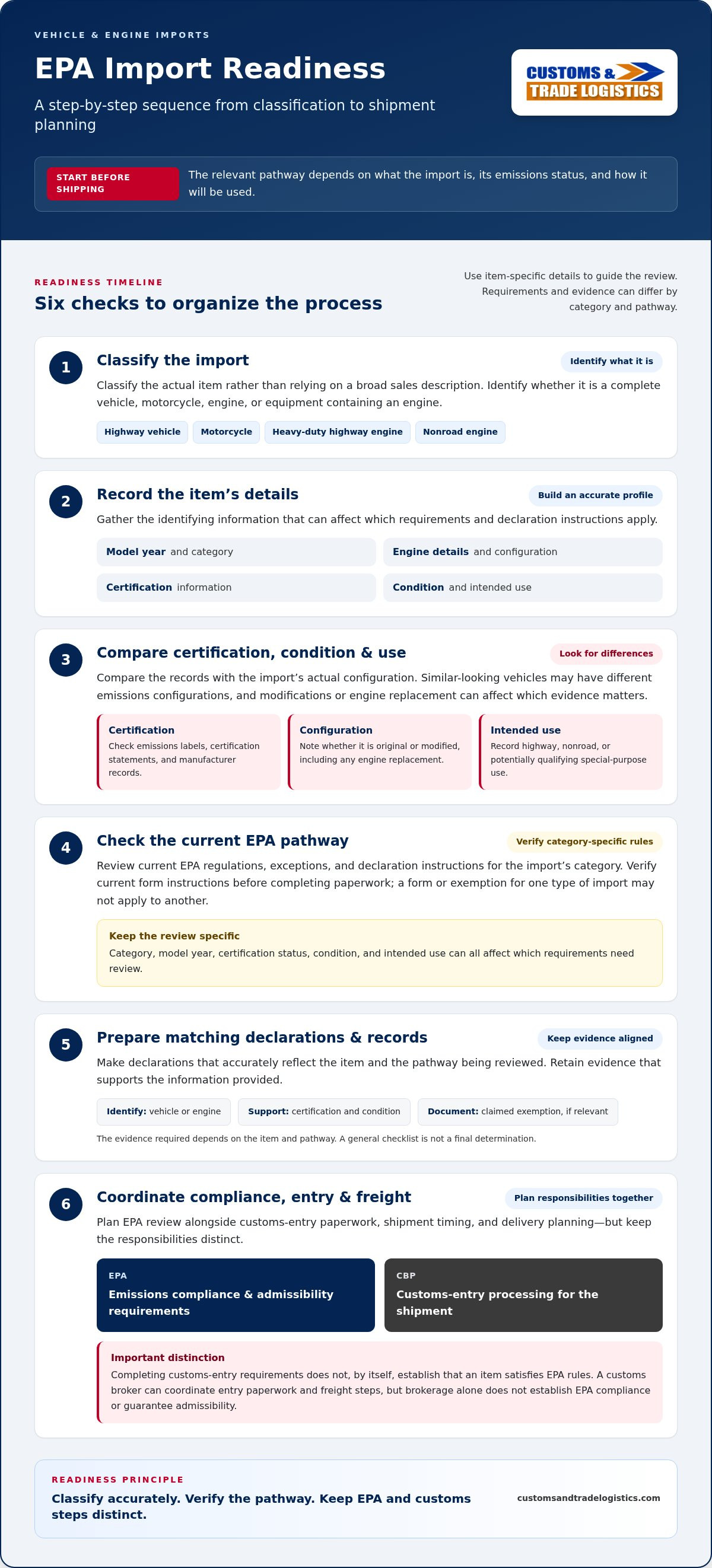
Build the file in sequence, checking each record against the item and the pathway under review. These steps help organize the work before shipment:
- Classify the import. Record whether it is a passenger vehicle, highway motorcycle, heavy-duty highway engine, or nonroad engine. Capture identifying details such as make, model, model year, engine information, and intended use.
- Document its condition and status. Gather available emissions labels, manufacturer records, and information about modifications or engine replacement. If considering an exemption, collect records relevant to its eligibility conditions.
- Match the EPA form to the category. EPA Form 3520-1 is used for passenger vehicles and highway motorcycles. EPA Form 3520-21 is used for heavy-duty highway engines and nonroad engines. These forms aren’t interchangeable, and their applicability depends on the item and declaration being made.
- Review current instructions and evidence requirements. The forms’ current versions were dated August 2024 in the information available for this guide. Before filing, verify the latest version, instructions, and supporting records required for the specific import.
- Reconcile all shipment documents. Compare descriptions, identification numbers, model details, quantities, and declared status across invoices, shipping records, EPA declarations, and customs-entry data. Resolve discrepancies before submitting the information.
Keep supporting records together so the declaration can be traced to the evidence behind it. A form by itself doesn’t establish that the item qualifies for a particular compliance pathway. The file should show which facts support the declaration and where the information came from.
How do EPA declarations connect with customs entry?
EPA declarations are part of the broader import-entry process, but they address emissions-related information and don’t replace customs-entry requirements. Information submitted to CBP must be accurate and consistent with the EPA declaration and its supporting documents. Verify current CBP and ACE procedures for submitting the applicable declaration at entry, since filing steps and requirements can vary.
Before the shipment moves, coordinate document review with the customs-entry and freight schedule. Customs brokerage and logistics coordination can help organize entry details and shipping steps. The importer remains responsible for accurate declarations and supporting evidence, while EPA compliance decisions remain distinct. Customs and Trade Logistics can help coordinate paperwork and logistics through import paperwork and logistics support.
How can importers coordinate EPA compliance, customs entry, and freight?
A well-planned import connects technical review with paperwork and shipment handoffs without treating them as one decision. EPA eligibility concerns emissions requirements; customs brokerage supports entry processing, and freight coordination manages cargo movement. Keeping these responsibilities distinct helps the importer see what’s settled, what remains open, and which documents need to be ready for each step.
Use this readiness sequence before cargo moves:
- Classify the item. Record its category, model year, condition, engine details, and intended use. Make sure supplier descriptions match the item being shipped.
- Verify the compliance route. Review the EPA requirements that apply to those specific details. Resolve open eligibility questions before treating the shipment as ready.
- Assemble the records. Gather applicable declarations and supporting evidence, then compare identifiers and descriptions across the file.
- Coordinate customs entry. Align entry information with the shipping documents and applicable EPA declaration. Verify current submission procedures for the entry.
- Plan delivery. Coordinate freight handoffs and destination delivery steps around the shipment and entry plan, while keeping unresolved agency requirements visible.
What should be settled before cargo moves?
Settle the basic facts first: what the item is, how it will be used, and which compliance pathway is being considered. Then compare descriptions, model details, and identifying numbers across supplier records, invoices, transport documents, and customs paperwork. For example, a mismatch between an invoice’s engine description and the supporting records can raise avoidable questions during document review. Address EPA questions early; an entry filing isn’t a substitute for resolving emissions compliance.
The EPA requirements for vehicle and engine imports should shape document preparation before shipment, not become a last-minute add-on. If a fact is unresolved, flag it clearly so the parties coordinating transport and entry don’t mistake an open compliance issue for a completed review.
How can a customs and logistics partner support the process?
A customs and logistics partner can organize paperwork, coordinate freight and shipping steps, support customs clearance, and plan delivery or redistribution. That coordination creates a clearer handoff between the importer, shipment documents, and entry process. It doesn’t replace the importer’s responsibility for accurate EPA declarations or establish emissions eligibility. Customs and Trade Logistics brings more than 35 years of industry experience to import coordination, helping manage practical steps while keeping agency responsibilities distinct.
For broader freight context, use an international shipping logistics guide alongside your item-specific compliance review. Customs and Trade Logistics can coordinate customs paperwork, freight movement, and delivery planning for your shipment. Coordinate your vehicle or engine import.
Set your import plan in motion with clarity
Your next step is to turn the compliance review into a practical shipment plan. Before cargo moves, make sure the information supporting your EPA pathway is consistent with the shipping and customs-entry paperwork. If a technical emissions question remains unresolved, address it separately rather than assuming customs filing will settle it.
Careful coordination can simplify each handoff, from document preparation and freight arrangements to customs entry and delivery planning. Customs and Trade Logistics is a family-owned customs brokerage and logistics consulting firm supporting importers across U.S. Customs ports. Its team can organize paperwork and logistics steps while keeping customs processing distinct from EPA compliance decisions.
For help planning the next steps, coordinate your import paperwork and freight with an experienced team. A clear plan for the EPA requirements for vehicle and engine imports can help you move forward with greater confidence and fewer preventable surprises.
Frequently Asked Questions
Do all vehicles and engines imported into the United States need EPA approval?
No, not every import follows the same EPA process or requires an individual approval. The EPA requirements for vehicle and engine imports depend on factors such as category, configuration, certification status, condition, and intended use. Some imports use a standard declaration process, while a nonconforming item or special-purpose import may need a different pathway. Don’t assume age or personal ownership removes requirements. Check the current rules for the exact item before shipment.
What EPA form is used to import a vehicle into the United States?
EPA Form 3520-1 is used for passenger vehicles and highway motorcycles, while Form 3520-21 applies to heavy-duty highway engines and nonroad engines. The right form depends on the item’s regulatory category, not simply the wording on an invoice. For example, equipment containing an engine may need an engine-focused review. Before completing a declaration, confirm the latest form version, instructions, and submission process for the specific import.
Can I import a non-U.S.-certified vehicle into the United States?
Possibly, but a non-U.S.-certified vehicle may need a different compliance route from a vehicle that matches applicable U.S. emissions certification. In some cases, an EPA-certified Independent Commercial Importer may be part of the process for a nonconforming vehicle. The route depends on the vehicle’s configuration and current EPA conditions. Don’t assume it can simply be modified after arrival; establish the applicable pathway and supporting evidence before arranging shipment.
How do I know whether an engine is subject to EPA import requirements?
Identify the engine’s application first, such as whether it’s intended for highway operation or nonroad equipment. Then collect details such as make, model, model year, configuration, and intended use. An invoice that describes an engine only in broad terms may not provide enough detail to determine its category. Compare its identifying information with current EPA rules and instructions, especially if it will be imported separately from the equipment it powers.
What happens if EPA paperwork is missing or inaccurate at import?
Missing, inconsistent, or incomplete information can prompt questions during import processing and complicate shipment planning while the issue is addressed. The appropriate response depends on what’s missing and the item’s compliance status. For example, resolve a discrepancy between an engine identifier on a declaration and the supporting records using accurate documentation, not an assumed correction. Follow current EPA and CBP procedures, and don’t treat customs filing as a fix for an emissions issue.
Does a customs broker certify that an imported vehicle meets EPA emissions standards?
No. A customs broker can support customs-entry paperwork and coordinate shipment steps, but that work doesn’t certify emissions compliance or determine whether an EPA pathway applies. The importer remains responsible for accurate declarations and supporting information. Keep technical records, such as certification evidence or documents supporting an exemption claim, available to substantiate the relevant details. Customs processing and EPA eligibility are connected parts of importing, but one doesn’t replace the other.
When should I check EPA requirements for an imported vehicle or engine?
Check before the supplier dispatches the shipment. That gives you time to clarify the item’s identity and intended use, gather manufacturer or certification records, and address pathway questions before documents and transport plans are finalized. For instance, if engine details on a product specification differ from the supplier’s invoice, resolve the discrepancy early. Then coordinate accurate descriptions across the records used for shipping and customs entry.