

What if the company that delivered your damaged freight isn’t the only party responsible? When you’re asking who is liable for cargo damage, the answer can depend on who handled the goods, which shipment leg was involved, and what the transport documents say. You may be unsure whether to notify the carrier, broker, seller, or insurer first.
Start by mapping the shipment’s route and preserving evidence: photographs, packaging, delivery records, and any notes on the bill of lading. Prompt notice matters, and deadlines vary by transport mode and contract. Waiting for responsibility to become obvious may put useful evidence or claim options at risk.
This guide explains who may be responsible at different points in a shipment, how carrier liability differs from cargo insurance, and what to do when damage or loss is discovered. It also covers how shipment documents and governing rules can affect a claim, and when legal advice may help. Clear records of each handoff make the next steps easier to organize, though they can’t guarantee a particular claim result.
Key Takeaways
- To determine who is liable for cargo damage, match each party’s role to the shipment leg and the documents governing that movement.
- A seller, carrier, broker, consignee, and insurer have different responsibilities. Whom to notify depends on what happened and what each party agreed to do.
- Review handoff records to narrow down where damage may have occurred and which transport arrangements apply.
- Before filing a claim, organize delivery records, photographs, and other evidence, then review the relevant contract and deadlines.
- Clear instructions about packaging, goods condition, and handoffs before dispatch make responsibility questions easier to assess later.
Who Is Liable for Cargo Damage? Start With Each Party’s Role
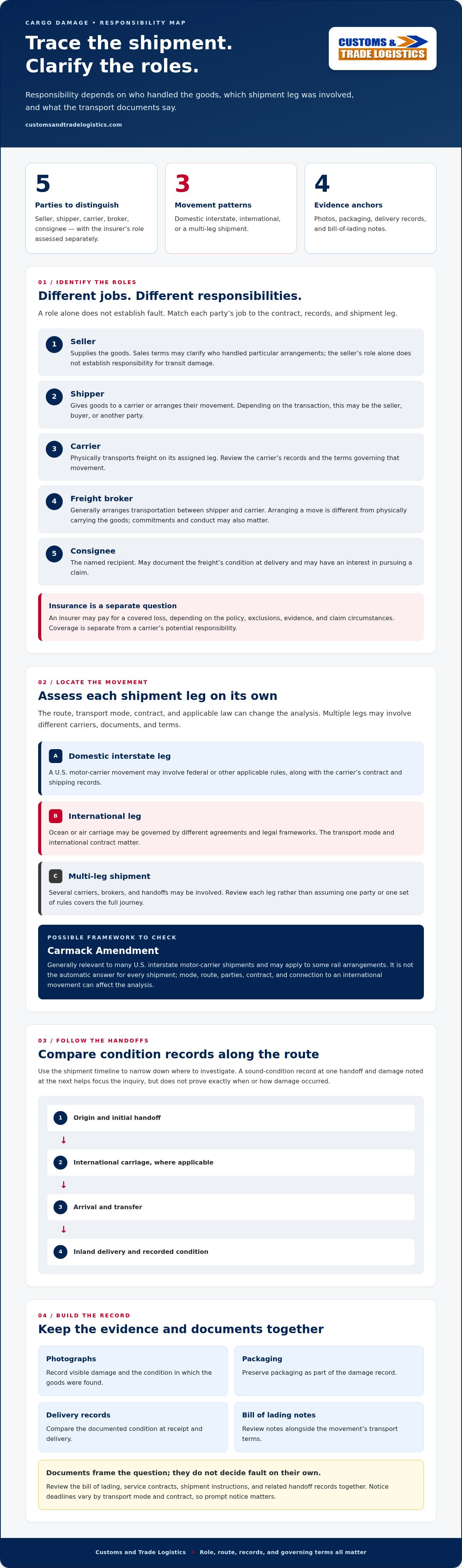
Responsibility for damaged freight depends on each party’s role, the contract, the transport leg where the damage occurred, and the law that applies. To determine who is liable for cargo damage, trace who sold, shipped, arranged, carried, received, or insured the goods, then review the records for each movement.
These roles can overlap, but they aren’t interchangeable. A seller may also act as the shipper, while a broker can arrange a carrier without physically transporting the freight. International shipments may pass through several carriers, so identifying each handoff helps narrow down where to look.
Carrier, broker, shipper, and insurer: who does what?
A carrier physically transports freight on its assigned leg. A freight broker generally arranges transportation between the shipper and a carrier. The broker’s actual commitments and conduct may also matter, so don’t assume every broker relationship is the same. Arranging a move is different from carrying the goods.
- Seller: Supplies the goods. The sales agreement and shipping terms may clarify who was responsible for particular arrangements, but the seller’s role alone doesn’t establish responsibility for transit damage.
- Shipper: Gives the goods to a carrier or arranges their movement. Depending on the transaction, this may be the seller, buyer, or another party.
- Consignee: The party named to receive the shipment. The consignee may document the freight’s condition at delivery and may have an interest in pursuing a claim.
- Insurer: May pay for a covered loss, depending on the policy, exclusions, evidence, and claim circumstances. Insurance coverage is separate from a carrier’s potential responsibility.
A freight claim is a request for recovery related to lost or damaged goods. The Freight claim overview provides additional context on claims and carrier liability, but it can’t determine what applies to a specific shipment.
Why the shipment’s documents matter
Review the bill of lading, service contracts, shipment instructions, and related records together. A bill of lading can record receipt of goods and the terms for a particular carriage. Contracts and instructions may show who arranged the move, what each party agreed to handle, and how responsibility was allocated.
The bill of lading and service contracts document the goods, agreed transport arrangements, and parties’ roles. They help frame which rules and obligations may apply to a damage claim. This is a starting point, not a finding of fault. Document names and terms vary by mode and transaction, and one file may not describe every stage of an international journey.
Compare the paperwork with the shipment timeline: who handed the goods over, which carrier took each leg, and where the condition was last recorded as sound. Keep copies of relevant records together. This role-and-handoff map helps you decide whom to notify, while the full facts and governing terms determine how responsibility should be assessed.
How Cargo Liability Changes Between Domestic and International Shipment Legs
An import rarely moves under one simple arrangement from seller to final destination. A shipment might leave a seller by truck, cross the ocean or fly by air, clear into the United States, then move inland with another carrier. If damage appears at delivery, identify not only who handled the shipment overall, but which party had the goods during the relevant leg and what terms governed that movement.
Treat each handoff as a point to investigate. Compare condition records and transport documents from origin, international carriage, arrival, and inland delivery. If goods were recorded as sound at one handoff but damaged at the next, that helps focus the inquiry, though it doesn’t prove exactly when or how the damage occurred. The answer to who is liable for cargo damage can depend on the route, mode, contracts, and applicable law.
Compare the shipment legs
Domestic interstate leg: A U.S. motor-carrier movement may involve federal or other applicable rules, along with the carrier’s contract and shipping records.
International leg: Ocean or air carriage may be governed by different agreements and legal frameworks. The transport mode and international contract matter.
Multi-leg shipment: Several carriers, brokers, and handoffs may be involved. Assess each leg separately rather than assuming one party or set of rules covers the entire journey.
When the Carmack Amendment may be relevant
The Carmack Amendment is generally relevant to many interstate motor-carrier shipments within the United States and may apply to some rail transportation arrangements. It isn’t the automatic answer for every shipment. The mode, route, parties, contract, and relationship to an international movement can affect the analysis. A qualified transportation attorney should verify its scope, exceptions, and current interpretation for the specific facts.
Why imports can involve more than one framework
Ocean, air, and inland carriers may each have different transport documents and contractual terms. For example, a shipment arriving by ocean and then moving by truck may require separate review of the ocean carriage documents and the inland carrier’s records. A broker’s role in arranging a leg is distinct from a carrier’s role in physically transporting it.
For imports from China, following the route and organizing records at each handoff can clarify which leg needs closer review. This import logistics guide for China shipments explains how the broader journey is coordinated. Customs and freight coordination can keep shipment information organized, but it doesn’t establish legal fault or guarantee a claim outcome.
Before deciding whom to hold responsible, line up the route, mode, handoff records, contracts, and delivery terms. Experienced international freight coordination can help importers organize shipment information across stages. For a legal determination, have qualified counsel review the complete documents and facts.
When Can a Broker, Carrier, or Shipper Be Responsible for Cargo Damage?
A damaged shipment doesn’t automatically point to one responsible party. A carrier may be accountable for loss or damage during its part of the journey, subject to governing rules, contract terms, and applicable defenses. The shipper’s actions and the broker’s commitments may also matter. To assess who is liable for cargo damage, focus on what happened, who agreed to do what, and what the records show.
Cargo liability depends on the evidence, shipment documents, applicable law, and each party’s role in the transaction. Match the damage to a point in the shipment timeline, then compare condition records, instructions, contracts, and communications. Crushed cartons, for instance, could raise questions about transit handling, but packaging condition and loading instructions may also be relevant. The appearance of damage alone doesn’t establish when it happened or who caused it.
When a carrier may not be responsible
Some legal frameworks recognize defenses that may affect a carrier’s responsibility. Examples can include damage connected to the shipper’s actions, the goods’ inherent characteristics, or an act of public authority. Other categories may apply under particular rules. These are general examples, not a complete legal test, and none automatically defeats a claim. Qualified transportation counsel should review the facts, contract, and applicable law.
Consider a shipment that arrives with moisture damage. The investigation may need to examine the packaging, the goods’ condition before dispatch, and handling records for the relevant leg. If records show the goods were already vulnerable or the packaging did not match the shipment instructions, those details may affect the analysis. Preserve the evidence rather than deciding fault from one clue.
When a broker’s role or contract may matter
A broker typically arranges transportation, while a carrier physically moves the goods. But labels alone don’t settle the question. Review the broker agreement, service commitments, shipment instructions, and transaction documents to understand what the broker undertook. If the broker agreed to a specific responsibility or its actual role went beyond arranging a carrier, those facts may matter. The answer is fact-specific, not a rule that brokers are always liable or never liable.
The shipper’s conduct can also become part of the inquiry. Relevant details may include who packed or loaded the freight, whether the goods’ condition was accurately described, and whether handling instructions were clear and followed. A consignee’s delivery notes and photographs can help establish what was observed on arrival. Earlier records may show the condition at dispatch or at a handoff.
- Compare the shipment timeline with condition records for each leg.
- Identify who controlled packing, loading, and handling instructions.
- Keep agreements and communications that clarify each party’s commitments.
- Ask qualified counsel to assess legal defenses and contractual terms before drawing conclusions.
Clear coordination and organized shipment information make handoffs easier to trace, though they can’t determine fault or guarantee recovery. Importers managing several parties may find international freight coordination useful for keeping logistics details together as a shipment moves.
What to Do When You Discover Cargo Damage
Damage at delivery can be stressful, especially if the shipment passed through several hands. First create a clear record, then notify relevant parties and check the terms and deadlines that apply. Acting promptly helps preserve useful information, but it doesn’t by itself establish who is liable for cargo damage.
Build a clear evidence file
Before cartons are moved, repaired, or discarded, document their condition as thoroughly as circumstances allow. If you must move goods to protect people or prevent further loss, photograph them first when practical and record what you changed.
- Record what you see. Photograph damaged goods, outer packaging, labels, seals, and the full shipment. Take close-ups and wider shots that show where the damage appears. Note missing cartons, broken seals, wet areas, crushed corners, or other visible issues without guessing at the cause.
- Write down the delivery details. Record the date, quantities received, visible condition, and the name of the person who accepted the shipment. If you find a shortage or damage at delivery, note it on the delivery receipt, bill of lading, or other delivery record when possible. Keep a copy of every notation and signed document.
- Preserve relevant materials. Set aside damaged packaging and packing materials where practical. Keep the bill of lading, delivery receipt, commercial invoice, packing details, shipment instructions, and correspondence together. These records help compare the shipment’s condition and contents across its journey.
For an import, customs paperwork is part of the broader shipment record, alongside transport and delivery documents. It can help organize transaction details, but it doesn’t by itself identify when damage occurred or establish responsibility. The US customs clearance services guide explains how import documentation fits into the clearance process.
Notify the right parties and protect applicable deadlines
Send prompt written notice to the carrier and other relevant shipment parties using the contact method stated in the transport documents or contract. Describe the shipment, delivery date, visible damage or shortage, and evidence you’ve preserved. Keep a copy of the message and any acknowledgment. Notice starts the communication trail. It isn’t a substitute for filing any required formal claim.
Deadlines differ by transport mode, contract, and applicable rules. Check the shipment documents for notice and claim procedures, and don’t assume one deadline applies to every leg. If the delivery record is signed without a damage notation, report the issue in writing as soon as you discover it and retain the original record. Avoid altering signed documents.
For a disputed claim, a high-value loss, or uncertainty about which agreement governs, ask qualified transportation counsel to review the documents and facts. Meanwhile, clear shipment coordination helps keep handoff and import records organized. Get support coordinating import logistics and shipment paperwork so the relevant information is easier to bring together.
How Importers Can Reduce Cargo-Damage Confusion Before Shipping
Before goods leave the seller, make the shipment’s condition, packaging responsibilities, transport arrangements, and handoffs easy to follow. Consistent records won’t prevent every loss or determine who is liable for cargo damage, but they can show what was agreed and help identify where a problem may have occurred.
Prepare shipment terms and records before dispatch
Bring the core shipment details together before dispatch, and check that they describe the same goods and arrangements. Mismatches between the invoice, packing details, transport records, and instructions can complicate efforts to understand what was shipped or who handled it.
- Record the goods’ condition. Keep a dated description and, where practical, photographs of the goods and their packaging before handoff. Note visible defects or special handling instructions rather than relying on memory later.
- Clarify packaging and loading responsibilities. Record which party packs, labels, secures, and loads the freight. If responsibility is shared, make the division clear in written instructions.
- Map the shipment stages. List the parties expected to handle the shipment from origin through international transport, arrival, and final delivery. Retain the transport records or handoff confirmations available for each stage.
- Keep the paperwork aligned. Check that commercial documents, packing information, transport records, and written instructions use consistent shipment details. Keep copies together so the file reflects the arrangements made before dispatch.
Review the relevant contract terms as part of preparation. Note what they say about responsibility, how to give notice, and which claim procedures may apply. Governing terms vary by route and transport mode, so don’t assume one set of instructions covers every leg. For legal questions or unclear allocations, qualified transportation counsel can assess the agreements and circumstances.
Use coordinated logistics support to clarify handoffs
An import can involve freight arrangements, customs paperwork, and delivery coordination across different stages. Keeping these details connected makes it easier to follow the shipment’s route and identify which records relate to each handoff. It also helps teams share consistent information when one party arranges transportation and another physically carries the goods.
Customs and Trade Logistics has more than 35 years of industry experience coordinating international freight, customs clearance, paperwork, and delivery redistribution. For importers managing multiple parties, organized logistics information can make the shipment’s sequence clearer. It does not decide legal liability or guarantee claim recovery.
Build a reliable record before the shipment moves, then keep it updated as arrangements change. Explore international freight logistics support to help coordinate freight and shipment information across the import journey.
Make Shipment Readiness Part of Your Routine
Before your next order moves, decide who will maintain the shipment record and how updates from each handoff will be added. A shared, organized file can help your team act quickly if goods arrive damaged, instead of piecing together details afterward. Make this process part of dispatch planning, not an emergency task.
If you’re still asking who is liable for cargo damage, a clear record gives you a stronger starting point for tracing what happened and reviewing the relevant terms. It won’t decide legal responsibility or guarantee recovery, but it can make the next steps more manageable. For complex imports, logistics support can help bring shipment information into one coordinated view.
Customs and Trade Logistics is a family-owned firm with over 35 years of industry experience, coordinating customs clearance, international freight logistics, paperwork, and delivery redistribution for importers. Explore international freight logistics support to plan a more coordinated path for your shipments. With clear records and the right support, you can move forward with greater confidence.
Frequently Asked Questions
Who is usually liable for cargo damage during interstate shipping?
For many interstate motor-carrier shipments, the carrier transporting the freight may be responsible for loss or damage, subject to applicable law, defenses, and agreed terms. The answer to who is liable for cargo damage still depends on the shipment facts. A written declared value or evidence of inadequate packing, for example, may affect a claim. Identify the carrier for the damaged leg and review the bill of lading and contract before deciding where to direct a formal claim.
Can a freight broker be held liable for damaged cargo?
Yes, a broker’s potential responsibility depends on the agreements and what it actually undertook, so neither “always liable” nor “never liable” is a safe assumption. If the broker arranged a carrier, that role differs from physically transporting freight. Review the broker-carrier arrangement, shipper-broker agreement, and communications for specific commitments. Written promises about handling or delivery arrangements may be relevant, but a lawyer should assess whether they create responsibility under the governing law.
Is the shipper responsible if cargo arrives damaged?
Not automatically. A shipper’s actions may be relevant if the evidence points to inadequate packaging, incorrect handling instructions, or a pre-existing condition that contributed to the damage. If a fragile item was packed without the protection required by the shipment instructions, for example, that may become part of the carrier’s defense or the broader claim review. Keep records showing who packed and loaded the goods, what instructions were provided, and the item’s condition before dispatch.
What should I do first when a shipment arrives damaged?
Document the condition before moving or disposing of anything: photograph the freight, packaging, labels, and seals, and record any missing quantities. If you’re accepting delivery, note visible damage or shortages on the delivery record when possible and keep a copy. Then send written notice through the contact process in the shipment documents. If damage is discovered only after unpacking, record when and how you found it, and preserve the packaging.
Does cargo insurance determine who is legally liable?
No. Cargo insurance and a carrier’s potential legal responsibility are separate questions. An insurer evaluates a claim under the policy’s coverage, conditions, and exclusions. A carrier’s responsibility depends on the applicable rules, contract, and evidence. A policy may provide a route to seek payment without deciding whether a carrier or another party caused the loss. Notify the insurer according to the policy and keep claim communications separate from correspondence with the carrier or broker.
How long do I have to file a cargo damage claim?
There’s no single deadline for every shipment. Under the Carmack Amendment, the written-claim period for covered interstate shipments must be at least nine months, and a lawsuit period must be at least two years from a written denial. Ocean and air shipments may follow different rules and contracts. Check the documents promptly and get legal advice on the applicable deadline, since notice, claim filing, and filing a lawsuit can be separate steps.
What documents help prove a cargo damage claim?
Useful records can include the bill of lading, delivery receipt, commercial invoice, packing list, photos, and written shipping instructions. Add carrier or broker correspondence, inspection reports, and records showing quantities shipped and received. A packing list compared with a signed delivery receipt may help clarify a shortage, while dated photographs can show visible damage. Keep original files and copies together, and record when each item was created or received to preserve a clear timeline.