

What if the hardest part of last-mile delivery for imported goods begins after customs release? Your shipment may be cleared, but it still needs a suitable transport arrangement, a ready receiving location, and a clear plan for the final handoff.
If you’re unsure who coordinates that next leg, or whether a container, truckload, or consolidated freight is the right fit, you’re not alone. Delivery can become stressful when paperwork, cargo readiness, and receiving arrangements fall out of sync. Planning these steps alongside customs clearance and international freight coordination helps connect release to the shipment’s final destination.
This guide explains how imported goods move from customs release to delivery, how common delivery options differ, and how to match an approach to shipment size, destination, and receiving needs. You’ll also find practical handoff details to align in advance, so you can identify gaps before cargo is ready to move. A coordinated process helps importers manage the transition with greater clarity, even without a large in-house logistics team.
Key Takeaways
- Last-mile delivery for imported goods starts when cargo is available for inland movement, not simply when customs releases it.
- Keep customs status, shipment documents, transport arrangements, and receiving details aligned before the handoff.
- Compare container transport, truckload, and consolidated freight based on shipment size, route, and receiving requirements.
- Use a readiness checklist to match delivery plans with inventory needs and customer commitments.
- Coordinating customs, freight, and delivery planning can help importers manage the journey without a large in-house logistics team.
What Last-Mile Delivery Means for Imported Goods
Last-mile delivery is the final planned movement of imported goods to the place they’re meant to be received. For an import, that leg begins when cargo is available for inland movement, not simply when a vessel or aircraft arrives or customs processing is underway. The destination might be a business location or another designated point in the shipment plan.
Import last-mile delivery is the final inland movement from the point where released cargo is available for pickup to its receiving destination. The starting point depends on the routing: cargo may move directly from an arrival point to its destination or travel inland before the final delivery leg. “Last mile” describes the final stage of a journey, not a fixed distance. The broader Last mile (transportation) overview explains how this stage fits into transportation and supply chains.
Where the Final Delivery Leg Begins in an Import Journey
An import journey has several connected stages. International freight brings cargo into the United States. Customs processing addresses required entry information and review. U.S. Customs and Border Protection (CBP) is the federal agency responsible for customs and border enforcement. Customs release is an important status, but it is separate from physical pickup: cargo also needs to be available for movement, and pickup and delivery arrangements need to be in place.
Once cargo is available for inland movement, domestic transportation carries it toward its destination. Depending on the route, the journey may include an intermediate stop before the final leg. The handoff point depends on the shipment’s routing and delivery arrangement. Align cargo status and documents with the transport plan and receiving location. Release alone doesn’t establish where the goods should go or whether the receiving party is ready.
Why the Import Handoff Matters to Small Businesses
When customs clearance and delivery planning are treated as separate tasks, gaps can emerge. One person may believe cargo is ready while another is waiting for pickup arrangements, paperwork, or destination details. If the receiving location isn’t prepared, the delivery plan may need to change. Clear responsibilities and shared shipment information help reduce confusion during this transition.
Smaller businesses may not have a dedicated logistics department to manage every handoff. Coordinating customs brokerage, freight movement, and delivery planning makes it easier to see what needs to happen next and who is responsible. For more detail on the clearance stage, see the customs clearance services guide. Knowing where clearance ends and delivery coordination begins gives importers a clearer starting point for planning the final leg.
How Imported Goods Move from Customs Release to Final Delivery
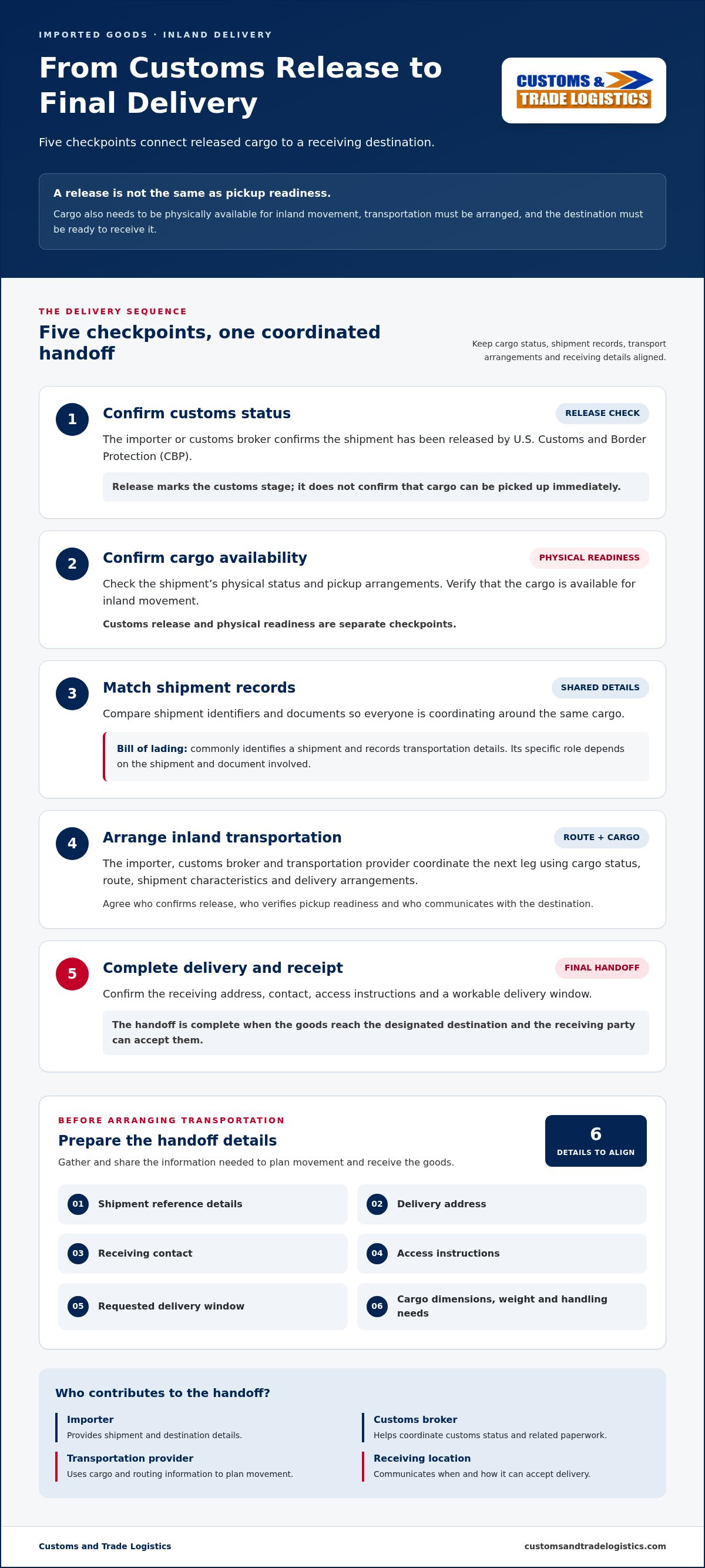
Customs release is an important milestone, but it isn’t the same as cargo pickup or completed delivery. The goods must be physically available, transportation must be arranged, and the destination must be ready to receive them. Following a clear sequence helps everyone understand what has happened and what still needs attention.
- Confirm the customs status. The importer or customs broker confirms that the shipment has been released by U.S. Customs and Border Protection (CBP). This indicates that the customs process has reached the release stage, but it doesn’t confirm that cargo can be picked up immediately.
- Confirm cargo availability. Check the shipment’s physical status and pickup arrangements. Cargo may still need to be made available for inland movement. Customs release and physical readiness are separate checkpoints.
- Match shipment records. Compare shipment identifiers and documents so everyone is coordinating around the same cargo. A bill of lading commonly identifies a shipment and records transportation details. Its specific role depends on the shipment and document involved.
- Arrange inland transportation. The importer, customs broker, and transportation provider coordinate the next leg based on cargo status, route, shipment characteristics, and delivery arrangements.
- Complete delivery and receipt. Confirm the receiving address, contact, access instructions, and a workable delivery window. The handoff is complete when the goods reach the designated destination and the receiving party can accept them.
The Main Handoffs After Customs Release
Each party contributes information to the handoff. The importer provides shipment and destination details. The customs broker helps coordinate customs status and related paperwork. The transportation provider uses cargo and routing information to plan movement, while the receiving location communicates when and how it can accept the delivery.
Clear ownership matters. If the importer assumes the broker has arranged pickup while the transportation provider is waiting for cargo availability, the next leg can stall. Agree in advance on who confirms release, who verifies pickup readiness, and who communicates with the destination.
What Importers Should Prepare Before the Delivery Leg
Before arranging transportation, gather shipment reference details, the delivery address, receiving contact, access instructions, and requested delivery window. Share cargo dimensions, weight, and handling needs as well. These details help determine how the goods can be moved and what the destination needs to receive them. Broader document preparation is covered in this import paperwork guide for small businesses.
Timing depends on cargo readiness, routing, carrier arrangements, and destination requirements, so release confirmation alone isn’t a reliable delivery schedule. From confirmed customs release to completed delivery, import cargo must be verified as available, matched to its documents, assigned inland transport, and received at a prepared destination.
Customs and Trade Logistics coordinates customs clearance, freight, and delivery planning to connect the release milestone with the next leg. Learn more about customs and delivery coordination.
Comparing Last-Mile Delivery Options for Imported Shipments
Which delivery arrangement fits your import? Start with the shipment’s dimensions and weight, then consider its route, delivery schedule, cargo readiness, and the receiving site’s capacity. The right choice depends on how these factors work together, not on shipment size alone.
Use this comparison as a planning guide for last-mile delivery for imported goods. Each option has different coordination needs, and the actual arrangement depends on the cargo and route.
| Option | Shipment fit | Coordination needs | Flexibility | Receiving requirements |
|---|---|---|---|---|
| Direct container transport | May fit cargo moving in its container when the delivery plan supports that approach. | Coordinate cargo availability, container movement, route, and destination readiness. | Moves the container as a unit, so planning depends on the full load and route. | Confirm access, space, and readiness to receive and unload the container. |
| Truckload | May suit a shipment that uses a full vehicle based on its size or configuration. | Align pickup timing, cargo details, route, and receiving arrangements. | Can be planned around one shipment’s destination and requirements. | Ensure the site can accept the load and has a clear unloading plan. |
| Consolidated freight | May work when the shipment doesn’t require a full vehicle. | Coordinate shared movement, shipment identification, and each delivery destination. | Can combine smaller shipments, though routing and handling involve coordination across loads. | Confirm each recipient’s address, availability, and receiving instructions. |
Direct Container Transport or Truckload
Direct container transport may fit when imported goods are moving together in a container and the planned route takes that unit to the receiving destination. Truckload may be a better fit for cargo arranged as a full-vehicle shipment. Neither is automatically the right choice. Compare dimensions, weight, cargo configuration, route, and schedule before choosing.
Plan for the destination as carefully as the pickup. Consider whether the site has suitable access and space, and whether there’s a workable unloading plan for the arriving cargo. If the receiving location can’t accept the load as arranged, the transport plan and delivery schedule may need to change.
Consolidated Freight and Redistribution
Consolidated freight combines shipments that don’t each need a full vehicle. It can suit smaller loads, but shared transportation requires clear shipment identification and coordination around routing and receiving details. If goods are intended for multiple destinations, redistribution helps organize which portion goes where and align each delivery with its receiving location.
APL Cargo has cited last-mile delivery as accounting for 53% of total shipping expenses. Treat that as a broad industry claim, not a universal estimate for an imported shipment: costs and cost shares vary with the shipment, route, and delivery arrangement. For an e-commerce-focused view of import delivery and redistribution, consider how the final destination and receiving plan shape the movement of goods.
How to Plan a Reliable Final Delivery for Imported Goods
A delivery plan works best when it reflects the shipment’s actual status and how your business will use the goods. Before arranging the final leg, check that the cargo, paperwork, transport plan, and receiving destination line up. This review helps your team spot gaps while there’s still time to coordinate the next step.
A Pre-Delivery Readiness Checklist
Use this checklist to confirm the main handoff details. The person responsible for coordination should be able to see what’s ready, what’s outstanding, and who can resolve an issue.
- Cargo status: Confirm customs release and separately verify that cargo is physically available for inland movement.
- Shipment documents: Make sure shipment references and paperwork correspond to the goods being picked up and delivered.
- Transport plan: Match the selected arrangement to the cargo’s dimensions, weight, handling needs, and route.
- Destination readiness: Confirm the address, access instructions, unloading arrangements, and ability to receive the load.
- Receiving contact: Share a reachable contact and the requested delivery window with the people coordinating the movement.
- Delivery points: Identify whether goods are going to one destination or need redistribution among multiple receiving locations.
These checks are connected. A receiving site may be ready for a partial shipment but not a full container, or a business may need goods divided among several destinations. Make the delivery plan fit the cargo and receiving setup rather than assuming that release means every part of the handoff is ready.
Planning for E-Commerce and Amazon Sellers
For an e-commerce business, delivery readiness affects more than transportation. It can influence when inventory is available for replenishment, promotions, and customer commitments. If a shipment is expected to supply more than one destination, account for the coordination needed to organize separate deliveries. Build the plan around confirmed cargo status and receiving arrangements for each destination, rather than treating an estimated arrival as inventory ready for use.
Amazon sellers can apply the same planning discipline when moving imported inventory toward a fulfillment destination. Receiving requirements can vary and may change, so don’t assume that a delivery plan or appointment process from a previous shipment still applies. Use the current instructions for the specific receiving destination and shipment. This Amazon seller import guide offers related context but doesn’t replace the requirements for a particular delivery.
If a delay arises, focus on the affected handoff. Confirm whether the issue is cargo availability, documentation, transport arrangements, or destination readiness. Then identify who owns the next action and share the updated plan with the other parties involved. Clear updates help your team adjust inventory plans and customer commitments without treating an uncertain delivery date as confirmed.
Customs and Trade Logistics coordinates customs, freight, and delivery planning for importers. Learn more about import delivery coordination.
Coordinate Imported-Goods Delivery with Customs and Trade Logistics
Customs release is one milestone in an import journey, not the end of the logistics work. The next steps still depend on cargo readiness, transport arrangements, paperwork, and a destination prepared to receive the shipment. Coordinating these pieces helps small and midsize businesses manage handoffs without organizing every stage across disconnected conversations.
Customs and Trade Logistics coordinates customs clearance, international freight, container transport, paperwork, delivery, and redistribution as part of the import process. This connects release information with the inland movement that follows. For businesses with a small operations team, a clearer picture of who is handling each step makes the process easier to manage.
When Coordinated Import Logistics Can Help
Importers often have to track customs paperwork, shipment status, pickup arrangements, and receiving instructions at once. When those details sit in separate conversations, it can be harder to know what’s ready and what still needs attention. Coordinating customs and freight planning connects clearance updates with transport arrangements while keeping delivery requirements in view.
This approach can help small and midsize businesses, including Amazon sellers, that don’t have a large in-house logistics team. It also supports importers planning to distribute goods to more than one receiving destination. Customs and Trade Logistics is family-owned and operated, with over 35 years of industry experience supporting importers across U.S. Customs ports. The focus is practical coordination, with attention to the shipment’s details and the business that depends on it.
Plan the Next Step for Your Shipment
A focused delivery plan starts with the details that shape the route and handoff. Prepare the shipment’s origin, cargo description and dimensions, current status, intended destination, and receiving requirements. If goods are going to multiple locations, outline how the shipment should be divided and where each portion needs to go. These details help connect customs paperwork, cargo readiness, transport planning, and delivery.
Customs and Trade Logistics works with importers across the United States, coordinating customs clearance and logistics from the import process through delivery and redistribution. For businesses planning last-mile delivery for imported goods, the team can help identify the next handoff, the information needed to plan it, and receiving details that could affect the arrangement. Sharing the actual cargo and destination details gives the planning process a useful starting point.
To discuss your shipment’s delivery needs, talk with Customs and Trade Logistics about your import delivery plan.
Make Your Next Import Handoff Easier to Plan
Bring the delivery plan into the import conversation early. Before cargo is ready to move, map how its arrival connects to inventory needs, receiving capacity, and any destinations that must be served. This gives your team time to identify open questions and coordinate the handoff before they become last-minute complications.
For last-mile delivery for imported goods, a clear understanding of the shipment’s origin, cargo, status, and intended destinations helps shape a practical plan. Customs and Trade Logistics brings a family-owned approach and more than 35 years of experience to import support, connecting customs, freight coordination, delivery, and redistribution for businesses across the United States.
Whether you’re arranging a first import or refining an existing process, you don’t have to map every moving part alone. Discuss your imported-goods delivery needs with Customs and Trade Logistics and take the next step toward a better-coordinated handoff.
Frequently Asked Questions
What is last-mile delivery for imported goods?
It’s the final planned movement of imported cargo to the business or other destination that will receive it. Unlike international freight, which brings goods into the country, this domestic leg focuses on getting available cargo to its intended recipient. For example, a shipment arriving in a container may need a separate inland transport plan before it reaches the importer’s facility or designated fulfillment destination.
Does last-mile delivery include customs clearance?
No. Customs clearance is a separate part of the import process that must be addressed before cargo can proceed through the planned delivery handoff. The two stages can still be coordinated: clearance information helps plan what follows, while inland delivery involves transport and receiving arrangements. Keeping the stages distinct avoids treating customs release as confirmation that pickup or final delivery has already been arranged.
What happens after imported goods are released by U.S. Customs?
After release, confirm that cargo is physically available and identify any remaining pickup steps. Then match the shipment to its transport plan and make sure the destination can receive it. For instance, if a shipment reference on the pickup paperwork doesn’t match the cargo details, resolve the discrepancy with the responsible parties before proceeding. Customs release is a status milestone, not proof that the goods have already been collected.
Can imported goods be delivered directly to an Amazon fulfillment center?
Yes, imported goods can be planned for direct delivery to an Amazon fulfillment destination if the shipment and receiving arrangements are set up for that destination. Amazon’s instructions can vary by shipment and may change, so use the current requirements for the specific delivery. Align the cargo plan, destination details, and any required receiving steps before arranging transport. Don’t assume a previous shipment’s process automatically applies again.
How do I choose between container delivery and consolidated freight?
Consider whether the cargo and destination suit moving a container as one load or sharing transport with other freight. Container delivery may fit a shipment planned to travel together in its container, provided the receiving site can accommodate it. Consolidated freight may suit a smaller shipment that doesn’t need a full vehicle. Compare the cargo’s dimensions, route, schedule, and receiving setup before selecting a plan.
What information is needed to arrange final delivery for imported cargo?
Prepare a shipment reference, cargo description, dimensions and weight, current cargo status, delivery address, receiving contact, and any access or unloading instructions. Include the requested delivery window and note whether the goods are headed to one destination or several. These details help connect the correct cargo with the right route and recipient. If handling needs or destination instructions have changed, share the update before transportation is planned.
Why can imported-goods delivery be delayed after customs release?
Release doesn’t always mean cargo is physically ready for pickup or that the next transport arrangement is complete. Delays can arise if cargo availability is unresolved, shipment details don’t align across paperwork, transport hasn’t been coordinated, or the destination can’t receive the load as planned. First identify which handoff is affected. Confirm the latest cargo status, then coordinate the next action with the party responsible for that step.