

Could your business recover some duties paid on imported goods if those goods are later exported, used in qualifying U.S. manufacturing, or otherwise meet drawback rules? If you’re asking what is a customs duty drawback, the short answer is that it’s a potential refund program, not an automatic credit. Eligibility depends on the transaction, the applicable rules, and the evidence connecting the import to what happened next.
It can be hard to know where to start. Import entries, production records, and export documents may be stored in different systems. Gaps between them can make a claim difficult to assess. A careful review helps establish whether a transaction may qualify and what records support it, without assuming a refund is guaranteed.
This 2026 U.S. guide explains the main drawback categories, the records that may matter, and why filing requirements deserve close attention. Customs and Trade Logistics is a Licensed U.S. Customs Broker with over 35 years of experience, offering drawback and duty refund assistance through its Customs Broker Services. A free consultation can help you understand the process and discuss a potential claim with care.
Key Takeaways
- Understanding what is a customs duty drawback starts with knowing it’s a potential refund under specific customs rules, not an automatic refund for every exported product.
- Compare manufacturing, unused merchandise, and rejected merchandise drawback to identify which category may fit the goods’ history.
- Importing and exporting alone don’t establish eligibility. The transaction relationship, applicable rules, and supporting evidence matter.
- Gather entry details, invoices, product information, production records, and export documents. Organize them before a formal claim is considered.
- Customs broker assistance can help organize records and navigate procedures, but it cannot guarantee eligibility or a refund.
What Is a Customs Duty Drawback, and Why Does It Exist?
If your business pays import duties on goods that later leave the United States, or on imported materials used in products that are exported, you may wonder whether those charges can be recovered. A customs duty drawback is a customs program that may refund certain import duties when a transaction meets applicable statutory conditions. It supports qualifying exports and U.S. manufacturing, but it doesn’t provide an automatic refund whenever an imported product is exported.
An export is only one part of the picture. The goods’ path, the drawback category, and the evidence connecting relevant transactions all affect whether a claim may be considered. For a broader historical overview and an explanation of the general claim flow, see Duty drawback on Wikipedia.
How does customs duty drawback work in principle?
Think of drawback as a possible link between an import and a qualifying later event. Depending on the category, that event might involve exporting imported goods, incorporating imported materials into a product that is later exported, or another qualifying circumstance under U.S. rules. The required connection differs by claim type, so assess the transaction under the category that may apply.
A claim is a documented request for drawback, not proof that a refund is assured. The business must support the relevant import and later activity with records, and the transaction must meet applicable requirements. In short, drawback may offer a route to recover eligible duties, but submitting a request alone doesn’t establish eligibility.
A possible drawback refund is not guaranteed. It depends on meeting the rules and supporting the claim with adequate documentation.
Which businesses may want to investigate drawback?
Businesses with import and export activity may have reason to review their transactions. For example, an importer might send eligible goods abroad without using them in the United States. A manufacturer might import components, use them in a finished product, and later export that product. These are situations to investigate, not proof that drawback applies.
Small and medium-sized businesses can review their activity too. Company size alone doesn’t determine whether a transaction qualifies. The goods’ movement, applicable rules, and available records are more relevant starting points. If you’re still mapping how imported goods enter your operations, understanding the customs clearance process can help clarify the import side of that history.
Start with a practical question: can your business connect import records to a later event that may qualify? A customs entry may identify what came in, while purchasing, production, and export records help show what happened afterward. If details are spread across teams or systems, list the relevant records and who manages them. Then identify the drawback category that may fit and the evidence needed to assess it.
What Are the Main Types of U.S. Customs Duty Drawback?
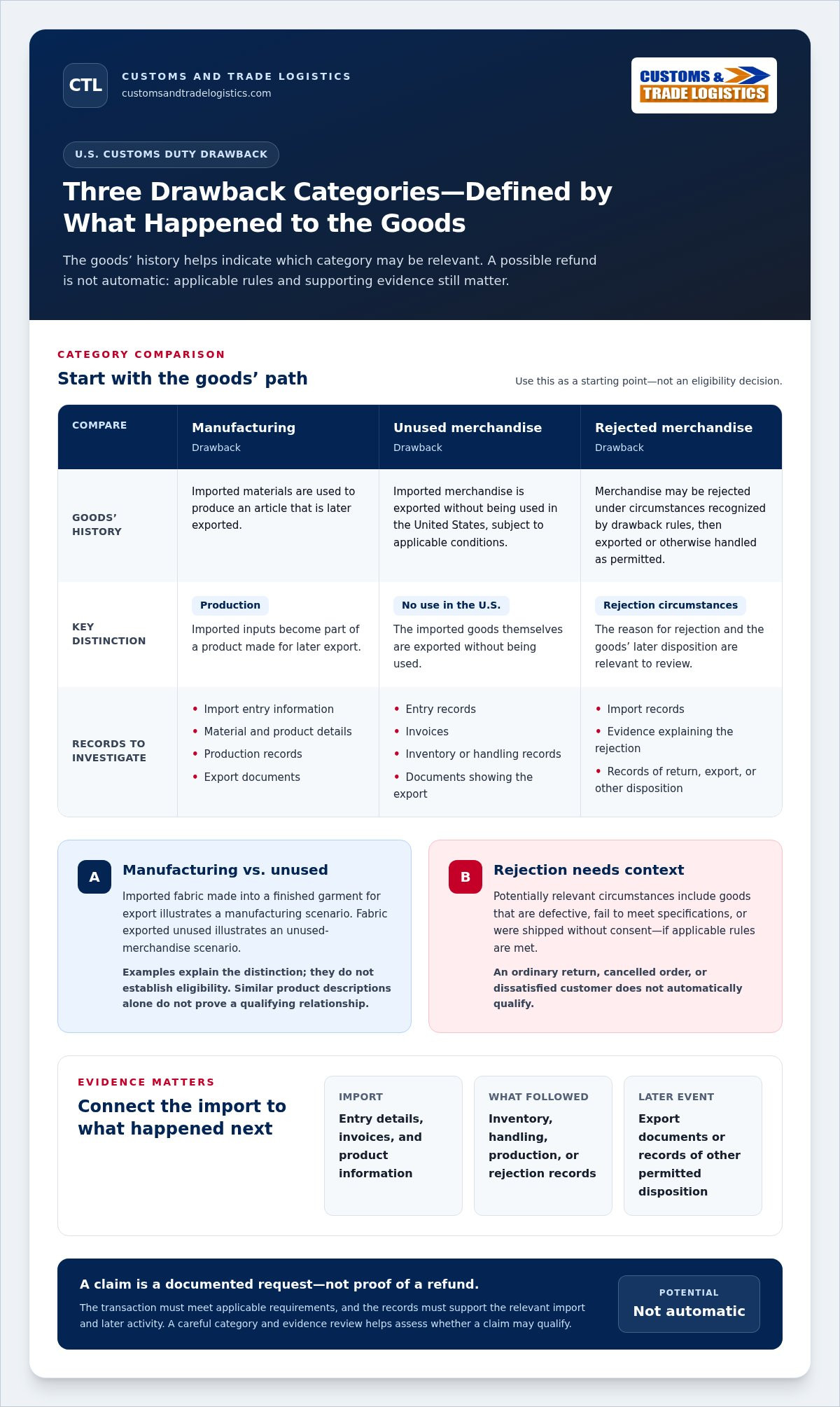
The right category depends on what happened to the imported goods after they entered the United States. Some transactions involve goods exported without use; others involve imported materials that become part of a product made here. Rejected merchandise follows a different path. Use this comparison as a starting point, not an eligibility decision. The rules and records for a specific claim still need careful review.
Drawback categories differ according to the goods’ history and disposition. To understand what is a customs duty drawback in practical terms, trace what was imported, how it was handled or changed, and what happened next.
| Category | What happens to the goods | Records to investigate |
|---|---|---|
| Manufacturing drawback | Imported materials are used to produce an article that is later exported. | Import entry information, material and product details, production records, and export documents. |
| Unused merchandise drawback | Imported merchandise is exported without being used in the United States, subject to applicable conditions. | Entry records, invoices, inventory or handling records, and documents showing the export. |
| Rejected merchandise drawback | Merchandise may be rejected under circumstances recognized by drawback rules, then exported or otherwise handled as permitted. | Import records, evidence explaining the rejection, and records of the goods’ return, export, or other disposition. |
How does manufacturing drawback differ from unused merchandise drawback?
Manufacturing drawback concerns production: imported inputs are used to make a product that is later exported. Unused merchandise drawback concerns imported goods exported without use. Example: imported fabric made into a finished garment for export illustrates a manufacturing scenario; fabric exported unused illustrates an unused merchandise scenario. These examples explain the distinction, not eligibility. Similar product descriptions alone don’t prove a qualifying relationship.
When might rejected merchandise drawback be relevant?
This category may be relevant when imported goods are defective, fail to meet specifications, or were shipped without consent, if the circumstances meet applicable rules. An ordinary return, cancelled order, or dissatisfied customer doesn’t automatically qualify. The reason for rejection and what happens to the goods matter. Review the current requirements in 19 CFR Part 191, the Drawback Regulations, alongside current CBP guidance.
For an initial review, group records by the goods’ path: import, production or handling, then export, return, or other disposition. This helps identify which category deserves closer attention without making assumptions based on a product name or customer return alone. Customs and Trade Logistics provides drawback and duty refund assistance through its Customs Broker Services. If your records span several steps, a free consultation about drawback assistance can help you discuss how to approach a potential claim carefully. Eligibility and any refund depend on the facts and applicable rules.
Who May Qualify for Duty Drawback, and What Does Not Qualify Automatically?
Importing goods and later exporting them doesn’t, by itself, guarantee a valid drawback claim. A business needs to identify a potentially applicable category, establish the required relationship between the import and later activity, and support the transaction with records. Eligibility depends on the facts and rules for the particular claim, not simply on whether a company trades internationally.
Importers may be natural candidates to investigate, but they aren’t necessarily the only parties involved. Exporters, manufacturers, or later owners may be able to pursue a claim if they meet applicable requirements, including obtaining the necessary right to claim from the importer of record. Before treating a potential refund as an asset, clarify who owns the goods, who holds the records, and who has authority to make a claim.
What facts can affect eligibility?
A useful review follows the goods from entry through their later use or disposition. Relevant details vary by drawback category, so a fact that matters for unused merchandise may not establish the required relationship for a manufacturing claim. A single invoice or matching product description won’t settle the question on its own.
Gather and compare information such as:
- What goods entered the United States and which import entries relate to them.
- What duties were paid and how the charges are identified in the import records.
- Whether the goods were used in production, exported unused, rejected, returned, destroyed, or otherwise handled.
- Which records connect the import to the later export or disposition, including production and transaction documents.
For example, an importer might have an entry record and a separate export document, but still need additional evidence to show how the goods relate to one another under the applicable category. Treat that as a reason to investigate, not an eligibility ruling. Review the full transaction history against the rules that apply.
Why should businesses avoid assuming every duty can be refunded?
Drawback rules distinguish among the type of charge paid and the circumstances of the transaction. Some duties may be potentially recoverable when statutory conditions are met; other charges may be restricted, excluded, or subject to special requirements. Antidumping and countervailing duties, trade-remedy tariffs, and other additional charges require particular care. Their treatment can depend on current law and the specific facts, so don’t assume they qualify or are excluded without checking authoritative, up-to-date guidance.
The same caution applies to any estimate of a potential recovery. A preliminary review may identify charges and transactions worth examining, but it shouldn’t present a universal refund rate or amount. Tie the analysis to documented entries and current rules, and separate confirmed facts from questions that still need review.
A customs broker can help organize information, identify gaps, and explain procedural questions. Customs and Trade Logistics provides drawback and duty refund assistance through its Customs Broker Services, with free consultations for prospective clients. This support can help you assess a potential claim carefully, but no review can guarantee eligibility or a refund.
How Do Businesses Prepare Records for a Duty Drawback Claim?
A potential claim is easier to assess when the records tell one connected story: what entered the country, what happened to it, and where it went next. If you’re researching what is a customs duty drawback, this record trail is central. The right documents depend on the applicable category, so use the list below as a practical starting point, not a complete filing checklist.
Which records should an importer organize first?
Begin by grouping available records around each import entry and the goods associated with it. Use consistent product identifiers where possible, and note gaps or differences rather than assuming similar descriptions refer to the same merchandise. Relevant records may include:
- Import and duty information: entry details, import invoices, and records showing duties paid.
- Product identity: product descriptions, part numbers, specifications, and purchasing records that help distinguish goods.
- Manufacturing activity: production records, bills of materials, and other documentation that connects imported inputs with finished products.
- Export or other disposition: export documents and records showing what happened to the goods, such as return or destruction records when relevant.
For a manufacturing scenario, the records should help trace inputs into production and connect that activity to the exported product. For exported merchandise, gather documents that substantiate the export and link it back to the relevant import. Consistent traceability across import, production, and export records supports a well-documented claim.
What are the practical stages of a drawback review?
Keep internal preparation distinct from formal filing. First, build a preliminary inventory of transactions that may warrant review. Then assess which drawback category may fit and whether the documents support the required relationship between the import and later activity. A missing link is a question to resolve, not a reason to assume the claim qualifies or fails.
- Collect and organize: Sort entry, invoice, product, production, and export records by transaction or product group.
- Map the goods’ history: Note how imported goods were used, processed, exported, or otherwise handled.
- Review the evidence and current rules: Identify gaps, confirm which requirements apply, and determine whether the records support a potential claim.
- Prepare and submit only after review: Formal drawback claims are filed electronically through CBP’s Automated Commercial Environment (ACE). Current U.S. rules generally set a five-year filing window measured from importation, so verify timing and claim requirements before proceeding.
Customs and Trade Logistics provides drawback and duty refund assistance through its Customs Broker Services. A free consultation can help you discuss how to organize records and approach a potential claim carefully, without assuming a refund is guaranteed. Discuss your drawback records with a customs broker.
How Can a Customs Broker Help with Duty Drawback Assistance?
Drawback questions can involve more than locating an import entry. A business may need to connect customs records with product information, manufacturing activity, and what happened to the goods afterward. A customs broker can help organize that information, review documentation, and explain relevant customs procedures, giving the business a clearer basis for assessing a potential claim.
If you’re still asking what is a customs duty drawback, broker support doesn’t change the basic rule: every claim must meet applicable requirements. A review can help clarify what the records show and where further evidence or questions may remain. It cannot make an ineligible transaction qualify or promise that CBP will issue a refund.
What can Customs and Trade Logistics help a business work through?
Customs and Trade Logistics offers drawback and duty refund assistance through its Customs Broker Services. As a Licensed U.S. Customs Broker with over 35 years of experience, the company helps businesses work through relevant import entries, available records, and questions about a potential drawback category. A compliance-first approach keeps attention on the applicable process and whether supporting documentation is accurate and consistent.
The quality of the review depends in part on the information available from the business. Clear product descriptions, complete transaction records, and a reliable account of what happened to the goods provide a sound starting point. If records conflict or leave gaps, identifying those issues is useful. Address open questions rather than treating assumptions as proof. Assistance doesn’t mean every transaction qualifies, and it doesn’t guarantee a refund.
What is a sensible next step for a potential claim?
Before an initial discussion, gather the records you already have. You don’t need to resolve every question first. An organized starting set can make the conversation more focused and show where the history of the goods is clear or incomplete.
- Import entry information and related invoices.
- Product details that help identify the imported goods.
- Production records, if imported inputs were used to make another product.
- Export documents or records of another relevant disposition.
Then use the free consultation to discuss your import and export records, the questions you’re trying to answer, and any documentation gaps you’ve noticed. Customs and Trade Logistics can help you understand how to approach the review carefully, without implying that a claim is eligible before the facts and rules are assessed.
Discuss your drawback questions with our team.
Turn Your Records Into a Practical Next Step
Knowing what is a customs duty drawback is only the starting point. Begin with an internal step: identify who can retrieve entry data, purchasing invoices, production details, and shipment records, then map where those records are kept. A simple list of record owners can reveal gaps early and make future transaction reviews more manageable.
Don’t wait until claim preparation to discover that product names differ across systems or that no one knows where a key document is stored. Note questions as they arise, preserve records connected to transactions under review, and separate confirmed details from assumptions. That preparation gives a customs broker a clearer foundation for discussing procedures and possible next steps, while keeping expectations grounded in the available evidence.
Ready to discuss your situation? Discuss your drawback questions with our team. A free consultation can help turn an uncertain paper trail into a more organized plan, one step at a time.
Frequently Asked Questions
What is a customs duty drawback?
A customs duty drawback is a U.S. customs program that may allow a refund of certain duties, taxes, or fees when imported goods meet specific statutory conditions, often tied to export or another qualifying disposition. The key word is “may.” Assess the transaction under the applicable category and current requirements, then support it with records. Treat drawback as a possible claim to investigate, not an automatic refund.
Can a small business claim duty drawback?
A small business may be able to investigate drawback if its transactions fit an eligible category and its records support the claim. Size alone doesn’t determine eligibility. For example, a smaller manufacturer could review whether imported inputs can be traced through production to exported products. Start by identifying relevant entries and goods, then compare the transaction history with current CBP guidance or discuss the details with a qualified customs professional.
What types of customs duty drawback are there?
Common U.S. categories include manufacturing, unused merchandise, and rejected merchandise drawback. They address different goods histories: inputs used in products that are later exported, imported goods exported without use, and merchandise rejected under qualifying circumstances. A return to a supplier, for instance, isn’t automatically a rejected-merchandise claim. The category’s specific conditions and evidence matter, so use examples to orient your review, not to decide eligibility.
Which duties and fees are eligible for drawback?
Eligibility depends on the specific charge, transaction, drawback category, and current U.S. rules. Some duties, taxes, or fees may be considered in qualifying circumstances, while others may be excluded or treated differently. Don’t assume every amount shown on an import record is recoverable, and avoid relying on a general refund percentage. Identify how each charge is described on the entry, then verify its treatment against current CBP guidance.
What documents are needed for a duty drawback claim?
The records depend on the claim, but a review may involve customs entry information, commercial invoices, proof of duties paid, product identifiers, production records, and export documents. To prepare, sort these materials by entry and product, then note how each document connects the imported goods to their later use or movement. Keep original records and flag inconsistent descriptions for review rather than trying to resolve them by assumption.
How long does a customs duty drawback claim take?
There isn’t one dependable turnaround that applies to every drawback claim. Timing can vary with the transaction, the completeness of the submission, applicable procedures, and government review. Before planning around a refund, check current CBP information and organize the records. A broker may help identify missing information before a claim is filed, but that preparation can’t guarantee how long government processing will take.
Can I claim drawback on goods I imported and then exported?
Possibly, but the export alone doesn’t establish that the goods qualify. Review whether the merchandise fits an applicable category, how it was used or handled in the United States, and whether the records connect it to the import entry. For instance, goods exported unused may raise different questions from goods used in production. Gather records for both sides of the transaction before treating an export as a potential refund.
Does Customs and Trade Logistics assist with duty drawback?
Yes. Customs and Trade Logistics offers drawback and duty refund assistance through its Customs Broker Services. Prospective clients can use the free consultation to discuss available import and export records, questions about a possible claim, and information that may need closer review. Assistance can help clarify the process, but it doesn’t mean a transaction qualifies or that a refund will be issued.