

Could a bulky carton be rated at more weight than the scale shows? Yes. That’s why how to calculate chargeable weight for air freight starts with both the shipment’s gross weight and the space its packed dimensions occupy. The higher figure usually determines the weight used for rating, but the carrier’s calculation rules can affect the result.
If you’ve received a quote that doesn’t match your first estimate, dimensions, units, rounding, and the divisor used in the calculation may explain the difference. Each can change the volumetric weight and, in turn, the estimated chargeable weight.
This guide explains how to estimate volumetric weight from packed measurements, compare it with actual gross weight, and identify carrier rules that may affect the final rated weight. You’ll also learn what shipment details to prepare for a clearer freight inquiry. Accurate measurements help set expectations and support smoother coordination from supplier to destination.
Key Takeaways
- Calculate volumetric weight using packed dimensions and the divisor stated in the carrier’s rate terms.
- Compare volumetric weight with actual gross weight to estimate which figure may determine the rating.
- Record each piece’s outer dimensions and gross weight before preparing a freight inquiry.
- Account for carrier rules that can make the final rated weight differ from an initial estimate.
- Use accurate measurements to support clearer freight coordination from supplier to destination.
What chargeable weight means for an air-freight shipment
Chargeable weight is the weight a carrier uses to rate an air-freight shipment. It is determined by comparing the shipment’s packed gross weight with its volumetric weight. The higher measure commonly forms the rating basis, subject to the carrier’s terms and calculation rules.
Why compare two different measures? An aircraft has limits on both the weight it can carry and the cargo space available. A dense shipment can use little room while adding substantial weight. A light but bulky shipment can take up valuable space without weighing much. Comparing the two helps account for both.
This is the key idea behind how to calculate chargeable weight for air freight: calculate both measures for the packed shipment, then apply the relevant carrier rules to determine the rated figure. Your calculation is useful for planning, but it may not match the final weight on a quote. The shipment details and rate terms matter.
Actual weight, gross weight, and volumetric weight
Actual weight is the packed shipment’s gross weight measured on a scale. It includes the goods and the packaging that travels with them, not just the product weight shown on an invoice. For a shipment with multiple pieces, record each packed piece’s gross weight so the figures can be reviewed clearly.
Volumetric weight, also called dimensional weight, represents the space a package occupies, converted into a weight figure using the carrier’s calculation method. A large carton filled with lightweight goods may have a low scale reading but a higher volumetric figure. Dimensional weight is a commonly used term for this space-based measure across freight and parcel shipping.
Why air-freight quotes use chargeable weight
Picture two shipments: one is compact and dense, while the other is light and takes up several times more room. The first may be rated using its scale-measured weight. The second may be rated using its space-based weight if that figure is higher under the carrier’s rules. You need both the packed dimensions and gross weight to know which measure applies.
A quote can differ from an initial estimate if the estimate used product weight only, dimensions measured before packaging, or a divisor that differs from the one in the applicable rate terms. Rounding and how pieces are assessed may also affect the final rated figure.
For a useful estimate, treat actual and volumetric weight as separate inputs rather than guessing from appearance. Measure the completed package and weigh it as shipped. Then apply the relevant carrier method and compare the results. The next step is to calculate volumetric weight from the packed dimensions.
How to calculate air-freight volumetric weight
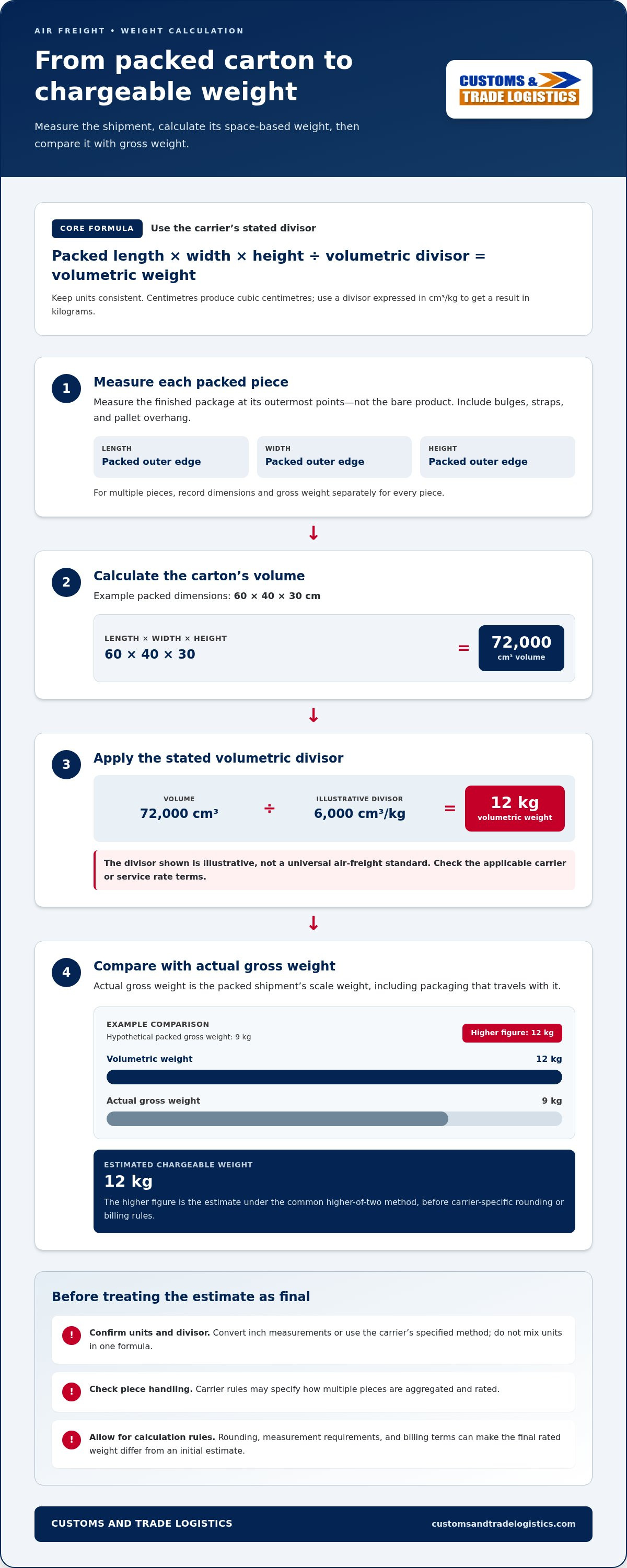
To estimate volumetric weight, multiply a packed piece’s length, width, and height, then divide the cubic volume by the carrier’s stated volumetric divisor. Keep units consistent: dimensions in centimetres produce cubic centimetres, so use a divisor expressed in cubic centimetres per kilogram to get a result in kilograms.
Formula: packed length × packed width × packed height ÷ carrier’s stated volumetric divisor = volumetric weight.
Calculate dimensions and volumetric weight
Measure each finished package at its outermost points, including bulges, straps, and any pallet overhang. Use the packed shipment’s dimensions, not the bare product dimensions. If a shipment contains several pieces, record each piece’s measurements separately before applying the carrier’s method. This makes it easier to check each package and prepare accurate shipment information.
For example, take one package measuring 60 × 40 × 30 cm. First calculate its volume: 60 × 40 × 30 = 72,000 cm³. Now use a hypothetical divisor of 6,000 cm³/kg: 72,000 ÷ 6,000 = 12 kg volumetric weight.
The divisor in this example is illustrative, not a universal air-freight standard. Carriers and shipping services can use different methods. Confirm the divisor and any measurement or rounding requirements in the applicable rate terms before treating the result as a quote-ready figure. If you record dimensions in inches, don’t enter them into a formula using centimetres and a centimetre-based divisor. Convert the measurements first or use the method specified for those units.
Compare volumetric weight with actual gross weight
Next, compare the calculated volumetric weight with the packed piece’s actual gross weight, measured on a scale. If the example package has a hypothetical gross weight of 9 kg, the comparison is 12 kg volumetric versus 9 kg actual. Its estimated chargeable weight is therefore 12 kg, before any carrier-specific rounding or billing rules are applied.
That’s the practical answer to how to calculate chargeable weight for air freight: calculate the space-based figure, compare it with actual gross weight, and use the higher figure as an estimate, subject to the carrier’s terms. For multiple pieces, record each piece’s dimensions and gross weight. Then apply the carrier’s stated piece-aggregation and rating rules. Don’t assume every shipment is combined or rounded in the same way.
Clear measurements make freight planning easier by helping align the estimate with the shipment details used for coordination from supplier to destination. If you’re preparing an import and want support connecting freight planning with customs processes, learn about a free consultation.
Actual versus volumetric weight: which one sets the air-freight rating?
Once you have both figures, compare them. Under the common higher-of-two rating method, the greater of actual gross weight and volumetric weight becomes the estimated chargeable weight. The examples below use a divisor of 6,000 cm³/kg to show the comparison. This is an illustrative calculation, not a rule for every airline, forwarder, or service, and the figures are not carrier quotations.
| Illustrative shipment profile | Actual gross weight | Volumetric weight | Estimated chargeable weight |
|---|---|---|---|
| Bulky, lightweight cartons, 120 × 80 × 60 cm | 40 kg | 96 kg | 96 kg |
| Compact, dense crate, 40 × 30 × 20 cm | 30 kg | 4 kg | 30 kg |
The table shows the general comparison, not the specific rating terms for a carrier. The dimensions and weights are illustrative; your packed measurements and the applicable divisor determine your estimate. Rounding, minimum billable weights, and how multiple pieces are combined can also affect the final rated weight. Review those details in the relevant rate terms rather than assuming the table’s result will appear unchanged on a quote.
When actual weight is higher
Consider the compact crate in the table. Its volume is 24,000 cm³, which gives a volumetric weight of 4 kg using the example divisor. If the packed crate weighs 30 kg on a scale, its actual gross weight is higher. Under the stated comparison method, 30 kg is the estimated chargeable weight. These figures are examples, not a carrier quotation.
When volumetric weight is higher
Now consider the large, lightweight cartons. At 120 × 80 × 60 cm, they occupy 576,000 cm³. Dividing that volume by the illustrative 6,000 cm³/kg divisor gives 96 kg, above the example’s 40 kg actual weight. Under this method, the estimated chargeable weight is 96 kg. A different divisor would change the volumetric result, so don’t treat 6,000 as universal.
This is the practical comparison behind how to calculate chargeable weight for air freight: work out each measure, then identify which is higher under the applicable rating method. A divisor converts package space into a weight equivalent. A smaller divisor produces a larger volumetric figure for the same dimensions. General air-freight calculations may use a different divisor from express services, and individual terms can vary.
Before relying on your estimate, confirm the divisor, rounding approach, any minimum, and whether the carrier rates pieces individually or combines them. Those rules don’t change the basic comparison, but they can change the final rated weight. Keep the actual dimensions and scale weights available so the estimate can be checked against the shipment details used for the quote.
A practical air-freight chargeable-weight calculation checklist
A reliable estimate starts with consistent shipment records, not a guess based on product size. Use this workflow to prepare the details for a freight inquiry and understand how the rated weight was reached.
- Pack the goods first. Measure the shipment as it will travel, including outer packaging and any pallet. Product dimensions alone won’t show the full space the packed shipment occupies.
- Record each piece. Note the piece count, outer length, width, and height, the measurement units, and the actual gross weight measured on a scale. Keep pieces separate in your records rather than recording only a shipment total.
- Calculate volume and volumetric weight. Multiply each piece’s packed dimensions, then divide the volume by the divisor stated for the shipment. Keep the units consistent with that divisor.
- Compare the two weights. Compare each piece’s volumetric weight with its actual gross weight, then apply the carrier’s stated rules for rating individual pieces and the shipment total.
- Check the quote against your notes. Review the dimensions and weights used, along with the divisor, rounding method, and any minimum or piece-aggregation rules stated in the applicable terms.
Record every packed piece before requesting a quote
A simple piece-by-piece record helps prevent product-only dimensions or mixed units from slipping into an estimate. For each carton or pallet, note its identifier, outer dimensions, units, and measured gross weight. Keep the worksheet or packing record available so you can compare it with the freight quote later.
Accurate measurements also support shipment coordination from supplier to destination. For broader planning around international shipping logistics, consistent piece-level information gives the people coordinating the shipment a clearer starting point.
Check the quote and resolve measurement differences
Compare the quoted measurements with your records piece by piece. If a dimension or weight differs, check whether the package was measured after final packing and whether the same units were used. Then review the divisor, how dimensions or weight are rounded, and how multiple pieces are handled. Differences between your measurements and the measurements used for rating can affect the final chargeable weight.
Keep freight rating distinct from import clearance. Chargeable weight helps establish the basis for freight rating. Customs clearance services in the U.S. address a separate part of the import process. Clear shipment records can support coordination across both without confusing their roles.
Understanding how to calculate chargeable weight for air freight helps you prepare a stronger estimate, but the carrier’s applicable terms determine the final rating. Explore freight and customs support through a free consultation.
Turn a chargeable-weight estimate into a smoother freight plan
A chargeable-weight calculation is a planning estimate, not a confirmed rating. The final figure depends on the shipment as packed and the carrier’s applicable divisor, measurement, rounding, and billing rules. Accurate details make your freight inquiry clearer and give the people coordinating the shipment a sound starting point.
Weight is one part of the plan. Origin, destination, piece count, packaging, and available shipment paperwork also help put the estimate in context. Keeping these details together can reduce avoidable questions as the shipment moves from supplier to destination.
What to include when preparing an air-freight inquiry
Prepare a concise shipment record before requesting a quote. Include:
- Origin and destination: Provide the shipment’s starting point and intended destination.
- Piece count: State how many cartons, pallets, or other packed pieces are included.
- Packed dimensions: Record the outer length, width, and height of each piece, and specify the units used.
- Gross weight: Record the measured weight of each packed piece, not only the goods’ product weight.
- Available paperwork: Include details from the commercial invoice and packing list when available, and keep the documents consistent with the shipment information.
Use final packed measurements rather than dimensions taken before packaging. If the goods are repacked or palletized after you calculate an estimate, update the dimensions and weight in your records. Accurate, consistent information supports freight planning and helps prepare the paperwork needed for compliant import processing. Businesses arranging international shipping logistics can use these details to coordinate shipment planning across the journey.
How professional logistics support can help
Freight rating and customs clearance are distinct parts of an import, but they connect through the shipment information being coordinated. Chargeable weight informs the freight rating. Customs brokerage supports the import clearance process. Clear dimensions and shipment records help keep freight-planning information aligned with the documents prepared for clearance. Learn more about customs clearance services in the U.S. and how they fit into the broader import process.
Customs and Trade Logistics provides international freight logistics and customs brokerage, including nationwide customs clearance at all U.S. ports. With over 35 years of experience, the team helps businesses coordinate shipping and customs processes. A free consultation is an opportunity to discuss your shipment details and next steps.
Ready to turn your estimate into a clearer freight plan? Discuss your shipment with our professional team through a free consultation.
Make your next shipment easier to plan
Make the estimate a repeatable planning step. Save packed measurements and weights with the shipment details, then update them if the packaging or piece count changes. That gives your team and logistics partners a consistent reference as plans develop, rather than relying on an early figure that may no longer match the shipment.
Knowing how to calculate chargeable weight for air freight helps you ask informed questions and prepare useful information for the next stage. The goal isn’t to predict every carrier adjustment on your own. Start with reliable details, understand what the estimate represents, and allow the applicable rating terms to determine the final figure.
If you’re ready to discuss how your shipment fits into a broader import plan, talk with our logistics team. A free consultation can help you consider the next steps with greater clarity. Move forward one well-prepared shipment at a time.
Frequently Asked Questions
Can an air carrier change the chargeable weight after measuring my shipment?
Yes. A carrier or handling partner may record dimensions or weight that differ from your estimate, which can affect the rated figure under the shipment’s terms. For example, a carton that bulges after packing may measure larger than it did during your first check. Keep dated measurements and scale readings for every piece, then compare them with the measurements used for rating. The applicable terms explain how discrepancies and adjustments are handled.
Does chargeable weight determine U.S. import duties?
No. Chargeable weight is used to rate freight transportation; it doesn’t, by itself, calculate U.S. import duties. Customs entry involves shipment documents and applicable classification and valuation requirements. For example, a change in a carton’s measured dimensions may affect freight rating without changing the product details shown on its commercial invoice. Keep freight-rating records distinct from duty calculations, and provide accurate commercial documents to support import processing.
Do all airlines use the same volumetric divisor for air freight?
No. Don’t assume a divisor in a sample calculation or online tool applies to your booking. The factor and rounding method can depend on the carrier, service, route, or quote terms. To understand how to calculate chargeable weight for air freight for a particular shipment, use the divisor stated for that shipment and save the calculation alongside its dimensions. This makes it easier to review the estimate if the booking details change.
Can an air-freight shipment have a minimum chargeable weight?
Yes, a carrier or service may set a minimum billable amount or other rating conditions. That means a shipment’s estimated weight from comparing actual and volumetric figures may not be the only factor reflected in its quote. For instance, if a small shipment falls below a stated minimum, the rated amount may follow that minimum instead. Review the terms attached to the specific shipment. Don’t assume the same minimum applies to every booking.
What should I do if a freight quote shows different dimensions from my records?
Compare the quote with your final packed measurements, checking units and piece count before drawing conclusions. A record showing one pallet, for example, won’t match a quote that rates several separate pieces. Keep dated notes and scale readings, then review the measurement difference with the team coordinating your shipment. Don’t change declared details simply to lower an estimate. Accurate shipment information helps keep freight coordination and import paperwork aligned.
What details should an air-freight quote show for chargeable weight?
Look for the actual weight, package dimensions, volumetric weight, divisor, and resulting rated weight, along with any stated rounding or minimum-rating conditions. These details help you trace how the quote was calculated rather than comparing only a single total. Save the quote with the piece-level shipment records. If packaging changes later, you can identify which dimensions or weights need updating and see how the revised information affects the estimate.