
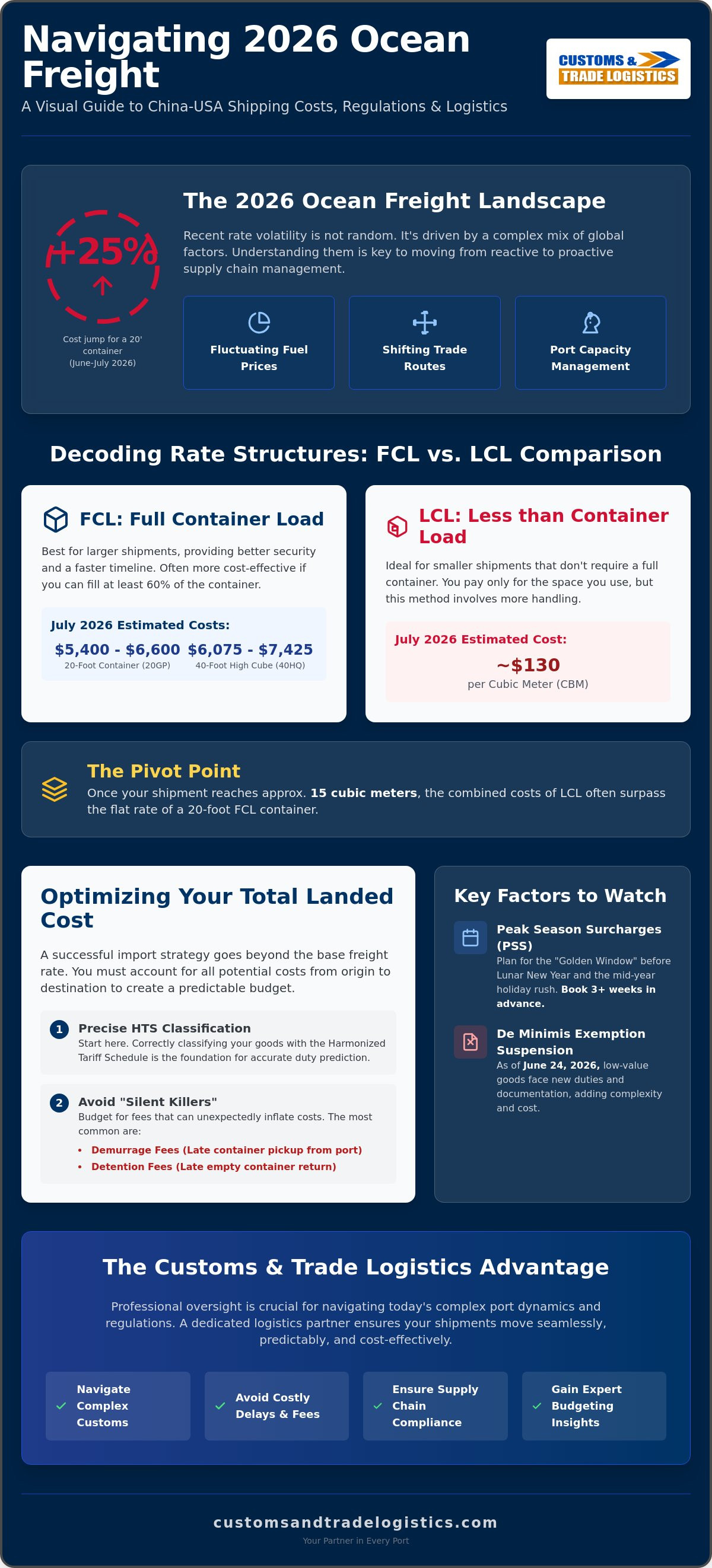
Did you know that between June and July 2026, the cost of shipping a 20-foot container from China jumped by a staggering 25%? It's frustrating to watch your carefully planned margins evaporate because of unpredictable ocean freight rates from China to USA and sudden regulatory shifts. You've likely felt the anxiety of wondering if your cargo will clear customs or if hidden fees will surprise you at the port. We understand that managing a supply chain can feel like a heavy burden when the rules seem to change overnight.
You're right to feel that the old ways of shipping no longer work in this high-pressure climate. This reference will help you master the complexities of trans-Pacific costs and learn how to optimize your landed costs with expert logistics insights. We'll break down the latest July 2026 pricing trends, explain how to handle the June 24 suspension of the $800 de minimis exemption, and show you how professional oversight ensures your shipments move seamlessly through customs. By the end of this guide, you'll have the tools to build a predictable budget and keep your inventory moving without the stress.
Key Takeaways
- Learn how to choose between FCL and LCL shipping to ensure you're only paying for the space you actually need.
- Identify and avoid "silent killers" like demurrage and detention fees that can unexpectedly drain your import budget.
- Master the strategic framework for calculating your total landed cost, starting with precise HTS classification for duty prediction.
- Understand the key drivers behind current ocean freight rates from China to USA so you can plan for 2026 market volatility with confidence.
- Discover how a dedicated logistics partner provides the professional oversight needed to navigate complex customs regulations and port dynamics.
The 2026 Ocean Freight Landscape: Understanding Rate Volatility
When you look at your shipping quote, it's easy to see ocean freight rates from China to USA as just the price of a slot on a ship. In reality, these rates are a living reflection of a complex global network. As of July 2026, we've seen a sharp climb in costs, with 40-foot containers rising by about 21% in a single month. This volatility isn't random. It's driven by a mix of fluctuating fuel prices, shifting trade routes, and the ongoing management of port capacity. Understanding these factors helps you move from reacting to price spikes to anticipating them with a steady hand.
The Federal Maritime Commission (FMC) plays a vital role here by enforcing rules on rate transparency and preventing unfair practices. However, even with oversight, the market remains sensitive. Choosing the "cheapest" rate on a digital board can sometimes be a costly mistake. These bargain slots often lack priority, meaning your cargo might get "rolled" or delayed during busy periods. Within the broader context of global maritime transport, reliability is usually worth more than a few dollars saved on the base rate. We've seen that shipments with professional oversight tend to avoid the hidden costs of those "cheap" delays.
Seasonal Trends and Peak Season Surcharges (PSS)
Timing is everything when you're importing from China. The "Golden Window" for shipping usually occurs four to six weeks before the Lunar New Year, which typically falls in January or February. During this rush, factories push to clear their floors, and vessel space becomes a premium commodity. If you don't book early, you'll likely face steep Peak Season Surcharges (PSS). In 2026, we noticed the mid-year peak season started as early as July as businesses built inventory for the holidays. To secure space when capacity is tight, we recommend booking at least three weeks in advance and maintaining a flexible schedule for your arrival ports.
The Impact of Global Trade Policy on Your Shipping Quote
Trade policies are currently shifting the landscape of ocean freight rates from China to USA faster than in previous years. For example, the June 24, 2026, suspension of the de minimis exemption has changed how low-value goods are processed, adding new layers of duty and documentation. These regulations don't just affect taxes; they influence which routes carriers prioritize. When trade compliance becomes more complex, carriers often adjust their pricing to account for the extra administrative burden at the ports. Our team at Customs and Trade Logistics monitors these regulatory shifts daily to ensure your supply chain remains compliant and cost-effective.
Decoding Rate Structures: FCL vs. LCL Comparison
Choosing between a full container and a shared one is one of the most critical decisions you'll make for your bottom line. It's not just about the volume of your goods; it's about how much control you want over the journey. For many importers, ocean freight rates from China to USA are the deciding factor, but the base price is only the beginning. As of July 2026, a 20-foot standard container (20GP) costs between $5,400 and $6,600, while a 40-foot high cube (40HQ) ranges from $6,075 to $7,425. If you have enough cargo to fill even 60% of a container, committing to a Full Container Load (FCL) often provides better security and a faster timeline.
Less than Container Load (LCL) is the alternative for smaller shipments, with July 2026 rates hovering around $130 per cubic meter (CBM). While LCL looks cheaper on paper for small batches, it carries hidden risks. Your goods are handled more frequently, increasing the chance of damage or loss during the consolidation process. There is also a "pivot point" to consider. Once your shipment reaches approximately 15 cubic meters, the combined handling fees and CBM rates of LCL usually surpass the flat cost of an FCL 20GP container. If you're unsure which path fits your current volume, our Import From China Consulting can help you run the numbers before you book.
Container Types and Their Price Implications
The type of box you choose impacts your final rate and how your goods are protected. A standard 20' container is great for heavy, dense items like machinery, whereas the 40' High Cube is the industry favorite for lighter, voluminous retail goods because it offers an extra foot of vertical space. Specialized equipment like refrigerated "reefer" containers or open-tops for oversized cargo will always command a premium. You should also keep an eye on container availability at major China ports like Ningbo or Shanghai. During peak periods, a shortage of standard 40' boxes can drive up ocean freight rates from China to USA for those specific units, forcing you to pay more for whatever equipment is left on the dock.
LCL Consolidation: What Happens at the Warehouse?
When you ship LCL, your goods must go through "de-vanning" at a container freight station (CFS) upon arrival. This process involves unloading the shared container and sorting individual shipments, which typically adds three to five days to your transit time. Paperwork accuracy is vital here. Because your cargo is grouped with others, a single documentation error can trigger a hold for the entire container. This is especially true given the current intensity of U.S. Customs and Border Protection enforcement, where inspectors are increasingly scrutinizing shared loads for compliance. Precise CBM measurements and clear descriptions are your best defense against unexpected warehouse delays.
Beyond the Base Rate: Port Dynamics and Hidden Fees
Your ocean freight rates from China to USA are only one piece of the financial puzzle. Once your container arrives at the harbor, a new set of variables comes into play that can either protect your margins or quickly erode them. The choice between the West Coast and East Coast is the first major decision. Shipping to Los Angeles or Long Beach is typically faster, with transit times averaging 14 to 22 days. However, these ports are often the first to experience congestion. Routing to the East Coast might offer more stability for inland distribution, but the longer journey through the canal adds to the base rate and increases your time-to-market.
You also need to prepare for the "silent killers" of an import budget: demurrage and detention. Demurrage fees are charged by the terminal when your container sits on the dock past its "free time" allowance. Detention fees occur when you keep the carrier's equipment, like the container itself, outside the port for too long. These penalties often arise from simple administrative delays or a lack of available trucks. To keep your budget predictable, it's vital to have a logistics plan that coordinates the pickup and return of equipment as soon as the vessel berths.
Navigating US Port Entry Points
Choosing the right entry point depends on where your final customers are located. While the West Coast is the traditional gateway for goods from China, the total cost often includes intermodal transport by rail or truck to reach the Midwest or East Coast. These "last mile" costs can sometimes double your initial ocean quote. You'll also encounter chassis split fees if a trucking company has to travel to a separate location to pick up the frame for your container. To manage these logistical hurdles, many successful importers rely on comprehensive customs clearance services us to ensure their cargo moves through the port without unnecessary stops.
Administrative and Compliance Fees
Compliance is a non-negotiable expense in international trade. The Importer Security Filing (ISF), often called the "10+2" rule, must be filed at least 24 hours before your goods are loaded in China. Failing to do this can lead to $5,000 fines and immediate cargo holds. You'll also need a customs bond, which acts as a financial guarantee to the U.S. government that all duties and taxes will be paid. Beyond these, expect to see Destination Delivery Charges (DDC) and terminal handling fees on your final invoice. These cover the cost of moving the container within the terminal and preparing it for the next leg of its journey. We find that clear communication with your logistics partner is the best way to demystify these line items before they appear on your bill.
Optimizing for Total Landed Cost: A Strategic Framework
Have you ever received a freight bill and realized your profit margin was much thinner than you expected? While ocean freight rates from China to USA are a major line item, they don't tell the whole story. To protect your business, you must focus on the total landed cost. This is the final price of a product once it arrives at your warehouse door; it includes every fee, tax, and insurance premium paid along the way. If you only budget for the shipping slot, you're leaving your margins to chance.
The first step in our framework is accurate HTS (Harmonized Tariff Schedule) classification. Assigning the wrong code to your goods can lead to overpaying duties or, worse, facing penalties from customs. Once your duties are predictable, you must factor in cargo insurance and any interest on financing. Next, ensure you've included custom brokerage service fees in your initial quote. These professional fees cover the expert filing of your entry and the management of regulatory hurdles. Finally, plan for the "last mile" of delivery and redistribution to your final warehouse or fulfillment center. This holistic view turns logistics from a cost center into a competitive advantage.
Special Considerations for Amazon FBA Sellers
Managing the "Factory to FBA" pipeline requires a high level of oversight to avoid Amazon's increasingly complex fee structures. Many sellers find that using specialized FBA freight forwarding services helps them bypass common pitfalls like inventory placement fees. By utilizing redistribution services, you can ship a single large container from China and have it broken down and sent to multiple Amazon warehouses domestically. This strategy works. It often results in lower overall ocean freight rates from China to USA compared to sending smaller, individual shipments that trigger higher per-unit costs and more administrative headaches.
Logistics for Startups: Building a Scalable Foundation
If you're launching your first product, it's tempting to chase the absolute lowest shipping rate you can find. However, for a growing business, compliance is far more valuable than a few dollars in savings. Compliance is your shield. We recommend that first-time importers read our guide on import logistics for startups to understand how to build a scalable foundation. Seeking professional consulting before you place your first large purchase order in China can prevent expensive mistakes that might sink a young brand. If you're ready to move beyond basic quotes and start building a real strategy, our International Freight Logistics team is here to guide you through every step.
The Customs and Trade Logistics Advantage: A Partner in Every Port
Digital platforms offer ocean freight rates from China to USA at the click of a button, but they often leave you stranded when a container gets stuck or a tariff code is questioned. We believe in a different approach. With over 35 years of family-owned expertise, we've seen every market shift and regulatory change since the 1980s. We don't just give you a number; we act as your dedicated advocate across every US port. This personal touch is what transforms a simple shipment into a secure supply chain.
Why choose a boutique consultancy over a massive digital marketplace? It's about accountability and deep industry literacy. When you partner with us, you aren't just another ticket in a support queue. We provide a seamless integration of customs brokerage and international freight logistics. This means the same team managing your vessel space is also overseeing your compliance. This unified oversight reduces the friction that often leads to the expensive port delays and "silent killer" fees we've explored. You deserve a partner who understands the granular details as well as the high-level strategy.
Demystifying the Import Process
Most small businesses feel overwhelmed by the scale of global trade. Our "safe pair of hands" approach is designed to lift that administrative burden off your shoulders. We bridge the gap between your local operations and the complex world of import from China logistics. Whether it's managing the 2026 export licensing requirements or handling the new electronic informal entry processes, we ensure every detail is thorough. We're here to mentor you through the journey, ensuring you feel supported at every stage from the factory floor to the final warehouse.
Ready to Secure Your 2026 Shipping Strategy?
The volatility of ocean freight rates from China to USA isn't going away, but your anxiety about them can. True security comes from knowing you have a veteran in your corner who values personal connection as much as technical compliance. Don't let your supply chain be a source of stress. Instead, let's build a predictable, scalable strategy that protects your growth and stabilizes your budget. It's time to move from uncertainty to total peace of mind. Contact Customs and Trade Logistics for a personalized quote today and let us handle the heavy lifting for your next shipment.
Secure Your Supply Chain for a Profitable 2026
Success in today's market requires more than just watching the numbers on a screen. You've seen how ocean freight rates from China to USA can shift in a matter of weeks, and you now have the framework to look beyond those base costs. By prioritizing total landed cost and choosing the right container strategy, you can protect your margins from hidden port fees and complex regulatory changes. Whether you're an Amazon seller or a growing startup, the key is to replace guesswork with professional oversight.
Are you ready to move forward with total confidence? At Customs and Trade Logistics, we bring over 35 years of industry experience to every shipment. As a family-owned and operated partner, we provide the personalized care you won't find in a digital marketplace. We act as your dedicated advocate across all US Customs ports, ensuring your cargo clears without unnecessary delays. It's time to lift the administrative burden off your shoulders and focus on growing your business. Request a Comprehensive Logistics Consultation today. We're here to be your "safe pair of hands" in the global marketplace. Your next successful shipment starts with a single, steady step.
Frequently Asked Questions
How much does it cost to ship a 40ft container from China to the USA in 2026?
As of July 2026, shipping a 40-foot high cube container (40HQ) from China to the US typically costs between $6,075 and $7,425. These rates have increased by approximately 21% since June because of early peak season demand and tighter vessel capacity. You should keep in mind that these are base freight rates; your final bill will include additional surcharges and port fees that depend on your specific destination port.
What is the cheapest way to ship goods from China to the US?
Ocean freight is consistently the most affordable method for transporting large volumes of goods across the Pacific. For shipments smaller than 15 cubic meters, Less than Container Load (LCL) is often the most budget-friendly choice because you only pay for the space you use. However, once your volume exceeds that 15-cubic-meter tipping point, booking a full 20-foot container usually results in a lower cost per unit and better security.
How long does ocean freight take from China to the United States?
Transit times for sea freight from China to major US ports like Los Angeles or Long Beach typically average between 14 and 22 days. This timeframe covers the actual journey from port to port but does not include the time needed for factory loading or customs clearance upon arrival. You should plan for a total door-to-door timeline of 35 to 45 days to account for land-side processes and potential port congestion.
What are the main "hidden fees" in ocean freight quotes?
The most common unexpected costs are demurrage and detention fees, which trigger when containers sit too long at the terminal or stay out with a trucker past their free time. You might also encounter chassis split fees, Destination Delivery Charges (DDC), or terminal handling fees. These "soft costs" often arise from poor coordination at the port, which is why having professional oversight of your supply chain is so valuable for maintaining a predictable budget.
Do I need a customs broker for ocean freight from China?
While you aren't legally required to hire a broker for every shipment, having a professional is essential for navigating the complex 2026 regulatory environment. With the June 2026 suspension of the $800 de minimis exemption, nearly all imports now require formal or informal entry processes. A broker ensures your documentation is accurate, helping you avoid expensive fines and ensuring your ocean freight rates from China to USA don't balloon due to unexpected storage delays.
What is the difference between FCL and LCL shipping?
Full Container Load (FCL) means you have exclusive use of a 20-foot or 40-foot container, providing faster transit and less handling of your goods. Less than Container Load (LCL) involves sharing container space with other importers, which is ideal for smaller shipments but requires extra time for consolidation at a warehouse. LCL shipments are handled more frequently, which can slightly increase the risk of damage compared to a sealed and protected FCL unit.
How do I calculate the total landed cost of my import?
To find your total landed cost, you must add the factory price of your goods to the cost of freight, insurance, and customs duties. You also need to include administrative expenses like customs bond fees and local trucking charges for the final delivery. We recommend using a structured checklist to ensure no small fee is overlooked, as this final number is the only metric that truly determines your profitability per unit.
Can I ship directly from a China factory to an Amazon FBA warehouse?
Yes, you can ship directly from a Chinese factory to an Amazon FBA warehouse, but your cargo must meet strict Amazon labeling and palletizing requirements before it arrives. Most successful sellers use a freight forwarder to manage this "Factory to FBA" pipeline. This ensures your goods are properly redistributed to the correct fulfillment centers, helping you avoid Amazon's inventory placement fees and ensuring your ocean freight rates from China to USA remain cost-effective.


