
Did you know that U.S. Customs and Border Protection processed over 10 million security filings last year and issued millions of dollars in penalties for simple clerical errors? It's a staggering figure that highlights exactly how much is at stake when your cargo is on the water. If you feel a sense of dread every time you have to coordinate supplier data and HTS codes, you aren't alone. Most small business owners find the paperwork more exhausting than the actual logistics of moving goods from overseas.
We understand that the ISF 10+2 filing for ocean freight feels like an intimidating hurdle, but it doesn't have to be a source of constant anxiety. You've worked hard to build your business, and a $5,000 fine for a late submission is the last thing your bottom line needs. This guide is designed to help you master these complexities so your shipments move through US ports without a hitch. We'll walk you through the essential data elements, the strict 24-hour loading deadlines, and the 2026 regulatory shifts that every importer must know to stay protected and keep their supply chain predictable.
Key Takeaways
- Master the ISF 10+2 filing for ocean freight by identifying the 10 specific data points you must collect from your supplier to satisfy CBP requirements.
- Protect your bottom line by submitting your filing at least 24 hours before loading to avoid the $5,000 penalty and "Do Not Load" messages.
- Use our practical preparation checklist to verify your Customs Bond and Importer of Record status well before your cargo ever reaches the port.
- Learn how professional brokerage services act as a safe pair of hands to validate your HTS codes and provide a seamless, end-to-end compliance experience.
What is ISF 10+2 Filing for Ocean Freight?
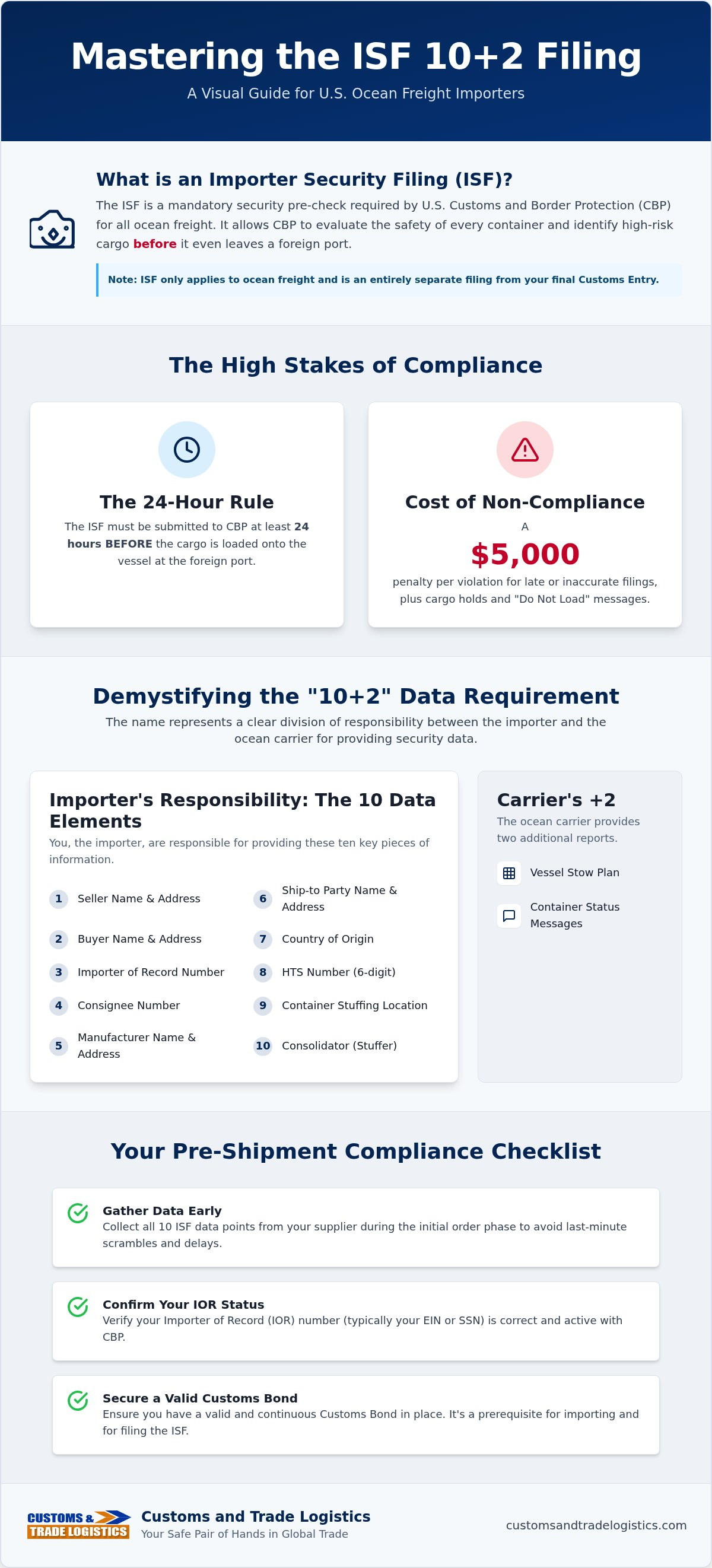
The ISF 10+2 filing for ocean freight is much more than just another digital form to complete. It's a mandatory electronic submission required by U.S. Customs and Border Protection (CBP) for all goods arriving in the United States by sea. Think of it as a security pre-check that allows the government to evaluate the safety of every container before it even leaves a foreign dock. By requiring this data 24 hours before a ship is loaded, the CBP can identify high-risk cargo and prevent potential threats from ever reaching our shores.
While it might feel like a bureaucratic hurdle, this regulation serves as a stabilizing force for the global supply chain. It ensures that every stakeholder, from the manufacturer in China to the small business owner in the U.S., is operating with transparency. For you, the importer, mastering this process is about more than just avoiding a fine; it's about establishing yourself as a reliable partner in the eyes of federal authorities. This early data exchange creates a sense of security and oversight that keeps the entire maritime industry moving forward.
Why ISF Only Applies to Ocean Freight
You might wonder why you don't face these same requirements when shipping via air, rail, or truck. The answer lies in the scale and complexity of maritime logistics. Because ocean vessels can carry thousands of containers at once, the potential risk is significantly higher than a single cargo plane or a semi-truck. Consequently, the "vessel" itself acts as the primary trigger for compliance. While air and land shipments have their own security protocols, they operate on different timelines and data structures tailored to their specific modes of transport.
An Importer Security Filing is strictly a security-focused submission and remains entirely separate from your formal customs entry. It's helpful to view the ISF as the "who and where" of your shipment, while the customs entry focuses on the "what and how much" regarding duties and taxes.
Demystifying the '10+2' Name
The name sounds like a math equation, but it actually represents a clear division of responsibility. According to the ISF 10+2 Wikipedia Page, the "10" refers to ten specific data elements that the importer is responsible for providing. These include details like the seller’s name, the country of origin, and the commodity’s HTS code. The "+2" refers to two additional pieces of information, the vessel stow plan and container status messages, which are provided directly by the ocean carrier.
All 12 of these data points are funneled into the Automated Commercial Environment (ACE) system. This centralized hub allows CBP to cross-reference your information in real-time. Ensuring this data is accurate from the start is the foundation of successful customs clearance services us. When your ISF is handled with protective care, it paves the way for a smooth transition through the port, acting as a safe pair of hands that guides your cargo from the high seas to your warehouse door.
The 10 Data Elements Every Importer Must Provide
How many times have you looked at a commercial invoice and wondered which address actually matters for customs? Accuracy is everything. The Official ISF 10+2 Requirements mandate ten specific data elements from the importer. These details must match your shipping documents exactly to avoid flags. You'll need the full names and addresses of the Seller and Buyer, the Importer of Record (IOR) number, which is typically your EIN or Social Security number, and the Consignee number. Don't forget the Manufacturer's details; CBP wants to know exactly where the goods were produced, not just who sold them to you. Finally, you must provide the Ship-to party, which is the name and address of the first deliver-to party scheduled to receive the goods after they clear the port.
Gathering this information early in the procurement process is the best way to handle an ISF 10+2 filing for ocean freight without stress. If you are feeling overwhelmed by these technical requirements, consulting with a seasoned expert can provide the clarity you need to move forward with confidence. We often see small businesses struggle because they wait until the last minute to ask their suppliers for these specifics. Start the conversation during the order phase to ensure your data is ready long before the ship is scheduled to depart.
HTS Codes and Country of Origin
Precision is your best friend when it comes to classification. You must provide the Harmonized Tariff Schedule (HTS) number at the 6-digit level for every item in your shipment. This code, combined with a verified Country of Origin, determines your duty rates and eligibility for trade programs. Verifying these details early is critical for correct duty calculations later. Many importers find that professional import from China logistics assistance prevents costly HTS errors that could trigger audits or shipment holds.
Container Stuffing and Consolidator Data
Do you know exactly where your goods were physically placed into their container? This is known as the Container Stuffing Location. For Less than Container Load (LCL) shipments, you also need the name and address of the Consolidator. This entity is responsible for packing multiple shipments into a single container. To get this specific technical data, ask your foreign freight forwarder for an "ISF Data Sheet" as soon as your goods reach their warehouse. They are the ones with eyes on the ground and can provide the most accurate stuffing details for your ISF 10+2 filing for ocean freight.
Critical ISF Deadlines and the Cost of Non-Compliance
What happens if you miss the filing window? In the world of international trade, timing is everything. The golden rule for an ISF 10+2 filing for ocean freight is that it must be submitted at least 24 hours before the cargo is loaded onto the vessel at the foreign port. This isn't a suggestion; it's a hard deadline. If you fail to meet this requirement, U.S. Customs and Border Protection (CBP) can issue a "Do Not Load" (DNL) message to the carrier. This effectively grounds your shipment indefinitely, leaving your goods sitting on a foreign dock while storage fees mount and your supply chain grinds to a halt.
Even if your cargo is allowed to board, a late or inaccurate filing acts as a red flag for authorities. CBP uses these filings to assess risk. When data is missing or submitted past the deadline, your shipment is far more likely to be flagged for a physical inspection upon arrival. These inspections are expensive, often costing thousands of dollars in drayage and labor fees, and they can add weeks to your delivery timeline. To keep the process moving, your broker uses the Bill of Lading (BOL) number to link your ISF data directly to the carrier’s manifest. This digital handshake is what allows your cargo to move seamlessly from the sea to the shore.
The $5,000 Penalty: Understanding the Stakes
The financial consequences of non-compliance are steep. CBP has the authority to assess liquidated damages of $5,000 per violation. This means if your filing is late, you're looking at a $5,000 fine. If it's also inaccurate, that could be another $5,000. Because these penalties can be cumulative, a single problematic shipment can quickly become a major financial burden. Beyond the immediate cost, frequent violations damage your "importer score." This internal CBP ranking influences how often your future shipments are scrutinized, making long-term compliance a vital part of your business health.
Amending and Canceling an ISF Filing
Life happens, and sometimes shipment details change after you've already filed. Can you fix it? Yes. You are permitted to update data elements as long as the changes are made before the goods reach the U.S. port. If a shipment is canceled or diverted to another country, you must also cancel the ISF to keep your records clean. Proactive communication with your broker is essential here. By acting as a safe pair of hands, a seasoned broker can help you navigate these late-stage changes and ensure that an amended ISF 10+2 filing for ocean freight doesn't lead to unnecessary delays or penalties.
Preparing Your ISF Filing: A Business Checklist
Success in global trade isn't just about what you sell. It's about how well you manage the details before your goods even touch the water. To ensure a smooth ISF 10+2 filing for ocean freight, you need a proactive strategy. Waiting for your supplier to send data at the last minute is a recipe for stress and potential fines. Instead, treat compliance as a milestone in your production timeline. Follow this checklist to keep your operations running like clockwork:
- Request the 'ISF Data Sheet' early: Ask your supplier for this document as soon as you place your order. It contains the core manufacturer and stuffing data you'll need.
- Verify your IOR and Bond: Confirm your Importer of Record status and ensure your Customs Bond is active. Without a valid bond, your filing won't be accepted.
- Secure the Master Bill of Lading: Coordinate with your freight forwarder to get the MBL number. This is the link that connects your data to the vessel's manifest.
- Aim for a 72-hour window: While the rule is 24 hours, aim to file 72 hours before loading. This provides a buffer for system processing or correcting unexpected data errors.
- Audit your documents: Review your commercial invoices and packing lists. Every name and address must be consistent across all ten data elements.
If you find this process overwhelming, you don't have to go it alone. Partnering with a dedicated logistics expert allows you to offload the administrative burden while ensuring total accuracy.
Special Considerations for Amazon FBA Sellers
If you're an Amazon seller, the stakes are even higher. You must use the correct 'Ship-to' party address for the specific fulfillment center assigned to your shipment, not just a general corporate office. Professional FBA freight forwarding services are specifically designed to handle these nuances. They manage the manufacturer data even when you're sourcing from multiple Chinese factories, ensuring every detail aligns with CBP's strict expectations.
Working with Foreign Suppliers
Language barriers can often lead to confusion when you're requesting technical stuffing data. We recommend using a standardized data template to reduce the endless back-and-forth emails. For those new to the game, import logistics for startups must prioritize supplier education. If your factory understands why these rules exist, they're much more likely to provide accurate information on time. This proactive communication is what builds a resilient supply chain for your ISF 10+2 filing for ocean freight.
How Professional Customs Brokerage Streamlines Your ISF
Managing an ISF 10+2 filing for ocean freight is a high-stakes task that requires both precision and speed. A professional broker acts as a 'safe pair of hands,' validating every data point against your commercial documents before it ever reaches federal eyes. This oversight is vital because even a minor typo in an HTS code can trigger the penalties we discussed earlier. With over 35 years of industry experience, we've seen how a proactive review prevents the most common causes of port delays and costly inspections. It's about replacing your anxiety with the relief that comes from knowing an expert is watching over your cargo.
Expertise in the Automated Commercial Environment (ACE) is another critical benefit. This system is the digital backbone of U.S. trade, and navigating its complexities requires specialized knowledge. By integrating your ISF with the final Customs Entry, a broker ensures a seamless data flow. This connection reduces the risk of discrepancies that often occur when different parties handle different stages of the process. You gain a streamlined experience where one submission naturally leads into the next, providing total management of your international shipping chain from start to finish.
The Value of an Expert Import Consultant
Beyond the actual filing, an expert consultant looks for ways to optimize your bottom line. They might identify HTS classification savings that you hadn't considered or manage the essential Customs Bond requirement on your behalf. Since a valid bond is a prerequisite for any ISF, having a partner who handles both simplifies your administrative burden. This allows you to step back from the paperwork and focus on what really matters: growing your business and serving your customers. We act as a knowledgeable bridge, making complex customs entries simple for small businesses.
Choosing a Partner for Long-Term Success
When you choose a partner, consider the value of a family-oriented mentor over a faceless digital platform. Our team provides the personal connection and diligent care that high-volume software often lacks. We believe in transparency, which is why understanding custom brokerage service fees is a core part of our budgeting advice. If you're ready to secure your supply chain for 2026, reach out for a comprehensive compliance review of your upcoming ocean freight. We are here to ensure your goods move predictably and your business stays protected.
Secure Your Supply Chain for 2026 and Beyond
Do you feel ready to tackle your next shipment with confidence? Success in international trade depends on turning complex regulations into a predictable routine. By prioritizing early data collection and verifying your HTS codes, you protect your business from the $5,000 penalties that disrupt so many small operations. Remember that the ISF 10+2 filing for ocean freight isn't just a hurdle; it's a security shield for your entire supply chain.
You don't have to manage this burden alone. As a family-owned consultancy with 35+ years of specialized customs experience, we act as your dedicated advocate in a complex global marketplace. Our ACE-certified filing covers all US ports, providing the professional oversight you need to keep your cargo moving seamlessly. Let Customs and Trade Logistics handle your ISF filing and protect your cargo today.
We're here to simplify the process and give you the peace of mind you deserve. Your growth is our priority, and we look forward to being the safe pair of hands that guides your imports home.
Frequently Asked Questions
What happens if I file my ISF 10+2 late?
A late filing triggers an immediate $5,000 penalty from U.S. Customs and Border Protection for each violation. Beyond the financial fine, you risk receiving a "Do Not Load" message that prevents your goods from boarding the vessel at the foreign port. If the cargo is allowed to arrive, expect mandatory physical inspections that add significant costs and weeks of delays to your delivery timeline.
Do I need a customs bond for an ISF filing?
You must have a valid Customs Bond to complete an ISF 10+2 filing for ocean freight. If you don't have a continuous bond for your yearly imports, you'll need to secure a single transaction ISF bond. This bond acts as a financial guarantee to the government that all regulations will be followed and any assessed liquidated damages will be paid promptly.
Can my freight forwarder file the ISF for me?
Many freight forwarders can handle the filing, provided they have the proper authorization and software to connect with CBP systems. However, they often collaborate with a licensed customs broker to ensure the data is validated before submission. It's always wise to confirm that your forwarder is acting as a safe pair of hands and not just passing along unverified data from your supplier.
Is the ISF the same thing as a Customs Entry?
The ISF and the formal Customs Entry are two distinct legal requirements with different objectives and deadlines. The ISF focuses strictly on high-risk cargo identification and must be filed 24 hours before loading at the foreign port. In contrast, the Customs Entry deals with duty payments and trade compliance, typically filed when the goods arrive or shortly before they reach the U.S. port.
What is the 'ISF-5' filing, and do I need it?
An ISF-5 filing is required for cargo that is not intended for the U.S. market but is passing through a U.S. port to another destination. This applies to Foreign Remaining on Board (FROB) shipments or goods moving under Immediate Exportation (IE) bonds. It only requires five data elements instead of the standard ten required for domestic imports destined for U.S. warehouses.
How much does it cost to file an ISF 10+2?
While CBP doesn't charge a fee for the filing itself, customs brokers and forwarders charge a service fee to manage the electronic submission. Industry service fees generally range from $25 to $50 per shipment depending on the complexity of the data and the number of HTS codes. Investing in professional filing is a small price to pay to avoid the $5,000 non-compliance penalty.
Can I file an ISF myself without a broker?
It is possible for an importer to file directly, but it's rarely practical for small businesses or startups. You would need to purchase specialized software that connects to the Automated Commercial Environment (ACE) and maintain your own bond. Most importers find that the administrative burden and risk of clerical errors make hiring a professional broker a much more reliable and cost-effective choice.
Does every ocean shipment require an ISF filing?
Yes, every ocean freight shipment destined for a U.S. port requires an ISF 10+2 filing for ocean freight. This includes full container loads, less-than-container loads, and bulk cargo. It's important to remember that as of August 2025, even low-value shipments that were previously exempt under de minimis rules now require a full security filing to clear customs safely.


