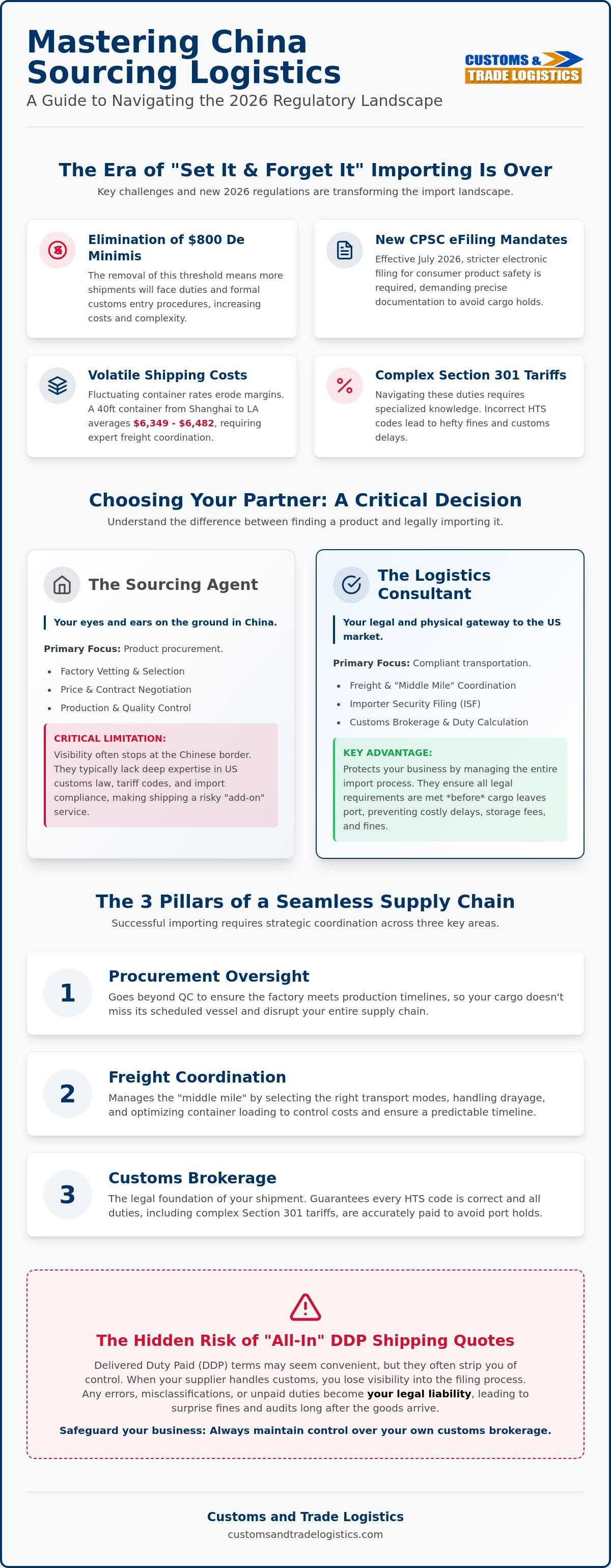
With the elimination of the $800 de minimis threshold and new CPSC eFiling mandates now in effect as of July 2026, the era of "set it and forget it" importing is officially over. You've likely felt the stress of rising container rates or the confusion of decoding Section 301 tariffs while your cargo sits idle at a port. It's frustrating when a simple shipment turns into a maze of HTS codes and unexpected fees that eat your margins.
We understand that you need more than just a carrier; you need a partner who treats your business like their own. This guide will help you master your China sourcing logistics support, providing the expert oversight required to move goods from the factory floor to your US warehouse with total confidence and relief. We'll walk you through the complex 2026 regulatory landscape, explain how to secure a predictable shipping timeline, and show you how to maintain clear communication between your factory and the customs broker. By the end of this resource, you'll have a roadmap to avoid hidden fees and ensure your cargo reaches its destination without the usual administrative burden.
Key Takeaways
- Understand why successful importing requires a seamless transition from product sourcing to a coordinated logistics and documentation framework.
- Distinguish between sourcing agents and logistics consultants to protect your business from common compliance gaps that lead to customs delays.
- Optimize your "middle mile" costs by securing professional China sourcing logistics support to manage factory drayage and container loading options.
- Learn the hidden risks of "all-in" DDP shipping quotes and why maintaining control over your own customs brokerage is the safest way to avoid fines.
- Leverage decades of industry expertise to bridge the gap between global manufacturing and final US delivery with a personal, family-oriented approach.
What is China Sourcing Logistics Support?
Many importers believe their job is done once they sign a contract with a factory in Shenzhen or Ningbo. However, finding a product is only the first step in a much longer journey. To understand What is China Sourcing Logistics Support?, you have to look at the entire framework that moves your goods from a production line to your customer's hands. It isn't just about procurement; it's the strategic coordination of freight booking, legal documentation, and strict customs compliance. Without this support, the physical movement of your goods and their legal entry into the US remain at risk.
Effective China sourcing logistics support integrates these moving parts so your supply chain doesn't break down at the port. In 2026, this integration is more vital than ever. With the elimination of the $800 de minimis threshold and new CPSC eFiling mandates that began on July 8, 2026, you can't afford to treat logistics as an afterthought. If your sourcing and shipping teams aren't communicating, you'll likely face costly delays, unexpected storage fees, or even legal fines. A US-based partner acts as your dedicated advocate, bridging the gap between your foreign supplier and domestic carriers. They provide the oversight needed to prevent your cargo from falling into a "black hole" of visibility during its long ocean transit.
The Three Pillars of Sourcing Support
- Procurement oversight: This goes beyond quality control. It's about ensuring the factory meets production timelines so you don't miss your scheduled vessel.
- Freight coordination: Selecting the right mode of transport is critical for managing 2026 costs. For example, Shanghai to Los Angeles container rates are currently averaging between $6,349 and $6,482 per 40ft container.
- Customs brokerage: This is the legal foundation of your shipment. It ensures every HTS code is correct and every duty, including Section 301 tariffs, is calculated and paid accurately to avoid port holds.
Who Needs Professional Logistics Support?
Small businesses that are outgrowing direct-to-consumer parcel shipping often find they need a more structured freight plan to remain profitable. Amazon sellers specifically require FBA-compliant redistribution and labeling to avoid rejected shipments at fulfillment centers; specialized 3PL providers like pikpak.com.au can help manage these needs to ensure inventory flows smoothly. Additionally, any importer handling sensitive or highly regulated product categories, such as children's toys or electronics, must have professional oversight to comply with the latest 2026 safety filing requirements. If you feel overwhelmed by the scale of international operations, having a "safe pair of hands" to manage these granular details provides the relief you need to focus on growing your brand.
Sourcing Agents vs. Logistics Consultants: Choosing Your Partner
Does your current partner understand the difference between a factory floor and a US Customs port? It's a common mistake to assume that the person who found your supplier can also navigate the legal hurdles of entry. While a sourcing agent is indispensable for finding a reliable manufacturer, they often lack the specialized knowledge required for China sourcing logistics support. Choosing the wrong partner for the shipping phase can lead to your goods being stuck in a port while storage fees climb into the thousands. You need to know exactly who is responsible for each leg of the journey to keep your supply chain moving.
The Sourcing Agent Role
Sourcing agents are your eyes and ears on the ground in China. Their expertise lies in factory vetting, price negotiation, and quality control. They ensure that what you ordered is what gets made. However, their visibility often stops at the Chinese border. Many agents offer to handle shipping as an "add-on" service, but they may not understand the nuances of US-specific tariff laws or the different types of entry required by Customs and Border Protection. A frequent pitfall occurs when an agent manages the Bill of Lading without considering how it impacts your legal standing as the importer. If the paperwork isn't perfect, you're the one who pays the price.
The Logistics and Customs Consultant Role
A logistics and customs consultant focuses on the legal and physical movement of your goods into the United States. They manage the critical "Import from China" logistics chain, ensuring that every Customs Compliance: The "Make or Break" of China Imports requirement is met before the ship even leaves the dock. This includes filing your Importer Security Filing (ISF) on time, securing the necessary customs bonds, and calculating duties accurately. Their primary goal is to protect you, the Importer of Record, from costly CBP audits and fines. They act as a bridge between the factory and your warehouse, providing the oversight that a general sourcing agent simply can't offer.
When you evaluate a potential partner, ask about their experience with specific China-to-USA lanes and their presence in all major US ports. You need a team that provides comprehensive China sourcing logistics support to bridge the gap between your foreign supplier and your domestic warehouse. If you're feeling overwhelmed by the paperwork, our team provides Import From China Consulting that takes the guesswork out of the process. We act as a "safe pair of hands," ensuring your business remains compliant while your cargo stays on schedule. Having a seasoned mentor by your side turns a complex international operation into a manageable, predictable process.
Managing the "Middle Mile": From China Factory to US Port
The journey from your supplier's gate to the export terminal is often where the most overlooked delays occur. This "middle mile" requires precise coordination between the factory, local drayage companies, and the port authorities in cities like Shanghai or Ningbo. In July 2026, US ports are projected to handle a record 2.47 million containers as importers rush to beat tariff deadlines. This surge means that vessel space is tight and port congestion is a reality. Managing this chain effectively involves more than just booking a truck; it requires active oversight to ensure your cargo doesn't miss its window due to paperwork errors or equipment shortages.
One of the first decisions you'll face is choosing between Full Container Load (FCL) and Less than Container Load (LCL). If you have enough volume to fill a 20ft or 40ft container, FCL is generally faster and reduces the risk of damage since the goods aren't handled during transit. For smaller shipments, LCL allows you to share space and costs, though it involves extra time for "de-vanning" or unloading at the destination. Professional China sourcing logistics support helps you weigh these options against current market conditions, ensuring you select the most cost-effective method for your specific timeline.
Ocean Freight Logistics Management
Selecting a carrier should be based on reliability and transit time rather than just the lowest price. For example, Shanghai to New York rates are currently averaging around $7,902 per 40ft container, but a cheaper "slow boat" might cost you more in lost sales if it sits at anchor for weeks. You also need to choose the right Incoterms. While Ex-Works (EXW) gives you total control, it also puts the entire burden of Chinese export formalities on your shoulders. Many importers prefer Free on Board (FOB), where the supplier handles the goods until they are on the ship. Reviewing the CBP guidelines for new importers can help you understand your legal responsibilities regardless of which term you choose. For a deeper dive into current pricing, you can check our reference on ocean freight rates from China to USA.
Delivery and Redistribution Services
The logistics process doesn't end when the ship docks at a US port. Once your cargo clears the terminal, it needs to move quickly to its final destination to avoid "demurrage" fees. If you're an e-commerce professional, you might need specialized Amazon seller import help to manage FBA-specific labeling and palletization requirements. Effective redistribution strategies ensure that once your container is de-vanned, the goods are sorted and dispatched to retail hubs or fulfillment centers without delay. This seamless transition from sea to land is what keeps your inventory levels stable and your customers happy.
Customs Compliance: The "Make or Break" of China Imports
Why is customs brokerage the most critical part of logistics support? Think of it as the legal filter that determines if your goods enter the country or sit in a warehouse under seizure. While many providers treat shipping as just moving boxes, true China sourcing logistics support prioritizes the legal requirements that prevent your cargo from becoming a liability. One of the biggest risks in 2026 is relying on "DDP" (Delivered Duty Paid) shipping quotes from overseas suppliers. While it sounds convenient, you remain the legal Importer of Record. If the supplier misclassifies your goods or under-declares the value to save on their end, US Customs will hold you responsible for the fines and back duties.
Accurate classification using the Harmonized Tariff Schedule (HTS) is your primary defense against overpaying or triggering an audit. Since the $800 duty-free threshold was eliminated in late 2025, every single shipment from China now requires a formal entry and duty payment. You also cannot ignore the Importer Security Filing (ISF). This document must be filed at least 24 hours before your goods are loaded onto a vessel in China. Failing to meet this deadline can result in an automatic $5,000 fine from CBP, even for a small shipment. We act as your advocate to ensure these filings are perfect before the ship ever leaves the dock.
Navigating US Import Regulations
If you import from China more than a few times a year, a continuous Customs Bond is a non-negotiable tool. It streamlines your entries and satisfies the legal requirement for a financial guarantee to the US government. A seasoned consultant also knows how to identify Section 301 tariff exclusions that might apply to your specific products, potentially saving you thousands in additional duties. For a deeper look at how to manage these requirements, explore our guide on customs clearance services us. This oversight ensures you aren't just following the rules, but you're also optimizing your landed costs.
Paperwork Assistance for Small Businesses
The paperwork required for international trade can feel like a foreign language. We help demystify the Commercial Invoice and Packing List, ensuring they contain the specific descriptions and values that CBP officers expect to see. Our "Safe Pair of Hands" approach involves reviewing these documents while your goods are still at the factory. This proactive step catches common errors that lead to intensive port exams and expensive storage fees later on. If you're ready to stop worrying about paperwork and start importing with confidence, our Customs Clearance Services provide the expert oversight your business deserves. We handle the administrative heavy lifting so you can focus on your growth.
Partnering with Customs and Trade Logistics for China Sourcing
How do you turn the complex 2026 regulatory environment into a competitive advantage? It starts with having a partner who understands that your business is more than just a sequence of shipping numbers. At Customs and Trade Logistics, our 35+ years of industry experience allows us to simplify the entire China-to-US journey for small and medium businesses. Being a family-owned and operated consultancy means you get direct access to seasoned mentors, not a call center. We provide the comprehensive oversight you need to move goods from a foreign factory to your final US destination without the stress of administrative blind spots.
Our national reach ensures that your cargo can be cleared at any US Customs port, whether you're shipping into Los Angeles, Savannah, or New York. We specialize in bridging the gap between high-volume manufacturing and the specific needs of the American marketplace. By managing the physical movement and the legal entry of your goods, we lift the heavy administrative burden from your shoulders. This end-to-end management is designed to provide relief and security, letting you focus on product development and sales while we handle the intricate details of China sourcing logistics support.
Our Approach to China Logistics Support
Our method is rooted in personalized consulting for both first-time importers and established brands. We don't believe in a one-size-fits-all strategy, especially when it comes to the unique requirements of Amazon FBA sellers. We act as your dedicated advocate, managing the friction between international carriers and US Customs and Border Protection. You can also expect transparent custom brokerage service fees, which allows you to budget your landed costs with absolute certainty. This transparency ensures there are no hidden surprises when your container arrives, providing a predictable path for your inventory.
Next Steps for Your 2026 Import Strategy
If you're ready to refine your 2026 import strategy, the first step is a thorough logistics audit. We'll review your supplier details and production timelines to identify potential compliance gaps before they become expensive problems. Setting up a Power of Attorney (POA) with us is a straightforward process that allows for seamless clearance on your behalf. Choosing the right China to USA import consultant is the most significant decision you'll make for your supply chain health. We invite you to reach out and discover how a "safe pair of hands" can provide the peace of mind you need to scale your operations in a global marketplace.
Secure Your Supply Chain for 2026 and Beyond
Navigating the shift from a factory floor in China to a US warehouse doesn't have to be a source of constant anxiety. You've learned that successful importing requires more than just finding a good supplier; it demands a robust framework for customs compliance and middle-mile coordination. By prioritizing accurate HTS classification and timely ISF filings, you protect your business from the costly delays and fines that often catch unprepared importers by surprise. Your role as the Importer of Record carries legal weight, and having a dedicated mentor to oversee these details is the best way to ensure your cargo arrives safely.
At Customs and Trade Logistics, we bring 35+ years of industry experience and national port coverage to every shipment we manage. Whether you need specialized Amazon FBA support or help navigating the latest 2026 tariff updates, we act as your "safe pair of hands" throughout the entire process. Don't let the administrative burden of international trade hold your business back. Get Expert China Sourcing Logistics Support Today and move your inventory with total confidence. We're here to help you grow, one successful shipment at a time.
Frequently Asked Questions
What is the difference between a sourcing agent and a customs broker?
A sourcing agent focuses on the production side, while a customs broker manages the legal entry of your goods into the United States. Your sourcing agent vets manufacturers and negotiates prices to ensure your product is built correctly. In contrast, a customs broker handles the complex legal relationship with US Customs and Border Protection, ensuring your cargo meets all 2026 regulatory requirements without facing fines or seizures.
Can I use a China sourcing logistics partner if I already have a supplier?
Yes, many successful importers find their own suppliers and then seek professional China sourcing logistics support to manage the actual movement of goods. We often step in once your production is underway to coordinate the factory pickup, ocean freight, and final US delivery. This partnership provides the specialized oversight needed to bridge the gap between your foreign factory and your domestic warehouse.
How much does logistics support for China sourcing typically cost?
The cost of logistics support depends on your shipment volume, the complexity of your product's HTS classification, and the specific ports involved. Most providers use a combination of flat fees for customs entries and variable rates for freight and drayage. To get an accurate picture of your total landed cost, it's best to provide your supplier details for a comprehensive quote that includes current 2026 duties and handling fees.
What are the most common logistics delays when importing from China?
Most delays stem from documentation errors, port congestion, and missed ISF filing deadlines. In July 2026, record port volumes have made vessel space extremely tight; any mistake on your Commercial Invoice can cause your cargo to be "rolled" to a later ship. Having a partner review your paperwork at the factory level prevents these issues from turning into expensive storage fees at the US terminal.
Do I need a different logistics partner for Amazon FBA shipments?
You don't need a separate partner, but you must work with one that has specialized Amazon FBA experience. Amazon has very specific rules for labeling, palletization, and delivery scheduling at their fulfillment centers. A provider with FBA support can handle the redistribution and labeling required to ensure your inventory is accepted quickly and doesn't face "out of stock" issues due to warehouse rejections.
How does a logistics consultant help with China tariffs and duties?
A consultant ensures your goods are assigned the most accurate HTS codes to prevent you from overpaying on duties. They also stay updated on Section 301 tariff exclusions and other trade programs that could save your business money. By providing an expert audit of your China sourcing logistics support, they help you navigate the 2026 elimination of the $800 de minimis threshold while protecting your profit margins.
What documents do I need to provide for China sourcing logistics support?
The primary documents required are the Commercial Invoice, Packing List, and Bill of Lading. You will also need to sign a Power of Attorney (POA) to allow your customs broker to file entries on your behalf. These documents must be perfectly aligned; even minor discrepancies in weight or product description can trigger an intensive customs exam that delays your shipment for weeks.
Is it better to use air or ocean freight for my China-sourced products in 2026?
Ocean freight is generally better for bulk shipments due to cost, while air freight is best for urgent or high-value items. With 2026 container rates from Shanghai to Los Angeles averaging between $6,349 and $6,482, sea transport remains the most economical choice for most businesses. However, if you are launching a new product or need to replenish stock quickly, air freight provides the speed necessary to keep your sales momentum.


