

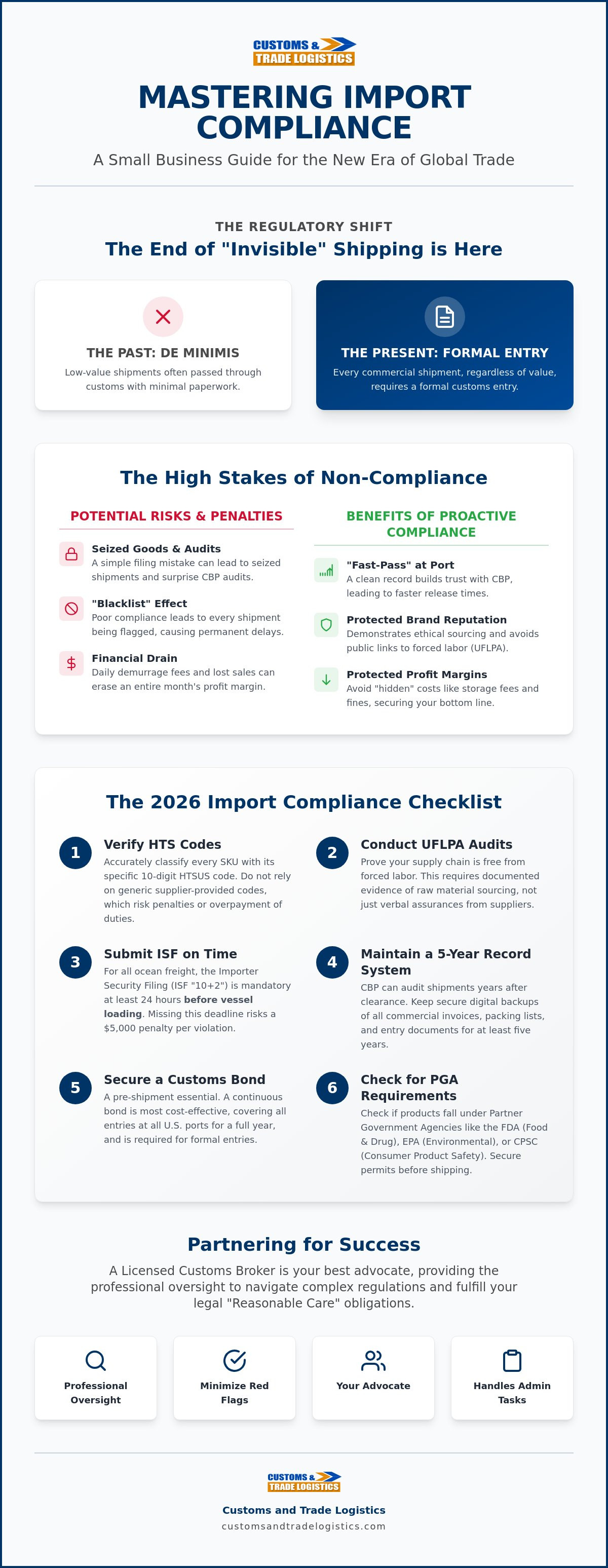
The era of "invisible" shipping ended when the de minimis exemption was suspended, meaning every single commercial shipment now requires a formal entry regardless of its value. You've probably felt the shift in your bottom line and your stress levels as you try to decipher 10-digit HTS codes or the latest Section 122 surcharges. It's exhausting to worry that a simple filing mistake might lead to seized goods or a surprise CBP audit.
You don't have to face these regulatory hurdles alone. Our comprehensive framework is designed to help you master import compliance for small business, ensuring you protect your profit margins and keep your shipments on schedule. We'll provide a clear 2026 roadmap that covers everything from mandatory ISF filings to specific tariff rates for China and India, giving you the security and peace of mind you need to grow your operations.
Key Takeaways
- Learn why a clean compliance record acts as a strategic asset to speed up your shipments and protect your brand from the "blacklist" effect.
- Follow our 2026 checklist to verify 10-digit HTS codes for every SKU, avoiding the common risks of using inaccurate supplier-provided data.
- Master your documentation by organizing a secure five-year record-keeping system and identifying the critical details required on every Commercial Invoice.
- Navigate complex modern regulations like UFLPA and PGA requirements to maintain total import compliance for small business without the stress.
- Discover how a licensed Customs Broker acts as your advocate, providing the professional oversight needed to minimize CBP red flags and handle heavy administrative tasks.
Why Import Compliance is Your Small Business’s Most Valuable Asset
Many entrepreneurs begin their journey as "accidental importers." You find a great product, place an order, and hope for the best. But with the 2026 regulatory shift, hope isn't a strategy. Establishing robust import compliance for small business is the difference between a scalable enterprise and one that collapses under the weight of federal penalties. When you prioritize compliance, you aren't just following rules; you're building a "safe" profile with Customs and Border Protection (CBP). A clean record acts like a fast-pass at the port. CBP is more likely to trust your filings, which means fewer physical inspections and faster release times for your goods.
Under U.S. law, the burden of accuracy sits squarely on your shoulders. This is known as "Reasonable Care." It means you're legally responsible for the correct classification, valuation, and country of origin marking for everything you bring in. Understanding the nuances of U.S. Customs Duties is essential to meeting this standard. If you fail to exercise this care, you risk more than just fines. You risk being "blacklisted," where every shipment you send is flagged for intensive examination, causing a permanent bottleneck in your supply chain.
The Financial Impact of Customs Delays
When goods get stuck, the clock starts ticking on expensive demurrage and storage fees. These costs mount daily and can't be negotiated away easily. For those selling on platforms like Amazon, the damage goes deeper. A delay means your inventory runs dry, your seller rating plummets, and you lose the "Buy Box" to a competitor. A single three-day delay at the port, when factoring in storage fees and lost sales, can easily erase a small business’s entire monthly profit margin. Professional oversight helps you avoid these "hidden" costs before they start eating your capital.
Protecting Your Brand Reputation
Compliance is also about the ethics of your supply chain. With the aggressive enforcement of the Uyghur Forced Labor Prevention Act (UFLPA), a lack of oversight can lead to your goods being seized and your brand being publicly linked to forced labor allegations. Transparency isn't just a buzzword; it's a requirement for modern consumers who want to know where their products come from. By taking control of your import compliance for small business, you create a foundation of trust. This proactive approach is a core part of building sustainable import logistics for startups, ensuring your brand is known for reliability rather than regulatory mishaps.
The 2026 Small Business Import Compliance Checklist
Staying ahead of the curve requires a methodical approach to your paperwork. Since the suspension of the de minimis exemption, nearly all commercial shipments now require a formal entry. This shift makes import compliance for small business more critical than ever. You can't rely on the "set it and forget it" mindset of the past. For a broader view of the legal landscape, you can consult the CBP Basic Importing Guide to understand the foundational requirements for any new venture.
- Verify HTS codes for every SKU: Don't rely on your supplier's suggestion. They often use generic codes that don't match the specific 10-digit HTSUS requirements, leading to overpayment or penalties.
- Conduct UFLPA audits: You must prove your supply chain is free from forced labor. This requires more than a verbal assurance; you need documented evidence of where raw materials were sourced.
- Submit ISF 24 hours before loading: The "10+2" Importer Security Filing is mandatory for ocean freight. Missing this window can result in a $5,000 penalty per violation.
- Maintain a 5-year record-keeping system: CBP can audit your shipments years after they've cleared. Digital backups of commercial invoices and packing lists are your best defense.
Pre-Shipment Compliance Requirements
Before your goods even leave the factory, you need a Customs Bond. For most growing brands, a continuous bond is the most cost-effective choice because it covers all entries at all ports for a full year. You should also check if your products fall under the jurisdiction of "Partner Government Agencies" like the FDA, EPA, or CPSC. Effective small business freight coordination ensures that these permits are secured well before your cargo reaches the water. If you're unsure which bond fits your volume, our team at Customs and Trade Logistics can help you evaluate your options.
Post-Entry Verification Steps
Compliance doesn't end when the truck leaves the port. Once your goods clear, you'll receive a CBP Form 7501, also known as the Entry Summary. You must review this document to ensure the HTS codes and duty rates applied match your records. It's common to find discrepancies between estimated and actual duties, especially with the temporary Section 122 surcharges currently in effect. Reconciling these costs immediately prevents balance issues during future audits. Remember, keeping these records organized for at least five years is a legal mandate that protects your business from retroactive penalties.
Classification and Valuation: Avoiding Common Paperwork Errors
The Commercial Invoice acts as the heart of your import file. It's far more than a simple receipt; it's a legal declaration of what you're bringing into the country and what it's truly worth. Many entrepreneurs treat this document as a formality, but CBP sees it as the primary evidence for import compliance for small business. If your invoice lacks a detailed description or shows a price that doesn't match your bank transfer, your shipment will likely be flagged for an intensive exam. Accuracy here is your best defense against unexpected port fees.
Mastering the Harmonized Tariff Schedule (HTS)
Your 10-digit HTS code is the "DNA" of your product. It determines your base duty, any Section 301 China tariffs, and the 10% Section 122 global surcharge currently in effect. Classifying multi-material products is particularly tricky. For example, is a decorative lamp "glassware" or "electrical equipment"? The answer depends on its "essential character." If you're ever in doubt about a complex item, you can request a formal Binding Ruling from CBP. This provides a written legal opinion that protects you from future classification disputes.
Proper Valuation of Imported Goods
Most shipments use "Transaction Value," which is the price actually paid or payable for the goods. However, you must also include costs like selling commissions and packing expenses. If you're importing from a related party or a company you own, you might need to use "Deductive Value" instead. Intentionally undervaluing goods to save on taxes is a federal offense that can lead to heavy fines or the permanent seizure of your inventory. If you find these calculations overwhelming, seeking advice from US import logistics services can help you establish a bulletproof valuation process that stands up to any audit.
Navigating Modern Regulatory Hurdles: UFLPA and PGAs
Customs duties are just one part of the equation. In 2026, the real challenges often come from non-tariff barriers that can halt your shipment before it even leaves the terminal. Since the suspension of the de minimis exemption in August 2025, every commercial package is under the microscope. This means that import compliance for small business now involves managing a complex web of "Partner Government Agencies" (PGAs) that have their own set of rules and required filings. You can no longer rely on the speed of small-parcel shipping to bypass these checks.
If you receive a CBP Form 28, don't panic. This is a formal "Request for Information" where customs asks for more details about your goods, their value, or their origin. It's essentially a spot-check of your "Reasonable Care" standards. If your documentation is organized and your HTS codes are verified, this is a routine hurdle. If you're unprepared, it can lead to a full-scale audit. Proactive management is always cheaper than reactive damage control, especially when dealing with high-priority enforcement areas.
Supplier Transparency and UFLPA
The Uyghur Forced Labor Prevention Act (UFLPA) has changed the rules of global trade. CBP now assumes that any goods with ties to specific regions are produced with forced labor unless you can prove otherwise. This "rebuttable presumption" means you must trace your raw materials, like cotton, aluminum, or polysilicon, all the way back to the source. China imports require an extra layer of oversight because the burden of proof is so high. You'll need production logs, purchase orders for raw materials, and even payroll records from your sub-suppliers to keep your supply chain moving without seizure.
Managing PGA Requirements
Customs isn't the only agency watching the border. Depending on what you sell, you might be caught in the "PGA maze." The FDA oversees anything that touches the body or food, including cosmetics and kitchenware. The EPA regulates engines and chemical components to ensure they meet environmental standards. If you sell children’s products or toys, the CPSC requires specific safety testing and certificates. Missing a single PGA filing can lead to a "Notice of Redelivery," where you're forced to send goods back to the port at your own expense. If you feel overwhelmed by these overlapping rules, our experts at Customs and Trade Logistics can act as your guide through the regulatory maze.
Partnering for Compliance: Why a Customs Broker is Your Best Advocate
With over 35 years of industry experience, we've navigated every major shift in trade policy, including the recent 2025 and 2026 tariff updates. We understand the specific nuances of different ports and how individual officers interpret regulations. This veteran perspective allows us to spot potential "red flags" in your paperwork before they trigger a costly audit or shipment seizure. To help you plan your growth effectively, we offer a transparent approach to custom brokerage service fees, ensuring you can budget for compliance without any hidden surprises at the end of the month.
The "Safe Pair of Hands" Approach
As a family-owned consultancy, we offer a level of personal care that large software-driven firms simply can't match. We treat your shipments as if they were our own, acting as a dedicated advocate if your goods are ever flagged for an intensive CBP inspection. We don't just file your entry and walk away. We manage the entire lifecycle of your shipment, from factory consulting to final delivery and redistribution. This end-to-end oversight ensures that your import compliance for small business is maintained at every touchpoint, giving you the relief of knowing your logistics are in a safe pair of hands.
Taking the Next Step in Your Import Journey
The first step toward a secure 2026 supply chain is understanding where you stand right now. We recommend conducting a preliminary compliance audit of your current processes to identify any gaps in your record-keeping or HTS classification. This proactive check is the best way to avoid the stress of a surprise "Request for Information" from the government. Once you have a clear picture of your needs, we can set up a consultation to refine your strategy and secure your inventory flow. We invite you to reach out to our team today for a personalized compliance review to ensure your business is fully protected against the complexities of modern trade regulations.
Future-Proof Your Global Supply Chain
The regulatory landscape of 2026 doesn't have to be a source of anxiety. By prioritizing accurate HTS classification and rigorous supplier transparency, you turn potential liabilities into a strategic advantage. Mastering import compliance for small business ensures that your shipments move through U.S. ports without the threat of unexpected seizures or heavy fines. Building a resilient supply chain starts with the right documentation and a proactive mindset toward every filing.
You deserve a partner who understands the high stakes of your operations. With 35+ years of customs brokerage expertise and national coverage across all U.S. ports, our family-owned team provides the personalized service you need to stay ahead of shifting CBP requirements. We act as your "safe pair of hands," managing the administrative burden so you can focus on your brand's growth. Secure your 2026 imports with a professional compliance audit from Customs and Trade Logistics. We're here to help you navigate these complexities with confidence and total peace of mind.
Frequently Asked Questions
Does my small business need a specific import license to start?
You don't need a general import license to start most businesses in the United States. For the majority of goods, your business Tax ID or Social Security number is sufficient to act as the Importer of Record. However, specific items like alcohol, tobacco, firearms, or certain food products require permits from specialized agencies. It's always best to check if your specific product category falls under these restricted groups before placing your first order.
What is a Customs Bond and why do I need one?
A Customs Bond is a financial guarantee between you, a surety company, and CBP that ensures all duties and taxes are paid. It's a mandatory requirement for all formal entries valued over $2,500 or for goods subject to other agency regulations. Without a bond, your goods won't clear the port. You can choose a single entry bond for one-off shipments or a continuous bond that covers all your imports for an entire year.
How much are the penalties for incorrect HTS classification?
Penalties for misclassification vary based on whether CBP determines the error was due to negligence, gross negligence, or fraud. For simple negligence, fines can reach up to two times the lost duty amount. If the error is deemed fraudulent, the penalty can equal the entire domestic value of the merchandise. Maintaining import compliance for small business means getting your HTS codes right every time to avoid these costly setbacks.
What is the "5-year rule" for import record-keeping?
The 5-year rule mandates that you keep all records related to your imports for five years after the entry date. This includes your commercial invoices, packing lists, certificates of origin, and any correspondence with your broker or supplier. CBP has the authority to audit these documents at any time during this window. Keeping digital copies organized by entry number is the most reliable way to ensure you're prepared for a surprise request.
Can my freight forwarder handle all my customs compliance?
While your freight forwarder manages the physical journey of your cargo, they don't always handle the legal nuances of import compliance for small business. Many forwarders outsource the customs entry to a third party or only handle the basic logistics. As the importer, you're legally responsible for the accuracy of every filing. Partnering with a licensed broker provides a direct line of expert oversight that a general logistics provider might lack.
What happens if U.S. Customs seizes my shipment?
When a shipment is seized, you'll receive a formal notice explaining the legal basis for the action and your options for recovery. You'll typically have 30 days to file a petition to explain the situation or provide missing documentation. Seizures often happen due to trademark violations, UFLPA concerns, or prohibited items. It's a stressful process that usually requires professional help to navigate the mitigation and release phases effectively.
How do I know if my product is subject to PGA regulations?
You can identify PGA requirements by reviewing the 10-digit HTS code for your specific product in the HTSUS schedule. Many codes carry "flags" that indicate if the FDA, EPA, or another agency needs to sign off on the entry. For example, a simple kitchen gadget might flag for FDA food-contact safety standards. Checking these flags early in the sourcing process prevents your goods from being blocked at the port for missing permits.
Is ISF filing required for air freight shipments?
ISF filing is not required for air freight; it's a mandate specifically for ocean cargo arriving at U.S. ports. While air shipments avoid the "10+2" requirement, they're still subject to strict advance data rules through the Air Cargo Advance Screening program. You still need to provide accurate manifest and house airway bill information to the carrier before the plane departs. The timelines are much tighter in air shipping, so data accuracy is even more time-sensitive.


