
Did you know that the $800 duty-free threshold is officially a thing of the past, and every inbound shipment now faces formal customs entry? If you're feeling overwhelmed, you aren't alone. Coordinating international shipments in this new era means managing a mountain of paperwork while dodging hidden fees like the 0.3464% Merchandise Processing Fee that went into effect for 2026.
It's frustrating to feel like you've lost control the moment your goods leave the factory floor. You likely worry about port delays, surprise costs, or the looming threat of a US Customs seizure because of a simple clerical error. We understand that behind every container is a business owner who just wants their products to arrive on time and on budget.
We believe global trade shouldn't feel like a gamble. This guide provides a practical framework to master your logistics, ensuring your cargo moves through a reliable network of carriers and brokers without the typical stress. We'll show you how to close the information gaps between your supplier and the port to secure a predictable schedule and clean customs entries every single time.
Key Takeaways
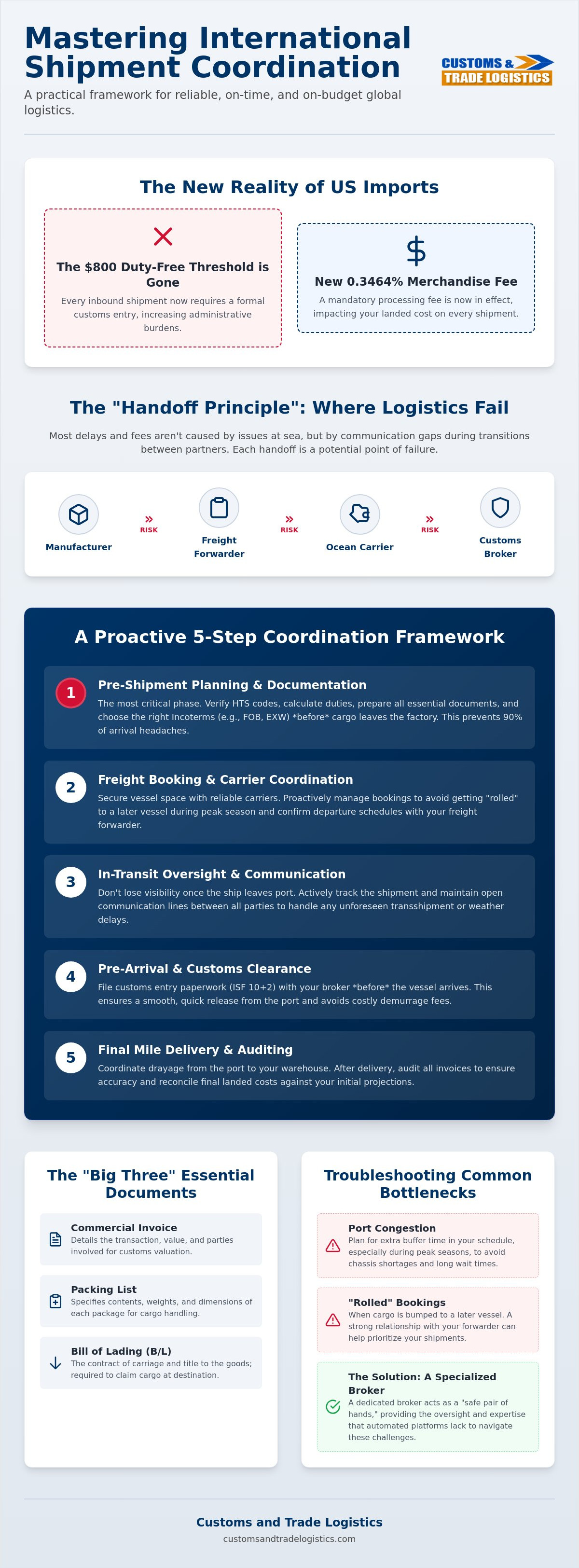
- Learn how the "Handoff Principle" identifies the exact moments where most logistics failures occur and how to manage stakeholders to prevent them.
- Discover a proven 5-step framework for coordinating international shipments that prioritizes pre-departure oversight to eliminate arrival headaches.
- Simplify your administrative burden by mastering the "Big Three" essential documents required for clean customs entries and predictable delivery schedules.
- Gain practical strategies for troubleshooting common bottlenecks, such as navigating port congestion and managing the risks of "rolled" bookings.
- Understand why a specialized broker provides a "safe pair of hands" for your supply chain, offering the dedicated oversight that automated digital platforms lack.
What is International Shipping Coordination and Why Does it Matter?
Shipping often looks like a simple straight line on a map, but the reality is much more like a high-stakes relay race. Coordinating international shipments is the strategic management of every stakeholder involved in that race. It isn't just about moving a container; it's about ensuring that the information flows as quickly and accurately as the cargo itself. When you master this, you move from being a passive observer of your supply chain to an active leader who dictates the pace.
We focus on what we call the "Handoff Principle." This is the idea that most logistics failures don't happen while a ship is in the middle of the ocean. Instead, they occur during the transitions between parties. If a trucker doesn't have the correct paperwork from the warehouse, or if your broker is missing a single digital file from the supplier, the entire chain grinds to a halt. These communication gaps lead to expensive demurrage and detention fees that can quickly turn a profitable quarter into a financial headache. In 2026, efficient coordination isn't just a "nice to have" feature; it's a vital competitive advantage for US businesses looking to scale without the stress of unpredictable costs.
The Key Players in Your Global Supply Chain
To coordinate effectively, you need to understand who is holding the baton at any given time. Each player has a specific role that impacts your final landed cost. It's about teamwork.
- The Manufacturer: Their job goes beyond production. They're responsible for precise packing, weight declarations, and labeling. A single error here can trigger a customs exam.
- The Freight Forwarder: Often described as the freight forwarder, this partner acts as the architect of the shipment journey. They piece together the rail, sea, and road routes to keep things moving.
- The Customs Broker: This is your advocate and essential link to US Customs and Border Protection (CBP). They translate complex regulations into clean entries.
The Difference Between Shipping and Coordinating
Is there a difference? Definitely. Shipping is the physical act of moving a box from point A to point B. Coordination is the management of the data, timing, and compliance that makes that movement possible. Many small businesses make the mistake of relying solely on their suppliers through "CIF" (Cost, Insurance, and Freight) terms. While this seems convenient, it often results in a total loss of control over the process. You're left waiting for updates that don't come until your goods are already stuck at a port.
The shift from reactive to proactive management is where the magic happens. Instead of wondering where your cargo is, you'll know exactly what's happening at every handoff point. This level of oversight ensures that your business stays agile, protected, and ready to meet customer demand without surprise fees or delays.
A Step-by-Step Framework for Coordinating International Shipments
Success in 2026 logistics requires a proactive stance. You can't wait for the cargo to hit the water before you start planning. Effective coordinating international shipments begins weeks before the first box is even packed. It starts with choosing the right Incoterms to define your boundaries. For example, Free on Board (FOB) gives you control over the ocean freight, while Ex Works (EXW) puts you in the driver's seat from the factory gate. Understanding these Export Shipping Basics ensures you know exactly where your responsibility starts and your supplier's ends.
Setting a realistic timeline is equally vital. In 2026, the peak shipping season started earlier than usual as retailers rushed to beat rising costs. You must account for potential port congestion and "rolled" bookings where cargo is bumped to a later vessel. A 5-step framework provides the structure you need to manage these variables without losing your mind or your profit margins.
Phase 1: Pre-Shipment Planning and Documentation
This is where most delays are born. Since the $800 de minimis threshold was suspended, every single shipment now requires a formal entry and is subject to duties. You must verify your Harmonized Tariff Schedule (HTS) codes and calculate the 0.3464% Merchandise Processing Fee before the cargo leaves. If you import regulated products, you'll also need to comply with the CPSC eFiling mandate that went into effect on July 8, 2026. Don't forget the Importer Security Filing (ISF). Filing this late can lead to a $5,000 penalty from CBP. We recommend a "triple-check" system to ensure the commercial invoice and packing list match perfectly.
Phase 2: The Transit and Customs Bridge
Once the goods are in transit, the focus shifts to visibility and timing. You should maintain a steady line of communication with your carrier to track any schedule changes. The goal is "Pre-Entry," which allows your broker to file paperwork while the vessel is still at sea. This proactive step can mean the difference between your goods clearing immediately or sitting in a terminal racking up storage fees. Finally, coordinate the "Last Mile" by having your domestic trucker ready the moment the container is discharged. If you're feeling the weight of these moving parts, our import from China consulting can help you streamline the entire process from the factory floor to your warehouse.
Managing the Documentation: The Heart of Coordination
Does the thought of international paperwork give you a headache? You aren't alone. Many business owners see the administrative side of trade as a confusing hurdle that slows down their growth. We like to think of documentation as the digital twin of your cargo. If that digital twin is messy or inaccurate, the physical goods simply won't move. In 2026, this accuracy is your best defense against delays. With the suspension of the de minimis threshold, every detail on your forms is now under a microscope by US Customs.
To keep coordinating international shipments from becoming a massive administrative burden, you must focus on the "Big Three" documents: the Bill of Lading, the Commercial Invoice, and the Packing List. These aren't just suggestions; they're the legal foundation of your trade. You'll also need to provide a signed Power of Attorney (POA). This simple document gives your customs broker the legal authority to act on your behalf, ensuring you don't have to navigate the technicalities of federal filings alone. As the industry moves toward fully digital documentation, a single typo can stop a shipment. Oversight is the key to keeping your supply chain fluid.
The Bill of Lading (BOL): Your Title of Ownership
The Bill of Lading serves as both a receipt for your goods and a contract of carriage between the shipper and the transporter. It's also a document of title. If you don't have the BOL in hand, you don't legally own the goods at the port of arrival. You'll likely encounter two versions: the House BOL issued by your freight forwarder and the Master BOL issued by the shipping line. Coordinating the release of these documents is the most critical step in ensuring your trucker can pull your container from the terminal before storage fees start to pile up.
Commercial Invoices and HTS Classification
Your commercial invoice is the primary document used for duty assessment. Vague descriptions like "plastic parts" or "machine components" are red flags that often trigger expensive customs exams. You need specific descriptions that match your HTS classification perfectly. Additionally, ensure your "Country of Origin" labeling is prominent and matches your paperwork exactly. Compliance isn't just about avoiding fines; it's about speed. For a deeper dive into these requirements, check out our guide on Customs Clearance Services in the US. Precision here ensures your goods move through the port while your competitors are still stuck in a paperwork audit.
Troubleshooting Common Coordination Bottlenecks
Even the best plans hit snags. When you're coordinating international shipments, you're dealing with global variables like weather, labor strikes, and overbooked vessels. These "logistics traps" often catch small businesses off guard, leading to expensive delays. Have you ever had a shipment "rolled"? This happens when a carrier overbooks a vessel and bumps your container to the next available sailing. It's a common headache during peak seasons, and without proactive oversight, you might not even know it happened until your inventory is a week late.
Delays aren't just about time; they're about money. If your cargo sits at the port past its "free time," you'll face demurrage fees. These can range from $150 to $500 per day per container. If the delay happens outside the port, such as a late container return, you'll be hit with detention fees. To minimize these "hidden costs," we recommend a "Logistics First Aid" checklist: verify the Last Free Day (LFD) immediately, confirm that all duties and fees are paid to avoid financial holds, and communicate delays to your warehouse team so they can reschedule labor. If you want to avoid these traps entirely, our International Freight Logistics team can manage the movement for you.
Avoiding Customs Delays and Exams
Customs exams are often random, but poor coordination increases the risk. Since the suspension of the $800 duty-free threshold in 2025, US Customs and Border Protection (CBP) has increased its scrutiny of all inbound shipments. A vague description on an invoice is like an invitation for an intensive inspection. Having a continuous Customs Bond in place is essential; it ensures your goods aren't held up at the port while you scramble to process a single-entry bond. If your shipment is flagged for an exam, don't panic. Provide the requested documentation quickly and let your broker handle the communication with the port authorities.
Managing Communication Breakdowns
The "Time Zone Trap" is a real hurdle for US businesses. If you're in New York and your supplier is in Shanghai, you're 12 to 15 hours apart. A simple question can take 24 hours to answer, which is an eternity when a ship is docking. Standardizing your status updates is the best way to bridge this gap. Instead of chasing your partners for info, set a schedule for when you expect updates. This is where a reliable freight forwarder becomes invaluable. They act as your local eyes and ears, managing the flow of information so you can focus on your business instead of the clock.
Partnering for Success: Why a Specialized Broker is Your Best Coordinator
Why should you trust a faceless digital platform with your company's most valuable assets? While many logistics companies offer sleek apps and automated portals, coordinating international shipments in 2026 requires more than just code. It demands a "safe pair of hands" that understands the nuance of a changing regulatory environment. When a port strike looms or a new CPSC eFiling requirement is announced, you don't need a ticket number; you need a dedicated advocate who knows your business by name. Mastering the art of coordinating international shipments requires a partner who values personal connection as much as technical compliance.
Customs and Trade Logistics acts as a seasoned mentor for growing SMBs and Amazon sellers. We bring over 35 years of industry experience to the table, helping you manage the complexities we've discussed, from HTS classification to port congestion. We believe that a true partner doesn't just clear your cargo; they manage the entire chain to lift the administrative burden off your shoulders. This holistic approach ensures that your logistics strategy supports your growth rather than hindering it. We've seen every type of delay and regulation change since the 1980s, and we use that veteran perspective to keep your cargo moving when others get stuck.
The Personal Touch in a Digital World
Have you ever felt like just another entry in a massive database? In an industry that is becoming increasingly automated, we prioritize the personal connection. Being a family-owned consultancy means we treat your shipments with the same protective care we'd give our own. If things go wrong at the port, you have a dedicated expert ready to solve the problem in real-time. We take pride in demystifying the process for first-time importers, turning what feels like an intimidating hurdle into a transparent, step-by-step journey toward success. You aren't just a client; you're a partner in trade.
End-to-End Oversight: From China to Your Door
Our expertise is specifically tailored to the China-to-US shipping corridor, one of the most complex routes in global trade. We don't stop at the port of entry. Our team handles the entire progression, including delivery and redistribution services that ensure your goods reach their final destination without a hitch. By managing every handoff, we eliminate the gaps where delays typically hide. You can stop worrying about the logistics and get back to focusing on your sales and scaling your brand. We act as the knowledgeable bridge between your small-scale operation and the global marketplace. Ready to experience a more reliable way of doing business? Let us coordinate your next international shipment and provide the peace of mind you deserve.
Secure Your Supply Chain for 2026 and Beyond
You've seen that a resilient supply chain isn't just about moving cargo; it's about mastering the information that moves with it. By focusing on critical handoff points and prioritizing document accuracy, you can turn a chaotic logistics process into a predictable part of your business growth. In an era where new processing fees and strict filing requirements are the new standard, coordinating international shipments with precision is your best defense against unexpected costs.
You don't have to face these complex regulations alone. With over 35 years of industry experience and deep expertise across all US Customs ports, our family-owned team is here to act as your dedicated advocate. We provide the personal service that automated platforms simply can't match, ensuring your goods move smoothly from the factory floor to your door.
Ready to eliminate the stress of global trade? Get Expert Help Coordinating Your International Shipments today. Your business deserves a partner who cares as much about your success as you do. We're here to help you grow with confidence.
Frequently Asked Questions
How long does it typically take to coordinate an international shipment?
Coordination timeframes depend on your shipping mode and the origin of your goods. For ocean freight from China, you should begin coordinating international shipments at least 14 to 21 days before your production is finished. This lead time allows for vessel booking and ISF filing. Transit typically takes 20 to 45 days depending on the US port, while air freight moves much faster, usually arriving in 3 to 7 days.
What is the most common mistake made when coordinating international shipments?
The most frequent error is failing to verify documentation before the cargo leaves the factory floor. Since the $800 duty-free threshold was suspended in late 2025, even small errors in HTS classification or commercial invoices lead to immediate port holds. Many businesses also forget to account for the 0.3464% Merchandise Processing Fee, which creates unexpected financial friction at the point of entry and delays the release of goods.
Can I coordinate my own international shipping without a broker?
You can manage the freight bookings yourself, but handling customs entries without a licensed broker is a significant risk for most businesses. The regulatory landscape in 2026 is dense, featuring new requirements like the CPSC eFiling mandate that went into effect in July. A broker acts as your advocate, ensuring your filings are legally compliant. Without one, you're responsible for every technical detail, and a single mistake can result in heavy fines.
How much does it cost to have a professional coordinate my logistics?
Professional logistics coordination is priced based on the complexity and volume of your cargo. While it involves a service fee, it's designed to save you from much larger "hidden" costs. For example, avoiding just one day of demurrage fees, which often range from $150 to $500 per container, can cover much of the coordination cost. It's an investment in predictability and protecting your bottom line from surprise terminal charges.
What is an ISF filing and why is it critical for coordination?
An Importer Security Filing (ISF) is a mandatory document that must be submitted to CBP at least 24 hours before your goods are loaded onto a vessel. It's critical because failing to file, or filing late, results in an automatic $5,000 penalty. Proper coordinating international shipments ensures this data is transmitted early, preventing "no-file" holds that keep your cargo sitting at the origin port while the clock ticks on your delivery schedule.
How do Incoterms affect who is responsible for coordination?
Incoterms are the "rules of the road" that determine where your supplier's responsibility ends and yours begins. If you use Ex Works (EXW), you're responsible for the entire journey from the factory door. If you use Free on Board (FOB), your supplier coordinates the local transport to the port, and you take over once it's on the ship. Choosing the right term dictates your level of control over the shipping costs and timeline.
What should I do if my shipment is stuck at a US port?
You must first determine why the container isn't moving. Is it a Customs hold, a terminal exam, or a simple unpaid fee? Check that the Harbor Maintenance Fee (0.125%) and the Merchandise Processing Fee have been cleared. Once you identify the bottleneck, your broker can communicate with the terminal or CBP to resolve the issue. Speed is essential to avoid daily storage charges that accumulate quickly after your free time expires.
Does coordinating international shipments change for Amazon FBA sellers?
Amazon sellers face extra layers of coordination because they must adhere to strict FBA warehouse requirements. Beyond standard customs clearance, you must ensure your goods are palletized and labeled to Amazon's exact specifications. Timing is also more sensitive, as you need to coordinate the "last mile" delivery to match your specific FBA appointment slot. Failing to hit these windows can lead to carrier rejection or expensive inventory placement fees.
To manage your inventory more effectively and avoid these high placement costs, you may want to check out 100storage for professional storage services that can bridge the gap between shipment arrival and final fulfillment.


