
Did you know that shipping rates on the Asia-US West Coast trade lane have surged by over 200% in the last year? For many US importers, this volatility makes the dream of a predictable supply chain feel like a moving target. You've likely experienced the anxiety of a shipment stuck at a US port because of a simple paperwork error or felt the frustration of a "black hole" in your tracking data. It's exhausting to manage these moving parts while trying to find a reliable partner for your international freight forwarding needs.
We believe that global logistics shouldn't be a source of stress; it should be the backbone of your growth. This guide will help you master the current landscape, from managing Red Sea reroutes to handling the latest US Customs regulations. You'll learn how to choose a forwarding partner that acts as a protective mentor for your cargo. We'll walk through the steps to achieve predictable shipping costs and a seamless factory-to-door delivery process that gives you back your peace of mind.
Key Takeaways
- Learn how to view your logistics partner as a "supply chain architect" who manages every detail from the factory floor to your warehouse.
- Discover how the right international freight forwarding strategy balances LCL shipping and carrier selection to keep your costs predictable.
- Understand the vital link between shipping and customs clearance services to prevent the paperwork errors that cause costly port delays.
- Compare automated digital platforms with personalized logistics management to determine which model best protects your specific business interests.
- See how shifting from transactional shipping to a strategic partnership can improve your long-term delivery and redistribution efficiency.
International Freight Forwarding: Your Global Supply Chain Architect
Think of your global supply chain as a complex construction project. You wouldn't dream of building a skyscraper without a lead architect to design the blueprints and manage the specialized contractors; similarly, in the field of property development, you can learn more about ML Traffic Engineers UK and how they facilitate planning success through expert transport assessments. In the world of global trade, international freight forwarding serves that exact purpose. It isn't just about moving a container from point A to point B. It's the strategic management of an end-to-end chain that includes route planning, carrier selection, and the heavy lifting of complex documentation like commercial invoices and packing lists.
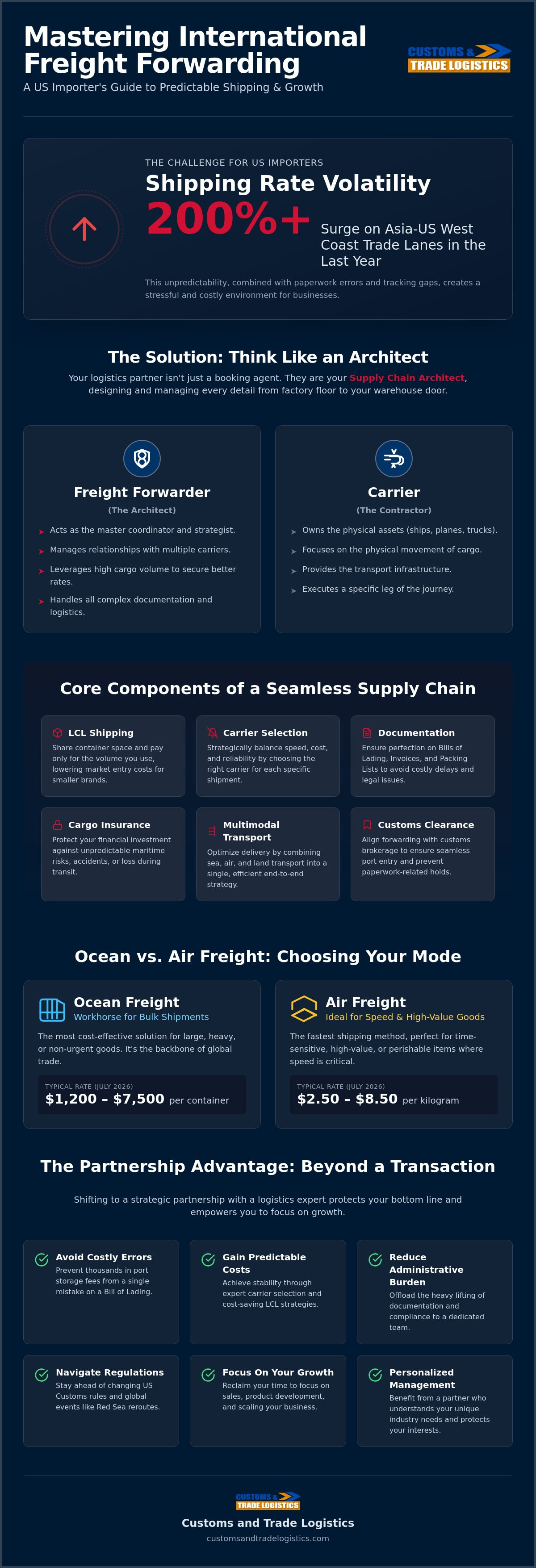
In 2026, the role of the Freight forwarder has evolved into something much more significant than a simple booking agent. With ocean freight rates on some trade lanes increasing by over 200% since last year, you need more than a transport provider. You need a partner who offers total supply chain oversight. Choosing the right partner for international freight forwarding means finding someone who understands the nuances of your specific industry. You should understand that a forwarder doesn't necessarily move the goods themselves. Instead, they act as the master coordinator, aligning the various entities that handle your cargo to ensure nothing falls through the cracks.
The Difference Between a Forwarder and a Carrier
What sets these two apart? A carrier is the company that actually owns the ships or planes. They focus on the physical movement of the cargo. A forwarder, however, manages the relationship with those carriers on your behalf. Because forwarders manage high volumes of cargo for many clients, they can often secure much better rates for small and medium-sized businesses than a single importer could get alone. This collective buying power levels the playing field for growing brands. For a deeper look at these roles, check out our essential guide for US importers.
Why Small Businesses Need Professional Logistics Oversight
Why should a growing brand invest in professional oversight? As your business scales, the risks of "going it alone" multiply quickly. A single error in a Bill of Lading can lead to thousands of dollars in port storage fees. We act as a "safe pair of hands," lifting the administrative burden off your shoulders so you can focus on sales and product development. Do you have the time to track changing US Customs regulations or monitor Red Sea reroutes daily? Probably not. By partnering with a seasoned expert, you gain the security of a veteran mentor who is deeply invested in your growth and protects your bottom line from unexpected delays.
Core Components of International Freight Forwarding Services
If your forwarder is the architect, then these core services are the building materials that keep your supply chain standing. Effective international freight forwarding relies on several synchronized events that happen long before your cargo reaches a US port. It starts with consolidation, or Less than Container Load (LCL) shipping. This is a lifesaver for smaller brands because it allows you to share container space with other importers. You only pay for the volume you use, which significantly lowers your entry cost into the global marketplace. Once your goods are ready, carrier selection becomes a balancing act of speed, cost, and reliability.
Managing the "paper trail" is another heavy administrative burden we handle for you. Documentation like the Bill of Lading, Commercial Invoice, and Packing List must be perfect to avoid legal snags during transit. We also strongly recommend cargo insurance to protect your investment against unpredictable maritime risks or accidents. Multimodal transport is a strategy that combines sea, air, and land to optimize delivery. If you're feeling overwhelmed by these choices, exploring our international freight logistics can help clarify the best path for your specific cargo.
Ocean vs. Air Freight: Choosing the Right Mode
How do you decide between the sea and the sky? The choice usually comes down to weight, volume, urgency, and your budget. Air freight is currently costing between $2.50 and $8.50 per kilogram in July 2026, making it ideal for high-value or urgent goods. Ocean freight remains the workhorse for bulk shipments, with rates ranging from $1,200 to $7,500 per container depending on the route. A seasoned partner is essential for coordinating international shipments that may require a mix of both modes to meet your deadlines. We're also seeing a shift toward greener technologies as the industry works toward decarbonization goals set by the International Maritime Organization.
The Importance of Real-Time Coordination
Automated tracking platforms are helpful, but they don't solve problems when a crisis hits. When geopolitical risks in the Red Sea add 7 to 14 days to a journey, you need a human advocate who can pivot your strategy in real time. We manage the "transfer of risk" points throughout the journey, ensuring your cargo moves smoothly through redistribution and final-mile delivery. The International Trade Administration highlights the distinct roles of Customs Brokers and Freight Forwarders, but we believe these functions should work in total harmony. This personal oversight replaces your shipping anxiety with a sense of security, knowing a "safe pair of hands" is watching every mile.
The Critical Link: Why Customs Brokerage and Forwarding Must Align
Have you ever heard an importer say that shipping is the easy part? It's a common sentiment because the physical movement of cargo is often more predictable than the legal process of crossing a border. Many businesses get "stuck" at the port, not because the ship didn't arrive, but because their paperwork hit a wall. When your international freight forwarding strategy is disconnected from your customs brokerage, you risk creating "orphaned" shipments. This happens when the person moving your box doesn't communicate clearly with the person legalizing its entry. If the data on your Bill of Lading doesn't perfectly match your Customs Entry, your cargo sits in administrative purgatory while storage fees climb.
We solve this by providing integrated customs clearance services that act as a bridge between transport and compliance. In 2026, the regulatory landscape is shifting quickly. With the ongoing USMCA annual reviews and new e-commerce regulations, having a partner who interprets these changes in real time is vital. Our goal is to ensure that your international freight forwarding experience is a smooth, continuous motion rather than a series of disconnected hurdles.
Navigating US Customs Entry at All Ports
Does your business ship into Los Angeles, Savannah, or New York? You need port-agnostic expertise that can clear cargo anywhere in the United States. Different ports often have local nuances, especially when you're handling specialized goods like textiles or complex electronics that require additional agency oversight. A single error in a Customs Entry can lead to storage fees far exceeding the original shipping cost. We act as your diligent advocate, double-checking every HTS code and valuation to ensure your entry is filed correctly the first time, regardless of where your ship docks.
Specialized Expertise for China Imports
Success when importing from China requires a very specific compliance strategy. Between Section 301 tariffs and fluctuating trade duties, the financial stakes are high for US brands. We provide the protective care of a consultant who understands both the factory floor in Ningbo and the terminal requirements in Long Beach. This "factory-to-door" oversight means we help you manage the specific documentation required for Chinese exports while preparing your US Customs filings simultaneously. This proactive approach eliminates the friction that often plagues high-volume trade lanes and keeps your supply chain moving with professional assurance.
Choosing a Partner: Digital-Only vs. Personalized Logistics Management
How do you decide who to trust with your livelihood? As you look for the right partner for international freight forwarding, you'll likely encounter two distinct models. Digital freight forwarders are tech platforms built for speed. They focus on automated booking and real-time tracking dashboards. On the other side, you have personalized, traditional forwarders. These are consultancies that prioritize relationships and complex problem-solving. While a sleek dashboard looks great on a laptop, it can't negotiate with a terminal manager when your cargo is stuck behind a port strike.
We believe the "hidden cost of automation" is one of the biggest risks for US importers in 2026. Automated systems are excellent when everything goes perfectly. However, with global schedule reliability hovering between 62% and 65% this year, things often don't go perfectly. When a ship is rerouted around the Cape of Good Hope, adding 14 days to your transit, an algorithm won't help you find a new redistribution strategy. You need a human advocate who understands your business goals. For most importers, the gold standard is a hybrid model. This combines the efficiency of modern tech with the protective care of an expert mentor. If you want a partner who prioritizes your growth over simple data entry, consider our international freight logistics services.
When Does 'Cheap' Become 'Expensive'?
It's tempting to choose a partner based solely on the lowest service fee. But have you calculated your total landed cost? A "cheap" provider might lack the oversight to catch a simple HTS code error. If that mistake leads to a customs hold, the resulting storage fees will quickly erase any initial savings. A family-owned firm offers a level of accountability that massive corporations simply can't match. We treat your cargo with the same diligence we'd use for our own family, ensuring that your "safe pair of hands" actually catches the problems before they cost you money.
Questions to Ask a Potential Forwarding Partner
Before you sign a contract, you need to dig deeper into their operational reality. Ask these three critical questions:
- Do you have in-house customs brokerage capabilities? As we discussed earlier, disconnected silos lead to delays.
- How do you handle communication during transit delays? You need to know if you'll be talking to a bot or a dedicated account manager.
- What is your experience with my specific product category? Handling electronics is very different from managing textiles or heavy machinery.
The right partner won't just give you a price; they'll offer a strategy that secures your entire supply chain and gives you the confidence to scale.
Optimizing Your Import Strategy for Long-Term Growth
Are you treating your logistics as a simple line item or a competitive advantage? Many businesses start by viewing international freight forwarding as a transactional necessity. They look for the lowest rate for a single box. But as you scale, this "one-off" approach often leads to bottlenecks. True growth happens when you shift to a strategic partnership. This means your forwarder isn't just a vendor; they're an extension of your team who understands your long-term goals. They help you improve delivery and redistribution efficiency by identifying patterns in your supply chain that you might miss while focused on daily operations.
A key part of this strategy involves selecting the right regional partners for the final stages of transit. For instance, Sameday Express Inc. offers specialized courier services that can enhance your redistribution efficiency across Canada, ensuring that the last leg of the journey is as reliable as the first.
We believe in leveraging the data from your past shipments to build a smarter future. By analyzing transit times and seasonal cost fluctuations, we can help you optimize your routes. For instance, if data shows that port congestion in Shanghai or Ningbo is peaking, we might suggest rerouting through a different hub to maintain your timelines. Professional outsourcing also reduces the administrative weight on your internal staff. Instead of your team chasing down carriers or filing paperwork, they can focus on product innovation and customer acquisition. This shift provides the relief of knowing your international freight forwarding is in a "safe pair of hands."
Logistics for Amazon FBA and E-commerce Sellers
E-commerce brings a unique set of challenges, especially when shipping from a factory directly to an Amazon warehouse. Amazon has strict requirements for labeling, palletizing, and delivery windows that can trip up even experienced importers. Avoiding these compliance pitfalls is essential for high-volume online sellers who can't afford inventory delays. You can find specific benefits in our FBA freight forwarding services, which are designed to manage inventory flow with precision. We act as a knowledgeable bridge, ensuring your goods meet every Amazon standard before they even reach the US border.
Building a Resilient Supply Chain
In 2026, resilience is the name of the game. With geopolitical risks in the Red Sea adding significant transit time and changing US Customs regulations affecting low-value shipments, you can't afford to rely on a single mode or port. Diversifying your strategy helps you avoid regional bottlenecks and keeps your business agile. Consistent communication is the glue that holds this stability together. We provide the steady, methodical oversight needed to navigate these complexities without the stress. Ready to take the next step? Partner with a seasoned expert to secure your international freight today and let us help you build a supply chain that supports your vision for years to come.
Taking Command of Your Global Journey
Mastering your supply chain is about more than just moving boxes; it's about building a foundation for your business to thrive on the global stage. You've seen how a strategic approach to international freight forwarding can replace port-delay anxiety with the confidence of predictable timelines. By aligning your transport logistics with expert customs brokerage, you ensure that every shipment arrives at your door without the sting of unexpected storage fees or compliance errors. This shift from transactional shipping to a strategic partnership is the key to scaling your brand with peace of mind.
We are ready to act as your seasoned mentor in this complex industry. With 35+ years of industry-leading expertise, our family-owned and operated firm provides the personalized accountability that larger corporations often lack. Our integrated customs brokerage ensures seamless port clearance, giving you a single "safe pair of hands" for the entire journey. It's time to stop reacting to logistics crises and start growing with a partner who is deeply invested in your success.
Secure your global supply chain with a personalized logistics consultation
The world of trade is waiting for your brand, and we're here to help you navigate it with ease and professional assurance.
Frequently Asked Questions
What exactly does an international freight forwarder do?
An international freight forwarder acts as the master coordinator for your global shipments. While they don't usually own the ships or planes, they manage the entire journey by booking space with carriers, organizing documentation, and arranging land transport. They find the most efficient routes and handle the heavy administrative burden so you can focus on your business growth. Think of them as your dedicated advocate in a complex global marketplace.
Is a freight forwarder the same as a customs broker?
No, they serve different but overlapping roles in the shipping chain. A forwarder focuses on the logistics of moving cargo, while a broker specializes in the legal entry of goods into the US. Many modern firms provide both services under one roof to prevent data mismatches and port delays. This integrated approach ensures your logistics and compliance strategies work in total harmony to protect your bottom line.
How much do international freight forwarding services typically cost?
Costs vary significantly based on your cargo volume, weight, and the chosen mode of transport. You'll typically see fees for carrier booking, documentation preparation, and handling. It's best to look at the total landed cost rather than just the shipping rate. A reliable partner provides a transparent breakdown that includes all necessary fees to avoid hidden surprises at the end of the journey. This clarity helps you maintain predictable shipping budgets.
Can a freight forwarder help me with imports from China?
Yes, they are essential for navigating the specific complexities of the China-US trade lane. A forwarder helps you manage factory-to-port logistics in China and ensures your documentation meets both Chinese export and US import requirements. They also provide guidance on managing Section 301 tariffs and other trade-specific duties that can impact your costs. Having a partner who understands both the factory floor and the US port is a major advantage.
What documents do I need for international freight forwarding?
You'll primarily need a Bill of Lading, a Commercial Invoice, and a Packing List. Depending on the type of goods, you might also require a Certificate of Origin or specialized permits for items like electronics or textiles. Your forwarding partner will review these documents to ensure every detail is accurate before your cargo reaches the port. This proactive check prevents the paperwork errors that lead to costly administrative holds and storage fees.
How do I choose between air freight and ocean freight?
You should base your decision on your budget, cargo volume, and how quickly you need the items. Air freight is faster and more secure but carries a higher cost per kilogram. Ocean freight remains the most cost-effective solution for bulk shipments but requires much longer lead times. A forwarder helps you balance these factors to find the right mode for each specific shipment, ensuring you don't overspend on urgency you don't need.
What happens if my shipment is delayed at the port?
Your forwarder will investigate the cause and act as your advocate to resolve the issue as quickly as possible. Delays often stem from paperwork errors, port congestion, or customs inspections. Your partner will communicate with terminal managers and customs officials to clear the bottleneck. Having a "safe pair of hands" during a delay is vital for minimizing expensive storage and demurrage fees that can quickly erode your profit margins.
Does a freight forwarder provide insurance for my cargo?
Most forwarders can arrange cargo insurance on your behalf to protect your investment against damage or loss during transit. Standard carrier liability is often very limited and rarely covers the full value of your goods. Arranging dedicated insurance through your international freight forwarding partner provides an extra layer of security. It ensures you're protected against unpredictable maritime risks, accidents, or weather-related disruptions that occur on the open sea.


