
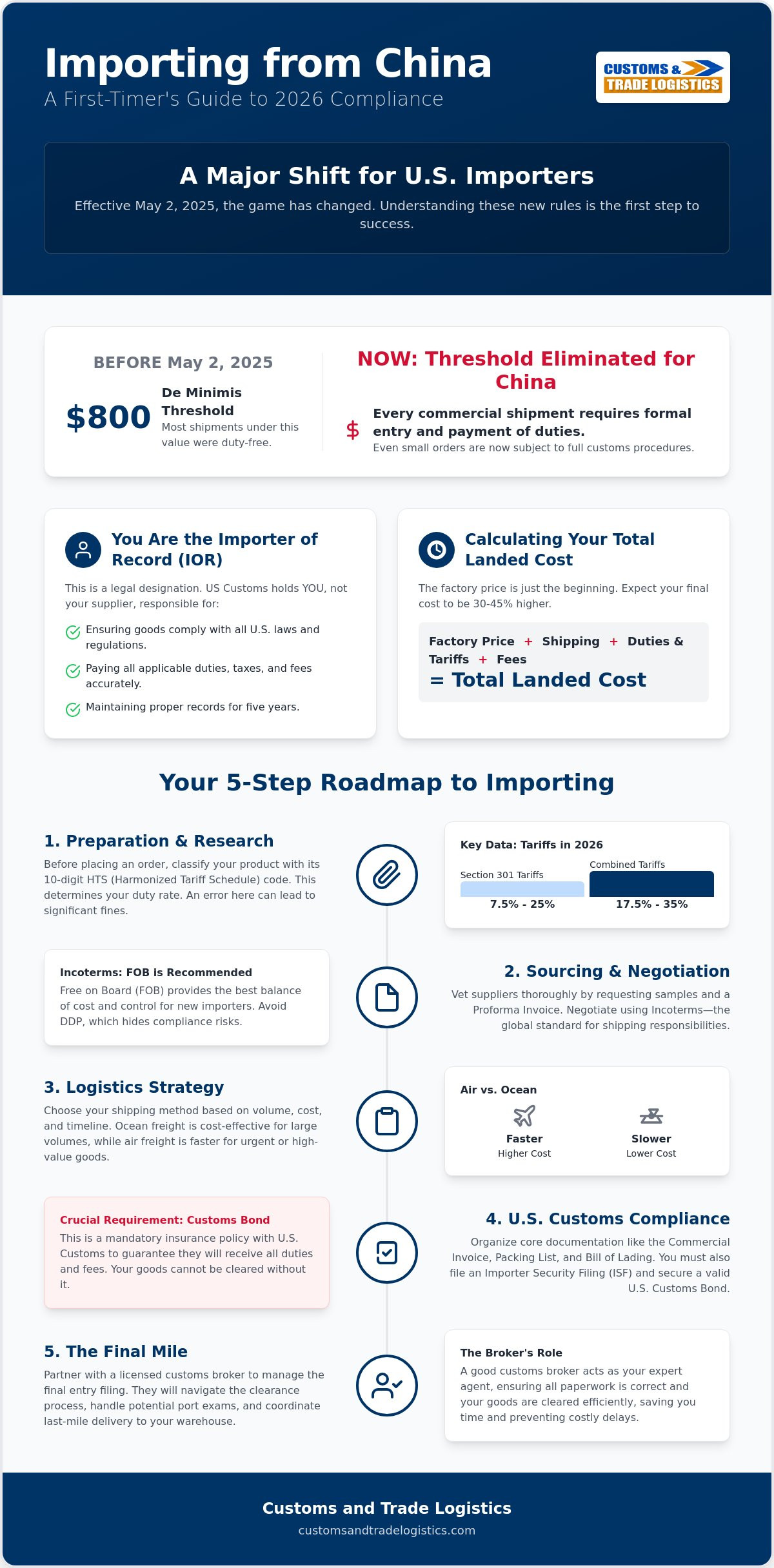
Did you know that as of May 2, 2025, the $800 duty-free threshold for shipments from China was completely eliminated? This means every commercial order now requires formal entry and incurs customs duties, making it vital to understand how to import from China for the first time before you place your first order. If you feel a bit paralyzed by the thought of your cargo being seized or hit with hidden fees, you aren't alone. It's perfectly normal to feel anxious about shipping jargon and the mountain of paperwork required by US Customs.
We believe that growing your business should feel like a partnership, not a gamble. This guide provides a methodical roadmap to help you manage suppliers and logistics without the stress of unexpected delays. We will walk you through the 2026 compliance requirements, from filing your Importer Security Filing (ISF) correctly to calculating your total landed costs with precision. By the end of this article, you will have a clear, manageable process to ensure your goods arrive on time and within your budget.
Key Takeaways
- Identify your product's HTS code and understand your responsibilities as the Importer of Record to avoid unexpected fees or legal delays.
- Master the essentials of how to import from China for the first time by vetting your suppliers through samples and negotiating clear Incoterms.
- Select the most cost-effective shipping strategy by comparing air and ocean freight based on your specific volume and timeline needs.
- Secure a valid US Customs Bond and organize your core documentation to streamline the clearance process and satisfy federal requirements.
- Partner with a licensed customs broker to manage the final entry process and navigate potential port exams with professional confidence.
Preparation: Essential Groundwork Before Your First China Import
Before you even browse a supplier's catalog, you need to understand that importing isn't just a purchase; it's a legal commitment. When you learn how to import from China for the first time, your business takes on the role of the Importer of Record (IOR). This means you are legally responsible for ensuring your goods comply with all US laws, paying duties, and maintaining accurate records. US Customs doesn't look at the factory in Shenzhen if something goes wrong; they look at you.
One of the most critical steps in this groundwork is identifying your product's Harmonized Tariff Schedule (HTS) code. This 10-digit number determines exactly how much duty you'll pay. In 2026, many goods are subject to Section 301 tariffs ranging from 7.5% to 25%, while combined tariff rates, including baseline duties, often reach between 17.5% and 35%. Additionally, since the $800 de minimis threshold was eliminated on May 2, 2025, even small-value commercial shipments now require formal entry and incur duties. If your product falls under a Partner Government Agency (PGA) like the FDA or EPA, you'll need to meet their specific filing requirements before your cargo can leave the port.
Classifying Your Goods with HS Codes
An HS code is essentially a universal language for products. Accuracy here is non-negotiable because even a minor error can lead to significant financial penalties. For instance, classifying a "plastic-coated wooden frame" as "plastic" instead of "wood" could result in thousands of dollars in fines for misdeclaration. To build a solid foundation, check out our guide on import logistics for startups to see how classification fits into your broader business strategy.
Understanding US Import Regulations and Restricted Items
The history of 'Made in China' reflects a massive evolution in global trade, but it also means US Customs has developed rigorous standards for specific categories. Items like electronics, children's toys, and food products often require extra permits or safety certifications.
US Customs and Border Protection expects you to exercise "Reasonable Care." This is a legal standard that requires you to be proactive about your compliance. If you're dealing with a complex or high-value item, we often recommend seeking a preliminary ruling from Customs to get a definitive answer on classification before you ship. This extra step provides the peace of mind that your first venture into global trade is built on a stable, compliant foundation.
Sourcing and Negotiation: Setting the Foundation for Success
Finding a supplier is often the most exciting part of the journey, but it's also where the most significant risks hide. When you are learning how to import from China for the first time, you must shift your focus from finding the lowest price to finding the most reliable partner. A manufacturer that offers a rock-bottom price might save you money upfront, but if they don't understand official U.S. import regulations, you could face massive fines or seized goods later. Always request a Proforma Invoice early in the process. This document acts as your roadmap, detailing the product specifications, unit costs, and the specific "Country of Origin" markings required by US Customs.
Negotiation isn't just about the money; it's about the "landed cost." In 2026, importers should expect the total cost of getting goods to their warehouse to be 30% to 45% higher than the initial factory price. If you're feeling stuck on which shipping terms to choose, our team offers import from China consulting to ensure your first deal is built on a safe, predictable foundation.
Mastering Incoterms: FOB vs. EXW vs. DDP
Incoterms are the three-letter codes that define who is responsible for the cargo at every stage of the journey. For most beginners, FOB (Free on Board) is the gold standard. Under FOB, the supplier handles everything in China until the goods are on the ship, giving you more control over the international freight costs.
We generally advise against DDP (Delivered Duty Paid) for your first shipment. While it sounds easy because the supplier "handles everything," it often leaves you in the dark regarding customs compliance and hidden fees. On the other end, EXW (Ex Works) requires you to manage the logistics from the factory floor in China to the port, which is often too complex for a first-time importer to handle alone.
Vetting Your Chinese Manufacturer
Trust, but verify. Before sending a deposit, ask for a copy of the supplier's business license and their Chinese export permit. A legitimate factory will have no problem sharing these documents. We also recommend using video calls for a "virtual tour" of the facility. Seeing the production line in real-time confirms the factory actually exists and isn't just a middleman.
- Request Samples: Never skip the sample phase. It's your only chance to verify quality before committing to a bulk order.
- Third-Party Audits: If your order is large, consider hiring a local inspection service like The Inspection Company to check the goods before they are packed.
- Written Contracts: Ensure your agreement specifies quality standards and what happens if the goods arrive damaged or incorrect.
Establishing these clear boundaries early creates a sense of security and partnership. It moves the relationship from a simple transaction to a professional collaboration that supports your long-term growth.
Logistics Strategy: Choosing the Right Way to Move Your Cargo
Once your supplier has the goods ready, you face a pivotal decision: how will that cargo reach the US? Choosing a shipping method is about more than just finding the lowest price on a screen. It's a strategic choice that affects your cash flow, inventory levels, and customer satisfaction. When you're figuring out how to import from China for the first time, we recommend starting with a clear understanding of your timeline and budget constraints. For a deeper dive into these complexities, our guide on import from China logistics offers a detailed look at the 2026 landscape.
Air Freight vs. Ocean Freight: The Trade-off
The choice between air and sea usually comes down to speed versus cost. Air freight is incredibly fast, typically taking only 3 to 5 days, but it's also 5 to 8 times more expensive than ocean freight. It's the best fit for high-value electronics, lightweight items, or urgent restocks. On the other hand, ocean freight takes much longer, about 25 to 35 days, but offers massive savings for bulky or high-volume orders. As of April 2026, shipping a 20-foot container from Shanghai to Los Angeles costs between $2,200 and $3,800. If you need a middle ground, some carriers offer sea-air hybrid options that provide a balance of speed and affordability. Reviewing U.S. Customs and Border Protection's tips for new importers can also help you understand how different shipping modes impact your entry requirements.
FCL vs. LCL: Optimizing Your Shipping Budget
If you choose ocean freight, you'll need to decide between Full Container Load (FCL) and Less than Container Load (LCL). LCL allows you to pay only for the space you use by sharing a container with other importers. While cost-effective for small batches, LCL carries a slightly higher risk of delays because the container must be consolidated in China and deconsolidated in the US. FCL gives you the entire container to yourself, providing better security and faster transit because the container stays sealed from factory to warehouse. A good rule of thumb is to switch from LCL to FCL once your shipment reaches about 15 cubic meters, as the flat rate for a full container often becomes cheaper than paying by the cubic meter.
Don't forget to account for landside costs. Your quote might cover the trip across the Pacific, but you still need to pay for port fees, customs clearance, and the final truck delivery to your door. Planning for these end-to-end costs ensures your first import journey ends with a profit, not a surprise bill. We are here to help you map out these final steps so your goods move smoothly from the port to your redistribution center.
US Customs Compliance: The Critical Paperwork Phase
Navigating the paperwork is often the part that causes the most anxiety for new business owners. When you're learning how to import from China for the first time, it's vital to view these documents as your legal gatekeepers rather than just administrative chores. One missed deadline can lead to thousands of dollars in "no-file" penalties. The most critical deadline is the Importer Security Filing (ISF), also known as "10+2." You must file this electronically at least 24 hours before the vessel is loaded at the Chinese port. If the ISF is late or missing, US Customs may issue a $5,000 fine per violation.
How do you ensure every form is filed correctly and on time? Managing these moving parts requires precision and a deep understanding of federal regulations. If you want to ensure your paperwork is perfect every time, our team provides expert customs clearance services to handle the heavy lifting for you.
The Role of a Customs Bond
Think of a customs bond as a financial guarantee to the US government. It ensures that all duties, taxes, and fees will be paid even if your business faces financial trouble. For a one-off shipment, a Single Entry Bond might seem like the logical choice. However, if you plan to import more than twice a year, a Continuous Bond is much more efficient. It covers all your entries at every US port for a full year. A licensed broker can facilitate the purchase of these bonds quickly, often within 24 to 48 hours, ensuring your cargo isn't held up at the dock.
Essential Documentation Checklist
Accuracy is everything. Your documentation must tell a consistent story to US Customs and Border Protection. Any discrepancy between your invoice and your packing list can trigger a manual inspection. For a deeper look at these requirements, see our guide on customs clearance services us.
- Commercial Invoice: This must match the actual transaction value. Under-valuing goods to save on duties is a major fraud flag that can lead to seizures.
- Packing List: This provides a detailed breakdown of every carton, including weight and dimensions, which is vital for physical inspections.
- Bill of Lading (BOL): This is your contract of carriage and serves as the title to the goods. You cannot claim your cargo without it.
Once the ship arrives, the "Entry" (CBP Form 3461) is filed to secure the release of your goods. Within 10 working days of that release, the "Entry Summary" (CBP Form 7501) must be filed, and duties must be paid. By staying organized and respecting these timelines, you replace the fear of the unknown with the confidence of a compliant importer.
The Final Mile: Clearing Customs and Last-Mile Delivery
Your cargo has finally reached the US coast, but the journey isn't over yet. Understanding how to import from China for the first time means preparing for the final logistical hurdles that happen on American soil. This stage is where your preparation meets the reality of US Customs and Border Protection (CBP) operations. Once the ship docks, your customs broker initiates the "Entry" process to secure the release of your goods. While many first-time importers worry about this phase, having a seasoned partner makes the transition from sea to shore feel like a natural next step.
It's important to remember that even with perfect paperwork, CBP may select your shipment for an exam. This could be a non-intrusive X-ray (VACIS exam) or a more intensive physical exam at a Centralized Examination Station (CES). While these exams are unpredictable, a dedicated broker will coordinate the movement of the cargo and keep you informed of any associated costs or timelines. Once cleared, you're ready for the final leg: moving the goods to their destination.
Why a Professional Broker is Your Best Asset
In an era of automated digital platforms, it's easy to think a software dashboard is all you need. However, software can't advocate for you when a shipment is flagged for an unexpected exam. At Customs and Trade Logistics, we bring over 35 years of family-owned expertise to every entry. We act as a "safe pair of hands" to navigate shifting trade laws and port-specific regulations. A professional broker doesn't just file paperwork; they manage the timing to help you avoid expensive demurrage and detention fees. These daily storage charges at the port can quickly eat into your profit margins if your clearance isn't handled with precision.
Redistribution and FBA Delivery
Whether your goods are headed to a private warehouse, a 3PL, or an Amazon fulfillment center, the final delivery must be coordinated carefully. For those selling on marketplaces, our Amazon seller import help guide details the strict labeling and palletization requirements required for FBA. We provide comprehensive Delivery and Redistribution services to ensure your inventory is compliant before it ever reaches the Amazon dock. This end-to-end oversight prevents the stress of rejected shipments or "last-mile" delays.
Finally, remember that your responsibility as an importer doesn't end when the goods are sold. You must keep all import records, including the commercial invoice, packing list, and entry summary, for at least five years. CBP can audit these records at any time. By maintaining a clean paper trail and partnering with a mentor who values your growth, you turn a complex international operation into a repeatable, successful business model.
Ready to Launch Your Global Trade Journey?
Mastering how to import from China for the first time is about building a foundation of compliance and clear communication. By prioritizing your HTS classification early, selecting the right Incoterms, and ensuring your ISF is filed on time, you transform a complex international process into a manageable business strategy. Success in 2026 requires more than just finding a supplier; it requires a commitment to the "Reasonable Care" standards set by US Customs. This preparation ensures that your first shipment is the start of a predictable, profitable venture.
You don't have to manage this administrative burden alone. With 35+ years of industry expertise, our family-owned firm acts as your dedicated mentor, providing a safe pair of hands for your cargo at every US port. We are here to help you navigate shifting trade laws and ensure your goods move seamlessly from the factory to your warehouse. If you're ready to secure your supply chain and grow with confidence, we invite you to Get a Personalized Consultation for Your First China Import today. Your global business expansion is within reach, and we look forward to being your stabilizing partner in the marketplace.
Frequently Asked Questions
Do I need a special license to import from China to the USA?
No general import license is required for the majority of commercial goods entering the US. You usually only need your IRS business tax ID (EIN) or your Social Security number to act as the Importer of Record. However, certain regulated products like medical devices, food, or children's toys may require specific permits from partner government agencies like the FDA or CPSC.
How much does it cost to hire a customs broker for a first-time import?
Fees for professional clearance depend on the volume of your shipment and the complexity of the product classification. Because the $800 duty-free threshold was eliminated in May 2025, all commercial shipments now incur entry fees regardless of their value. We recommend focusing on the value of a professional partner who ensures compliance rather than searching for the lowest transaction cost.
What is the 10+2 rule (ISF) and why is it critical for China imports?
The Importer Security Filing (ISF) is a mandatory electronic document for all ocean cargo arriving in the US. You must file it at least 24 hours before the vessel departs from the Chinese port. It includes 10 data elements from the importer and 2 from the carrier. Missing this deadline can lead to a $5,000 fine and significant delivery delays.
How long does it typically take to ship from China to the US in 2026?
In 2026, air freight remains the fastest option, typically taking 3 to 5 days for delivery. Ocean freight is much more economical but takes significantly longer, usually between 25 and 35 days depending on the destination port. These timelines can fluctuate based on port congestion, so we always suggest building a buffer into your inventory planning cycles.
What happens if my goods are seized by US Customs?
If CBP seizes your goods, you'll receive a "Notice of Seizure" detailing the specific legal violation. This often happens due to intellectual property issues, safety violations, or mislabeled "Made in China" markings. You can file a petition to explain your case, but the process is time-consuming and often requires professional brokerage assistance to resolve the compliance error.
Can I import from China as an individual or do I need a business entity?
You can certainly import as an individual using your Social Security number, but establishing a business entity like an LLC is often more practical for tax and liability reasons. For entrepreneurs in the setup phase, using the Secretary of State Directory is a helpful way to verify name availability and research business entities across all 50 states. When you are researching how to import from China for the first time, consider that using an EIN provides a more professional appearance to international suppliers and logistics partners while protecting your personal assets.
How are import duties calculated for products coming from China?
Duties are determined by multiplying the transaction value of the goods by the percentage rate listed in the Harmonized Tariff Schedule (HTS). In 2026, you must also account for Section 301 tariffs, which add an extra 7.5% to 25% to the cost of many Chinese-made products. These combined rates often range from 17.5% to 35% of the product's value.
What is the difference between a freight forwarder and a customs broker?
A freight forwarder acts like a travel agent for your cargo, coordinating the trucks, planes, and ships that move the goods across borders. A customs broker is a licensed expert who handles the legal bridge between your cargo and the US government. They ensure all duties are paid, paperwork is filed correctly, and your business remains in total compliance with federal laws.


