
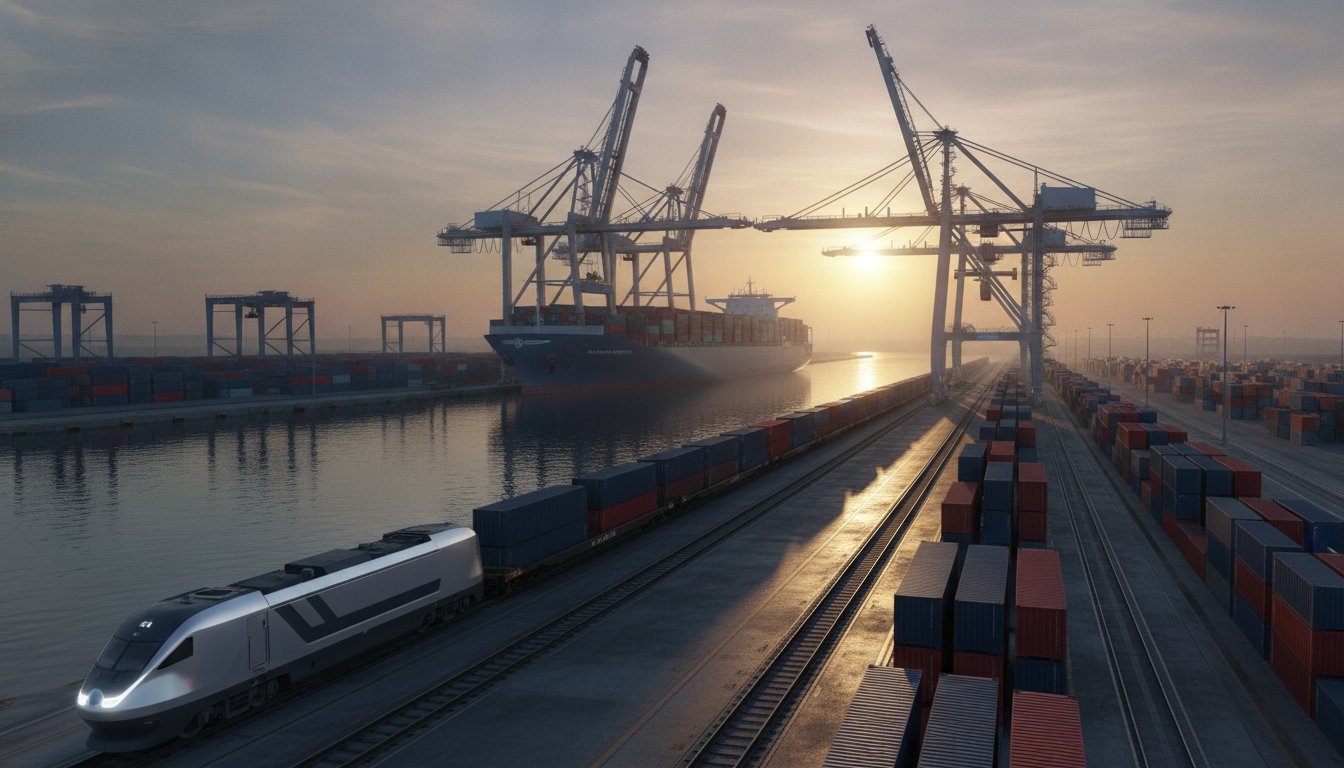
With the Howard Street Tunnel now officially supporting double-stacked container trains as of June 2026, the Port of Baltimore has transformed into a high-capacity gateway for your entire U.S. supply chain. However, having more capacity doesn't automatically mean fewer headaches for your business. Managing Port of Baltimore import logistics often feels like a moving target, especially when you're balancing the new July 2026 CPSC electronic submission requirements with shifting Section 301 tariffs on Chinese goods. You want to focus on scaling your operations, not decoding complex customs paperwork or stressing over unpredictable terminal delays.
We understand that the administrative burden of international trade can feel overwhelming. That's why we've designed this expert-led roadmap to help you master the complexities of commercial shipping from China. We'll show you how to navigate the current regulatory environment with confidence and security. This guide provides a clear step-by-step process to reduce your risk of customs audits, manage shipping costs, and ensure efficient redistribution to your final destinations across the country. By the end of this article, you'll have a reliable strategy to move your cargo from the factory floor to the customer's door with total peace of mind.
Key Takeaways
- Discover why Baltimore's strategic location and recent infrastructure upgrades offer a faster route to major Midwest and Atlantic markets.
- Learn how to coordinate seamless ocean freight from China by selecting the right Incoterms as part of your Port of Baltimore import logistics strategy.
- Avoid the stress of customs audits and unexpected delays by mastering HTS codes and the latest 2026 regulatory submission requirements.
- Gain a clear understanding of the drayage process to move your containers efficiently from the terminal to their final U.S. destination.
- Find out how a dedicated logistics partner acts as a protective bridge between your operations and the global marketplace.
The Strategic Value of Port of Baltimore Import Logistics
Port of Baltimore import logistics isn't just a technical term for moving a container from a ship to a truck. It's the comprehensive, end-to-end management of your commercial goods as they enter the U.S. East Coast. This process involves everything from coordinating with ocean carriers to navigating the complex web of federal regulations that govern international trade. For many commercial importers, this port represents the most efficient bridge between global manufacturing hubs and the American consumer.
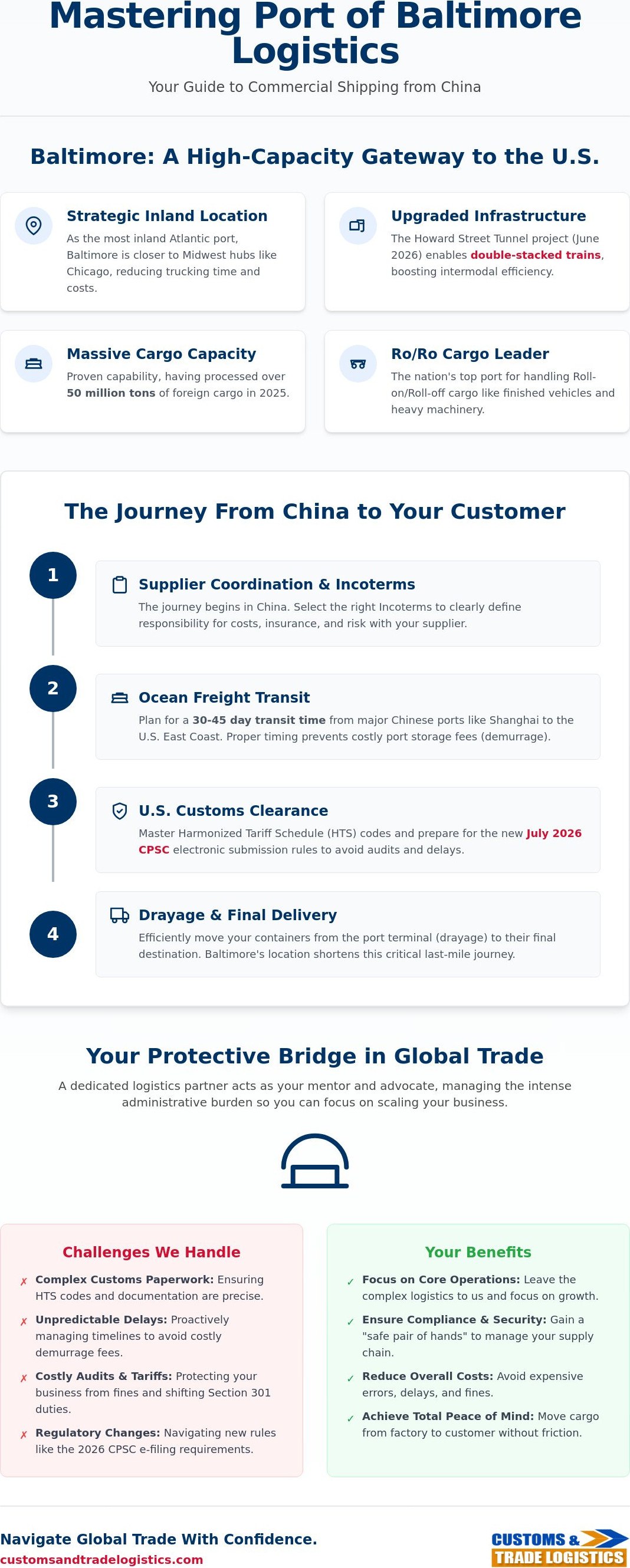
What makes this location so vital? Its geography is a massive competitive advantage. Baltimore is located further inland than any other Atlantic port, placing it closer to the industrial heartland of the Midwest. This proximity means your goods spend less time on a truck or train once they leave the terminal. For a deeper look at the facility's history and capacity, this Port of Baltimore overview highlights why it remains a top-tier choice for global shippers, especially as it processed 50 million tons of cargo in 2025.
Many commercial importers are shifting their focus here to avoid the historical congestion and labor uncertainties often found at West Coast ports. While Baltimore is a premier hub, it's important to remember that professional brokerage and consulting expertise should apply to all U.S. ports of entry. Whether your cargo lands in Maryland, Georgia, or California, the standard for administrative precision remains the same. You need a partner who understands the local nuances of the Chesapeake Bay—home to vibrant local businesses like Dermatology Laser Center & Medispa—while maintaining a bird's-eye view of national trade compliance.
Why Baltimore is a Gateway for National Distribution
The port's infrastructure is built for scale. With deep-water berths and specialized capabilities for Roll-on/Roll-off (Ro/Ro) cargo, it's the nation's leader for handling finished vehicles and heavy machinery. The completion of the Howard Street Tunnel project in June 2026 has been a game-changer. It now allows for double-stacked container trains, which significantly boosts intermodal transport efficiency. Because the port sits so far inland, your "last-mile" trucking distances to major hubs like Pittsburgh, Cleveland, and Chicago are shorter, directly reducing your overall shipping costs.
The Role of a Customs Broker in Port Operations
Think of a customs broker as your personal mentor and advocate within the busy terminal environment. They act as a "safe pair of hands," managing the intense administrative burden so you don't have to. From ensuring your HTS codes are accurate to meeting the new 2026 CPSC electronic filing requirements, a broker protects your business from costly audits. This level of oversight is essential for maintaining a smooth supply chain, which is why many businesses seek customs clearance services us to manage the heavy lifting. Having an expert who understands Port of Baltimore import logistics ensures that your cargo doesn't just arrive; it clears without friction.
Step-by-Step: Coordinating Commercial Shipping from China Logistics
The journey of your goods begins long before the ship enters the Chesapeake Bay. Successful Port of Baltimore import logistics starts with clear communication between your business and your Chinese suppliers. One of the most critical decisions you'll make at this stage is selecting the right Incoterms. These international shipping terms define who is responsible for costs, insurance, and risks at every point of the voyage. Are you handling the freight from the factory door, or is your supplier delivering it to the port in China? Getting this right prevents expensive misunderstandings once the cargo is on the water.
Generally, the transit time for ocean freight from major Chinese ports like Shanghai or Ningbo to the East Coast takes between 30 and 45 days. Because this is a significant window, you must have a firm grasp of your timeline to avoid costly port storage fees, often called demurrage. If your paperwork isn't ready when the vessel arrives, your container sits at the terminal, and those daily fees add up quickly. Working with a partner who provides import from China logistics consulting can help you synchronize these moving parts and keep your supply chain moving.
Securing the Ocean Leg: From Factory to Port
Selecting a freight forwarder who specializes in China-to-U.S. routes is your next priority. They manage your container bookings and oversee the ocean freight logistics management. During this phase, the Bill of Lading is your most vital document. It acts as a receipt for the cargo, a contract of carriage, and a document of title. It's essentially the passport for your goods. For those looking to understand the broader economic context of where their goods are landing, Maryland's Port of Baltimore provides excellent data on the facilities that will eventually receive your shipment.
Documentation Requirements for China Imports
You can't wait until the ship is in sight to start your paperwork. Beginning July 8, 2026, the U.S. Consumer Product Safety Commission (CPSC) requires electronic submission of Certificate of Conformity information for certain consumer products at the time of import. This is in addition to your standard Commercial Invoice and Packing List. Most importantly, you must comply with the "10+2" rule, also known as the Importer Security Filing (ISF). This must be filed electronically at least 24 hours before your goods are loaded onto the ship in China. Failure to file on time can lead to "no load" orders or heavy fines. If you feel overwhelmed by these requirements, reaching out for professional logistics guidance can ensure your administrative house is in order before the first container leaves the dock.
Navigating US Customs: Avoiding Delays at Any Port of Entry
The thought of a customs audit or a shipment sitting in "customs limbo" is enough to keep any business owner up at night. It's the top anxiety for commercial importers, and for good reason. A single missing document or an incorrect data point can lead to thousands of dollars in storage fees or even the seizure of your goods. Successful Port of Baltimore import logistics depends on getting these details right before your container even leaves the water. For those new to the process, reviewing CBP's Tips for New Importers is a great way to ground yourself in the basics of federal compliance.
A customs broker acts as your protective shield, translating dense federal requirements into a manageable checklist for your business. Beyond paperwork, every commercial entry valued over $2,500 requires a Customs Bond. This bond acts as a financial guarantee to the U.S. government that all duties and taxes will be paid. Whether you choose a single-entry bond or a continuous bond for multiple shipments, having this in place is a non-negotiable step in the import chain. Your broker ensures this security is active so your cargo moves through the terminal without a hitch.
The Importance of Accurate HTS Classification
The Harmonized Tariff Schedule (HTS) is a massive directory used to classify every single item entering the country. Your HTS code doesn't just describe what you're selling; it dictates the exact duty rate you'll pay. Misclassifying a product isn't just a clerical error. It's a compliance risk that can lead to heavy fines. We always suggest a "pro-tip" to our partners: consult with your broker to verify your HTS codes while your goods are still at the factory in China. This proactive step prevents a "safe pair of hands" from being tied by unexpected regulatory hurdles once the ship docks.
Managing Duties and Taxes Efficiently
Calculating what you owe involves more than just looking at a price tag. Duties are based on the cargo's value, its country of origin, and its HTS classification. When importing from China, you must be particularly aware of Section 301 tariffs. As of 2026, these rates remain volatile. For example, lithium-ion EV batteries face a 25% tariff, while other critical minerals are also taxed at 25%. You should also prepare for the proposed 12.5% tariff resulting from the forced labor investigation, which has a key hearing scheduled for July 7, 2026. Staying ahead of these payment requirements ensures you have the necessary liquidity to clear your goods and keep your supply chain moving.
Post-Port Logistics: Delivery and Redistribution Strategies
Once your cargo clears U.S. Customs, the final leg of the journey begins. Clearing the terminal is a major milestone; however, the transition from the port to your final destination requires precise coordination to keep costs from spiraling. This stage is where your Port of Baltimore import logistics strategy moves from administrative compliance to physical movement. Whether you're heading to a local storefront or a regional distribution center, the speed of this transition determines how quickly your capital starts working for you again.
For many commercial importers, the goal isn't just to get the goods into the country, but to get them into the hands of customers across the Midwest and Atlantic regions. Because Baltimore is the closest Atlantic port to the Midwest, it serves as a high-velocity launchpad for national distribution. Managing this phase effectively means having a plan for drayage, unloading, and the eventual redistribution of your products to their final shelves.
Drayage and Container Unloading
Drayage is the specialized trucking service that moves your container from the terminal to a nearby warehouse or rail ramp. It sounds simple, but you're working against the "per diem" clock. Shipping lines provide a limited number of "free days" to return the empty container. If your trucking partner isn't ready the moment the container is grounded, you'll face expensive detention fees. Once the container arrives at a facility, the "de-vanning" or floor-loading process begins. This is where your bulk cargo is carefully unloaded and prepared for the next step. Coordinating this movement requires a partner who can monitor terminal wait times and secure reliable drivers even during peak seasons.
Redistribution for E-commerce and FBA
If you're an e-commerce brand, your shipment rarely stays in one piece. Redistribution involves breaking down a massive ocean shipment into smaller, palletized loads for various destinations. This is especially vital for those who need Amazon seller import help to navigate the strict delivery windows of FBA centers. By utilizing a central hub near the port, you can split your inventory; sending some to Amazon, some to local retail partners, and keeping some for direct-to-consumer orders. A logistics partner who manages this entire end-to-end chain prevents the communication gaps that often lead to missed delivery appointments. If you're ready to streamline your final-mile movement, you can request a redistribution quote to see how we simplify this complex hand-off.
Navigating Global Trade with a Seasoned Logistics Partner
Mastering Port of Baltimore import logistics is a journey that requires more than just a map; it requires a seasoned guide. We've seen how the 2026 infrastructure upgrades and evolving tariff regulations create a complex environment for any business. For a small or medium-sized enterprise, trying to manage these variables alone often leads to the administrative burnout we discussed earlier. That's where a family-owned firm with 35 years of experience steps in. We act as your mentor, bridging the gap between your local operations and the global marketplace with professional assurance and approachable warmth.
Our approach is rooted in the belief that you shouldn't have to carry the weight of international trade compliance on your own. By positioning ourselves as a stabilizing force, we replace the typical anxiety of shipping with a sense of security. We provide the oversight and facilitation needed to move your goods across borders without the friction that usually slows down growing companies. Our expertise in international freight logistics isn't just about moving boxes; it's about providing a protective care that treats your cargo as if it were our own.
The Advantage of Personalized Consulting
Why does personalized consulting matter for your specific scale? Many large, automated digital forwarders rely on rigid systems that treat every shipment like a data point. When a document error occurs or a shipment is flagged for a CPSC review, an algorithm won't advocate for you. A dedicated consultant does. We understand that small businesses need direct communication and clear, declarative answers. This hands-on mentorship helps you avoid common paperwork mistakes, such as incorrect HTS classification or late ISF filings, which are the primary causes of terminal delays. We're here to ensure that no stage of the service feels rushed or overlooked.
While we've focused on the strategic value of Maryland's terminals, our expertise extends across all U.S. Customs ports. Whether your cargo lands in Baltimore, Savannah, or Los Angeles, the standard of protective care remains identical. We serve as a "safe pair of hands" wherever your goods enter the country. Our goal is to lift the heavy administrative burden from your shoulders, allowing you to finally transition from an anxious importer to a confident business owner who can focus on growth rather than red tape.
Take the Next Step in Your Import Journey
The complexities of global trade don't have to be a barrier to your success. You deserve a partner who is as invested in your growth as you are. By choosing a veteran firm that values personal connection as much as technical compliance, you gain total resolution and peace of mind. We're ready to help you simplify the complex world of trade and turn your supply chain into a competitive advantage.
Ready to experience a more secure way to import? Contact Customs and Trade Logistics for a quote today and let us provide the expert-led roadmap your business needs to thrive in 2026 and beyond.
Secure Your Supply Chain for 2026 and Beyond
Baltimore's evolution into a premier East Coast gateway offers your business a significant edge, especially with the recent completion of the Howard Street Tunnel. By mastering Port of Baltimore import logistics, you ensure your cargo moves swiftly from the factory floor in China to the final customer's door. We've explored how early documentation and accurate HTS classification prevent the costly terminal delays that often derail growing companies. Whether you're an Amazon seller needing specialized FBA help or a small business scaling your national distribution, having a "safe pair of hands" makes all the difference.
Our family-owned team brings over 35 years of industry expertise to your side. We specialize in China-to-U.S. import consulting, acting as a dedicated advocate for small businesses navigating the complexities of global trade. You don't have to face shifting tariffs or new CPSC requirements alone. Let our family-owned team manage your Port of Baltimore logistics so you can focus on what you do best: building your brand. We're ready to help you trade with confidence and security.
Frequently Asked Questions
Why should I choose the Port of Baltimore for my China imports?
Baltimore is the closest Atlantic port to the U.S. Midwest, providing a faster route to major industrial hubs like Chicago and Cleveland. The completion of the Howard Street Tunnel project in June 2026 now allows for double-stacked container trains, which significantly boosts efficiency for Port of Baltimore import logistics. This strategic inland location reduces your trucking distances and helps lower the overall cost of your national supply chain.
What is the typical timeline for customs clearance in Baltimore?
Most commercial shipments clear customs within 24 to 48 hours of arrival if all documentation is submitted correctly in advance. We recommend pre-filing your entry before the vessel docks to ensure the terminal can release your container as soon as it's grounded. If your goods are flagged for an exam or if paperwork is missing, this timeline can extend by several days or even weeks.
Do I need a customs broker if I am a small Amazon seller?
Yes, any commercial shipment valued over $2,500 requires a formal entry, and navigating the specific requirements of Amazon FBA can be challenging for a solo importer. We act as a mentor for small sellers, ensuring your HTS codes and labels meet both federal and Amazon's strict compliance standards. Having a professional advocate prevents your inventory from being rejected at the warehouse or held by customs for administrative errors.
What are the most common reasons for customs delays when shipping from China?
The most frequent delays involve incorrect HTS classifications, late ISF filings, or missing certificates of conformity. Beginning July 8, 2026, the CPSC requires electronic submission of certificates for certain consumer products at the time of entry. If these digital records aren't filed correctly, your shipment may face an immediate review or refusal. We help you double-check every data point before the cargo leaves the factory in China.
How much does it cost to clear a commercial shipment through US Customs?
The total cost is determined by the value of your goods, their HTS classification, and current tariff rates, such as the Section 301 duties on Chinese products. While we don't provide a flat fee for our services because every business has different needs, we help you calculate the exact duties and taxes you'll owe the government. This transparency ensures you aren't surprised by unexpected costs when your cargo arrives at the terminal.
Can a customs broker handle my shipment if it arrives at a different US port?
Absolutely. While we've highlighted Port of Baltimore import logistics, our national permit allows us to manage customs clearance at any U.S. port of entry. Whether your cargo lands in New York, Savannah, or Los Angeles, we provide the same level of protective care and administrative oversight. You get the benefit of a single, reliable point of contact for your entire U.S. import operation.
What is an ISF filing and why is it critical for China logistics?
The Importer Security Filing, often called "10+2," is a mandatory electronic submission that must reach U.S. Customs at least 24 hours before your goods are loaded onto a ship in China. It provides federal authorities with advanced data about the cargo and the supply chain. Failing to file this on time can result in "no load" orders at the origin port or heavy fines once the vessel reaches the U.S.
How do I track my shipment once it reaches the Port of Baltimore?
You can monitor your container's status through the ocean carrier's portal or the terminal's gate system using your bill of lading or container number. While we don't offer 24/7 real-time tracking, we act as your eyes and ears at the port. We track the vessel's progress and the container's discharge to ensure your trucking partner is ready for pickup the moment the cargo is released.


