

What if the biggest customs risk in a textile shipment is decided before it leaves the factory? Importing textiles and apparel into the US starts with details such as fiber content, garment construction, country of origin, and intended use. Get those wrong, and a shipment may face classification questions, labeling issues, or delays, even when its shipping paperwork looks complete.
It’s understandable to focus first on freight and delivery. But a smoother import process starts earlier, with accurate product information and a plan for classification, origin, and compliance. Those details help shape the customs entry, required documents, and landed-cost estimate.
This 2026 guide breaks the process into practical steps, from gathering product specifications and reviewing the correct HTSUS classification to preparing shipping documents and checking textile labels. You’ll also learn how to coordinate suppliers, freight, customs clearance, and final delivery, so you can address avoidable problems before goods are on the move. Organizing the right information upfront makes each handoff easier to manage.
Key Takeaways
- Start by defining exactly what your shipment contains, since product type, materials, construction, and intended use shape the compliance questions.
- For importing textiles and apparel into the US, gather detailed product and origin information before assessing HTSUS classification and duties.
- Review consumer-facing label requirements separately from customs entry documents, and assess which agency rules apply to the goods.
- Organize supplier records, invoices, packing lists, and transport documents before shipment, then confirm what the specific entry requires.
- Coordinate freight, customs clearance, and final delivery as connected steps to keep handoffs clear and reduce avoidable delays.
Importing Textiles and Apparel into the US: Map the Compliance Questions First
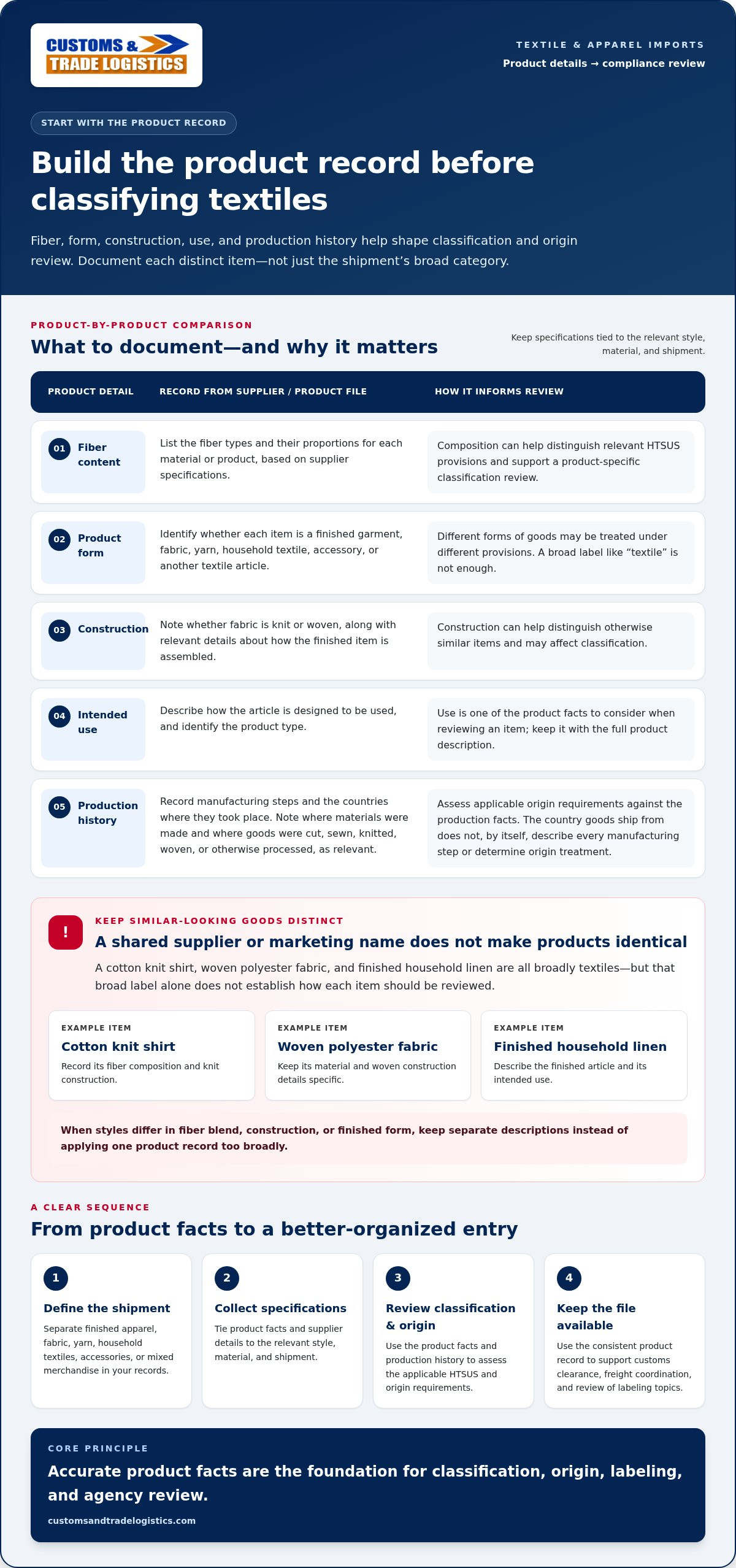
Textile requirements depend on the actual product, its materials, how it’s constructed, and its intended use. A cotton knit shirt, woven polyester fabric, and finished household linen may all be described broadly as textiles, but that label alone doesn’t establish how each item should be reviewed for import.
Start by defining the shipment’s scope. Are you importing finished apparel, fabric, yarn, household textiles, accessories, or a mix of merchandise? If one order contains several product types, separate them in your records rather than treating the shipment as one uniform category. This inventory helps identify missing details and gives your customs and freight planning a clearer foundation.
Product-specific import compliance means reviewing each distinct item against its own materials, construction, use, and production history instead of relying on a generic textile checklist. That distinction matters throughout importing textiles and apparel into the US, because product facts inform classification, origin, labeling, and agency reviews.
What product information should an importer collect?
Use supplier descriptions as a starting point, not as the complete product record. A style name or marketing description may not distinguish one item from another. Collect the practical details below and tie them to the relevant style, material, and shipment:
- Fiber composition: Record the fibers and their proportions for each material or product, based on supplier specifications.
- Construction: Note whether the fabric is knit or woven, and describe how the finished item is assembled.
- Product and use: Identify whether the item is a garment, fabric, household textile, or accessory, and describe its intended use.
- Production history: Ask for the manufacturing steps and the countries where those steps took place. Keep the information with the supplier’s product records.
Keep separate descriptions for styles that differ in fiber blend, construction, or finished form. For example, two tops with similar names may need separate records if one is knitted and the other woven, or if their fiber compositions differ. Clear distinctions help prevent one product description from being applied too broadly.
Why apparel and textile shipments need product-by-product review
Small product differences can matter. Fiber composition and construction may affect classification, while the difference between a finished garment and fabric or yarn can change which details need attention. Don’t assume that similar-looking goods belong in the same category simply because they share a supplier or marketing label.
Origin also requires a product-specific review. The country from which goods ship doesn’t, by itself, describe every manufacturing step or determine how origin rules apply. Record where materials were made and where the goods were cut, sewn, knitted, woven, or otherwise processed, as relevant. Then assess the applicable origin requirements against those facts rather than applying one rule to every textile shipment.
Keep this product file available throughout the process. It gives your customs clearance and freight coordination team a consistent basis for organizing shipment details. It also helps flag labeling topics, including the Textile Fiber Products Identification Act (TFPIA), for review against the specific goods. Start with accurate product facts, and the next compliance questions become easier to organize.
Classify Textile Goods and Assess Origin Before Estimating Import Duties
Once you’ve documented what each item is, use those details to support classification and origin review. The Harmonized Tariff Schedule of the United States (HTSUS) is the framework used to classify imported goods and determine their tariff treatment. A product name alone is rarely enough to select a code. Fiber, construction, garment type, and other product details help distinguish the relevant provisions.
A reliable tariff estimate requires a verified product classification and country of origin, reviewed against the trade measures that apply to that specific shipment. That’s why a general rate or a code copied from a similar product can give a misleading estimate. For broader context on how classification fits into the entry process, see this US customs clearance guide.
How do product details affect HTSUS classification?
Classification depends on the full product description, not just a style name or a supplier’s suggested code. Compare the facts for each item and keep supporting specifications together. The table identifies details to investigate. It isn’t a classification decision or a source of duty rates.
| Product fact | What to document | Why it matters |
|---|---|---|
| Fiber content | Fiber types and composition | Composition can help distinguish tariff provisions. |
| Garment or article type | Finished garment, fabric, yarn, or another textile article | Different forms of goods may be treated under different provisions. |
| Construction | Knit or woven fabric and relevant construction details | Construction can help differentiate otherwise similar items. |
| Intended use | How the article is designed to be used | Use may be relevant to identifying the appropriate provision. |
For example, two tops that look similar may differ in fiber composition or construction, so don’t assume they share a classification. Avoid assigning a code from a broad description such as “women’s shirt” without reviewing the complete product details. If you’re importing textiles and apparel into the US, tie classifications to distinct products rather than applying one code across a mixed order.
How should importers assess country of origin and trade measures?
Origin needs its own review. Map where materials were produced and where relevant manufacturing steps occurred, such as knitting, weaving, cutting, or sewing. Which steps matter can vary by product and applicable origin rule, so don’t reduce the analysis to a single operation or assume the shipping country establishes origin.
After documenting production locations, assess the applicable origin rules and check for current trade measures or quota requirements that may affect the product. These can depend on both the item and its origin, so verify them against current requirements before estimating duties or finalizing shipment plans. Keep supporting supplier information with your classification notes so customs entry preparation uses a consistent product record.
Clear classification and origin records make the next steps easier to coordinate. Customs clearance and freight coordination can help organize product information and entry paperwork as goods move from supplier shipment toward delivery.
Prepare Textile Labels and Check Which US Agencies Apply
A shipment can have accurate customs paperwork and still need consumer-facing labels that meet separate rules. Treat these as two related but distinct reviews: entry documents support customs processing, while labels provide information to buyers of covered products. Customs paperwork supports an import entry; required product labels must accompany covered consumer goods and meet the rules that apply to those goods.
Before labels go into production, review the product type, fiber details, intended user, and how the item will be sold. A finished garment, textile accessory, or household textile may raise different requirements. Build label checks into the supplier’s production timeline so discrepancies can be resolved before the goods are packed and shipped.
Which label details should apparel importers review?
For covered textile products, assess the Federal Trade Commission’s (FTC) Textile Fiber Products Identification Act and related rules, including the Care Labeling Rule. Common topics include fiber content, country of origin, manufacturer or responsible business identification, and care instructions. Exact requirements, exceptions, and presentation can depend on the product and applicable rule.
Review each proposed label against the product record, not just a supplier’s standard template. Verify the required wording, label placement, permanence, and language for the specific item before approving production. If the fiber blend or origin details change, review the label proof again.
- Match fiber-content statements to the product’s documented composition.
- Check country-of-origin and manufacturer or business identification requirements.
- Confirm care information and any applicable placement, permanence, language, or exception rules.
When might FTC, CBP, or CPSC requirements matter?
The FTC oversees labeling requirements for covered textile and wool products and care information. U.S. Customs and Border Protection (CBP) handles import entry and admissibility, and may review origin-related information as part of that process. These roles overlap in the import journey, but a label is not a substitute for an accurate entry, and entry paperwork does not replace a required consumer label.
Children’s apparel deserves a separate product-safety review. Consumer Product Safety Commission (CPSC) requirements depend on the product and its intended user, so don’t assume every garment has identical obligations. As of July 8, 2026, CPSC requires electronic filing through the Automated Commercial Environment (ACE) of applicable Certificates of Compliance for apparel imports: a General Certificate of Conformity for adult apparel and a Children’s Product Certificate for children’s apparel. Confirm which certificate and product-safety rules apply to the goods before entry.
For importing textiles and apparel into the US, keep label proofs and applicable safety information aligned with product descriptions and shipment records. This makes it easier to spot mismatched fiber or origin details before goods leave the supplier, and to organize the separate information needed for customs entry and product compliance.
Follow a Practical Import Workflow from Supplier Documents to Delivery
A reliable shipment plan connects supplier information, transport records, customs entry, and final delivery. Set responsibilities and document handoffs before goods leave the supplier. This gives your team time to resolve mismatched descriptions or missing details while the shipment is still being prepared.
- Confirm the supplier and product records. Gather accurate descriptions for each item, along with the specifications and production details needed for classification, origin, and applicable compliance reviews.
- Build the commercial document set. Request a commercial invoice and packing list that clearly show the products, quantities, values, and package details. Collect the transport document for the chosen mode, such as a bill of lading for ocean freight or an air waybill for air freight.
- Reconcile the information. Compare the invoice, packing list, product records, and transport details. Resolve differences in item names, quantities, or package counts before the records are used for entry preparation.
- Check shipment-specific filing needs. Ocean shipments may have advance filing requirements. Verify which requirements apply to the shipment and confirm the relevant timing before cargo moves.
- Coordinate entry and delivery. Align freight plans with customs documentation and entry processing. After release, arrange container transport or delivery redistribution as needed to move the goods to their intended destination.
What should the supplier provide before goods ship?
Request detailed invoices and packing information that identify each product clearly, rather than relying on broad descriptions such as “clothing” or “fabric.” Collect the fiber, construction, manufacturing, and origin details associated with each item. Then reconcile those facts against quantities and package information across the commercial records. If goods ship from China, this China import logistics guide offers additional context for coordinating the shipment.
How do freight coordination and customs entry connect?
Freight planning establishes how and when goods move; customs entry preparation organizes the information needed for import processing. These workstreams should share consistent product descriptions and shipment details. Changes to quantities, packaging, or schedules should reach the people coordinating transport and entry so records can be updated before they cause confusion at a handoff.
Keep one working document set and a clear communication path among the supplier, freight coordination, customs clearance, and delivery stages. This is especially helpful when container transport or redistribution is part of the plan, since release is one handoff in the journey, not the final delivery step. Customs and Trade Logistics coordinates these connections as part of its import logistics services. Get experienced help coordinating an import.
Coordinate Textile Customs Clearance and Freight with an Experienced Partner
Textile imports involve several connected handoffs: supplier information, freight arrangements, customs entry, shipment release, and delivery. Customs and Trade Logistics manages customs clearance and coordinates international freight, helping keep product details and shipment records aligned as goods move. For a small business managing these steps alongside day-to-day operations, a clear communication path makes responsibilities easier to follow.
Customs and Trade Logistics is a family-owned firm with over 35 years of industry experience supporting small and medium-sized US businesses. Its services include customs clearance, international freight logistics, container transport, and delivery redistribution, with particular expertise in imports from China. Textile shipments can come from many sourcing countries, so coordination starts with the details of your supplier, products, and route.
What can an import logistics partner coordinate?
Coordination connects activities that are easy to treat as separate tasks. Product descriptions and supporting paperwork inform entry preparation; shipment mode and movement plans inform freight coordination; and the intended delivery destination helps shape the final transport handoff. Keeping those details consistent gives everyone involved a clearer picture of the shipment.
- Customs entry preparation: Organize product and shipment information for customs clearance.
- Shipping coordination: Align freight planning with supplier readiness and the import schedule.
- Transport and delivery: Coordinate container transport and delivery redistribution where needed.
As plans change, clear communication helps relevant updates reach the people handling freight, entry, and delivery. This does not remove the need for accurate supplier records or product-specific compliance review. It gives the shipment a more orderly path from origin through its next handoff.
How can importers prepare for a useful first discussion?
You don’t need a perfect file to begin organizing the shipment. Bring the product descriptions and details you have, then identify what you still need from the supplier. Sharing a clear starting picture helps focus the discussion on practical coordination needs before the goods leave the supplier.
- Prepare product descriptions, available fiber and construction details, and supplier information.
- Note manufacturing locations and the production details available for each product.
- Share the expected shipment mode, timing, destination, and delivery requirements.
- Identify open questions about documents, entry preparation, freight handoffs, or final transport.
Early coordination gives the team time to organize known details and clarify how shipment stages connect. For businesses importing textiles and apparel into the US, preparing these basics can focus the conversation and help keep supplier, transport, entry, and delivery information moving through a consistent channel.
Bring your shipment details together and discuss your textile or apparel import with Customs and Trade Logistics.
Make Your Next Import Easier to Plan
Use your next order to establish a dependable process for future shipments. Keep product specifications, supplier records, label approvals, and customs documents organized by item, then update them whenever a material, manufacturing step, or supplier changes. This gives your team a clearer starting point for reviewing new orders and sharing accurate information across the shipment process.
Importing textiles and apparel into the US can involve a lot of coordination, especially when product compliance and delivery planning come together. You don’t have to manage every handoff in isolation. Customs brokerage, international freight coordination, and delivery redistribution can help your business manage the process with greater clarity.
Take the next step with a conversation about your shipment. Discuss your textile or apparel import with our experienced team, and start shaping a practical plan around your products and delivery needs.
Frequently Asked Questions
What documents are commonly needed to import textiles and apparel into the US?
Common records include a commercial invoice, packing list, and transport document, such as a bill of lading or air waybill. Customs entry also requires shipment and product information, while origin documents, certificates, or safety records may apply depending on the goods and entry. For example, a children’s clothing shipment may require product-safety information beyond standard freight paperwork. Confirm the document set for the shipment’s mode, products, and applicable agency requirements.
How do I determine the country of origin for imported clothing?
Determine origin by reviewing the product’s manufacturing history under the rules applicable to that garment, not simply by noting where it shipped from. Gather details about where fabric was made and where operations such as cutting and sewing took place. For instance, clothing shipped from one country may have involved materials or processing elsewhere. Keep supplier records that show those steps, then assess the specific origin rule before making an origin declaration.
Do textile samples have the same import requirements as retail apparel?
Not necessarily. A sample’s purpose, condition, and intended use can affect how it is treated, but calling goods “samples” doesn’t automatically exempt them from customs entry, duties, or applicable product rules. A prototype sent for evaluation differs from garments intended for resale, yet both need accurate descriptions and values for entry. Identify whether each item is a sale sample, production sample, or other merchandise, and document its intended use clearly.
Does every textile shipment need an Importer Security Filing?
No. Importer Security Filing (ISF) is associated with ocean cargo destined for the United States, so an air shipment generally isn’t handled under the same ocean filing process. For an ocean shipment, determine whether ISF applies and coordinate the required data and filing timing with the shipment team. Don’t assume a small textile order or sample is exempt just because it isn’t retail inventory. Requirements can depend on how the goods move and the shipment circumstances.
Do I need a customs bond to import apparel into the US?
A customs bond may be required for an entry, but the answer depends on the entry type and circumstances. A bond serves as financial security for obligations connected with the import entry; it isn’t a substitute for accurate classification, records, or payment of applicable duties. Before the shipment moves, determine how the entry will be made and whether a bond is needed for that transaction. Build the bond decision into entry planning rather than treating it as a last-minute document.
Can clothing made from several fibers use one generic tariff classification?
Usually, a broad label such as “blended-fiber shirt” isn’t enough to support one generic classification across different garments. Classification can depend on fiber composition and construction, along with garment type and other product details. A cotton-polyester knit top and a woven garment with a similar blend may need separate review. Maintain product-specific specifications and don’t reuse a supplier’s code across styles without checking that the underlying goods match.
Can apparel be imported if its labels are added after it reaches the US?
Don’t assume labels can be added after arrival without affecting import or sale. Whether correction after import is permitted depends on the product, the labeling rule, and any applicable customs procedures. Missing or inaccurate labels can create compliance and delivery complications, so address label proofs before production and shipment whenever possible. If a shipment arrives with a labeling issue, the appropriate next step depends on the specific goods and circumstances; avoid distributing affected products until the issue is resolved.